
Today's 5 Bullets
 SpaceX’s Halo
 Talk about a powerful delayed reaction: Space stocks are soaring to new heights — because today’s the first trading day since this happened on Friday evening.

SpaceX conducted the 12th test flight of its Starship rocket — complete with a controlled splashdown in the Indian ocean.
The mainstream tried to pooh-pooh it. “Mixed success,” said CNN. “The completely redesigned version three of the rocket demonstrated engine upgrades and successfully deployed dummy satellites,” said Barron’s. “Still, there were some engine issues with the booster and upper stage.”
Whatever. As Elon Musk has said for years, “If things are not failing, you are not innovating enough.”
Bearing Musk’s maxim in mind, traders are grabbing every share of space companies they can.
AST SpaceMobile — a favorite of Paradigm tech specialist Ray Blanco spotlighted in last Saturday’s edition — is up 14% on the day. Many of the other names are performing just as well, if not better.
Meanwhile, the space ETFs like NASA and UFO are up about 8%.
“That's not a stock picker's tape. That's the halo trade,” Ray says this morning. “Capital that wants SpaceX exposure can't buy SpaceX yet, so it buys the basket.”
As a reminder SpaceX goes public on Friday June, 12. “The biggest IPO in history is 18 days out today,” says Ray — “and the gravitational pull is so powerful it's reshaping the entire sector.”
In our April 1 edition, Ray tipped us off to those new ETFs that launched in March — and their significance.
“The ETF product cycle is one of the most reliable institutional confirmation signals in all of finance,” he told us then. “Fund companies don't build dedicated vehicles around a theme unless the allocator class — the pension funds, the wealth advisers, the endowments — has decided the sector is durable enough to justify permanent capital flows.”
That’s what’s happening now. And in a way, it’s just the beginning.
“The Netscape IPO in 1995 unleashed years of gains in internet stocks,” Ray reminds us. “SpaceX is going to do the same for space.”
Meanwhile, Ray has found a stunning number tucked within SpaceX’s prospectus.
The company released its financials last Wednesday. The media dutifully relayed the headline figures — which do not convey the real story.
“Buried in a section called ‘Our Market Opportunity,’” says Ray, “the company tells the SEC it's chasing a $28.5 trillion market.”
What market could possibly be that big when the U.S. economy’s entire output last year was $30 trillion?
“Let’s break it down,” says Ray…
- $370 billion in Space. “Launch, satellites, in-orbit operations. The business everyone associates with SpaceX is the smallest slice.”
- $1.6 trillion in Connectivity. “Starlink broadband. Starlink Mobile. Enterprise and government.”
- $26.5 trillion in AI. “Compute infrastructure. Consumer subscriptions. Digital advertising. Enterprise applications.”
Notice how that last number dwarfs the others.
“SpaceX is not pitching itself as a rocket company. It is pitching itself as the infrastructure layer of the AI age,” Ray continues.
“Nvidia, the most valuable company in history, sells into a data center market projected at $7 trillion by 2030.
“SpaceX is claiming a total addressable market four times that.
“The entire global space economy in 2024 was $613 billion. SpaceX is telling you that number is a rounding error in its own business plan.
“The $1.75 trillion valuation is being asked of investors against a $28.5 trillion claim. An implied capture rate of about 6%.”
Audacious? Or insane? Ray says you can decide.
“But it's really hard to read this prospectus,” he says, “and come away thinking SpaceX is asking for permission to be a rocket company.”
On the other hand, “without the rockets, there is no market to capture.”
Stay tuned…
[Reminder: You can be reading analysis like this in real-time as Ray and our other editors post it to the Paradigm Press mobile app.
Not only do you get instant insights you can’t read anywhere else, but the app is the simplest way to keep track of the buys and sells in your paid publications. It’s one-stop-shopping — no sifting through your email to find the actionable information. Download here and see what you’ve been missing.]
 Here We Go Again
The “war’s almost over” trade is back in play.
On Saturday, Donald Trump said an agreement between the United States and Iran was “largely negotiated.”
The details that dripped out were met with hostility from Israel as well as from the likes of Mark Levin and Sen. Lindsey Graham.
Thus the president went into defensive mode, contrasting his deal with that negotiated by Barack Obama. “Our deal is the exact opposite,” he said on Truth Social, “but nobody has seen it or knows what it is. It isn’t even fully negotiated yet.” [Emphasis ours]
(So the deal is like the Druids at Stonehenge: “No one knows who they were… or what they were doing.”)
No matter: U.S. oil futures resumed electronic trading for the week on Sunday night… and instantly collapsed from nearly $99 to below $90, back to their lows earlier this month.
Yesterday, Washington carried out what it called “defensive” airstrikes on Iran while insisting the war had not resumed.
By last night, “First Squawk” — one of the worst finance slop accounts on X — found itself saying with a straight face, “U.S. attacks missile sites in Iran amid negotiations to end war.”
And that’s where it stands today. In the absence of a deal, final or otherwise, U.S. oil futures are back up to $94. That’s still substantially lower than they’ve been most of this month.
➢ In other hotspots: The Ukraine war is getting cranked up to its most intense levels in months. Moscow is promising to hit “military sites and decision-making centers” in the Ukrainian capital of Kyiv after a Ukrainian drone attack on a school killed 21 people.
As for stocks, “the market is clearly getting frothy here. But that doesn't mean it has to correct,” observes Greg Guenthner at The Trading Desk.
“In fact, we could be entering the beginnings of a bigger melt-up. That's exciting and scary at the same time...
“What we're seeing right now is a highly concentrated run-up in just a few key sectors -- mainly chips, space stocks and a handful of other tech names. I keep watching and waiting to see if the rally broadens out. But so far, the biggest gains remain concentrated in these groups.”
Amid that backdrop the S&P 500 is back in record territory — up more than a half percent at 7,516. Likewise the Nasdaq, up nearly 1% and approaching 26,600. The Dow, however, is about a quarter percent in the red.
Treasury yields are backing down — the 10-year note just over 4.5% and the 30-year bond at 5.03%. That looks like a knock-on effect of the oil trade — falling oil prices, falling inflation expectations, falling yields.
But the “war’s nearly over” trade is doing no favors for precious metals — not today. Gold is about to crack below $4,500 again and silver is sinking toward $76.
No joy in crypto — Bitcoin around $76,500 and Ethereum under $2,100.
 Good News About the Grid
Going into a potentially hot summer, the U.S. power grid is… surprisingly resilient.
The North American Electric Reliability Corporation is out with its annual “Summer Reliability Assessment.”
We’ve been following this report since 2022. It spotlights regions of the country that are potentially at risk of rolling blackouts during an intense heat wave. That’s a major concern because the U.S. power grid’s capacity didn’t grow at all from 2011–2023… and while it’s growing now, it’s not growing fast enough to keep pace with AI.
In recent years, NERC’s map was covered in red and orange, revealing areas subject to “load shedding” in the summer. But this year, not so much…
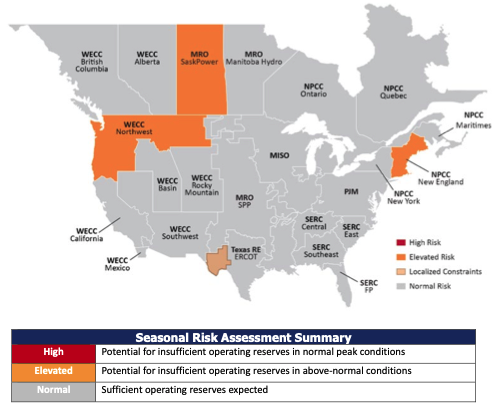
Basically the only issues in the United States are in New England, the Pacific Northwest, and a chunk of Texas.
Most of the other regional grid operators are in OK shape — including the biggest, PJM. Also off the list this summer is MISO, encompassing the Upper Midwest and Mississippi Valley. (MISO’s risk level in 2022 prompted your editor to get a generator.)
“The pace of change across the North American grid continues to accelerate,” says NERC’s John Moura, “but industry is working diligently to construct the necessary generation and transmission needed to power the future.
“We are seeing a record-breaking amount of on-peak capacity being interconnected in a single year strengthening system readiness for summer conditions.”
Good deal. But Moura emphasizes “there are also increasing risks for early fall and winter seasons.”
NERC’s winter assessment comes out every November. We’ll be watching…
 Recovered History: Barney Frank
If it’s bad form to speak ill of the dead… well, here we go anyway. Besides, it’s been a week.
Former Rep. Barney Frank (D-Massachusetts) died last Tuesday. He’d been in hospice for congestive heart failure; he was 86.
Most of the mainstream obituaries spotlighted his role in shepherding the Dodd-Frank Act through Congress amid the 2008 global financial crisis. “A sweeping overhaul of the financial industry,” was how The Washington Post described it.
Which is true as far as it goes. But it’s not the whole story.
The mainstream left out some essential details that undercut the narrative of a heroic figure who stood up to Wall Street and the big banks. But they’re there to be found in our voluminous archives — and they’re worth recounting on this occasion.
Rewind to March 2009: The Financial Accounting Standards Board (FASB) proposed easing corporate accounting rules.
It was a gift to the too-big-to-fail banks: No longer would they have to assign current market prices to the assets on their balance sheets ("mark to market"). They could instead assign hypothetical future prices that were, of course, higher.
In theory, FASB is a private nonprofit entity. In reality, it is highly subject to political influence. On March 9, word slipped out from Washington that Frank and his fellow congressmember Paul Kanjorski planned to schedule a subcommittee hearing clearly aimed at strong-arming FASB into changing the rules.
Which it did three weeks later.
Bad for corporate accountability, but great for the stock market. FASB’s revisions, combined with the Federal Reserve tripling the size of its “quantitative easing” program, put a floor under the S&P 500 at the infamous level of 666. A years-long bull market followed.
And then there was Frank’s post-congressional career — in which he became a board member of the now-defunct Signature Bank.
In 2018, Congress rewrote a major plank of Dodd-Frank — redefining a “systematically important financial institution.” That is, something the feds consider too big to fail.
Under the original law, banks with assets of $50 billion or more were considered a “SIFI,” subject to extra regulation. But under the rewritten law, that threshold was upped to $250 billion, encompassing only the 12 biggest banks.
While no longer in Congress, Frank approved heartily of this revision — not least because he’d become a director at Signature Bank, a growing institution that was on the verge of exceeding the old $50 billion minimum.
Signature Bank took on a lot of crypto clients in the ensuing years. Then it went belly-up in March 2023 — the fourth-biggest bank failure in U.S. history. It fell victim to the same panic that took down Silicon Valley Bank the same month.
The Financial Times calculated that Frank collected about $2 million from Signature in the eight years before its failure. Nice work if you can get it…
 Mailbag: Cynicism
“Dave, so good! Nailed it!” says one of many responses to Friday’s edition.
“Your article was remarkably accurate and insightful,” says another. “I enjoyed reading it and will read it again after I let it sink in to a deeper level of understanding.”
Strictly speaking, Friday’s 5 Bullets was a reprise of something I wrote just over a year ago. Back then it generated enough reader response to fill nine pages of a Word document. This time, about the same.
“I learned long ago that there is a very small, thin line between cynicism and realism. And unfortunately, very few people can discern between the two,” writes a third reader.
“I thoroughly enjoy your newsletter because IT IS REAL. I have never viewed anything you have written as strictly your opinion. You give us observations, then ideas on how to respond.
“I, for one, find that very refreshing. Keep up the good work, you realist you!!!”
“Amen, Dave! I especially like the last part about breaking the cycle and gaining enough financial independence that we can enjoy the things that matter — the true luxuries of life.
“I hope that we can break the cycle. It will be quite unpleasant for some time, whether the cycle continues or is broken, but we'll be much better off if we can get off this train of more and more government controlling our lives.
“I took a picture of your list of true luxuries and plan to look at it every day to remind me to be grateful for all the good that is in my life. Thank you for your articles.”
Dave responds: A couple other people wrote in to say they printed off that meme to put up on a wall or a refrigerator somewhere. It’s not original to me… but I figured it would resonate.
“I’m (much) older than you.🙂 I grew up in an America with, seemingly, endless possibilities and opportunities,” writes our final correspondent.
“My (step)dad had a floor-waxing biz and my mom taught in parochial schools. Some way, they were able to send my two siblings and me to some awfully fine colleges and universities.
This America, now, only remotely resembles the one I grew up in and afforded me these opportunities.
“How, why, when did it go so badly awry? And, in just in a couple of generations. Worth examining.
“Within the constraints of a financial newsletter, you do fine work in examining this phenomenon. Particularly, the consequences of the (over)financialization of our economy.
“From my perspective, your discourse is rather genuine/sincere versus ‘cynical.’ Actually, our rulers and the elites they serve are the cynical bunch.
“So, Dave, ‘Damn the torpedoes, full speed ahead.’ Thank you!”
Dave: Thank you for the input — and for the recognition that something has gone off the rails. Not everyone your age seems to think so.
You remind me there’s been a disturbing trend on social media this month — and some of it even found its way into our inbox — in which boomers are dunking on younger generations for complaining about the cost of living. They believe millennials and Gen Z need to lower their sights.
On one level, I get it. DoorDash delivery costs can add up.
But there’s a disturbing “I’ve got mine” subtext to a lot of the boomer posts — and an obliviousness to certain realities that older generations never experienced. (Begin with the fact that these days starter homes are either unaffordable or unavailable.)
I thought it was one of the most fundamentally American beliefs — to expect younger generations would live a better life than you.
No more?
I really hope not. That’s the kind of cynicism we could all do without…


