
So What Will AI Cure, Anyway?
 So What Will AI Cure, Anyway?
 The juxtaposition was unintentional — but also revealing.
The Wall Street Journal published an article in its print edition last Thursday pouring cold water on the notion of AI-aided drug development.
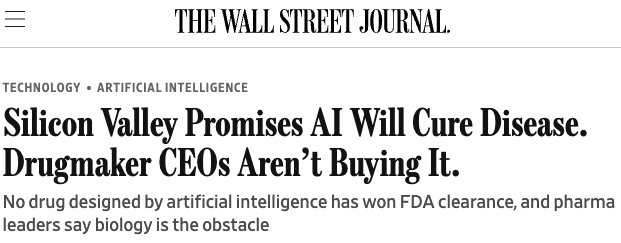
Confronted with the claim that AI would cure 90% of human disease in the next seven years, the CEO of Vertex Pharmaceuticals said, “That’s complete BS.”
And he’d know, having contracted with 50 AI companies to sift through its data set of 10,000 drug compounds.
The same day, Paradigm AI authority James Altucher took the stage at the Paradigm Shift Summit in Nashville.
“My talk was called AI Will Cure Cancer, and I spent most of it arguing with my own title,” James recalls.
“Because on its own it won’t, and maybe it never happens in one big moment.”
That said, “a few weeks ago a friend called me after his wife got hard news from her doctor and neither of them knew what to do next.
“I told him to send the scan over, it went through AI and what came back helped them decide where to go from there.
“Now I’m not telling you to do that for yourself, and she may simply have gotten lucky. But when he wrote back to say thank you, though, I figured that in that sense the title was right.”
So maybe AI won’t cure 90% of diseases in the next seven years… but it can still make a difference in extending lifespans and enhancing quality of life.
“New systems are beginning to diagnose difficult cases… uncover diseases hidden inside routine scans… and potentially identify serious problems before doctors can see them,” says James.
“I believe health care could help prove just how valuable AI can be — and create an entirely new wave of opportunities.”
Going into 2027, James and his team will redouble their efforts to identify which ones will be a flash in the pan… and which ones really could change the world. Stay tuned.
 After a Manic Monday…
After a day of elation yesterday, Mr. Market is bummed out by a hotter-than-expected inflation number.
The Labor Department issued an incomplete version of the October consumer price index this morning — incomplete because there are no numbers to indicate year-over-year increases.
That’s owing to the “partial government shutdown” in October 2025; nobody was conducting surveys to see who was charging how much for what products.
So the only thing we have to work with is the month-over-month increase — which was 0.4%. That’s lower than the September number, but still higher than the typical Wall Street economist was counting on.
And it’s no better if you look at the “core” rate, excluding food and energy. The 0.3% increase from September to October was also higher than expected.
Only yesterday, Federal Reserve Governor Christopher Waller said if the core rate remained elevated, the Fed would need to look at a super-sized interest rate hike next month: “Hiking only 25 basis points would put our credibility at risk.”
So that would mean raising the fed funds rate from 4.0% to 4.5% in one fell swoop. And that’s coming from a Trump appointee!
Looking at the action in fed funds futures this morning, traders assign a 15% probability of this super-sized hike… an 85% probability of a more “normal” hike… and a zero percent probability the Fed will stand pat.
With that, the S&P 500 is back below 7,500 and the Nasdaq is in danger of cracking beneath 25,000 again. Meanwhile, Treasury yields are back on the rise — the 10-year note about to surpass 5%.
At least on this day, rising yields translate to tumbling precious metals: Gold is down $115 and threatening the $4,000 level again, while silver’s down two bucks to $51.24.
No joy for crypto, either: Bitcoin is barely over $73,000 and Ethereum is in danger of cracking below $2,000 for the first time since August.
At $86.59, U.S. oil futures continue to buy into the narrative that — as Donald Trump put it yesterday — there’s “positive momentum” toward an end of the Iran war.
 Money Miscellany
If timing is everything, Anthropic’s IPO is surely coming a few weeks late.
This morning the company behind the Claude AI platform announced it would go public on Thursday, Nov. 19.
The numbers accompanying the announcement aren’t nearly as giddy as they might have been a few weeks ago — a share price of roughly $70–78, a market cap of $1.3 trillion and an expectation the IPO will raise $64 billion in new capital.
No doubt the AI spending scare is having an impact. Anthropic would have been much better off making its announcement last summer when only cranky contrarian newsletter types were wondering whether the massive capital spending on AI would pay off!
Meanwhile, shares of Nvidia are down another 6.2% as we write — as CEO Jensen Huang’s “honeypot” scandal won’t go away.

We won’t dwell on the sordid details, which you can read about anywhere.
But there’s something hinky about the timing of all this. The rumors about the company where Huang’s mistress was an executive? They’ve been out there for months.
But then The New York Times publishes allegations from anonymous U.S. officials that the mistress was a spy only days before the election? And Huang has to come clean about his affair only a few days after?
Just spitballing here: Expect a lot of huffing and puffing about this on Capitol Hill in the weeks and months ahead. Indictments, not so much.
The feds don’t like to bring cases unless they’re all but certain that can get a conviction — and cases like these are notoriously hard to prove.
Going into the election, the mood on Main Street was decidedly “meh.”
The National Federation of Independent Business is out with its monthly Small Business Optimism Index. The headline number ticked down slightly from 97.9 in September to 97.8 in October — a hair below the survey’s average going back over 50 years.
More interesting is the part of the survey where business owners are asked to identify their single-most important problem. Here, “quality/availability of labor” was cited by 25% of respondents. The number has oscillated around the 25% level for the last four months.
“Our company has found it very hard to find qualified candidates to work in the construction
inspection field,” said a business owner in Pennsylvania. “Candidates are either terminated for nonperformance or quit after a few months.”
Taxes were cited by 21%, inflation by 17%. Everything else was 7% or lower.
All else being equal, the NFIB’s membership leans Republican. We’ll see what the November survey turns up next month…
 Not All Data Center Companies Lost the Election
To be sure, last Tuesday's Democratic sweep brought new headaches for the AI data-center industry.
Texas, a leading market for planned data centers, elected a governor who wants to halt new approvals until the state addresses concerns about electricity rates, water supplies and specific effects on local communities. As we mentioned over the summer, outgoing Gov. Greg Abbott had already suspended certain permits pending an audit.
Investors responded by dumping stocks tied to the data-center buildout.
But Paradigm contributor Davis Wilson thinks Wall Street may be overlooking something.
“What if Wall Street has this backward? What if tougher rules around data centers actually make the best AI infrastructure companies more valuable?”
Yesterday’s trading offered a hint that investors were making distinctions. AMD jumped 13%, Corning (GLW) rose 9% and Bloom Energy (BE) gained about 12%. (Of course, Nvidia is a whole other story…)
One day's trading doesn't establish a trend, but the selling is no longer indiscriminate.
As always, revenue and cash flow affect share prices. AMD just reported a 97% year-over-year increase in data-center revenue. Corning's optical-communications sales rose 44%, while Bloom's companywide revenue climbed 138%.
And on Friday, research firm IDC raised its 2026 worldwide AI-infrastructure spending forecast to $521 billion.
The data center industry is not preparing to shut down. New restrictions could certainly delay projects and increase costs. But developers still need enormous computing capacity, and electricity remains one of the biggest obstacles.
That's where Davis sees an opportunity.
Nvidia and AMD are developing chips that squeeze more computing power out of the electricity available. Bloom's fuel cells allow data centers to produce power on site, reducing dependence on the grid. Corning's advanced fiber helps move vast amounts of information while consuming less energy.
None of this guarantees higher stock prices. Customers could postpone orders, and investors can still overpay for a growing business.
But stricter rules may concentrate where the money goes rather than stop it altogether.
As Davis puts it: “These companies aren't the problems regulators are trying to solve. They’re the solution.”
 Mailbag: The 2024 Throwback
“Your commentary from November 2024 looks like the facts of November 2026,” a reader writes in response to last Wednesday’s post-Election Day edition — which was a reprise of something I wrote shortly after Election Day 2024.
“Dave, I think this throwback issue was a very timely reminder, and similar to what I was thinking last night. A friend of mine messaged me this morning, ‘It's a great day in America’... This was my response:
Not really. This is the exact same disdain for the way our government is run — regardless of which side is in charge — that led to Trump being elected in the first place. When things get so bad that the pendulum swings so fully to the other side every two years, it's more a statement of how disgusting the political landscape has become overall. It reeks of electorate desperation more than anything.
In two years the same people will be so disgusted by what this blue wave doesn't accomplish that it will swing right back the other way. Breaking the cycle would take putting a real alternative in power, but the red-versus-blue divide is so strongly ingrained in people’s minds that we just can't risk voting for things we actually believe in. Too risky to 'waste' our vote and let 'the other side' win and all that.
So we will just keep repeating this cycle until it all collapses. Moving closer toward communism over the next two years will certainly speed up that process though, so yay?”
One of our semiregulars chimes in: “I'm not at all surprised by Tuesday's results. I don't really expect much to change as a result of it. The wars abroad will continue, prices will keep increasing at home, etc., etc. Maybe with both chambers the Dems will attempt to impeach Trump again, or maybe they won't since they're just as for the wars as Trump is, and removing Trump means handing the Oval Office to Vance.
“One thing that has changed though. The results seem to have brought gold back to life, and the tech sector continues to slide after their earnings announcements. Maybe we'll be able to look back in a year and call this the catalyst for the market's change in tune?
“Aside from federal results, even in local propositions I'm seeing repudiations of ‘license plate reading cameras’ and data centers. While I don't think Dems will be any less warm to the idea of mass surveillance and data centers than the GOP has just recently been, the market's expectations seem to have noticeably changed.
“The only part I can't figure out is how come the paper price of crude keeps going down. Must be the invisible hand of the market?”
OK, two more reactions here…
“What is the word? Prescient. Please write a similar column for our new Congress.”
“Well done Dave, I just hope that when you’re spectacularly wrong about something, you’ll be as open about it,” writes our final correspondent. “Perhaps Mr. Rickards can show you how it’s done as he explains his utter failure to predict the 2026 Republican wipeout. In the meantime, I’m praying for our country. We’re gonna need it.”
Dave responds: Ha!
Look, I didn’t write that issue with the intent of doing a big I-told-you-so two years later. I just thought the post-election giddiness back then needed a bit of a reality check. I take no particular pleasure in having come so close to the target.
And so I will briefly take up the challenge of an outlook for the new Congress that may or may not pan out.
In general the Democrats will overplay their hand and will tailor their appeal not to a broad swath of the electorate but rather to the geezers who watch MS NOW and turn out for “No Kings” protests.
A few specifics…
- For all the squawling you hear about the Democratic Socialists, no credible challenge from the left will emerge against Hakeem Jeffries as House speaker and Chuck Schumer as Senate minority leader. The party’s center-left establishment remains in control for now.
- Democrats will continue to fund the Iran war to make sure the Iran war stays front-and-center in the public mind to undercut the GOP presidential candidate in 2028. (Cynical? Yes. And it’s exactly the approach the Democrats took with the Iraq war after winning both houses of Congress in 2006. Worked like a charm come 2008.)
- House Democrats will launch as many impeachment proceedings as it takes to keep the focus on Trump through the conclusion of his term. (This is not the approach the Democrats took with George W. Bush 20 years ago. But the Dems have nothing to stand on except that they’re not Trump.)
- At the same time, there will be zero meaningful inquiry about Jeffrey Epstein, because politicos of both parties have dirty hands. Anything the Dems do will be totally theatrical, with no consequential disclosure. (This is much like the 1990s, when the GOP went after Bill Clinton only for the sex stuff and not for the Clintons’ shady dealings with the Riady family. In exchange the Dems dropped their inquiry into the Koch brothers’ campaign finance violations on behalf of the GOP in several 1996 congressional races.)
Most worrisome is that if the Dems make a clean sweep of the White House and Congress in 2028… they will indulge all their most delusional fantasies about engineering regime change in Moscow.
They still think Vladimir Putin is the only reason Donald Trump came to power in the first place. They’ll want their final revenge. And they’ll see the risk of nuclear war as a risk worth taking to achieve that goal.


