
The Market as a Rigged Casino
 The Market as a Rigged Casino
 “Don’t even try to ‘invest’ in this market, folks, and if you decide to trade, realize that you’re playing in a rigged casino and the entire force of the government is not only behind rigging the casino but explicitly endorses and permits the rigging to go on and continue, despite being fully aware of it.”
So wrote a prominent financial blogger — 15 years ago.
Back then, the complaints centered on HFT or high-frequency trading — high-speed, automated bids and offers built on scads of data available to Wall Street’s high rollers, but not to everyday folks.
(If that sounds like an early application of AI, it is.)
Point being, complaints about rigged markets have been around for as long as markets have been around.
If those complaints resonate with you at this particular moment in time… well, you’re not alone.
This week, our AI authority James Altucher sent around a survey to his readers via text message. One of the questions he asked was essentially, Do you think the market is rigged?
About 2,000 people answered that particular question. I asked the Claude AI engine to sift through a random sample of about 450.
Readers answered “yes” by an overwhelming margin, about 18:1.
The accompanying comments were an eye-opener.
“Heads Wall Street wins and tails Wall Street wins,” says a reader from the Chicago suburbs. “It’s not ‘if’ it’s rigged, it’s by who and how much,” adds someone from Wisconsin. “Only Congress makes money on stocks now,” says a reader from Southern California (and she was not alone in that sentiment).
From Georgia: “It used to be powerful individuals (Morgan, etc.). Now it’s powerful entities (BlackRock, etc.).”
From South Carolina: “Seems rigged to me. I know I can’t keep up with the machines.”
Several readers replied with a variant on the late George Carlin’s famous line “It’s a big club and you ain’t in it.”
And this pointed remark from a reader in the Kansas City area: “Of course the game is not fair. That’s why I pay you money to help me out.”
Which brings us to a project of James’ that’s still in progress… and still needs more input from readers like you.
It’s been in the works for years. James suspects the time is approaching to take the wraps off.
“With all the recent volatility we’re seeing in the markets, and everyday investor portfolios down across the board,” he says, “I’ve decided to finally go public with all the details for the first time ever.”
Long story short: For years, James has been looking around for a way to get ahead of the best investors on the planet like Warren Buffett, George Soros and Paul Tudor Jones.
“Without AI, it was impossible,” James says.
But now, he’s finally secured access to a powerful type of AI that makes this ambitious goal achievable — predicting which stocks billionaires and legendary Wall Street investors will buy before they actually do.
We’ll leave it there for today; we have plenty of other business to attend to. If you want access to James’ updates on this project going forward, we urge you to follow this link and he’ll send you progress reports via email or text message — your choice. (I’m almost certain he’ll have another update within the next 24 hours; signing up is the only way to make sure you won’t miss out.)
 Anthropic’s (Nonexistent) Halo
If Anthropic’s debut on the Nasdaq today was supposed to give a lift to the rest of the stock market… it’s not working.
To be sure, ANT’s numbers are staggering: Last week the company was figuring on a share price of roughly $70–78. Yesterday, it raised $81.3 billion, the IPO share price set meaningfully higher at $83. Retail trading began around lunchtime on the East Coast today — at $111.50.
Anthropic as a $1.4 trillion company? Try $2 trillion.
Is it justified? In terms of pre-IPO revenue growth, no other company has ever come close. James Altucher recently shared this chart with his readers: “That green line shooting practically off the page is Anthropic.”
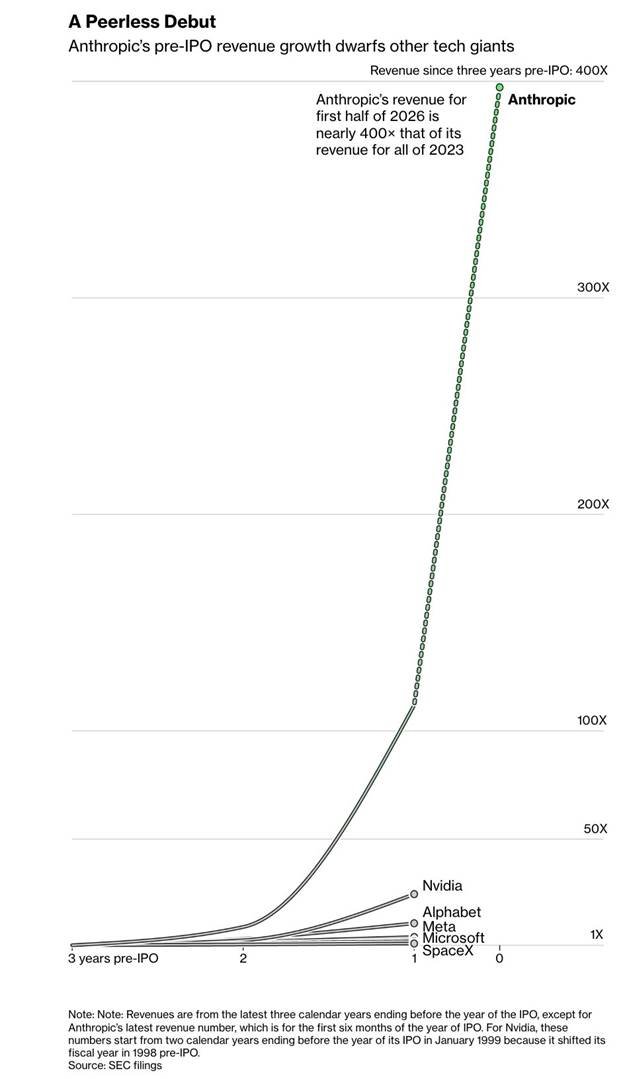
In the first six months of 2026, Anthropic brought in nearly 400 times as much revenue as it did in all of 2023.
But… the company still lost $1.3 billion from operations in the first nine months this year.
And then there’s that number we mentioned yesterday — ANT’s commitments to spend roughly $900 billion on computing and infrastructure, some of it stretching through 2045. About $71 billion is due by September 2027.
Some of Anthropic's biggest suppliers are also helping finance its expansion.
Google, Nvidia and five other technology companies have agreed to buy $26 billion of shares in a separate private placement. Several also sell the chips and computing services Anthropic needs.
SpaceX? They’re another major supplier. Anthropic has agreed to spend up to $120.5 billion with Elon Musk's company for computing power. Monthly payments are expected to reach $3.1 billion once all capacity is delivered in December.
Several of Anthropic's investors could profit twice: from their shares and from selling the company the computing equipment and services it needs.
But what about ordinary investors buying shares at the IPO?
Well, it comes back to that old saying about how the best time to get in on an IPO… is before it goes public.
[I wonder, in light of these developments, whether James Altucher is feeling more urgency for the undertaking I mentioned a few moments ago. Really, the best way to keep up with his project to predict billionaire buys of stocks is by signing up at this link.]
In any event, Anthropic’s halo is not extending to the market as a whole: The S&P 500 and the Nasdaq have now made big ol’ round trips back to levels last spring.
At last check the S&P is down nearly 0.9% on the day to 7,259. That’s down 7.1% from the peak on Oct. 6 — and no better than its close on May 5. The story in the Nasdaq is similar. The Dow is taking the biggest hit — down 1.3% on the day and breaking decisively below 50,000.
Precious metals can’t catch a break — gold down to $3,678 and silver at $44.57. (We’ll have more to say about this corner of the market tomorrow.) But crypto is stabilizing with Bitcoin a hair over $63,000 and Ethereum approaching $1,800.
Other things we’re keeping an eye on today…
- Walmart delivered its quarterly numbers and beat the estimates of Wall Street analysts. But Mr. Market is unimpressed, sending WMT shares down 1.7% as we write
- The Federal Reserve has issued the minutes from its October meeting. The big takeaway is that Fed-heads are concerned about AI demand being “a material source of inflation risk.” As always, Fed “minutes” are a political document aimed at telegraphing a message to the market: The message here is that Wall Street’s expectations for an interest rate hike next month are well-founded.
- There was nothing market-moving to come out of the summit in Shenzhen, China between President Trump, Russia’s President Putin and China’s President Xi. (There were a lot of platitudes about reducing the three nations’ nuclear arsenals.)
 Who Says the War’s Over?
U.S. oil futures continue to trade in the low $80s — despite signs that a new Democrat-controlled Congress will continue funding the Iran war.
Your editor anticipated this development in our edition nine days ago. The first confirming sign this week came from the center-left intelligentsia as represented by New York Times columnist Thomas Friedman.
Friedman always gives the Democratic Party establishment cover to support Republican Party wars. Certainly that was the case with the Iraq War during the 2000s, when he kept telling Times readers the war effort needed only six more months to ultimately succeed. (Progressive bloggers of the era took to calling six months a “Friedman Unit” or simply “FU.”)
Yesterday, Friedman wrote, “I think it would be a mistake for Democrats to try to cut off funding for the war, just as I thought it was a mistake to talk about defunding the police. You defund it, you own it. That is, Trump will say forevermore that he had the Iranians on the ropes and then the Democrats pulled the rug out from under him.”
Perhaps taking his cue from Friedman, House Minority Leader Hakeem Jeffries — the presumed House speaker next year — suggests he might be willing to support temporary legislation to prevent a partial government shutdown on Dec. 11 even if it lacks provisions restricting the war. “We’ll see what happens,” he says. “I don’t want to get out ahead of that process.”
The progressive group Just Foreign Policy says Jeffries’ stance “would be a huge betrayal of voters by the Democratic leadership.” (So what else is new?)
Conventional wisdom attributes a lot of the drop in the oil price this month to the expectation that Democrats will cut off war funding. But from this perch, that expectation looks profoundly misplaced.
And in the meantime, U.S. reserves continue to be drawn down to make up for oil that’s trapped in the Strait of Hormuz; the government’s Strategic Petroleum Reserve now totals only 276.4 million barrels — another low last seen in 1982.
 Metals That Go Down Must Go Up?
Mining stocks are getting pummeled. But Paradigm natural resources expert Matt Badiali sees an opportunity on the way.
“We have a universal bear move in the mining markets,” he says. “It’s across all metals.”
The Sprott Uranium Miners ETF (URNM), Global X Lithium & Battery Tech ETF (LIT) and Sprott Critical Materials ETF (SETM) are each down more than 35%.
Higher interest rates, rising costs and investors' reluctance to take risks have all contributed to the sell-off.
Matt’s seen this action before: Mining stocks run in cycles. After the 2009 bottom, the SPDR S&P Metals & Mining ETF (XME) climbed more than 170%. It did it again starting in 2016.
From 2025 into early 2026, XME gained 160% before the latest downturn.
The next recovery could be especially strong — as Matt sees it, thanks to China.
Beijing spent more than 20 years building its grip on critical-mineral production and processing. The U.S. now depends heavily on foreign suppliers for materials used in weapons, electronics and advanced manufacturing.
As you’re probably aware, Washington wants to change that. The Trump administration has been investing heavily in critical-minerals security. Biden did, too. It's one of the few things Democrats and Republicans agree on.
Matt believes critical-minerals stocks could outperform the broader mining market when the recovery comes — but he's not buying yet.
“Right now, the larger trend is against us,” he cautions. Sometimes the best action is no action.
The Democratic wave in the midterm elections adds still more uncertainty — but Matt expects those concerns to fade once the new Congress takes office and investors see that support for critical minerals remains strong.
The need for critical minerals isn't going away. Neither are the mining industry's booms and busts. Matt intends to take advantage of the next boom.
But first, he's waiting for the bust to run its course.
 Mailbag: Housing
“In regards to JC Parets’ commentary about a housing boom possibility,” a reader writes: “As someone who has been though 2008 til today it’s a little more nuanced.
“It not only varies wildly based on area but the builders by themselves are not a good indicator of the health of the real estate market. Here in Houston we have had the worst years ever in over 20 years and the resale market has been hurt significantly by the builders.
“Existing home sellers can’t sell, leading many into foreclosure (or becoming accidental landlords, making that market more saturated and probably requiring more trips to Home Depot since now they have to actually repair things).
“The builders are undercutting resale with rate buy-downs from their lender arm and lower prices to move their stagnant inventory. Often the same sellers who can’t sell bought from that same builder who is now killing them. The builders have no choice to build or die because they bought lots years ago when the market was different and paid a premium. Now they have to do something with those lots. You also are seeing more build-to-rent neighborhoods, which doesn’t help unless your definition of a housing boom means more rentals.
“The American dream of homeownership is at its worst level in 16 years and projections say 2033 before we get back to a stable market.
“Here in Texas rates are an issue, even though they are not historically high, because home prices went up so much during COVID. We also have very high property taxes and very high/nonexistent insurance further compounding the issues.
“Maybe the Democrats will print some free money for housing vouchers to help prop the market up and I hope JC is right but I fear the graphs of builders and Home Depot don’t tell the whole story but rather are the tip of the iceberg, ignoring what is below the surface.”
Dave responds: Thank you for your on-the-ground insights.
No doubt, the numbers this week are dreadful. Permits in October rang in way lower than expected, and permits are supposed to be a sign of future housing starts. Meanwhile, pending sales of existing homes are down 4.7% month-over-month and 17% year-over-year to a record low.
As JC cautioned, the share prices of PulteGroup (PHM) and Toll Brothers (TOL) have not yet broken out to all-time highs.
But if they do, that will be the tell — and we’ll know the market is anticipating developments that don’t yet show up in figures from the Commerce Department and the National Association of Realtors.


