
Jensen Got Rubio’d
 Jensen Got Rubio’d
 There’s a new addition to the list of people and institutions who might have been involved in a coordinated takedown of Nvidia CEO Jensen Huang — Secretary of State Marco Rubio.
When we left you on Friday, we were attempting to pour cold water on the narrative that Huang’s paramour Alice Huang (no relation) was a Chinese spy.
If anything, Alice Huang was working behind the backs of the Chinese authorities — who want to keep Nvidia chips out of China, shielding China’s homegrown chip industry from U.S. competition.
And we also explored who had a vested interest in taking down Jensen Huang. The C-suite at Anthropic… leading Democratic politicians who want to portray Donald Trump as “soft on China”... mainstream media.
Speaking of the last group on that list…
Since Friday, with Jensen Huang out of the picture, the corporate media have begun “walking back” their wildest claims about Alice Huang.
Back on Nov. 6, The New York Times asserted flat-out that that Alice Huang “was a spy for China’s Ministry of State Security,” citing anonymous U.S. intelligence officials.
But now?
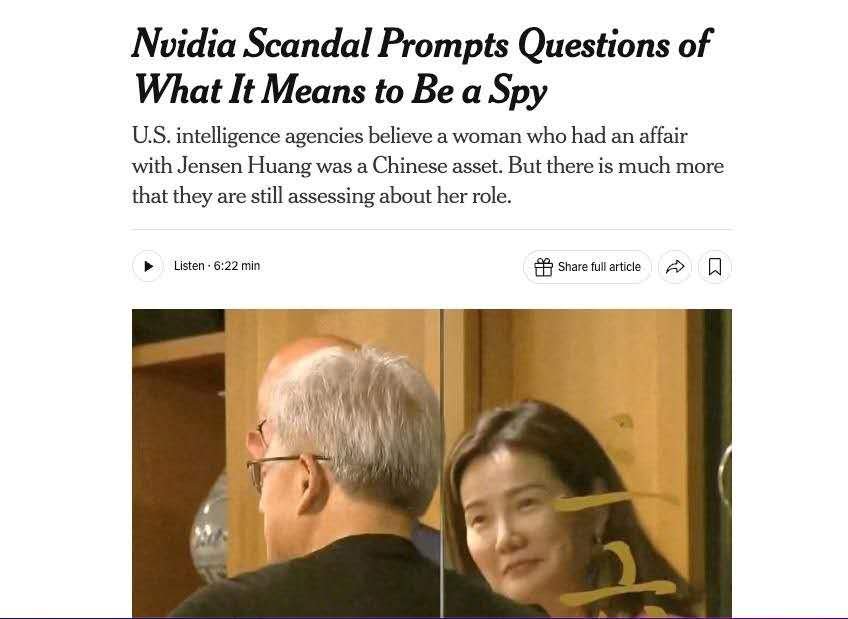
A follow-up story this past weekend included these butt-covering caveats…
Chinese espionage is complicated. There are a range of ways that Chinese business executives can conduct espionage for the Beijing government, from simply reporting what they know to taking active direction.
U.S. intelligence agencies have confidence in their information about her interactions with Chinese intelligence services, despite all that they do not know about Ms. Huang…
Approached by the Chinese government to collect information or prod an American company for access to high-end chips, many Chinese executives might feel they have no choice but to comply.
As the French tech entrepreneur and longtime China resident Arnaud Bertrand tweeted, almost anyone could be a spy by this definition — “someone who may have told their government something, at some unknown point, willingly or not, to an unknown extent.”
It doesn’t help the narrative that Attorney General Todd Blanche pushed back at a reporter’s leading questions on Thursday: “Your first question assumes something that I have never said and that I don’t know to be true. So you assumed that the DOJ has learned that she is in fact a spy. Nobody said that. I certainly haven’t said that.”
No, but Marco Rubio sure as hell did say it. He just made sure not to leave his fingerprints on it until after Jensen Huang was gone.
And then it could come out in The Washington Post: “Huang’s downfall, which has the potential to mark a dramatic shift in power, was ultimately set in motion by one of the capital’s most influential China hard-liners, national security adviser and Secretary of State Marco Rubio.”
It seems a while back, the CIA wrote up a routine intelligence memo, the contents of which we still don’t know. According to the Post’s sources, the memo fell into Rubio’s hands — and Rubio proceeded to write a new brief “recasting the agency’s reporting in his own more assertive terms.”
The new memo, addressed to President Trump, warned specifically about a relationship between Jensen Huang and a suspected Chinese spy.
Per the Post’s reporting, China hawks in the West Wing are high-fiving Jensen Huang’s resignation from Nvidia: “With the downfall of the leather jacket-sporting CEO, the hawks are ready to seize on the moment to redirect the national agenda toward tougher policies on China.”
Meanwhile, you might have heard about an attempt by Huang to stage a comeback. The attempt appears doomed — but not for the reasons you might think.
“Huang has discussed with confidants the possibility of returning,” says the Financial Times. “One Huang ally told the FT they were putting together a ‘war room’ of Silicon Valley executives to lobby for the former Nvidia chief’s return and would try to garner support from the White House.”
To be sure, Elon Musk is among those publicly calling for Huang’s reinstatement on a website called “Stand with Jensen” — citing, among other things, Huang’s 33 years as the company’s only CEO.
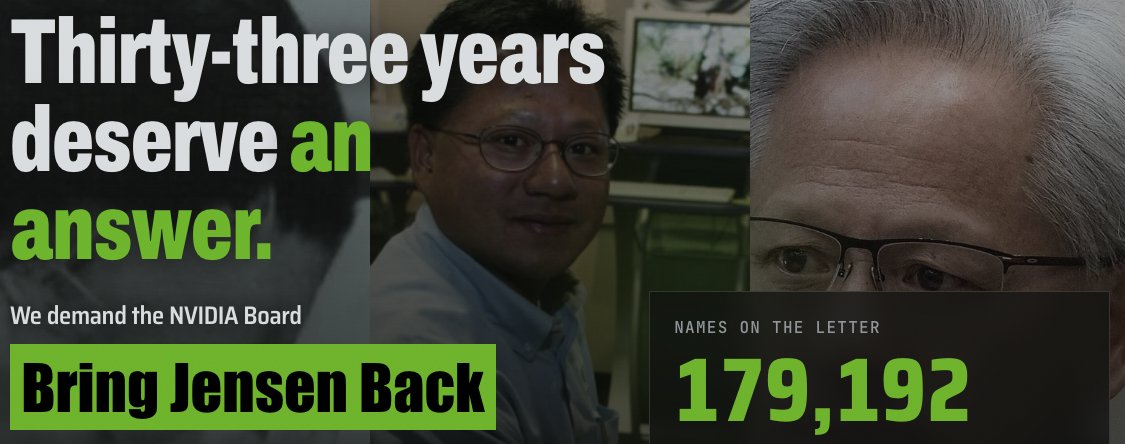
But this effort runs aground on the claims that, in addition to Alice Huang, Jensen Huang also had affairs with at least one underling at Nvidia.
“From the perspective of the board of directors, the relationships with subordinates may have been worse than the Chinese spy allegations,” says Paradigm macroeconomics authority Jim Rickards.
Jim spent decades as inside counsel for a number of Wall Street firms. “I dealt with quite a few sexual harassment claims. One would always conduct a proper investigation.
“Management’s response to valid claims (or even close cases) was always the same — termination of the offender and compensation for the victim. Smart management has zero tolerance for this behavior…
“Any director who failed to address serious misconduct could face legal liability for violating internal policy or failing to supervise. Huang had little chance of hanging on as CEO.”
Meanwhile, Jim says Huang’s downfall gives Donald Trump “little room to maneuver” as he heads to China this week for an unprecedented meeting with both Russia’s Vladimir Putin and China’s Xi Jinping.
“Any concessions on semiconductor exports might now look like capitulation to Beijing.”
 Markets Today: One Encouraging Sign
Meanwhile, the broad stock market is sinking along with Nvidia as a new week begins.
NVDA sank below $160 this morning — territory last seen nearly 18 months ago. Paradigm hedge fund veteran Enrique Abeyta says the company has shed over $2.2 trillion in market value — more than the entire Australian stock market, more than than GDP of Mexico.
(Reminder: NVDA reports earnings tomorrow!)
At last check, the Nasdaq is down nearly 1.9% on the day — the 25,000 level a distant memory. The S&P 500 is down 1.25% to 7,468 — well below the 7,600 level technicians are watching closely.
“That post-midterm melt-up rally we were waiting on? Forget it,” says Trading Desk editor Greg Guenthner. “It looks like we’re going to need to see some more corrective action before stocks find a floor.”
That said, the airline stocks seem unperturbed by the air-traffic control fiasco that shut down all U.S. flights for a few hours on Friday night. The JETS ETF is up 1.35% as we write. But L3Harris Technologies (LHX) — widely implicated in whatever went haywire — is down 2.5%.
“One thing that I find most encouraging right now is that, when investors sold AI stocks, they didn’t run to cash. They moved the money into other parts of the market,” says Paradigm analyst Zach Scheidt.
“You could see last Monday. Nvidia fell sharply on the investigation into its CEO, and the S&P 500 still closed up 2.35%, its best day since April 8.
“Even in a volatile October, the average S&P 500 stock gained nearly 5%. Health care stocks have been making new highs, and discount retailers are strong.
“And underneath the AI sell-off, the fundamentals haven’t cracked. The biggest cloud spenders keep raising their capital spending forecasts for the next two years, even as their stocks swing wildly.”
Indeed, the Paradigm editors have racked up several wins for their readers so far this month.
Ray Blanco locked in gains of 45% and 125% on a couple of biotech names. That’s just the first half of those positions; Ray advises to let the rest ride.
Meanwhile at The Divergence, JC Parets’ premium subscribers pulled in 100% gains in only three trading sessions playing call options on the gold giant Newmont Mining. And readers of Chris Cimorelli’s 10X Trade Club booked 137% gains in less than a month playing call options on The Trade Desk.
Elsewhere, bond yields are backing off last week’s highs, the 10-year Treasury now 5.12%.
Precious metals can’t catch a break — gold down a half percent to $3,862 and silver down 4% at $46.68.
Crypto looks positively fugly, with Bitcoin under $65,000; most of the big gain since August has been vaporized. Ethereum is sinking toward $1,800.
U.S. oil futures are down 1.75% to $87.02 — perhaps on the theory that the United States and Israel won’t resume the Iran war while Donald Trump is meeting with Putin and Xi later this week.
 Could AI LOWER Your Electric Bill?
What if AI data centers had the effect of lowering your electric bill? A new study suggests how it could be done.
Researchers at the Energy Systems Integration Group and Brattle Group modeled a large new customer connecting to a utility’s grid. When the utility already had spare power plants and transmission lines, adding the customer lowered rates for everyone else by about 6% over 15 years.
Think of it like a Costco membership.
Every new member helps pay for the warehouse, the lights and the staff. The store can spread those costs across more people without building another building.
A data center can do the same for a utility.
To be sure, the picture changes if the utility has to build new power plants and lines. In that case, the study found rates rose about 3%. Worse, if the data center never opens, opens late or uses less power than promised, existing customers can still get stuck with the bill for equipment that was built for someone else.
Given the public mood, utilities are trying to stop that from happening.
On Oct. 7, Duke Energy announced an agreement with Amazon, Google, Meta, Microsoft and others in North Carolina. Large customers would help pay for grid improvements upfront and commit to minimum payments even if they use less power than expected. The deal still needs regulatory approval.
As you know by now, voters are already putting the brakes on new projects: According to Ballotpedia, voters favored restrictions in 40 of 41 local data-center ballot measures.
And electricity prices aren’t the only concern — as we see in how attitudes toward data centers soured appreciably since the first of the year…
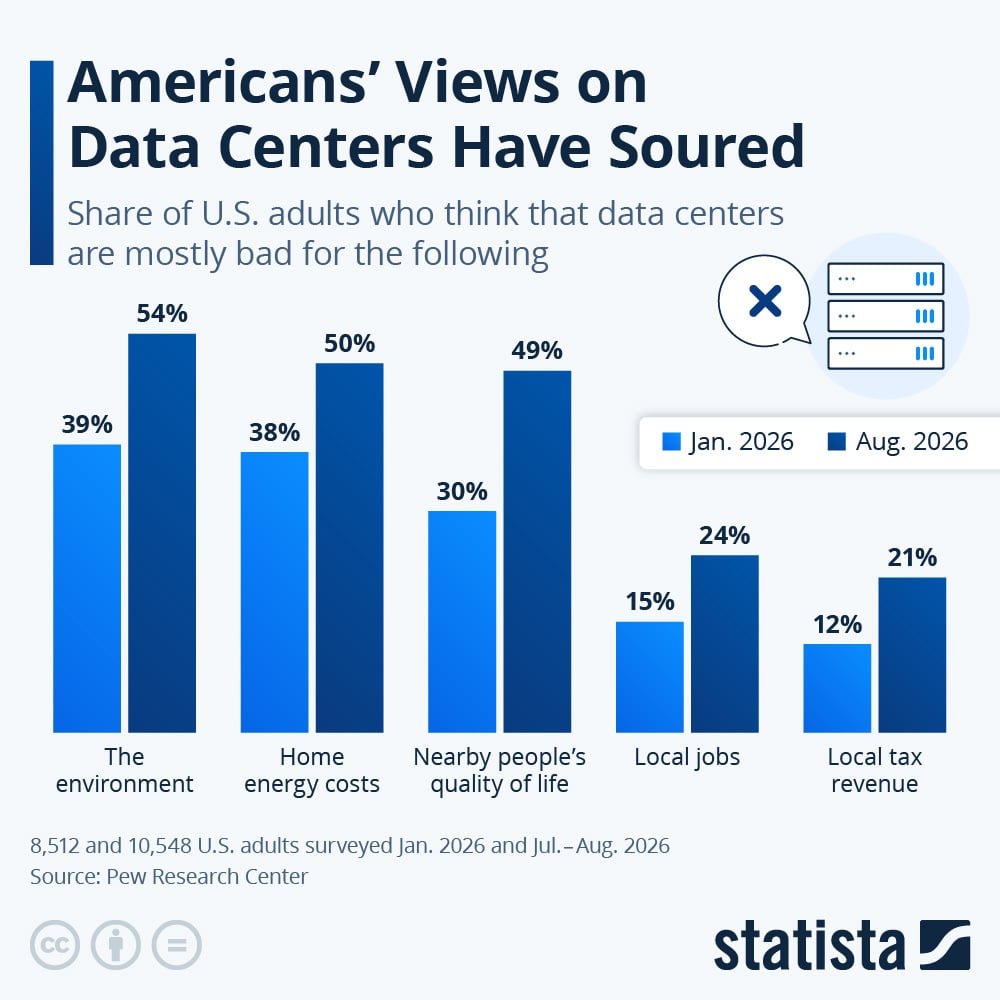
But utilities may have an easier time winning public support if they can show households will actually benefit — or at least show that existing customers won’t be left holding the bag.
The lesson isn’t that data centers automatically make electricity cheaper. It’s that they don’t automatically make it more expensive, either.
Like any big customer, a data center can help everyone else pay the bills. But it has to show up, stick around and pay its share.
 Comic Relief
It really was kind of a cluster on Friday, wasn’t it?

OK, in the first place — and all rumors to the contrary — National Weather Service radars did not go down on Friday.
In the second place, this is probably a good time to insert a public service announcement that FEMA is doing one of its periodic nationwide tests of the Emergency Alert System tomorrow at 2:20 p.m. EST.
You won’t even notice unless you still rely on traditional TV or radio. Apparently this time the alert messages will not be sent to your wireless phone.
 Mailbag: Huang and Huang
“This article is one of the best pieces Dave has ever written,” a reader writes after Friday’s edition. “Actually it is his best!
“I recommend that it be sent to some key news people and posted on X.”
Dave responds: Thank you very kindly but I don’t do much on social media. I did post a link on LinkedIn where maybe some of my long-lost colleagues in the news biz might see it. (But probably not.)
“I thought something about Nvidia was off from the start too — but never thought it would be so complicated,” writes another reader. “That just proves once again there’s always more to the story.
“Amodei does kinda have a point but I’m skeptical about his ulterior motives when it comes to regulation and making it harder for the competition.
“And I wouldn’t describe Jensen’s choice to have affairs as ‘catastrophically debauched.’ Sure, it was wrong but people are blowing this up to be way bigger than it is. Whatever her motives, Alice Huang is clearly more to blame and I also think the Nvidia board was a bit spineless for putting pressure on him to resign, even if it looks bad.”
“Thank you for the deeper look at this Nvidia spy BS,” says our final correspondent.
“Jack Clark of Anthropic could have written the story, and sent it to the press. Be that as it may, your write-up outlines a far more logical picture than the usual.
“Alice Huang is skirting around USA and China regulations, to use Nvidia chips and sell services to China? Sounds reasonable to me. Not a spy at all!
“In fact, a sort of colleague or partner, indirectly.
“The timing is telling: before Anthropic’s IPO, and right around midterms. Really?!!!!! Seems logical that Amodei is using the story to push his agenda for moat-making legislation.
“In addition, plenty of Democrats would like to fabricate another trumped-up attack on Donald, saying he is (again) too cooperative with other nations (Russia, China).
“[Of course, no excuse for conflict, either. (Anyone who understands Iran is way ahead of me.)]
“Thank you. Refreshing to read this perspective.”
Dave: As I said Friday, I don’t want to jump to conclusions and connect dots that probably shouldn’t be connected, not yet anyway.
The plot continues to thicken: While leaving for China, Donald Trump said this morning that he “wouldn’t mind” seeing Huang reinstated at Nvidia.
So we’ve got Trump and Elon plus a handful of other tech execs and maybe Commerce Secretary Howard Lutnick on one side… against Marco Rubio, Treasury Secretary Scott Bessent, the Democratic Party’s center-left establishment, along with Anthropic and probably OpenAI on the other. The Chinese and the Israelis are standing aside and popping the popcorn.
It’s at this moment I’m reminded of a passage from James Norman’s 2008 book The Oil Card: “Nation-states behave with logics, moralities and imperatives all their own. Who can know them? When these elephants rage, we pygmies are trampled. It pays to know when to get out of the way.”
Back then, Norman was writing about maneuvers and manipulations in the oil market.
Now with AI it’s not just nation-states — but also trillion-dollar tech companies in which tens of millions of everyday Americans are invested, if only through an index fund.
High stakes. The Paradigm team will do its level best to continue identifying when to take cover — and where to seize the moment.


