“I Don’t Want a Data Center in My Backyard”
 “I Don’t Want a Data Center in My Backyard”
 Will control of the U.S. Senate come down to the issue of… data centers?
Of the 35 seats up for grabs this year, a half dozen or so are extremely competitive. That includes Ohio, home to the fifth-largest concentration of data centers in the country — as well as relentlessly rising electric bills.
Incumbent Republican John Husted is taking the heat for fast-tracking new data centers during his time as lieutenant governor. Democrat Sherrod Brown — hoping for a comeback after losing Ohio’s other Senate seat two years ago — labels Husted “the face of data centers.”
The race is tight. Internal Republican polling suggests this seat might flip to the Dems — although for the record, our Jim Rickards projects Husted will hang onto it.
It seems data centers are a hot topic for the midterms — and beyond. You can buy T-shirts and hoodies invoking both The Terminator and the 2028 presidential race…

Here in 2026, it seems how you vote might depend on your proximity to a data center.
All this year, researchers for The Economist have been regularly surveying nearly 150,000 Americans — comparing the voting intentions of those living within two kilometers (1.6 miles) of a data center versus everyone else.
For the first half of the year, there was little difference. But over the summer, a divide emerged.
Among those living near a data center, support for Democratic candidates rose from 54% to 61%. Among those living further away, the increase was much more modest — from 53% to 55%.
The trend was similar even among people who voted for Donald Trump in 2024. Seventeen percent of Trump voters who live near a data center say they intend to vote for a Democrat now. If they live further away, the jump is a much smaller 6%.
“Of course, only a small minority of voters live within two kilometers of a data center, limiting the issue’s potential impact on statewide Senate races,” write demographers Neil Howe and Christian Ford.
“But in a handful of House districts, the backlash could make a difference. Democratic candidates in Nevada’s 2nd, Colorado’s 4th and Ohio’s 15th districts are campaigning heavily on the issue.”
A much bigger impact could be on governor’s races.
This fall your editor has been following the work of Rich Baris — an unconventional pollster who’s not afraid to call out the mainstream when it’s wrong (frequently), and willing to acknowledge those occasions when the mainstream gets it right.
Baris says data centers are “toxic” in many rural Republican strongholds.
Case in point: Florida. Statewide, 53% express opposition to data centers. But in rural stretches of the state, that opposition swells to 61% — with a paltry 6% saying they “strongly support” data centers.
Baris conducted a focus group in Dixie County in the Big Bend area — which broke 85% for Trump in 2024. A faithful Republican said “I’ll have to vote for David Jolly” — the Democratic candidate. Why? “Because I don’t want a data center in my backyard.”
The Republican candidate, U.S. Rep. Byron Donalds, is all-in on data centers, calling them a “lifeline” for rural communities.
➢ That makes Donalds a real outlier. According to the website The Information, 60 of the 72 major-party candidates for governor this year support some sort of limits on data centers.
Yesterday the Axios site posted a story in which anonymous Florida GOP leaders were given a platform to fret that rural racism is a problem for their candidate. (Donalds is Black.)
Nonsense, according to Baris. “Of course they’d say this instead of confronting the fact that [only] 6% of their rural vote strongly supports data centers in their communities.”
No, none of this is to predict that Florida’s about to get its first Democratic governor this century. But if the results are closer than conventional wisdom has it… well, now you know why.
Meanwhile, at least one of the frontier AI companies sees which way the winds are blowing. Well, sort of.
“Right after Tuesday's midterms, OpenAI will unleash a policy and PR blitz to try to get in sync with the new Washington,” says another Axios story.
Key to the effort will be an attempt to rebrand data centers as “AI compute campuses.”
Yeah, good luck getting that to resonate with normie Americans. So far almost no one outside of the tech or investment space has adopted “compute” as a noun.
 Markets Today: Pausing for Breath
The big market stories today are a pause to the AI spending scare… and a (seemingly) inexplicable plunge in U.S. oil futures.
The S&P 500 took a 1.8% stumble on Friday, while the Nasdaq-100 formally entered “correction” territory, down 10% from its most recent high.
At last check this morning, the S&P has recovered about half of Friday’s loss, back over 7,600.
But it’s a bit soon to call the all-clear, says Trading Desk editor Greg Guenthner: “We're either seeing a washout move that will potentially set us up for a rally over the next couple weeks. Or this is just the start of a bigger market rollover
“It's difficult to say for certain which path the market will take in November. We just have to keep an open mind and take this market one day at a time.”
Amid the turmoil of last week, Enrique Abeyta urged readers of The Maverick to take 40%-plus gains after only eight days from their call options on Quanta Services.
The fate of the major indexes rides in large part on the fate of the Magnificent 7 names. And they sit at a critical juncture.
After going nowhere for much of this year, they started taking off in September — only to give back a big chunk of those gains in October.
“Now they’re testing a critical level of support,” says Paradigm trading authority JC Parets. “Here’s the Roundhill Magnificent Seven ETF (MAGS) trying to hold above its prior-cycle highs:
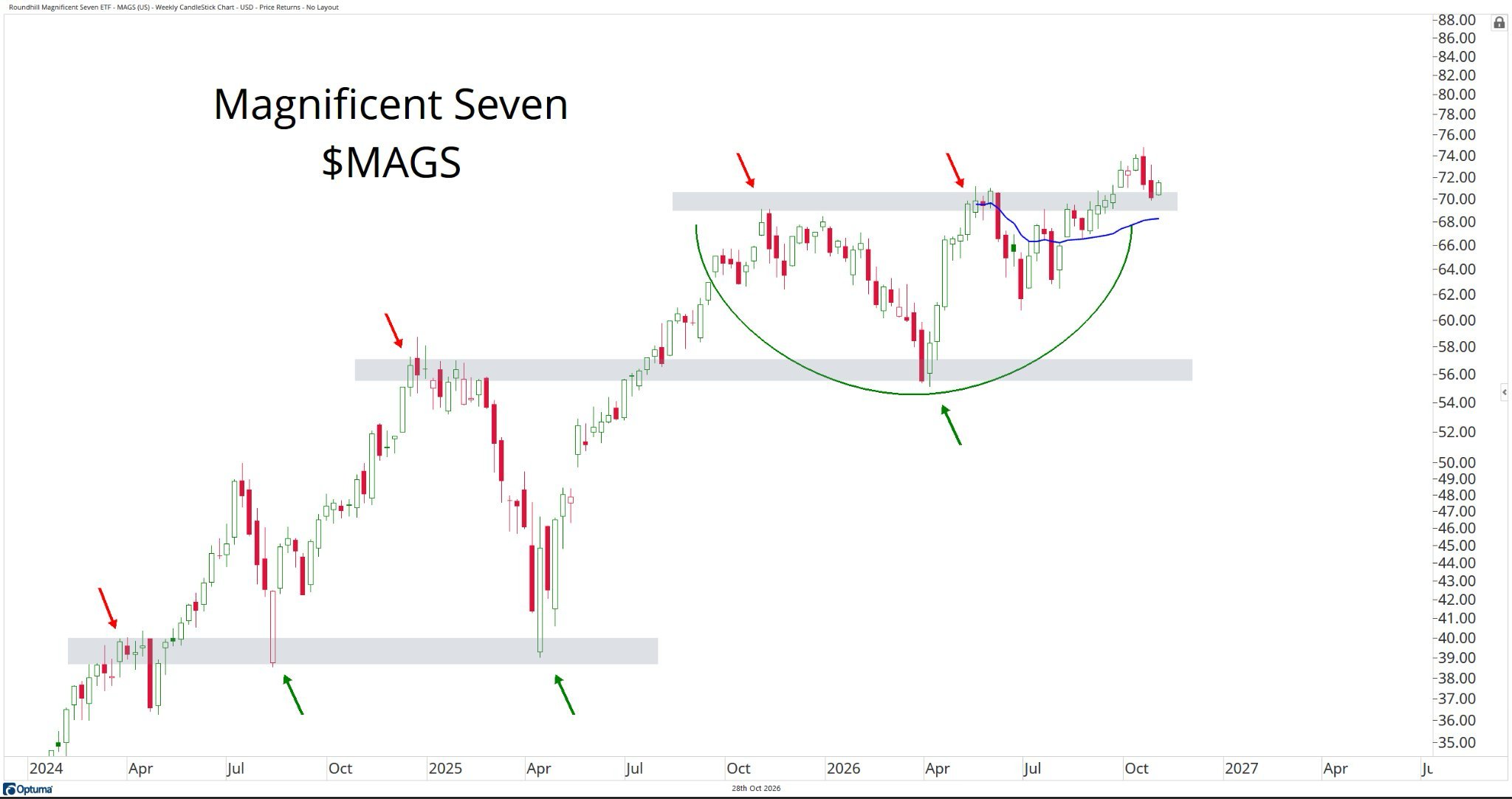
“Those prior-cycle highs are represented by the gray bar on the top. I’ve traced recent price action with a thin blue line.
“We're right there testing it. And we need MAGS to hold above that gray bar up there.
“Above that gray bar, the bull market is on, and we’re still looking for stocks to buy. A decisive break below that level, we’ll need to reassess.”
➢ Elsewhere, precious metals are enjoying an oversold bounce — gold up 2.2% to $3,959 and silver up 3.8% to $50.85. Crypto is trying to recover from the Binance hack, with Bitcoin back over $77,000 and Ethereum at $2,266.
For no obvious reason, U.S. oil futures are down 6.5%, sinking toward $97.
CNBC has some headline about “Iran Peace Talk Hopes Ahead of Midterms”... but the evidence to support it is tissue-thin. Secretary of State Rubio says the U.S. administration “prefers” not to use military force; Iran’s foreign minister Abbas Araghchi says a deal is possible if Washington “demonstrates goodwill.”
Meanwhile in the real world, “Tanker Ablaze as Fear over U.S.-Iran Escalation Grips Region,” says an Al Jazeera headline.
What can we say? Other than to direct your attention to this brief history of oil-price manipulation.
 The AI Crash Has Already Happened (in China)
You think the AI sell-off in this country has been rough? Try going to China.
China's AI-heavy STAR50 index has lost roughly $480 billion in market value over four months — a 40% plunge since June, according to Reuters.
Humanoid-robot maker Unitree and chipmakers MetaX and Moore Threads have each lost roughly half their value. Optical-component suppliers Innolight and Eoptolink have fallen about 60%.
Yet even after the collapse, the STAR50 was trading around 100 times trailing earnings — compared with roughly 30 times for America's Nasdaq-100. (Go figure, a stock can lose almost half its value and still be expensive.)
Several pressures contributed to the sell-off: extraordinary valuations, intense competition, doubts about future profits and proposed American restrictions on Chinese technology suppliers.
But Paradigm AI authority James Altucher sees a crucial difference between the two markets.
Last week he told Altucher Investment Network readers that China's AI ambitions aren't measured entirely in profits. There’s also resilience: Beijing wants domestic alternatives to American technology, particularly Nvidia's advanced chips.
Point being, “A Chinese chipmaker could help the country become less dependent on Nvidia and still turn out to be a lousy investment.”
In contrast, Microsoft and Alphabet were making billions long before ChatGPT arrived.
Microsoft's latest quarter produced $92.3 billion in revenue and $36.6 billion in net income. Its Azure cloud business grew 48%. Google Cloud performed even better, doubling revenue to $30.7 billion while operating income more than tripled to $11.1 billion.
Yet as we mentioned in real-time, Alphabet shares plunged nearly 13% on Thursday.
Investors weren't questioning whether its cloud business was growing. They were questioning the cost.
Alphabet spent $51.4 billion on capital expenditures during the quarter, contributing to negative free cash flow of $9.1 billion. Slower-than-expected advertising growth and an investment-related paper loss also weighed on its earnings.
Even extraordinary growth couldn't save Alphabet's stock from a beating.
China shows what happens when investors lose patience with sky-high valuations. Alphabet's sell-off suggests that patience may be wearing thin in America, too.
Our Enrique Abeyta said as much in this space on Oct. 14: “Even revolutionary technologies are vulnerable to ordinary business cycles.”
China’s crash shows what happens when valuations run far ahead of demonstrated earnings under a particular set of incentives.
America’s leading AI companies already generate tens of billions in real revenue, so the path is not identical. Still, Alphabet’s drop shows investors are already questioning the cost of the buildout.
The technology can succeed, demand can stay strong, and data centers can keep getting built — while shareholders still discover they paid too much.
To be continued…
 Update: The Truth About Time Change
Oh, now they tell us…
For over a century, daylight saving time has been sold to us as an energy saver.
To coincide with time change this past weekend, Bloomberg posted a story telling us that “according to in-progress research from Yale economics professor Matthew Kotchen, the effects on energy use from both transportation and electricity ‘are probably relatively small, within 1% or 2%’ of total electricity consumption, or even less.”
Why is Bloomberg telling us this now? We’ve been mentioning Kotchen’s research periodically since 2014 — including this comprehensive rant against DST published three years ago.
In 2010, Kotchen and fellow researchers realized they had a perfect case study in Indiana: Much of the Hoosier state defied daylight time until the state legislature decided to conform in 2006.
The before-and-after research concluded the energy saved by less indoor light during the summer months was offset by an increase in the use of heating and air conditioning. Indeed, daylight saving time contributed to a 1% jump in electricity use.
Kotchen is taking on a new, more granular, research project: He and his colleagues are “examining hourly electricity load and integrating data from traffic monitors around the country, using a statistical model to estimate how changing the clocks impacts energy usage,” says Bloomberg.
“Because the sun sets at a different time of day depending on where you are, Kotchen says, the key is being able to compare energy usage at any given clock and solar time, and consider what would happen if a different clock time were synced to that solar time.”
The findings are preliminary, but they don’t change his thesis: “The overall effect will be very small.”
By the way, the U.S. House passed a measure earlier this year that would impose year-round daylight saving time. It appears destined to die in the Senate — and just as well.
 Comic Relief
Well, it’s almost over anyway…