
Wipeout: The Day After
 Nashville
 So yes, I’m writing to you twice today. That’s because there will be no 5 Bullets tomorrow.
Greetings from Nashville, where the Paradigm Press team is gearing up for tomorrow’s 2026 Paradigm Shift Summit.
The theme this year couldn’t be more timely: America’s Great Divide: Critical Tipping Points for AI, Politics and Markets. Among the Paradigm editors who will speak are James Altucher, Jim Rickards, JC Parets, Enrique Abeyta, Byron King and Ray Blanco.
Now… maybe you’ve been a Paradigm Press customer for a while and you’re wondering why this is the first you’re hearing about it.
Answer: This year we’re making the event exclusive for our Omega Wealth Circle members.
As you might be aware, Omega combines our top services into one bundle — giving members a wide spectrum of investment strategies and recommendations in one place.
For the last 18 months or so, we’ve been bending over backward to figure out how to give these VIP customers the best possible experience. One of the ideas our leadership team landed on was an in-person conference exclusive for them.
The Omega Wealth Circle isn’t for everyone… and we don’t open membership to just anyone. But if you already have two or more subscriptions with us, you can expect an invitation sooner or later.
In any event, we won’t leave you completely in the dark: I’ll bring you highlights from the event in next Monday’s edition.
On to other matters…
 “Don’t It Make My Red State Blue…”
(Yeah, apologies to Crystal Gayle…)
In retrospect, I should have known the outcome of the midterm elections shortly before dinner last night.
Neoconservative pundit Mark Levin had already posted a teary video in which he blubbered, essentially, It’s not my fault!
Just for the heck of it, I checked the 5 Bullets inbox. I had the reasonable expectation that a reader or two would let me have it after yesterday’s edition — in which I cited the work of conservative pollster Rich Baris. For months, Baris was adamant that Trump wrecked his 2024 coalition by starting the Iran war (with all its impact on “affordability”) and that the GOP would pay dearly in the midterms.
I figured someone would take issue with that assessment. Doomer! Panican! People like you are the reason our side will lose!
But no. Nothing. Crickets.
Had reality set in even before the polls closed?
I won’t dwell on the numbers, which you can find anywhere. In the interest of accountability, we’ll note that Jim Rickards’ midterm forecast missed the mark. He projected the Republicans would retain their 53-47 Senate majority. In the event, Democrats will control at least 54 seats — and maybe more depending on the outcomes in Mississippi and Alaska.
In the House, he projected a slender Democrat majority of 223-212. As of this writing, the Democrats already hold 228 seats — with 68 races yet to be decided.
Jim nailed both of Donald Trump’s shock victories in 2016 and 2024 — down to the exact electoral vote count two years ago. Being a stand-up guy he’ll own this one and examine what went awry; in general it seems his midterm projections since 2018 have been too generous for the GOP.
Baris’ analysis, shared here yesterday, was spot-on: While conventional polls in recent years undercounted Trump supporters, a repeat of that misfire was not in store this year — not when so many 2024 Trump voters were so disillusioned.
And for the record, it is Mark Levin’s fault. And everyone else Trump listened to earlier this year — Benjamin Netanyahu, Laura Loomer, the late Lindsey Graham (whose sister got smoked last night).
 Data Centers, Taxes
To the extent that data centers were on the ballot yesterday, they lost.
On Monday, we examined the impact of the data center debate on the midterms — with the spotlight on two races.
In Ohio, Democrat Sherrod Brown will return to the U.S. Senate after a two-year absence. He successfully tagged incumbent Republican John Husted as “the face of data centers.”
In the Florida governor’s race, Republican Byron Donalds eked out a win over Democrat David Jolly by a margin of 1.3 percentage points. As we chronicled on Monday, Donalds’ vocal support for data centers cost him support in rural GOP strongholds.
As for the three U.S. House races where Democrats made opposition to data centers a major issue… the Democrat flipped Ohio’s 15th district while Democrats are in the lead in Colorado’s 4th and Nevada’s 2nd.
And while we didn’t mention Texas on Monday, data centers figured big in the ousting of three-term Republican Gov. Greg Abbott. As noted here in August, Abbott imposed a moratorium on approvals of new data centers connecting to the power grid. It still wasn’t enough.
And then there were the tax referenda.
Florida’s Amendment 3 — a major property-tax overhaul — passed with a supermajority of 62%. The measure phases in a homestead exemption starting at $150,000 next year — jumping to $250,000 in 2028. It would also authorize the legislature to abolish property taxes altogether if it so chose.
So now what?
As the researchers for the Tax Foundation wrote earlier this year, “eliminating such a sizeable share of Florida’s property tax base would not reduce the cost of providing local government services; it would simply require that the lost revenue be generated elsewhere, including from higher millage rates on all property that remains taxable.” That is, commercial property and second homes.
Meanwhile, it’s too soon to call the results on California’s proposed “billionaire tax.” (The rest of the country has figured out how to count early and absentee ballots by now; why not the Golden State?) At last check, about 60% of the vote is in and the proposal is losing 56-44%.
Meanwhile in Colorado, the vote is neck-and-neck for a proposal to scrap the flat-rate income tax in favor of progressive rates.
 Certainty
If, as the saying goes, “markets hate uncertainty,” then they love the certainty that’s come with this election result.
Stock futures wobbled last night when it was still up in the air whether Democrats would take both houses of Congress.
But with all doubt removed, every major index ripped higher in the first hour of trading — the S&P 500 by 1.5%, the Dow by nearly 2%, the Nasdaq by 2.2%.
About the only notable losers are Elon Musk’s companies — SpaceX down 2.5% and Tesla down 2.75%. That’s Mr. Market sniffing out “regulatory risk” in the form of congressional investigations.
Precious metals are also rallying hard — gold up over $100 and back over $4,300 while silver is up two bucks to $51.66.
Crypto is showing signs of life after the Binance hack last week — Bitcoin back over $80,000 and Ethereum cresting $2,400.
U.S. oil futures are down over $3% “against any basic logic,” as the DarioCpx trading account on X says — to $93.67, the lowest in over three weeks.
For all the market turmoil this fall, most stocks were up year-to-date going into Election Day.
Paradigm trading pro Enrique Abeyta tells us “two-thirds of the stocks in the S&P 50 are up YTD and 22% are up more than 30%.” Here’s a breakdown from Ritholtz Wealth Management…
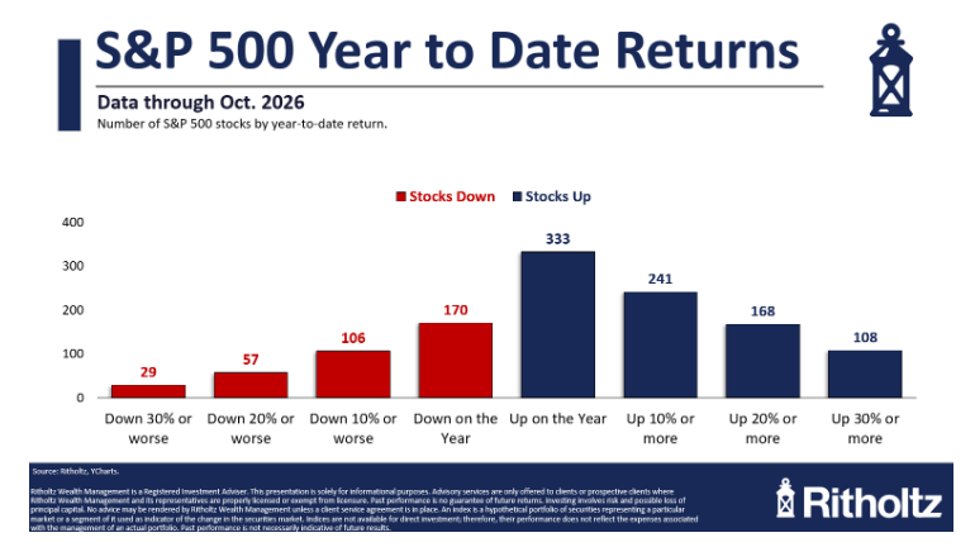
“This is the sign of a bull market and not a bear market,” Enrique avers.
 Mailbag: ASTS
After Zach Scheidt’s guest edition a week ago today — about SpaceX’s foray into wireless service — we got a one-sentence reader query: What does this mean for AST SpaceMobile (ASTS)?
Altucher’s Investment Network contributor Ray Blanco — maybe the most passionate advocate for ASTS in our shop — is not worried.
“AT&T and ASTS just announced that a smartphone connection was handed off from an AT&T tower to an ASTS satellite and back without dropping, in a test on Oct. 21 in Washington state,” he wrote yesterday.
“Think about driving out of town on a call. The towers thin out and the call dies. With ASTS, the satellite picks it up, and the tower takes it back when you’re in range again. ASTS has mastered extending the carrier’s own network into space. It’s seamless to you, the user, and that’s a big deal, since it is a very hard piece of engineering to master.”
What’s more, Ray says ASTS’ satellite infrastructure could give the major wireless carriers an excuse to ditch cell towers in rural areas that are costly to maintain and serve relatively few customers.
“In its latest filing,” Ray continues, “T-Mobile says it’s shutting down ‘low customer value sites.’ In the same filing, it commits spectrum to satellite providers.
“T-Mobile doesn’t connect those two in the filings but I will. Every rural tower a carrier can retire and hand to a satellite is cost off its books, and the handoff tech ASTS just demonstrated is what lets that happen without customers noticing.”
Ray’s bottom line: “There’s plenty of room for Elon’s network and the carriers’ networks via ASTS.”


