
Altucher: Two Questions
 Altucher: Two Questions
 It’s one of the great investing truisms: In any investment boom, the most reliable returns come from the “pick and shovel” plays.
Presumably the expression’s origins trace back to the California gold rush of 1848–1855. Very few prospectors struck it rich prospecting for gold — but many people made a small fortune selling essential gear to the prospectors.
Across the decades, it rang true for Paradigm’s own James Altucher. But lately he’s had nagging second thoughts.
“What if the shovel costs $40,000?” he wonders. “What if the shovel factory costs $10 billion to build? What if you have to borrow that $10 billion at 15% interest?
“And what if, by the time you finish building the factory, somebody has already invented the Super Turbo Shovel©, which digs holes 10 times faster than your pathetic little antique?
“Now being a shovel investor gets complicated. I don’t just have to believe people will want your product. I have to believe you can finance the factory, survive the interest payments and eventually make enough money to justify everything you spent getting there.”
If you haven’t figured it out already, James is talking about AI.
This morning the AI spending scare is once again front-and-center for Mr. Market: Will all that lavish capital spending for chips and data centers ever pay off?
Google parent Alphabet reported its quarterly numbers late yesterday: The media fixated on revenue and earnings that missed Wall Street’s expectations — and the fact that AI is clearly starting to chip away at the company’s bread-and-butter search business.
But the standout number is free cash flow — the money left over after meeting both operating and capital expenses. For a second-straight quarter, the number is negative. In fact, at $9.1 billion, the cash burn is way higher than Wall Street analysts had figured on. Meanwhile, GOOG’s capital spending totaled $51.4 billion during the third quarter — up 14.5% from the previous quarter.
GOOG shares opened the day down 13%. That proved to be a drag on the rest of the market — with the Nasdaq-100, for instance, down 2%.
“Demand isn’t the problem here,” James points out. “The world wants more chips, more computing power, more data centers and more electricity than anyone imagined just a few years ago.
“But none of this stuff is imaginary. You can't ask ChatGPT to hallucinate a power plant into existence. Somebody has to build all of it.
“And somebody gets paid to supply the chips, equipment and technology that make it possible. That's a pretty extraordinary business to be in right now.”
And yet… estimates from the likes of McKinsey and Goldman Sachs are that the AI buildout will cost $7 trillion or more over the next four–five years.
“No industry I can think of has ever had to build this much this fast.”
And at a time when financing that buildout is a steeper climb; those near-zero interest rates of the 2010s are long gone.
That’s the essence of the AI spending scare: “The market has stopped rewarding ambition by itself,” James says. “Now it wants proof that these companies can afford their ambitions.”
Hence, the sell-off in many AI-adjacent names this fall… the fact the Nasdaq-100 has been trading sideways for six months… and the flurry of inquiries James is getting from his readers.
They usually go like this: James, you’ve spent the last few years telling us how enormous these opportunities in AI, space and the technologies surrounding them could become… Do you still believe that?
The answer is yes.
He says it comes down to two questions: Are people actually using AI? And… Is anybody actually making money from it?
In both cases, he says the answer is also yes.
Lost in the shuffle of Google’s numbers was the release of Microsoft’s numbers at the same time. MSFT beat Wall Street’s estimates on both the top and bottom lines; its Azure cloud business grew 48% in the most recent quarter.
Meta reported its numbers last week. James can’t help but be impressed by the fact that quarterly revenue climbed 26% “even as it poured increasingly enormous sums into AI infrastructure.
“That demand travels down the supply chain. Nvidia expects Blackwell and Rubin chips to generate at least $1 trillion in cumulative revenue through 2027 and is securing manufacturing capacity years ahead.”
But yes, times have changed: “When money was cheap and enthusiasm was everywhere, almost everybody could look like a winner. The next phase won't be so forgiving,” James says.
“The trillions coming into the AI industry aren't going to be spent evenly. Some of it will be wasted spectacularly. There will be empty data centers, bad loans, failed businesses, the whole nine yards.
“Which is fine by me. I'm not trying to own all of AI. I'm just trying to figure out where those trillions of dollars have no choice but to go.”
James and his team are sifting through every recommendation in the Altucher’s Investment Network portfolio — making sure it has only the names that will benefit from those trillions.
Bottom line, getting back to the gold rush analogy: “I haven’t changed my mind about where this is all headed. There’s still plenty of gold in the ground… And yes, I still want the shovels.”
 Inflated
In the face of today’s AI sell-off, the Federal Reserve’s latest moves are looking like an afterthought. But you ignore them at your own risk.
To no one’s surprise, the Fed stood pat yesterday — leaving the benchmark fed funds rate at 4.0%.
“Oct. 28 was not opportune for a rate hike because it was too close to midterm Election Day,” says Paradigm macroeconomics authority Jim Rickards. “The Fed wanted to avoid the charge of favoring Democrats or Republicans, so the safe path was to do nothing.”
The next meeting of the Fed’s Open Market committee comes in mid-December. Between now and then, Fed chair Kevin Warsh says he’s expecting a boatload of economic numbers to guide the FOMC’s next move. “The period right in front of us is information rich,” he said.
[Wait, did he just say the Fed is “data-dependent?” Gee, and Warsh was sold to us as some radical departure from the Bernanke-Yellen-Powell years!]
As it happens, the Commerce Department is out this morning with the Fed’s preferred inflation gauge.
“Core PCE,” this measure is called. When Fed leaders talk about their 2% inflation target, this is the number they have in mind.
Unfortunately for the Fed, this number has exceeded 2% since March 2021. And while it’s nowhere near the highs of 2022, it’s been moving up steadily for the last 18 months — now at 3.1%.
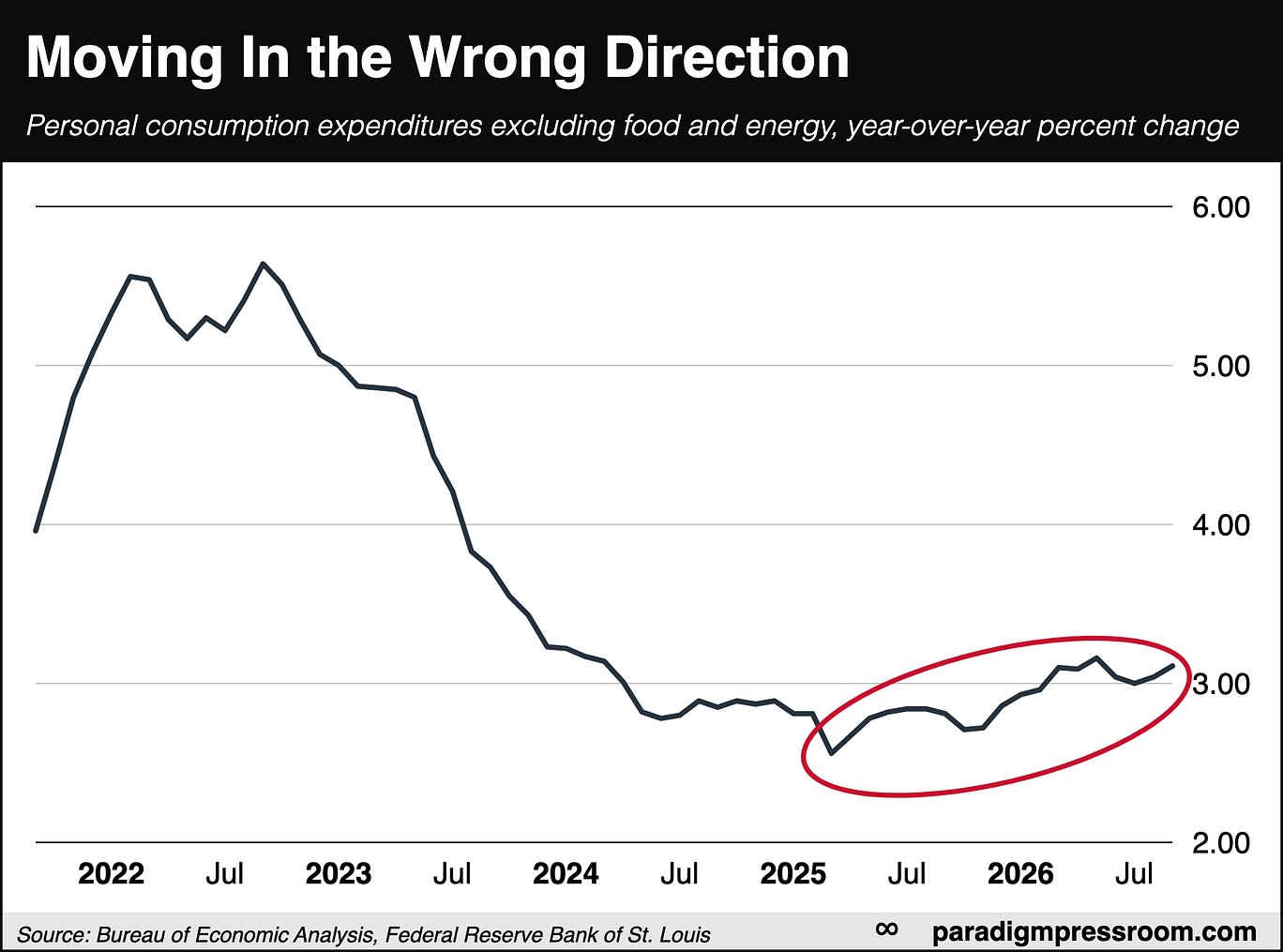
Even more unfortunate for the Fed is that it’s powerless to contain many of the current forces behind rising consumer prices: “Inflation is driven by a combination of supply-side pressures, including oil and diesel prices,” Jim says — “and demand-side forces such as deficit spending and consumer spending financed by bank lending.
“Given the limited influence of the Fed’s target rate on these forces, it’s difficult to see how another rate hike would bring inflation under control.”
But Jim says a second rate hike on top of the one in September is the most likely scenario for the Fed’s December meeting, at least right now. Futures traders agree: They assign an 80% likelihood the Fed will bump up the fed funds rate up to 4.25%.
➢ Worth a mention: Warsh says the Fed will dial back the tempo of these policy-setting meetings — from eight times a year now to six by 2028. This is in keeping with his stated desire to wean Wall Street off its 18-year addiction to Fed jawboning and “forward guidance.”
As the day wears on, the AI spending scare is wearing off.
The Nasdaq-100’s loss, 2% at the open, is a more modest 1.1% as we check our screens. The S&P 500 is down a quarter percent, still comfortably over the 7,700 level.
“Today and tomorrow’s trading action are going to tell us a lot about just how resilient this market is heading into November,” says Trading Desk editor Greg Guenther.
“We’ve seen some constructive action since last Thursday’s big drop. But if stocks can’t build on these young rallies we’ve witnessed this week, we might be in for additional chop and/or downside over the next few weeks or more.”
Precious metals are taking a hit on the assumption the Fed will raise interest rates in six weeks. But gold is still holding the line on $4,000. Silver, alas, is down another $1.50 to $52.33, territory last seen nearly a year ago. Elsewhere in the commodity complex U.S. oil futures are down 2.5% for no particular reason but they’re still over $100.
Crypto still can’t get any traction — Bitcoin at $81,589 and Ethereum at $2,362.
 The Tax Collector's Boomerang
Higher taxes don’t always deliver higher revenue. And Exhibit A is New York’s cigarette tax.
The Empire State taxes cigarettes at $5.35 a pack versus 37 cents in Georgia. New York City adds another $1.50. That's enough to make a road trip, or a smuggling operation, look profitable.
According to a new Tax Foundation report, 61.1% of cigarettes consumed in New York in 2024 weren't legally purchased in the state — up from 51.8% the year before. In between, New York raised its cigarette tax by $1.
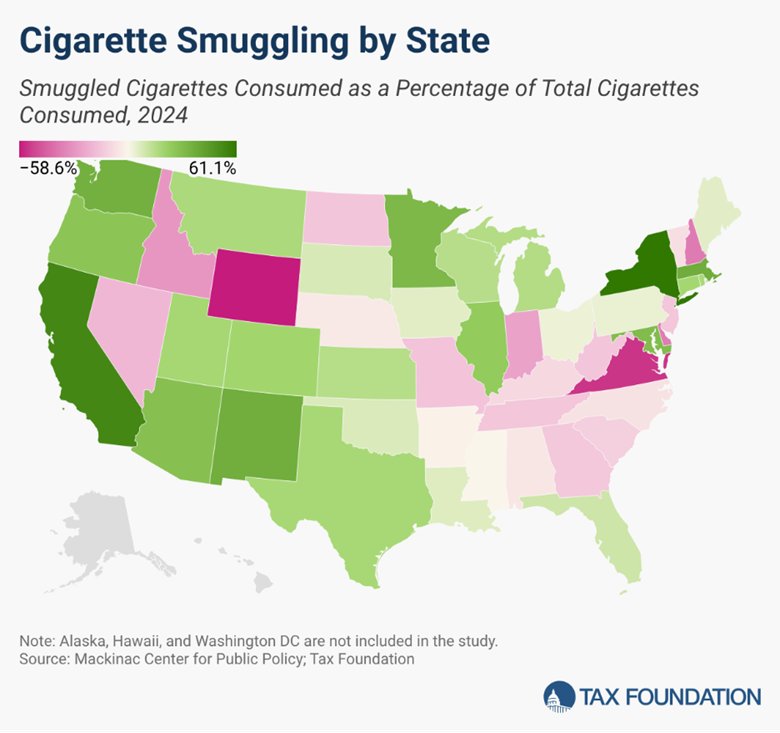
According to Tax Foundation estimates, the state missed out on $1.2 billion in potential cigarette-tax revenue. Meanwhile, actual cigarette and tobacco-product tax collections slipped from $832 million in 2023 to $747 million in 2025.
Yes, fewer people smoking also helps explain the drop. Higher taxes may discourage smoking, and that’s part of the idea. But they haven't guaranteed more money for Albany.
Now compare New Hampshire. At $1.78 a pack, its tax is one-third New York's. Yet it collected about $155 per resident in tobacco-product taxes in 2023, versus roughly $44 in New York, according to Census figures. Cross-border buyers from higher-tax states help explain the gap.
Beyond cigarettes, there’s a bigger lesson here going into next week’s elections.
On Tuesday, California voters will consider Proposition 40, a one-time 5% levy on the covered wealth of billionaires who lived in California on Jan. 1, 2026.
The nonpartisan Legislative Analyst predicts tens of billions of dollars in temporary collections — but warns that wealthy residents leaving could reduce future income-tax revenue.
A working paper this month from the National Bureau of Economic Research goes further. It forecasts about $30 billion in wealth-tax collections but a $38.9 billion negative net fiscal effect once the present value of lost income taxes is included. (Keep in mind that’s a model, not a certainty.)
One California billionaire almost made that mobility question tangible: Mark Zuckerberg.
According to a Meta securities filing, Zuckerberg considered leaving the state because of the proposed tax. Meta responded with a new class of nonvoting shares he could sell without giving up voting control, while securing his commitment to stay in California, or wherever Meta maintains its headquarters, for eight years, subject to conditions.
Moving today wouldn't erase the tax: Proposition 40 looks back to Jan. 1. But Meta's deal shows that the tax proposal is already changing behavior.
Lawmakers can set tax rates — but they can't dictate how taxpayers respond.
 Comic Relief, Streaming Wars Edition
Words of wisdom…

To be clear, Disney+ recently revised its “subscriber agreement” to specify that its top tier would include promos and/or sponsorship announcements before and after playback, not during. But the point stands…
 Mailbag: Someone Noticed
“LAUGH,” says the subject line to an email from one of our regulars.
“Dave, using a new pic in your byline? Funny but I thought someone new had been covering for you. Hilarious!
“A Studlier Dave vs. the Nerdy Dave. The same ol’ can get a bit boring.🙂 We must change with the changes.🙂”
Dave responds: On the one hand I’m a little embarrassed anyone even noticed.
On the other hand, the old picture goes back 10 years. And I’d just as soon that if readers want to say hello next week at the 2026 Paradigm Shift Summit in Nashville they know what I look like now!


