
Iran Won
 Iran Won
 When it comes to the Middle East and Persian Gulf, “the dominant power in the region going forward will be Iran, not the U.S. or Israel.”
So wrote Robert Kagan last weekend in The Atlantic.
Kagan is no Islamist sympathizer and he’s certainly no peacenik. In 1997, along with Bill Kristol, he founded the infamous Project for the New American Century. PNAC laid the intellectual groundwork in D.C that made the Iraq War possible a few years later. Over the decades, Kagan has been at least as hawkish about Iran.
But ideology notwithstanding, he sees the writing on the wall.
Tomorrow marks six months since Washington and Tel Aviv launched a sneak attack on Iran while negotiations were ongoing.
If the idea was to “decapitate” Tehran’s leadership and install a more friendly regime — the Venezuelan template, just with more violence — it backfired spectacularly.
Kagan’s assessment: “Iran has, with American help, completely reconfigured the power structure of the Middle East and the Persian Gulf.”
Less than two weeks into the war, we published an edition on March 10 titled “What If Iran Wins?”
Our own Jim Rickards pointed out how enormous a country Iran is, with forbidding terrain. He also was among the very first public figures to warn about Washington’s alarming shortage of weaponry — which has since become common knowledge.
Jim is no America-basher, nor is he anti-Trump. He wants Trump’s presidency to succeed — not least because if it doesn’t, it leaves an opening for the Democratic Socialists.
So it pains him to say, as he did this week in Rickards’ Strategic Intelligence, that “Trump has lost all credibility on his conduct of the war in Iran.”
Jim won’t go so far as to say Iran has won the war. But at the same time, nothing has taken place over the last six months to counter the concerns he expressed during the war’s first days. And is there any doubt Iran holds sway over the region in a way it did not six months ago?
“Victors in war do not make concessions, they dictate terms,” tweets the military analyst Will Schryver.
At what point over the last six months has Trump dictated terms to Tehran?
Meanwhile, Tehran did dictate terms under the short-lived “Memorandum of Understanding” signed in June. And even now, Tehran dictates terms about who can transit the Strait of Hormuz — which was free for all to navigate before Feb. 28 of this year.
For Iranian leaders, that’s plenty victory for now. And Jim Rickars says time is on their side.
“The longer the clock ticks,” he said yesterday in The Situation Report, “the greater the possibility that the U.S. will blink first in terms of Iran’s demands because of the threat to the U.S. and the global economy coming from the closing of the Strait.”
When might that be? Both at home and abroad, crude reserves are being drained and not being replenished. Don Johnson, chief economist at MacroEdge and an oil industry veteran, believes we’ll be staring down fuel shortages by the end of October.
Jim’s guidance for the next two months: “Investors can prepare for this looming financial Armageddon by increasing allocations to gold, silver, cash, real estate and U.S. Treasury bills.
“Those assets will preserve wealth and liquidity and are robust to the inflation that will result from a world with broken supply chains and unprecedented uncertainty.”
 NVDA’s Halo
Tech stocks are riding high on the latest quarterly numbers from Nvidia.
NVDA reported after the closing bell yesterday. Revenue and profit both doubled — and management forecast that pace would accelerate.
With that, NVDA shares are up 7.7% as we write… and the Nasdaq Composite is up 1.2% to 26,449.
“Risk on,” Weekly Wealth Alert editor Alan Knuckman says on our internal e-chat. He thinks this could be the catalyst for new highs in the Nasdaq-100. At just under 29,500 it’s about 4% below its record close in early June.
“After listening to Jensen Huang and CFO Colette Kress' conference call, I came away even more bullish than before,” writes colleague Davis Wilson.
It’s fair to say Davis, editor of our sister e-letter The Million Mission, is the most passionate NVDA advocate in our shop.
On the call with analysts, management said the firm expects revenue growth next year of 70% — in contrast with the average analyst’s expectation of 44%.
“That means Wall Street’s current $575 billion revenue estimate for 2027 should really be revised closer to $680 billion,” Davis writes. “Assuming similar margins, that’s earnings per share closer to $16 — well higher than the current $13.13 estimate.
“At the current price tag of $220 per share… the world’s most dominant AI company sells for less than 14X forward earnings.
“Realistically a company of this caliber should trade at 20–25X forward earrings — conservatively.
That’s a price target of $320–400.”
You can review Davis’ full updated case right here.
Apart from the tech sector, the other major indexes are also in the green today — the S&P 500 up a half percent and the Dow a quarter percent.
Hats off to readers of The Trading Desk. Greg Guenthner told them yesterday to take 435% gains from their call options on the software name UiPath. Not bad for only 13 days — and way more than enough to offset the loss they took yesterday on another position.
And we’d be remiss to overlook the breakthrough at Revolution Medicines — which won FDA approval yesterday for a pancreatic cancer treatment. Ray Blanco recommended shares to his Catalyst Trader readers about 14 months ago, and they’re up 480% to date.
Elsewhere, gold is treading water just below $4,600 while Bitcoin has poked its nose back over $80,000. U.S. oil futures are little moved, just over $82.
So… having now addressed NVDA, let’s move on to the other big market-moving story of the week…
 Wall Street’s Withdrawal Pangs
Wall Street suffers from an 18-year addiction — and the new Federal Reserve chair Kevin Warsh is cutting off its supply.
Tomorrow’s the day when by tradition, the Fed chair delivers the much-hyped keynote address to an annual confab of central bankers in Jackson Hole, Wyoming.
The mainstream media previews emphasize how Warsh’s stated commitment to get inflation under control is running headlong into Treasury Secretary Scott Bessent’s efforts to shore up the market for U.S. Treasury debt.
“You don’t want an unpredictable, whimsical Treasury,” warns Lisa Shalett, chief investment officer at Morgan Stanley Wealth Management. If Bessent goes too far, Shalett tells the Financial Times “it would be an admission that they’re worried in D.C. about debt sustainability.”
As the FT frames it, “The response to Bessent’s surprise intervention has heaped pressure on the Fed chair to soothe investors’ concerns over the financial and economic risks emanating from the Trump administration’s war in Iran, which has sent costs spiraling for consumers and businesses.”
All true as far as it goes. But Warsh has an even bigger problem — which gets back to that 18-year addiction…
Since the 2008 financial crisis, three successive Fed chairs — Ben Bernanke, Janet Yellen, Jerome Powell — have hung their hats on “forward guidance.”
That means the Fed bends over backward to telegraph its intentions to the market before it makes a move. No surprises, no drama.
Over a decade ago, our sister e-letter The Daily Reckoning compiled an Essentialist’s Glossary — a very tongue-in-cheek catalog of financial terms that were in vogue at the time. Here was the entry for “forward guidance.”
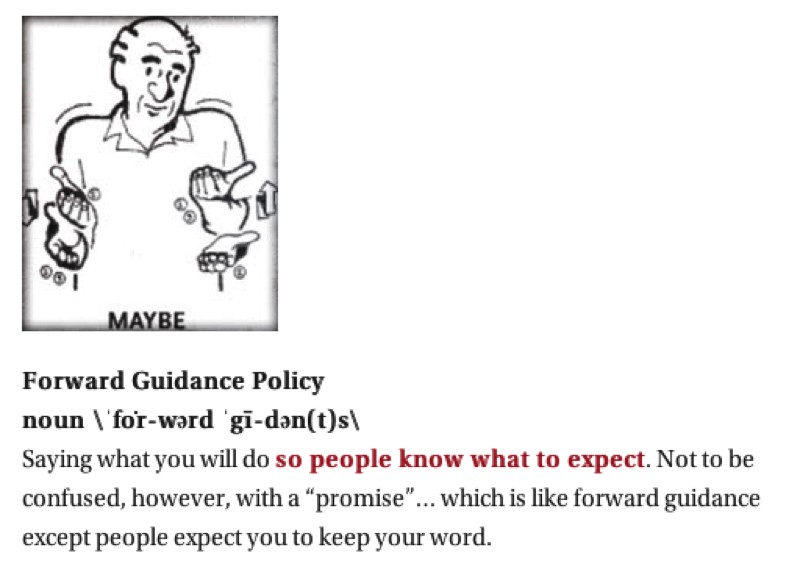
The problem with forward guidance is that Wall Street became hooked on every speech, every interview, every belch and wheeze emanating from every Fed official.
Case in point: CNBC thought this was worthy of sending to my iPad this morning…

As the recovering finance pro Ben Hunt observed in 2019, Fed jawboning began to matter more to asset prices than traditional metrics like supply and demand, or sales and profits. “It’s the use of words and narratives,” Hunt said on the Hidden Forces podcast. “There are no fundamentals for markets now.”
Warsh, it seems, wants to get away from that. He studied at the feet of the late Alan Greenspan — who during 19 years as Fed chair was notorious for obfuscation, misdirection and bafflegab.
Only a few months into the gig in 1987 he told a Senate committee, “If I seem unduly clear to you, you must have misunderstood what I said.”
But it was an entirely different era. Fed policy wasn’t fueling high consumer price inflation. (It did fuel asset bubbles.) There was no social media reacting to every development in the markets and the economy 24/7. And no one expected the Fed chair to hold regular press conferences. (Bernanke started those in 2011.)
So Warsh has a tough climb tomorrow — trying to say nothing while sounding profound and tamping down inflation expectations at the same time. We’ll be here to chronicle the market fallout…
 So Much for Internet Privacy
Meta’s $18 billion settlement with 48 state attorneys general might have destroyed the last remaining shreds of internet privacy.
Shortly before the market opened yesterday, the company came to terms and closed an epic case centering on the alleged harm that its Facebook and Instagram platforms bring to teenagers. Perhaps the biggest change is a default two-hour time limit on the apps for users under 18.
“Under this settlement,” says a statement from the Electronic Frontier Foundation, “young users will now have less access to Meta products, and a lesser ability to exercise their rights to speak, access information and art and culture, associate and form communities and play.”
But there’s an even bigger consideration…
“This settlement — and the litigation that led to it — was effectively a backdoor effort by the government to mandate age verification. It succeeded,” tweets Nico Perrino of the Foundation for Individual Rights and Expression.
Age verification online is one of those issues that makes politicians of all stripes feel warm-n-fuzzy. Look at what we’re doing for the children!
But age verification is a process that inevitably ensnares adults as well — compromising anyone who wishes to speak up while remaining anonymous.
From the Electronic Frontier Foundation’s statement: “The settlement also embeds age assurance into every product, mandating the collection of even more personal information from users of all ages; this enshrines Meta's harmful surveillance into law, and it will compromise users' privacy and anonymity while increasing their exposure to data breaches and government data requests.
“And the data minimization and security measures don’t keep states from using data collected under the agreement for other law enforcement purposes…”
No sooner was the agreement signed than Meta was badgering TikTok and Google-owned YouTube to adopt its new strictures…
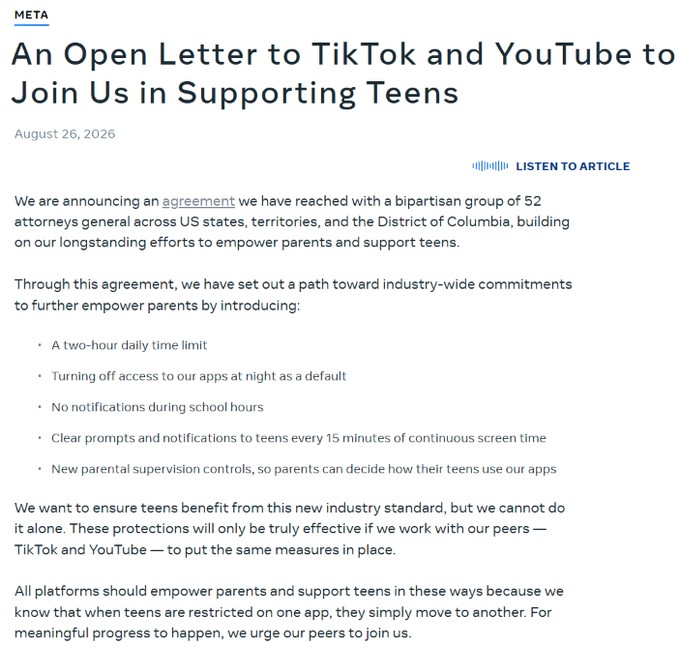
Meta was trying to pass itself off as fostering social responsibility. But as the day wore on, people began noticing a curious section of the settlement.
As the New York Post puts it, TikTok and YouTube “must agree to make the same safety changes to their apps before Mark Zuckerberg will pay the full amount of the deal.
“Under the bizarre clause, Meta is initially on the hook for 70% of the payment, or about $12.7 billion. The remaining 30%, which totals $5.3 billion, will be ‘released’ only in the event that TikTok and YouTube pay a combined $5.3 billion and impose changes including a one-hour daily usage limit for teens, a ‘night mode’ barring use during bedtime hours and age verification.”
How can these terms be imposed on TikTok and YouTube if they weren’t parties to the lawsuit?
Whatever. The agreement has had no meaningful impact on Meta’s share price. It was up slightly yesterday and is down slightly today.
 As Long as You Brought up 1990…
Now a brief follow-up to Tuesday’s edition — about how the government’s inflation numbers are totally fake.
This tweet’s been making the rounds this week…
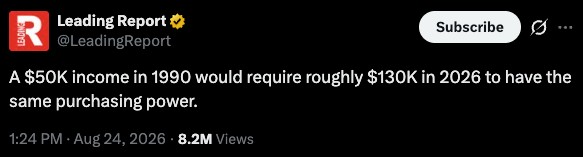
That number checks out with the official inflation figures: In theory you need an additional 1.6 times the number of fiat dollars you held in 1990 to have the same purchasing power today.
But how realistic are the official figures?
In most households, housing is the single biggest expense. In 1990, your editor rented an apartment in Denver for $225 a month. I looked up what it goes for now — at least $1,060, maybe more. That’s a 3.7X increase.
True, 1990 marked rock-bottom for the housing market after the savings-and-loan crisis and the onset of a recession. But the following year, I moved to Tampa and rented an apartment for $375. This unit now sets you back $1,250. That’s still a 2.3X increase. And a lot more than 1.6X.
I know, anecdotes aren’t evidence. But they are an illustration. And they’re something to think about the next time your instinct is to tune out younger people when they complain about affordability…


