
Bad Policy, Big Profits
 Bad Policy, Big Profits
 “Don’t let politics influence your investing” is a reliable old saw.
There are subtleties and nuances, of course.
As we said on Joe Biden’s Inauguration Day in 2021, policies coming out of Washington, D.C., inevitably impact different industries and sectors for good and for ill. And it always pays to look out for that.
(Thus, the Paradigm team’s recent attention to drones in light of the Pentagon’s budget blueprint requesting a 240X increase for drone warfare.)
But our bigger point for a while is that if you let red team-blue team tribal loyalties enter the equation, well, it can be hazardous to your wealth.
In early 2009 as Barack Obama entered office, many investors were tempted to abandon the stock market for good.
During 2008, the financial crisis tanked the S&P 500 by 38.5% — its worst yearly loss.
And with Obama pursuing a tax-and-regulate agenda at the start of 2009? It could only be downhill from there, right?
Wrong. The S&P bottomed at 666 in early March. (Obama called it almost to the day — which was no coincidence.) Four years later, a couple of months into Obama’s second term, it finally exceeded its 2007 peak of 1,565. By the end of his eight years, the number was 2,263.
We also recall the early months of Trump’s first term — when the shoe was on the other foot.
In April 2017, our Greg Guenthner ventured to a conference in New York.
“According to many of the professionals I chatted with,” he recalled, “the anti-Trump crowd is yanking their money out of the market at a frantic pace. Money managers attempting to play potential policy changes are getting more than an earful from their clients.”
Or as one prominent fund manager told him, “Half the country wants Trump to fail," one prominent fund manager told Greg. "They aren't putting their money to work."
Again, bad move: The S&P 500 stood at 2,263 at the handoff from Obama to Trump. Four years later, it registered 3,799.
Heck, look at the current Trump administration’s own rhetoric.
On April 9 of last year, Treasury Secretary Scott Bessent spoke to the American Bankers Association.
“For the last four decades,” he said, “Wall Street has grown wealthier than ever before. And it can continue to grow and do well. But for the next four years, it’s Main Street’s turn.”
Yeah, later that day Trump reversed his “Liberation Day” tariff scheme — to the delight of Wall Street. The S&P 500 closed under 5,000 the previous day. A couple of weeks ago it notched an all-time record close near 7,800 — a 56% gain in just over 16 months.
But what’s top-of-mind this morning is a poll we mentioned a few weeks ago in our Saturday edition.
In CNBC’s regular All-America Economic Survey, there was a question this year about the U.S. government taking ownership stakes in private companies.
Only 19% thought it was a good idea… 32% were undecided… and 49%, nearly a majority, was opposed.
“The finding comes,” CNBC said, “as the Trump administration has negotiated 30 deals worth nearly $27 billion in total, according to the Council on Foreign Relations, a nonpartisan think tank.”
Not all of those deals have dollar figures on them. The biggest by far is Intel ($8.9 billion in equity).
The one with the most impact for our readers is probably the rare-earth name MP Materials — recommended in several of our publications. Altucher’s True Alpha readers benefited the most, with 918% gains on MP call options.
And it’s a safe bet at least some of those readers think it’s a lousy idea for the feds to take ownership stakes in companies!
As it happens, the team at Altucher’s True Alpha is zeroing in on a new opportunity that’s looking like buyout bait for the Trump administration. And James Altucher believes the profit potential is even bigger than that 10X that readers like you booked on MP Materials.
But the window of opportunity is closing soon. For reasons James will lay out when you click here, you’ll want to jump on this before Thursday.
 War’s Back On
As night falls over Iran, so have American bombs and missiles. U.S. oil futures are up 4.3% to $89.43 — the highest since July.
When we left you yesterday, U.S. and Iranian forces had traded airstrikes. Overnight, two oil supertankers hauling Saudi Arabian crude and trying to transit the Strait of Hormuz were hit by projectiles. Then at midday on the East Coast, U.S. forces struck several targets in southern Iran.
And so a familiar pattern emerges again: Higher oil prices are feeding rising inflation expectations — and that translates to rising interest rates.
The yield on a 10-year Treasury note now exceeds 4.78% — approaching the January 2025 peak of 4.8%.
And it’s not just the United States. Traders are sniffing out inflation throughout much of the developed world. As a result, the yield on 10-year Japanese government bonds just surpassed 3% for the first time since 1996. And Germany’s 10-year rate is the highest since 2011.
All else being equal, rising bond yields translate to falling precious metals prices — and that’s certainly the case today. Gold’s late-August pop to $4,663 didn’t have any staying power; at last check, the bid is down another $83 today to $4,364. And silver is down 2.5%, back below $65.
Tech stocks also groan under the weight of rising interest rates — and as such the Nasdaq is down over three-quarters of a percent on the day to 26,166. Barring a monster rally today or tomorrow, the index has gone three months without recording an all-time closing high.
The S&P 500 is holding up better, down a half percent at 7,651. The Dow is faring about the same, back below 53,000.
Under the circumstances, crypto is lucky just to be treading water — Bitcoin a little under $78,000 and Ethereum still holding the line on $2,400.
Back to oil: Strictly from a chart standpoint, Weekly Wealth Alert editor Alan Knuckman says crude is on a trajectory to break past $90… on its way to $110.
 Gimme Sulfur
As we can’t emphasize enough, it’s not just oil that (in normal times) transits the Strait of Hormuz.
It’s also refined diesel and jet fuel… liquefied natural gas… fertilizer… aluminum… iron ore… and sulfur.
Sulfur? “This yellow element goes in nearly everything,” says Paradigm natural resources pro Matt Badiali. “The market for sulfur is relatively small, about $6.5 billion per year (in 2025). But we use it in a broad swath of critical stuff:
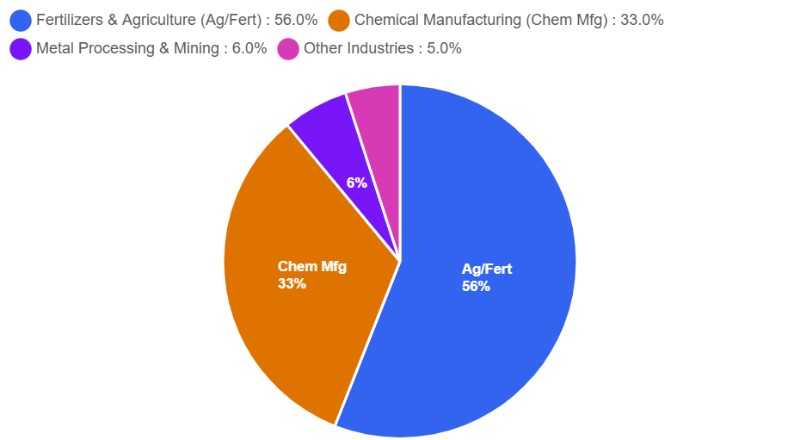
“Most of the sulfur we use comes from oil refining,” Matt goes on. “A large part of global sulfur comes from refineries in the Persian Gulf…behind the Strait of Hormuz. Fully 50% of the world’s seaborne sulfur got shut down with the Strait closed. And about 40% of the Middle East’s supplies are offline due to military strikes on oil refineries there.
Sulfur prices were already on the rise before the war — from under $200 in the spring of 2025 to about $450 just before the war started a year later. Now they’re over $1,000.
Bad news all around — except for refiners who can get oil from parts of the world besides the Middle East.
“Refiners with sulfur recovery units (SRU) specialize in sour crude oil,” says Matt. “Initially, that was done so they could use low-cost crude oil. SRUs remove sulfur before the refiner makes gasoline or diesel. Companies like Valero, Marathon and Exxon Mobil all produce sulfur as a byproduct. And the revenues are soaring.”
The simplest way to play it is the VanEck Oil Refiners ETF (CRAK). Matt talked up CRAK in this space shortly before Memorial Day — when it was still under $50. As we write today it’s going for $62.42.
And as you can see, there’s still more upside ahead…
 Comic Relief
Well, if you didn’t laugh you’d cry…

If you’re a newer reader and wonder how it got this way, we devoted all 5 of our Bullets to the matter one day last year.
 Mailbag: Higher Ed
Our item in last Friday’s edition about falling enrollment at Arizona and a degree in how to be an “influencer” at Arizona State brought forth a couple of comments…
“Dave, there is a serious push to drop the required units for a Bachelor’s degree from four years to three years — saves students the cost of a year of tuition, housing and living expenses — and the list of universities is growing.
“Doesn’t apply to every major and can impact the ability to qualify for graduate school.
“Always enjoy your writings — oftentimes it makes me think outside the box. Much appreciated.”
“Dave, I'm having an internal laugh, as I envision the parents talking to their wide-eyed incoming freshman as they explain their future degree in, err... ‘influencer.’
“I further laugh to myself, as this is a degree coming from the school of journalism. This won't end at ASU... I feel those parents’ pain.
“We all thought journalism degrees were going by the wayside???
“Err, isn't your degree in journalism? Just sayin’, Always enjoy ‘The 5.’”
Dave: Wow, the three-year plan reeks of desperation.
For the past decade or more, universities have been notorious for structuring their required-course sequences in such a way as to rope in undergrads for a fifth or even sixth year.
But based on what the first reader describes, the logic now is that a student who attends for three years still generates more revenue than someone who skips college altogether.
My own degree, to be precise, was in Radio-Television. I’m sure it’s been rebranded in some way to include the word “digital” now. (The major trade organization in broadcast news did so in 2010.)
As I had occasion to say almost three years ago, the best thing that could happen to the news biz now is that bosses get over their fixation on a college education.
By one estimate, more than half the reporters in the country back in the 1950s had (at most) a high-school degree. They learned their skills on the job, mentored by veterans who understood that a tutoring role came with the territory.
There’s no reason it can’t be done that way again. Take it from someone who’s been there: There’s nothing about the work that demands the “rigors” of a four-year degree.


