
Perception vs. Reality
 Perception vs. Reality
 “These explosive moves happen when reality diverges from perception,” says JC Parets — the newest member of the Paradigm team, laying out his one-of-a-kind strategy.
Moments ago, JC wrapped up his streaming event with James Altucher called The 100X AI Window.
We won’t dwell on the ins and outs of his strategy here…
[you can see it step-by-step watching the replay of James’ interview with JC at this link]
… but there’s an example from JC’s files worth spotlighting.
It’s the case of Super Micro Computer (SMCI) — a company that makes hardware for AI data centers — during 2024.
In August of that year an outfit called Hindenburg Research published a damning white paper — accusing SMCI of accounting fraud.
The following day, the company said it would delay filing its annual report. Shares collapsed 25% in a matter of hours.
Hindenburg’s white paper soon caught the eye of the Justice Department. Nasdaq threatened to delist SMCI. The company’s own auditing firm resigned.
“At one point the stock was down 80%,” JC recalls. “It looked like a complete dud.”
But then in mid-April 2025 the company showed up in an obscure government document — a document that signaled a new profit window was about to open. “When this window opens and the stock begins to move,” says JC, “it’s almost unstoppable.
“Less than a week later, the stock began to turn around — and it went ballistic.
“Anyone who knew how to read this report and knew how to take advantage of this new AI window could have turned $5,000 into almost $50,000 in a little over three weeks.”
That’s a 10X gain in a very brief timeframe. Similar profit windows tied to this little-known government report have delivered gains of 50X and even 100X. (More examples in JC’s interview with James Altucher.)
And a new window is about to open on Thursday, Sept. 24 — one week from today. “I believe it’s going to trigger the next explosive opportunity,” JC says.
You owe it to yourself to learn more about JC’s unique approach. James Altucher has known JC for more than 15 years — and he’s thrilled that they’re now on the same team. Check out their discussion right away at this link.
 Overreaction Much?
Mr. Market got a good night’s sleep and decided this morning he overreacted to the Federal Reserve.
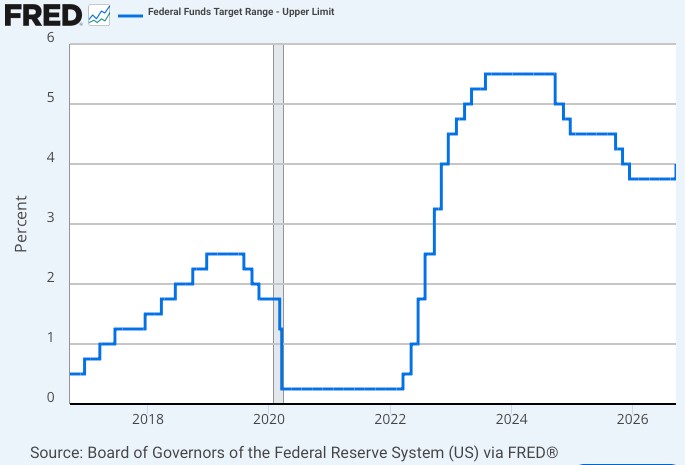
The Dow Industrials took a 1.2% spill by day’s end yesterday — after the Fed’s Open Market Committee voted unanimously to raise short-term interest rates for the first time since July 2023. The benchmark fed funds rate is now 4%.
In the interest of accountability, Paradigm macro maven Jim Rickards got this one wrong — only the second time out of 24 Fed forecasts he’s issued since 2022.
He wrote an after-action report this morning for readers of Crisis Trader: “My view is that this rate increase was mainly performative, driven by a widespread view among economists that the Fed had to do something about inflation.
“A rate hike was also considered necessary in some quarters to reinforce the idea of ‘Fed independence,’ something I have long regarded as more myth than reality.
“But it remains an important part of the Fed’s institutional identity, especially when its policy decisions run contrary to President Trump’s stated preferences.”
All that said, Jim says this rate hike will do little to contain inflation.
“The fed funds rate is an overnight lending rate between banks. But banks, especially the largest ones, are flush with reserves held at the Fed. There is no shortage of liquidity.
“More importantly, the Fed doesn’t directly control many of the forces driving inflation. A higher fed funds rate won’t lower oil prices, currently over $100 per barrel, and the market ultimately sets yields on 10-year Treasury notes and 30-year Treasury bonds. Mortgage and credit card rates respond to Fed policy, but they also reflect broader market conditions and credit risk.
“Many of today’s inflation pressures come from supply-side factors, particularly the price of oil, along with deficit spending and consumer borrowing. Raising the overnight rate does little to address those pressures directly.”
As it happens, oil prices and long-term interest rates are both climbing down today. That and the passage of time have put the stock market in the green.
U.S. oil futures are down 1.3% at last check — although they’re still over $101. Meanwhile the yield on a 10-year Treasury note is down to 4.95% after settling over 5% yesterday for the first time since July 2007.
Amid that backdrop, the Dow has recovered a portion of yesterday’s losses — up 0.4% at 51,664. The S&P 500 is up nearly 1% and back over 7,600. And the Nasdaq is strongest, up 1.25% and back above 26,300.
Precious metals are likewise recovering yesterday’s post-announcement losses — gold up over 2% to $4,355 and silver up over 4% at $65.53.
Crypto appears to be yawning at news that the Securities and Exchange Commission is opening a temporary path for the trading of tokenized stocks 24/7. “Two days after the Clarity Act failed to advance in the Senate, the SEC is moving to build as much of the regulatory rulebook for the crypto industry as its existing authority permits,” reports CNBC.
With that, Bitcoin is back over $76,000 and Ethereum around $2,450.
 Something Melty This Way Comes
What about the stock market outlook the rest of this year?
Last month Paradigm chart hound Greg Guenthner laid down the gauntlet — predicting “a melt-up in its purest form: a generational move not seen since the final phase of the 1990s dot-com boom.”
He has yet to pick up that gauntlet. But at the same time he won’t be surprised at all to see a little blood in the water first. “The herd needs to experience a little angst before we light the fuse.”
September is typically the market’s worst month of the year. And this September has had no shortage of troubles — AI executives calling for a slowdown, a Fed rate hike, the typical sloppy action during midterm election years.
Speaking of midterm election years, Greg drops the following chart from 1998. The Asian currency crisis had morphed into a default by Russia and the collapse of the hedge fund Long Term Capital Management. That was enough to drag down the Nasdaq over 25% in two months.
And then came a 240% run to the top in March 2000.
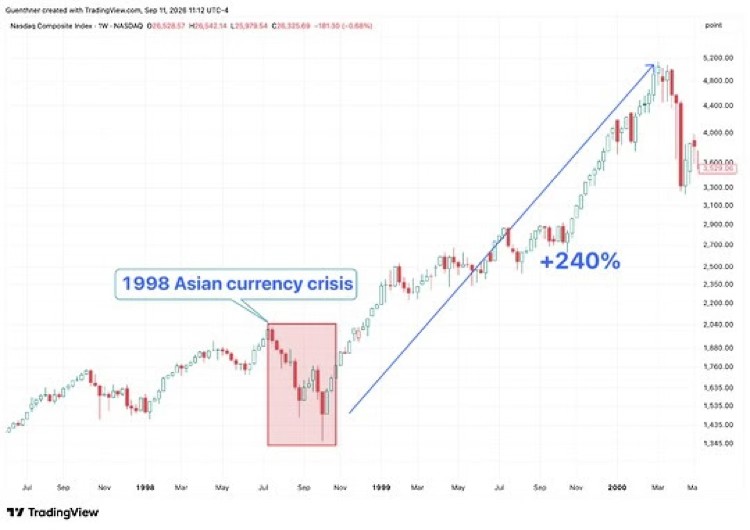
Greg is not calling for the same washout this time around. A milder scare, he says, “is likely to resolve to the upside.” If this time around is even half of 1999 “we’ll be swimming in a fantastic sea of trading opportunities.
“Whatever you do, don’t get too caught up in any bearish narratives if the market loses its footing this September.”
The trick will be to roll with the September punches and then sail with the rally afterwards.
 “The Cure for Low Prices Is Low Prices”
Paradigm resource expert Matt Badiali recently spotlighted estimates that major U.S. row-crop farmers could lose about $31 billion this year — and another $32 billion in 2027.
As Matt puts it, “They are getting hit hard.”
The problem is what he says are “record high input prices.” Fuel, fertilizer and other costs are high, while the prices of corn and wheat have stayed relatively weak. Farmers can’t easily pass along their rising costs.
As Matt explains, “farmers… are price takers.”
But even they can only “take” so much. When corn costs too much to grow, farmers pull acres, shrink output or move into crops that pay better.
Which brings us back to one of Matt’s favorite commodity-market rules: “The cure for low prices is low prices.”
Weak prices discourage production, causing supply to tighten, which ultimately causes prices to rise. Matt believes that’s setting up the next move in grains.
His conclusion is straightforward: “Prices must go up.”
Matt expects both corn and wheat to move higher over the next year and a half. He points to the Teucrium Corn Fund (CORN) and the Teucrium Wheat Fund (WEAT) as direct ways to play that move.
Matt’s specialty is finding resource markets where the economics have become distorted, so that a big move may be setting up.
In his paid research, Matt goes further by identifying specific companies and trades he believes offer the best leverage to those shifts.
 Mailbag: Iran
“How do you know that Iran is not pursuing a nuclear weapon?” a reader writes after a parenthetical comment toward the end of yesterday’s edition.
Dave responds:"Before the war began the U.S. Intel Community, including CIA, was in agreement that Iran wasn't developing a nuclear weapon,” says Joe Kent — who resigned in protest as director of the National Counterterrorism Center a few weeks after the war began.
A year earlier, Kent’s boss — Director of National Intelligence Tulsi Gabbard — testified to Congress that the U.S. intelligence community "continues to assess that Iran is not building a nuclear weapon, and Supreme Leader Khamenei has not authorized the nuclear weapons program that he suspended in 2003.”
Given the history both Kent and Gabbard have, fighting Washington’s forever wars in uniform, it’s hard to make the case that they belong to some pro-Islamist conspiracy.
As such their words deserve more weight than those of Israel’s prime minister and his partisans in this country.
“We have spent billions to prevent Iran from developing a nuclear weapon. It seems to me that’s just money wasted,” observes another reader.
“If Tehran really wanted a nuclear weapon, it would just buy one from one of the less scrupulous countries that have them.”
Dave: That’s more or less what North Korea did. It perfected nukes with technology furnished under the table by A.Q. Khan, widely considered the father of Pakistan’s atomic weapons program.
It’s worth noting that North Korea withdrew from the Treaty on Non-Proliferation of Nuclear Weapons years before conducting its first weapons test in 2006.
It’s also worth noting that Iran remains a signatory to the treaty, while Israel never signed it.


