
It’s Alive! (Mag 7)
 Magnificent Once More
 Amid the market turmoil this month, something happened that (almost) no one saw coming.
“The Magnificent Seven just broke out to new all-time highs,” says JC Parets, the newest contributor in the Paradigm Press stable.
Yes, that Magnificent Seven. Nvidia, Microsoft, Google, Amazon, Meta, Apple and Tesla. The market darlings of 2023, 2024 and 2025. Until they stopped being darlings in 2026 and the Mag 7 became the “Lag 7.”
“The group spent almost a year going sideways while other parts of the market took their turn leading,” JC reminds us.
“For much of 2025, people complained that the entire stock market depended on these seven companies. Then the Magnificent Seven stopped leading, and the market kept going anyway.
“That’s sector rotation. Leadership moved elsewhere, the bull market broadened and now the Magnificent Seven are joining the party again.”
To illustrate the concept, “think about a basketball team,” JC says.
“Your star players don’t need to score every point. In fact, you probably don’t want them to. You want other players contributing while the stars catch their breath.
“But when your best players start scoring again, too? That’s not usually the part of the game you complain about.”
And that’s where we are now. Apple touched an intraday all-time high on Monday. Nvidia is on track to log its best monthly close next week.
“Those aren’t exactly the places I’d expect to see collapsing if the message from the market were that investors should be running for the exits,” JC continues.
Now… in recent weeks market pundits have expressed concern about “breadth” — the fact that fewer than a third of S&P 500 stocks are trading higher than their 50-day moving average.
Which is true — but JC says it’s irrelevant: “This is where I think investors can get themselves into trouble.
“If you stare too closely at one indicator, over one short period of time, you can completely lose sight of what’s actually happening.”
As JC sees it, it’s far more important that the Nasdaq Composite set a record high Monday — and the S&P 500 was within spitting distance.
“Technology is breaking out. The Magnificent Seven are breaking out. Apple is making record highs. And seven of the 11 G10 stock markets are within 3% of their own records.”
Back to the basketball analogy: “The lesson is that leadership rotates, and strong markets have a funny way of finding new leaders while the old ones catch their breath.
“For almost a year, some of the biggest and most important companies on Earth sat on the bench. The rest of the team kept playing. Now the stars are checking back into the game.”
 Markets Today: Bullish Signal
If history is any guide, the Nasdaq is poised to move from strength to strength.
The record high JC mentioned in Bullet No. 1? It came after a three-month consolidation in which the index chopped up and down.
Paradigm trading pro Enrique Abeyta points us to figures from Bespoke Investment Group showing “historically when this happens, the Nasdaq has been up 100% of the time in the next 30 days!”
In records going back to 1971, the average 30-day gain is 3.1%.
What’s more, the average gain after 12 months is 12.3%. That includes rip-roaring growth such as 30% in 2020… 34% in 1995 and 34% again in 1998. (On the downside, there was a nasty 33% drop in 1973.)
After Monday’s record and the Tuesday-Wednesday sell-off, the Nasdaq might be leveling off.
At last check the index is down less than 0.2% on the day at 26,886. The S&P 500’s loss is similarly modest, but the Dow is taking a bigger hit of close to 0.5%.
Big movers include Oracle — down 4.25% after delivering a “force majeure” notice to its partner on a big data center project in New Mexico that’s run into both public opposition and regulatory roadblocks. Per a Bloomberg scoop, “Oracle is attempting to put off payments should the data center dubbed Project Jupiter get derailed and fail to come online in 2028 as planned.”
Meanwhile the bond market remains on edge — prices lower, yields higher.
The yield on a 10-year Treasury note has sailed up to 5.15% — another high last seen in 2007. The 30-year T-bond is up to 5.44%, a level last seen in 2004. Not coincidentally, mortgage rates are back over 7% this morning.
Precious metals continue to sell off — gold at $4,258 and silver down another buck to $63.33. Bitcoin is holding its own over $84,000 while Ethereum is approaching $2,700.
U.S. oil futures are up 3% on the day and nearing the $95 level again. There’s no real “news” that we see — which suggests that the big sell-off Monday and Tuesday was way overdone.
 Copper: It’s Relentless
This week copper hit an all-time high of $6.83 per pound.
Paradigm’s natural resource expert Matt Badiali recently pointed out that copper prices keep rising because “copper is the most important metal for electrification.”
It’s used in housing, transportation, power grids and nearly every major industrial system. And unlike many commodities, copper is ”so integral to electricity that it has no substitute in many cases.”
Under ordinary circumstances, rising copper prices suggest a growing economy. Indeed that’s how the metal has earned the nickname Dr. Copper because — as the saying goes — it “has a Ph.D in economics.”
But this time could be different. Dr. Copper may be signaling something else entirely: scarcity.
The data center boom has driven huge demand for copper in transmission lines, transformers, cooling systems, backup power and electrical equipment. But the recent backlash against data center construction — along with longer lead times for electrical equipment delivery and even fears of AI going rogue — has put a dent in the share price of many data center-adjacent stocks.
Apparently, copper didn’t get the memo.
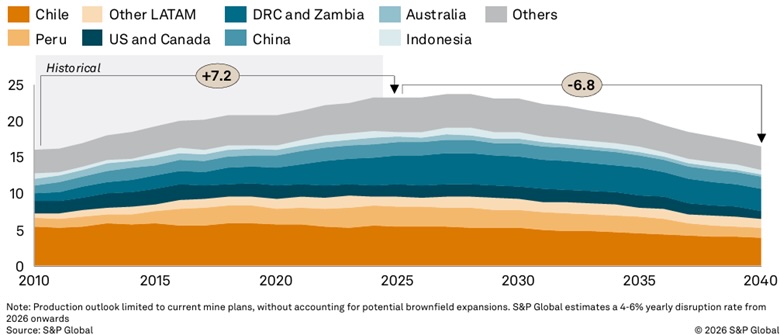
That’s because even if the AI boom slows, AI data centers alone could consume roughly 500,000 tons of copper a year by 2030. S&P Global sees copper demand climbing from roughly 28 million metric tons in 2025 to 42 million by 2040.
Meanwhile, the supply side can’t keep up. Without major new supply, S&P Global estimates a potential 10 million ton shortfall by 2040.
As Matt Badiali puts it, “We simply can’t bring new mines on fast enough to meet supply needs.”
You can build an AI model in months. You can build a data center in a few years. But discovering, permitting and developing a major new copper mine can take far longer.
That’s why Matt says in the short term, “most of the new copper supply will come from expanding existing mines, rather than from new mines opening up.”
But here’s the strange part.
Matt notes that copper mining stocks recently fell even while copper itself climbed. Earnings are already reflecting higher prices, with major miners reporting sharply stronger results.
And there’s a catalyst on the horizon. A tariff on imported refined copper could come as early as January. That would be a boon to companies that can process copper in the U.S. There are only two. Freeport-McMoRan (FCX) in Arizona and Rio Tinto (RIO) in Utah.
Just like the coins in your pocket, copper is easy to spend. Replacing it is the hard part. Matt’s conclusion is straightforward: “It really is this obvious. Buy. Copper. Now.”
Speaking of data centers…
 Data Centers Pay Up
No more free rides for the operators of data centers. Not if Google’s latest deal is any indication.
From the Reuters newswire: Southern Company's unit, Georgia Power, said on Monday it had signed an agreement with Google to support upgrades at two of its nuclear plants that could add about 96 megawatts of electricity capacity.
“The deal comes as surging electricity demand from data centers and other large users is driving interest in expanding existing nuclear plants as a source of round-the-clock, carbon-free power.”
Note that Google is ponying up the funds to expand the nuke plants’ capacity. It won’t be on Georgia Power’s residential and business customers.
Assuming approval from state regulators, “Google's subscription would enable about $900 million in projected benefits to customers over the life of the units… Georgia Power said the arrangement would help meet large customers' clean-energy goals while shielding non-participating customers from costs tied to the upgrades.”
Look for more deals like this one as the data center backlash shows no sign of letting up — in either blue or red states.
By the way… while the number of data centers under construction is at an all-time high, the consultancy Wood Mackenzie says new projects on the drawing board fell 19% between the last quarter of 2025 and the first quarter of 2026. Those are the most recent figures available.
 Mailbag: Harvard Business, Doom and Gloom
A reader wishes to correct your editor after the mention of Polymarket’s CEO during yesterday’s edition.
“You must have meant to say ‘the value set of an infamous graduate of the Harvard Business School,’ referring to Jeffrey Skilling.
“There are bad apples in every organization and every training program and students generally come to the programs with their ethical standards pretty well established.
“I never experienced any encouragement to become a mercenary business person while I was there and I do not agree with your characterization.”
Dave responds: Obviously I can’t speak to your firsthand experience.
But I do urge you to read my original 2018 write-up with the admittedly cheeky title “How Harvard Business School Wrecked the World” — drawing in part on the journalism of authors Duff McDonald and Susan Cain. Eye-opening stuff for anyone who’s never been on the inside…
“Wow, I've read negative articles before,” a reader writes, “but your whole issue yesterday was negative. The only place to be is cash?
“You may well be right, but I hope you're not.
“The midterms? Well, I'm guessing that the Democrats will take over along with their socialist counterparts and if that happens, the U.S. is dead.
“I'll never understand this war with Iran, especially because of what it is causing to us citizens of the USA. And you're saying that it won't end this month.
“Oh well… going to hang in just a little longer.”
Dave: To be clear, my observation about cash being the only place to hide pertained only to yesterday’s market action and not any broader trend.
Indeed it’s the consensus among several of my Paradigm colleagues that the stage is potentially set for a 1999-style “melt-up” come next year. Obviously that episode ended in tears, but it’s way too soon now to say “the top is in.”
I didn’t even bring up the midterms except in passing. But your assessment is right in line with that of Rich Baris, aka “The People’s Pundit” on social media: “If you truly believed ‘Democrats can't be allowed to win because socialism is bad,’ then you never would've started a war you knew damn well would compromise your coalition.”
Was yesterday’s edition unusually gloomy? Perhaps, but that was not my intention.
And so I’ll leave you today with this upbeat observation: The backlash across the political spectrum against Flock cameras is a wonder to behold. It finally made the front page of The Wall Street Journal earlier this week.
Not only is it bringing together people of disparate backgrounds and dispositions, it’s doing so in service to a cause that actually aims to expand the envelope of human freedom rather than shrink it. Heroic!


