
Diesel Deception
 Diesel Deception
 U.S. oil futures ended last week over $101. By day’s end yesterday, they were $90.52.
What changed in two trading days? Not much.
Over the weekend, rumors abounded that U.S. forces would launch airstrikes on the Houthi faction in Yemen that’s fighting Saudi Arabia — but by Monday, those rumors hadn’t panned out.
Then yesterday mainstream financial media — citing the usual anonymous sources — said that Saudi Arabia’s big east-west oil pipeline would be up and running again by the end of the week. It’s been shut down since Sept. 11 after a series of drone strikes.
You’ll notice both of these developments fall into the realm of rumor and speculation. Nothing happened that actually brought more barrels to market.
Which brings us back to a running theme of ours ever since the Iran war started — the disconnect between the price of oil futures and the price of actual physical barrels.
“The price you read about is typically a futures contract price based on either West Texas Intermediate or Brent crude oil. Those are the two leading oil benchmarks,” says Paradigm macro maven Jim Rickards. “They refer to specific grades, delivery terms and locations of oil, and they are legitimate market prices.
“But the widely quoted futures contracts are basically bets about where oil prices will be at the time of delivery in the weeks and months ahead. They reflect a mix of hedging, speculation and expectations about future supply and demand. But they are not necessarily the price of actual oil available for immediate delivery.
“If you want physical oil delivered to your refinery next week, you have to enter the physical market and buy an available cargo, including cargoes already underway at sea.
“What’s the price of these wet cargoes on the physical market? Depending on the grade, location, freight costs and availability, physical crude can trade at substantial premiums to benchmark futures.”
That’s why the “crack spread” — the difference between the price of crude and the price of refined products like gasoline, diesel and jet fuel — has blown out to extremes.
The gap is widest with diesel — where, not coincidentally, supply is tightest. Russia used to be a diesel exporter, but now it’s a diesel importer because Ukraine keeps attacking Russian refineries (with the help of targeting data from the U.S. military).
Reminder: Diesel powers most of the economy, including freight, farming, construction and heating.
“Diesel has traded at the equivalent of roughly $180 per barrel or even higher during this year’s disruptions,” Jim says — “while crude prices have been far lower. At times, that has produced extraordinary crack spreads approaching $100 per barrel.”
And so within the last 24 hours Donald Trump has floated the possibility of a ban on U.S. diesel exports.
“I’ve called for that, too. I said, ‘Let’s not send out the diesel.’ We make a lot of diesel... I’ve called for it — I’ve called for it within my people,” he said.
U.S. refiners have been producing flat-out since the war began — exporting a considerable diesel surplus, selling to global buyers willing to pay a steep premium.
An export ban would keep all that diesel here at home — hypothetically suppressing domestic diesel prices.
But at what cost?
“Refiners’ profit margins would be crushed,” colleague Adam Sharp wrote recently at The Daily Reckoning. “Investors might lose faith in U.S. energy companies, especially refiners, because at any time the government could smash their profitability.”
Over time, that would crimp U.S. oil production. What’s the incentive to “drill, baby, drill” if the feds can muscle their way in at any moment and change the rules of the game?
The end result could easily be less fuel to go around for everyone.
And the scheme wouldn’t even offer that much relief for Americans in the short term.
“Keeping distillates and diesel home does not change the world price that references our prices,” tweets GasBuddy’s chief analyst Patrick De Haan. “You can't fence off a globally traded commodity by executive order and expect the global price to stop applying to it.”
As he sees it, the only U.S. region that might see meaningful price declines is the Gulf Coast — where the bulk of the diesel surplus resides.
“Politicians imagine prices plummeting in all states,” says De Haan, ”and that's a significant disconnect from reality.”
Meanwhile, the president says he thinks the war will end “immediately after the election.”
“I wouldn’t count on it,” counters Jim Rickards. “The full impact of the war on the economy has been delayed, but not eliminated. It’s hitting home now.”
 Nowhere to Hide
As for markets today, there’s nowhere to hide other than cash.
Bonds are selling off, pushing yields higher. At one point today the 10-year U.S. Treasury note hit 5.13% — the highest since July 2007. If that level holds at day’s end, it would be the biggest one-day jump since May.
Yields pulled back a bit in sympathy with oil yesterday and the day before — but not much. Now with U.S. oil futures up nearly 1.5% at last check to $91.88, yields are surging. As a reminder, the 10-year yield feeds through to everything from mortgage rates to corporate borrowing.
And the potential chill on corporate borrowing is having an impact on the stock market. After notching a record close yesterday, the Nasdaq is down over 1% and back under 27,000. The losses in the S&P 500 are more modest — about two-thirds of a percent — while the Dow is down about a half percent.
Precious metals are also taking a hit — gold down $68 and back below $4,300. Silver’s down 3.7% to $64.47.
Crypto isn’t immune to the selling — Bitcoin down over $2,000 in the last 24 hours to $84,300 and Ethereum back below $2,700.
 The Culture of Impunity, Part 1
Imagine you’re the CEO of a company and you learn from one of your vendors that fraudsters are using stolen debit cards to do substantial amounts of business with your firm.
Do you…
A. Notify law enforcement and work with the vendor to cut off the fraudulent activity?
B. Blow the whole thing off and carry on as before?
If you’re Shayne Coplan, the 28-year-old CEO of the prediction platform Polymarket, you opt for B.
That’s the gist of a Wall Street Journal expose this week: “Users were linking stolen debit cards to Polymarket U.S. accounts, then trying to use them to make wagers and withdraw the money into clean cards or accounts they controlled. Thieves tried to make off with at least $10 million.”
At its worst, the vendor — a debit card processor — rejected 80% of the deposits it was handling. The industry standard is closer to 1%.
When Coplan’s underlings brought the matter to his attention, the Journal reports his response amounted to “Just keep growing and pay a fine if regulators ever find out.
“Current and former employees said Coplan’s reaction, which hasn’t previously been reported, was characteristic of his plan for Polymarket — growth at all costs.”
Like many “tech” entrepreneurs, Coplan bailed out of a university education early on — he quit during his freshman year at New York University — but he nonetheless absorbed the value set of Harvard Business School.
We’ve reprised this incident now and then since we first related it in 2018, but it’s relevant once more.
As the story goes, one day in the late 1970s a group of students was presented with one of HBS’ famous “case studies.” The scenario was this: You’re the CEO of a company and you discover your firm is making a product that might kill its customers.
“I’d keep making and selling the product,” said one student, as his classmates nodded in agreement. “My job as a businessman is to be a profit center and to maximize return to the shareholders. It’s the government’s job to step in if a product is dangerous.”
That student was Jeffrey Skilling — who went on to oversee the epic late-1990s fraud known as Enron. He was sentenced to 24 years in Club Fed and ended up serving 14.
Harvard Business School sets the tone for the rest of corporate America and the power elite: Coplan has mastered its lesson plan as Polymarket prepares to go public sometime in the next year…
 The Culture of Impunity, Part 2
The people who are supposed to prevent the next major bank failure are instead busy finger-pointing and blame-shifting about a previous one.
A while back the Federal Reserve commissioned an outside review of the events leading up to the failure of Silicon Valley Bank in 2023 — then the second-biggest bank failure in U.S. history.
While the review hasn’t been released yet, the Fed’s Vice Chair for Supervision Michelle Bowman says the report found that Fed staff “knew, or should have known” that the bank was taking irresponsible risks with its customers’ money.
“Bowman’s announcement of the report’s findings immediately escalated political tensions around the Fed,” reports CNBC. “The White House said the report implicated Fed Governor Michael Barr, who was appointed by President Joe Biden in 2022 and held Bowman’s job as the Fed’s top bank regulator during the banking crisis in 2023 that led to Silicon Valley Bank’s failure.”
As a reminder, every SVB depositor was made whole during the crisis — even if their deposits vastly exceeded the $250,000 FDIC insurance limit. To replenish the FDIC’s insurance fund, the government ordered a “special assessment” on healthy, responsible banks. They, of course, passed on those costs to you in the form of higher fees, commissions, etc.
To be sure, Barr was asleep at the wheel — as we said in this space more than once.
“Why was Michael Barr not removed from office immediately after this historic failure?” asked our own Jim Rickards less than three weeks after SVB went under.
But Bowman is herself planting the seeds for the next catastrophic bank failure.
As mentioned in this space six months ago, the Federal Reserve has proposed slashing the big banks’ capital requirements — the amount of money they need to set aside for a crisis.
When Barr was the Fed’s VP for supervision, he proposed raising capital requirements by 19%. (Understandable, seeing as SVB’s failure took place on his watch.) Under Bowman, the proposal effectively cuts capital requirements by nearly 5%.
The Fed will finalize the rules by year-end. But the outcome is already locked in. What’s more, Bowman plans to let go about 30% of her supervisory staff.
You might want to mentally file this away for when the next major bank failure goes down… you end up paying more fees as a consequence… and the Fed issues another inconsequential finger-pointing report.
 AI Merch
Some people wear clothing to demonstrate their allegiance to a sports team. Others demonstrate their allegiance to… an AI company. Or even an AI CEO.
Like Nvidia’s Jensen Huang, who already attracts crowds of fans for autographs and selfies. (Meta’s Mark Zuckerberg has described Huang as "Taylor Swift, but for tech.")
So it’s no surprise then that Nvidia apparel quickly sells out from the few venues where it’s available.
Natalie Fratto, who runs a New York-based tech startup, has a green jumper with a cartoonish image of Huang on the front. “I have a New Zealand All Blacks rugby jersey, and I think of my Jensen sweater in kind of the same way," she tells the BBC. To her, it represents a team and ethos that she proudly displays on social media posts.
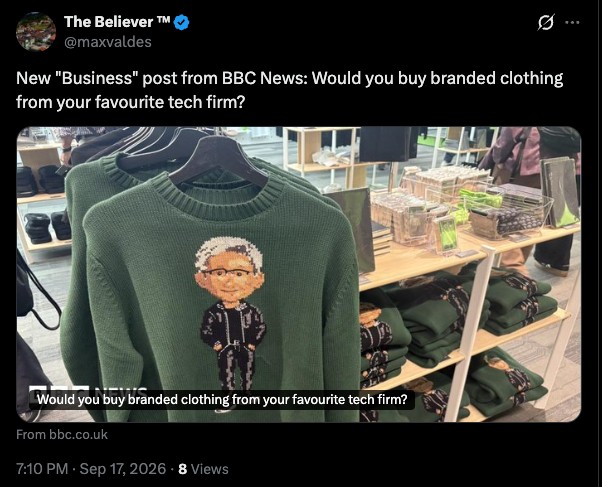
Nvidia isn’t the only tech company offering limited merchandise. OpenAI, Anthropic, Anduril and others have joined the trend, offering branded items at conferences or during general sales for only a few days on their websites.
If the companies only intend to sell a very limited number of items, why do they do it, and why are they so coveted? Obviously, the teensy amount of revenue doesn’t move the needle.
Professor Hazel Clark of Parsons School of Design explains the limited availability. It “elevates the desirability.”
Ah, so it comes back to one of fashion’s oldest tricks — scarcity.
But only for so long. As companies grow, and the clothing becomes more available, they’re no longer unique and they lose their allure.
Just as in the stock market, if you seek to collect the greatest reward, you must be ahead of the trend!


