
The Market’s “Nearing Crash” Stage
 The Market’s “Nearing Crash” Stage
 We’re taking the highly unusual step today of starting these 5 Bullets with an inquiry from the mailbag.
“I am new to trading in options after having just joined Paradigm a couple of months ago,” a reader writes.
She might be new, but she’s serious — following several of our premium advisories including Altucher’s True Alpha, The Trading Desk and Weekly Wealth Alert.
And she’s on the lookout for what she calls the market’s “late euphoria stage” — something akin to the melt-up in 1999 when the dot-com boom became a bubble. Once the bubble burst, the Nasdaq took a 78% spill from early 2000 till late 2002.
“I love that options help to amplify gains,” she says, “but the fact that they also amplify and accelerate losses becomes a bigger concern if the market is approaching a free fall.
“I am nearing retirement age and due to some family circumstances I never had a chance to build up very much of a retirement before now. I am excited at the prospect of Paradigm programs helping me to remedy that, but worried about how to handle the options recommendations once we do reach the impending market decline.
“Can you give some strategy suggestions for how to approach my trading services’ recommendations as we approach the late euphoria/nearing crash stage for those of us who can't afford to have their retirement funds cleared out by many options plays tanking all at once due to a dramatic turn in the market?”
The reader raises an excellent question. It might not be relevant now — but one day it will be.
Yes, the market has logged double-digit gains four years in a row — a rarity. But that doesn’t necessarily signal “the top is in.”
In fact, the market action to date looks nothing like 1999 right now. Rather, the years 2023–2026 look a lot like the years 1995–1998.
And if history rhymes, we’re in for a choppy market soon, not unlike 1998: “The next six–seven weeks carry a high probability of elevated volatility and a meaningful market pullback,” says Paradigm trading pro Enrique Abeyta.
But he also says that chop could be “the storm before the melt-up” — and that “year-end levels are still likely to finish above current levels.”
Once a bubble starts, the people closest to it are highly motivated to pour on the gasoline — so that others are left holding the bag when it falls apart. This process has a name on Wall Street: distribution, or selling the remaining pieces to the public.
After the cracks begin to show, the AI bubble can be expected to have a last, sloppy public act left in it. That is the distribution window.
And the window is opening now. Just look at the amount of money the AI hyperscalers plan to spend.
A Reuters analysis of consensus estimates says that by 2027, combined capital spending at Microsoft, Alphabet, Amazon, Meta and Oracle could exceed those five companies’ combined free cash flow.
Together, from 2025–2027 they are expected to generate about $340 billion more in annual operating cash flow and add about $534 billion in capex. That is $1.57 of extra investment for every extra dollar of free cash flow.
That gusher of money won’t last forever. But as long as it lasts, the stage is set for a 1999-style melt-up come 2027.
To help you take advantage, Paradigm just signed Wall Street legend JC Parets to the team — joining our other luminaries like Jim Rickards and James Altucher.
Now… circling back to the reader’s question…
Most of our editors grappled with the dot-com bubble and bust as it happened. All of them contended with the 2008 financial crisis. They know full well that options strategies amplify both gains and losses.
Rest assured they will not leave you high and dry. Just follow their guidance and breathe deep whenever the bull begins to back away and the bear starts to growl.
 Markets Today: The Fed, the Energy Crunch, the Crypto Pullback
As we go to virtual press, the Federal Reserve has pulled the trigger on its first interest rate hike since 2023.
The benchmark fed funds rate goes from 3.75% to 4%. The vote was unanimous. We’ll follow up on the fallout tomorrow.
Ahead of the announcement, the S&P 500 was up nearly a half percent on the day — back over 7,600. Precious metals were also rallying — gold up over 50 bucks to $4,349 and silver up nearly a dollar to $64.39.
Meanwhile, Big Oil executives say the supply crunch they’ve warned about since May is getting real.
Both the government’s Strategic Petroleum Reserve and private-sector inventories are effectively drained — and China has resumed importing crude after drawing down its own reserves.
“We don’t have nearly the buffers in the system that we did when [the Iran war] began,” Chevron CEO Mike Wirth said recently at a conference in Texas.
And the crunch is getting worse: Saudi Arabia is canceling shipments of crude to Europe after the bombings of its big east-west pipeline. Meanwhile, Ukraine and Russia continue to attack each other’s energy infrastructure — Donald Trump’s claims to the contrary notwithstanding.
But for the moment, U.S. oil futures are reacting to the Energy Department’s weekly inventory numbers — which are somewhat less dire than expected. (Hooray?) West Texas Intermediate is down over three bucks to $102.57.
Crypto is taking a hit after the latest developments in Washington, D.C.
Bitcoin has sunk below $76,000 for the first time in nearly a month, and Ethereum has dipped below $2,400.
Yesterday a procedural vote on a measure called the Clarity Act failed to get the required 60 votes in the Senate. The bill would have set up the first comprehensive regulation framework for digital assets.
But as Paradigm’s lead crypto analyst Chris Campbell sees it, this development is not unexpected and it’s not a big deal. The Securities and Exchange Commission will take the steps Congress won’t.
As he put it to readers of Altucher’s Early-Stage Crypto Investor last Friday, “Either way, the same products are coming — stocks that trade 24/7 on-chain, perpetual futures onshored into U.S. markets, derivatives on raw computing power. None of it is waiting for a vote.”
 Affordability
Why do Americans feel an affordability crisis while traditional indicators say the economy is fine?
“The economy grew 2.1% over the past year. Unemployment remains low. And the stock market has created enormous wealth,” pointed out the aforementioned Enrique Albeyta, “yet Americans aren't buying the good news.”
A recent Gallup survey found that 45% of Americans rate the economy as "poor," and only 19% call it "good" or "excellent."
Going by the official numbers, consumer prices are roughly 28% higher than they were just before the pandemic. Inflation has cooled from its 9.1% peak in June 2022, but cooling inflation is not the same as lower prices. An item that went from $100 to $128 does not become $100 again just because the rate of increase slowed.
Making matters worse, the official numbers show for about one-third of workers, wage gains trailed inflation from early 2021 to early 2026.
Housing makes the contrast sharper still.
Household income and the income needed to buy a typical home tracked together before COVID. In 2021, home prices leapt ahead. Enrique notes that the gap today is roughly $40,000.
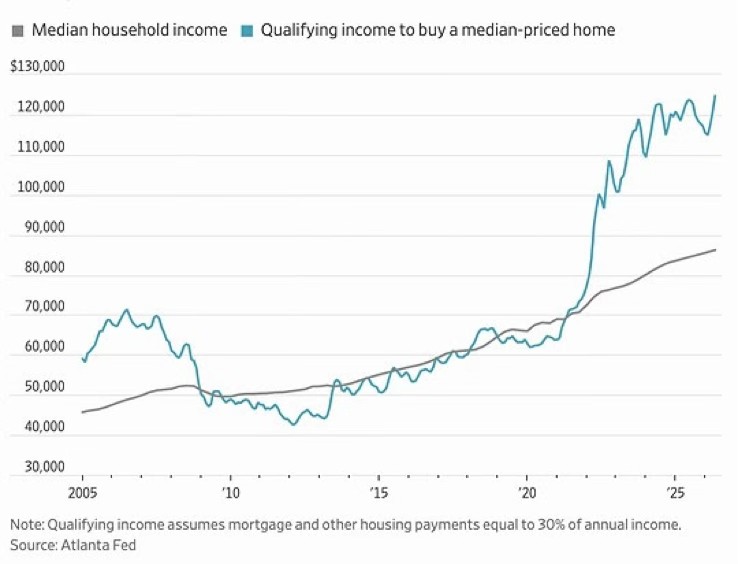
Meanwhile, a typical 30-year mortgage that went for just over 3.5% in early 2020 is over 7% this week. Note well: The Consumer Price Index does not directly include home prices or mortgage rates, so official gauges miss much of the squeeze.
How did we get here?
 Economic Hardship = Political Upheaval
By now it’s easy to forget… but the fiscal shock post-COVID was enormous.
The Government Accountability Office reports that $4.4 trillion was spent through COVID relief laws up to the end of 2021, which is about the same as all of government spending in fiscal year 2019 ($4.45 trillion).
That required a larger money supply, typically measured as “M2.” Result — rising asset prices, especially homes and stocks, as you see in this chart from the Federal Reserve Bank of St. Louis.
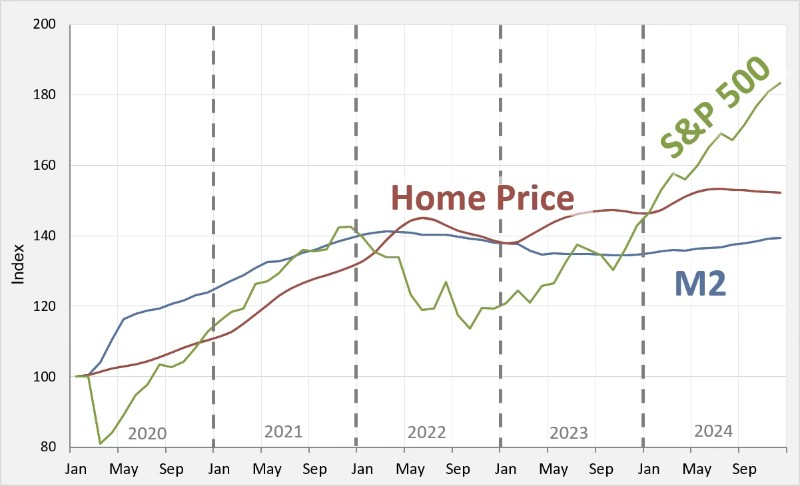
Granted, these trends existed long before COVID. From their lows in 2012, the average home price has leaped about 150%. Over the same stretch, the S&P 500 is up more than 300%.
That wealth has been highly concentrated and is becoming more concentrated. Younger and lower-wage earners have been all but shut out of home ownership since the pandemic. With no meaningful stake in stocks or housing, they can’t keep up with rising prices.
So then what? Dire economic circumstances open up people to political solutions they wouldn’t consider otherwise.
Money & Power editor Buck Sexton recently penned an article with the provocative title “A Socialist America… Thanks to Republicans.”
“Most Americans understand there is no magical government money tree growing behind the Treasury Department. But when people get frustrated enough with the way things are going, they become a lot more willing to listen to ideas they would have laughed out of the room five years earlier.”
Affordability is no longer just an economic gap. It’s an ideological and political chasm — and it keeps widening.
If you’re fortunate enough to have assets, Jim Rickards recommends you keep 10% of them in physical gold. “It might be time to think about owning more physical gold and silver, which are harder for tax collectors to find.”
 Readers Write: Social Security
“Yet another application of Stein's Law: If something cannot go on forever, it will stop,” writes a reader as our Social Security discussion rolls on.
“While not a suggestion for a remedy, an outcome with a significant non-zero probability of happening looks like this:
- Increased retirement age
- Eliminate cap on taxed income
- Full taxation of benefits
- Means testing in lieu of benefit cuts — i.e. benefit cuts for ‘the rich.’”
The reader concludes with a quotation from the 18th-century French economist Anne Robert Jacques Turgot, in a letter to David Hume…
“You know, also, as well as I do, what is the great aim of all the governments of the earth: obedience and money. The object is, as the saying goes, to pluck the hen without making it cry out; but it is the proprietors who cry out, and the government has always preferred to attack them indirectly, because then they do not perceive the harm until after the matter has become law…"
“I'm wondering if anyone suggested an idea I heard a long time ago,” another reader writes — “waive the use of income/SS payments in any tax year to calculate future SS benefits in exchange for deducting your SS payments on that year's income tax return.
“Of course this would stress the U.S. budget even more in the short term. Worth it? And to whom? I'd be interested in seeing the numbers for that.”
“Let’s put the two parts of your Monday newsletter together (AI freakout and Social Security comments relating to the K-shaped economy),” writes our final correspondent.
“It highlights the two most prominent issues expressed by voters, especially the young voters: concerns over AI and feeling left behind in this economy.
“If the Republicans want to stand a chance of winning in November, they need to address both. The best thing the Republicans could do in this cycle is to adopt a ‘nibble’ the rich approach. Remove the income cap on Social Security taxes while keeping the cap on payouts. Eliminate the carried interest shield on private equity, venture capital and real estate fund managers’ income and treat it as ordinary income versus long-term capital gains.
“It would show that they are not beholden to the ‘billionaires,’ and the rich would go along with it because the alternative is to be eaten rather than nibbled upon.
“The Republicans should also aggressively pursue a two-tier approach to AI regulation. Heavy regulation on frontier models based on a hard mathematical cutoff based on training compute with mandatory sandboxing, high-security isolation and third-party oversight for models above the cutoff.
“The cutoff should be set high enough to cover only the frontier LLMs and the most capable open-weight models. The second tier below the hard cutoff would apply to the remaining roughly 95% of SLMs and specialized models and not at all to the application-layer software and only be subject to consumer and other protections now developing around social media (don't harm the kids, don't expose consumer data, etc.).”
Dave responds: Hmmm…
Whatever the merits of your proposals, it seems the Republicans are instead hanging their hat on two propositions this fall: 1) No amount of economic sacrifice is too much to prevent Tehran from obtaining a nuclear weapon (which Tehran isn’t pursuing) and 2) the only consideration when it comes to AI development is “winning the AI race with China.”
Not very inspiring. And the best the Democrats have to offer is “we’re not Trump.”
But under the circumstances, that’s probably good enough for the Dems to secure a narrow majority in the House…


