
Stranded No More?
 Stranded No More?
 What in the world is going on with Middle East oil shipments — really?
In recent days, you’ve no doubt heard claims from corporate media and the White House that crude shipments through the Strait of Hormuz are their highest since the start of the Iran war — or even approaching prewar levels.
In this telling, Middle East crude is no longer stranded.
By and large, these claims are based on figures from a Brussels-based data firm called Kpler, sometimes described as “the Bloomberg of the physical world.”
There’s ample reason not to take these figures at face value — as colleague Adam Sharp spelled out last Thursday at The Daily Reckoning.
And now it turns out Kpler’s chief of crude oil analysis is a hardcore Iranian monarchist.
Until a few days ago, the picture on his X profile was of Iran’s “Lion and Sun” flag used before the 1979 revolution — now an icon for opponents of the current regime.
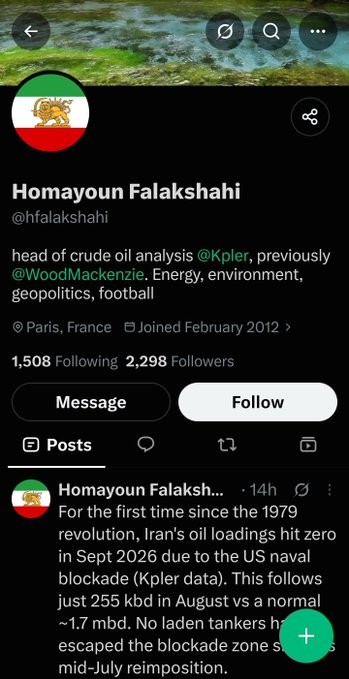
And to leave no doubt about where he stands, this is what he posted after Israeli airstrikes killed Iran’s supreme leader Ayatollah Khamenei at the start of the war…

In principle, one can advocate for a restoration of the Peacock throne in Tehran and still objectively analyze oil flows through the Strait of Hormuz.
But it’s a bad look. It’s easy to draw the conclusion, as the military analyst Will Schryver does, that “Kpler is a western intel info op.”
There was another sketchy claim making the rounds late last week.
You might well have heard about this one too — “a third aircraft carrier headed to the Arabian Sea.” Supposedly the USS Theodore Roosevelt was on its way to join the USS George Washington and the USS George H.W. Bush.
But no. Turns out that the USS Theodore Roosevelt will be relieving the USS George H.W. Bush — which made a stop in Thailand over the weekend for R-and-R.
Too, the Roosevelt is still on its way. For the moment, only one carrier is in the region.
“I think there's a pressure on everybody in the financial industry and in the media to not criticize or not contradict what the administration is saying, which is not necessarily true about the actual energy situation.”
So says hedge fund consultant Michael Belkin, a Wall Street veteran who cut his teeth during the crash of 1987. His Belkin Report is one of those publications for ultra-high-net-worth types; its pricing is “available upon request.”
“There's something called the rapid response team in the administration,” he said on the Financial Sense podcast this past weekend. “And whenever some story comes out that's not politically acceptable to them, they come out and they counter it with all these other stories.
“And I think they lean on the mainstream media to report things that are favorable, and nobody wants to upset the administration.”
Now… there’s no doubt that the corporate media have it in for Donald Trump. But that doesn’t invalidate what Belkin says here.
In fact, it makes what Belkin says even more concerning.
It suggests that at this time, the power elite places a lower priority on undermining Trump than it does on propping up the markets and the economy at all costs. What is it that they fear?
And yet reality can’t be suppressed forever. Both of the major financial newspapers acknowledge as much this morning.
From the Financial Times…
The world’s oil stockpiles are now “scarily thin,” the chief executive of Saudi Aramco said, adding that it would take up to two years to rebuild inventories depleted during the Middle East conflict.
Amin Nasser said the seven-month war between the U.S., Israel and Iran had reduced oil supply from the region by “nearly 3 billion barrels,” equivalent to roughly half the crude oil and refined fuels that would have passed through the Strait of Hormuz over that period.
Even The Wall Street Journal — which was peddling the oil-flowing-through-Hormuz narrative last week — has issued what you might call a backdoor correction…
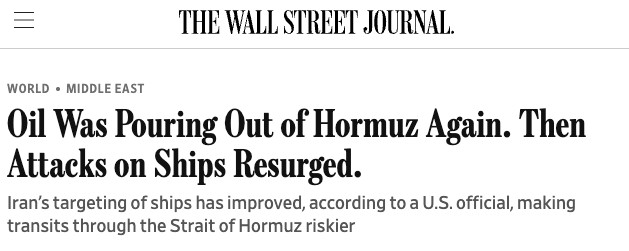
“Lies don’t work so good when one or two ships are getting hit a day in the Strait and burning wrecks and oil slicks litter the waters,” quips the energy-market observer on X who goes by the name “Carolina Lion.”
And yet… U.S. crude futures traded for a while this morning under $90 a barrel.
In mid-September they briefly touched $105. That’s a 14% drop in three weeks.
Is the supply situation 14% better now than it was then? Judging from the foregoing, no.
But as we chronicled once again last spring, oil futures have been massively manipulated for decades.
And as Paradigm macroeconomics authority Jim Rickards has been saying for months, there’s a disconnect between the “paper price” of oil and the price of real physical barrels for delivery — which is now manifesting as a record-high gap between the price of oil futures and the price of diesel fuel.
Investment takeaways? Year to date, energy is the strongest performing sector in the S&P 500 — up 40%. Yes, that beats the information-tech sector, up 29%.
Under the circumstances, that outperformance is likely to continue — even if we’re not looking at a worst-case scenario of the sort Belkin seems to be hinting at.
We’ll continue to look at the glass half-full for Bullet No. 2…
 October Optimism?
After a choppy September, the calendar might be turning in the stock market’s favor.
True there’s no shortage of worries. Treasury yields have climbed to levels not seen since 2002. Oil is elevated relative to summer’s levels. The Fed hasn’t ruled out another rate hike. And market leadership remains unusually narrow.
But for all the ups and downs of last month, the S&P 500 finished September roughly flat — and the Nasdaq actually gained ground.
So what about October? “Since 1950, October has been the best-performing month for the S&P 500 in midterm years, finishing higher roughly three-quarters of the time,” observes Paradigm analyst Zach Scheidt, writing on Friday for Altucher’s True Alpha. “November has typically followed with solid gains, too.”
Of course, “seasonality isn't a guarantee.”
But the official inflation numbers are climbing down for the moment, the AI industry is still investing in the future and well-to-do consumers are still spending briskly.
After surviving September, the bulls may finally have history on their side.
Sure enough, the S&P is up another half percent on the day to 7,758 — less than 50 points from its record close in mid-August. The Nasdaq’s gain is a bit stronger; the Dow is flat.
Gold is down but still holding the line on $4,100. Silver continues to bounce off the $60 level. Crypto is holding its own with Bitcoin a little over $85,000 and Ethereum just under $2,700.
It’s shaping up to be an exceptionally quiet week for both economic numbers and earnings. But a new earnings season will be underway starting next week…
 Medicare: After $90 Checks, Is a Premium Cut Next?
Is a cut in Medicare premiums coming next year? And will the announcement come soon?
Over the weekend, President Trump said the government will soon issue payments of $90 for everyone on Medicare Part B. The money should be direct-deposited sometime this week.
The president framed it as a rebate from the Medicare Improvement Fund, which he called a “slush fund” for waste, fraud and abuse under Democrats.
For perspective, $90 is a little less than half of one month’s standard Part B premium. Looked at another way it covers about five months of the premium increase that kicked in at the start of 2026.
Here’s a table — created with the help of the Perplexity AI engine — showing all the premium increases in recent years, as well as when those increases were announced by the Centers for Medicare and Medicaid Services.
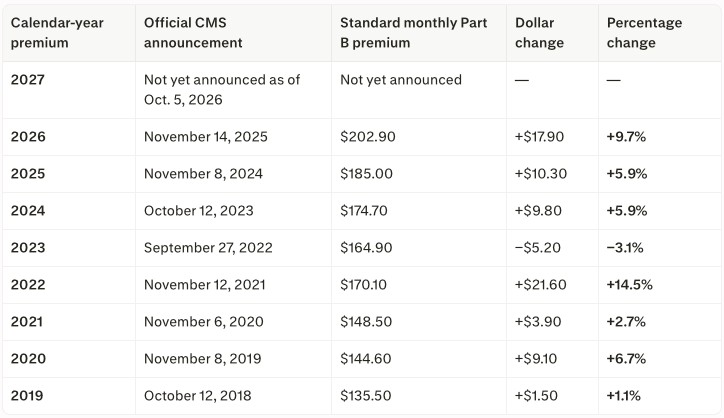
Not a big sample size, but there’s an interesting pattern emerging in the post-COVID era. Note the big increase announced toward the end of Joe Biden’s first year as president in 2021.
Note also that a cut in premiums was announced the following year — and the announcement came earlier than usual, ahead of the 2022 midterm elections.
Sure enough, the first year of Trump’s term brought a hefty increase. Will this year bring a cut? And will it be announced any day now?
Stay tuned…
 Ten Days to a Flying Car?
The long-awaited rollout of Tesla’s Roadster will have to wait a while longer.
Scheduled originally for last Thursday night, the event has been pushed back to Oct. 15, a week from Thursday. Tesla blames the delay on severe weather in the Waco, Texas area, saying the event “can only be held outdoors.”
Why outdoors? Paradigm contributor Davis Wilson has a theory: the Roadster may actually leave the ground.
Elon Musk has teased an optional “SpaceX package” using cold-gas thrusters to boost acceleration, braking and cornering — and perhaps allow the car to briefly hover.
Tesla claims the Roadster could go 0–60 mph in under one second. Yet Musk has called that “the least interesting part.”
Davis’ theory goes further. Tesla and SpaceX already share technology, facilities and employees. Now SpaceX technology could literally be built into a Tesla.
Which means the eventual merger of SpaceX and Tesla — something Davis has been speculating about since January. A successful Roadster launch in 10 days could bring that possibility closer to reality…
 Mailbag: AI Liability, AI for Writing, AI Czar
“Excellent article, thank you,” says a reader’s short note after Friday’s edition.
A second reader elaborates: “I would like for you to continue this theme because it is very relevant to this concept that the AI developers ‘can't do anything about’ the rogue AI gremlins in the code. And my thinking is along your lines — ‘Where ARE the handcuffs?’ Indeed. And legally, who is responsible for the damage that could be done here?
“I am of the opinion that the developers/executives of the company are, as you mentioned, with reference to other things like products that cause harm, and the companies that produce them are responsible.”
Meanwhile, Friday’s edition also brought up more, uh, stylistic concerns pertaining to AI…
“Dave, I just read the Oct. 2 edition of The 5. I noted that it contained what seemed like a large number of ‘—,’ i.e., long dashes between words.
“I didn’t go back and compare to past editions of The 5 to see if this was normal or a change in your style, but I recently became aware that the long dashes are a ‘tell’ that the text may have been created with the assistance of AI.
“I use AI to help me with my own work and it has been a huge productivity enhancer so I’m not being critical or judgmental. You seem to be both idealistic and pragmatic so I’m simply curious as to where you fall on the AI spectrum.”
Dave responds: I addressed the question in-depth a month ago. Since then, my understanding has continued to evolve. Really, once you start noticing the hallmarks of AI-generated copy, you see it everywhere.
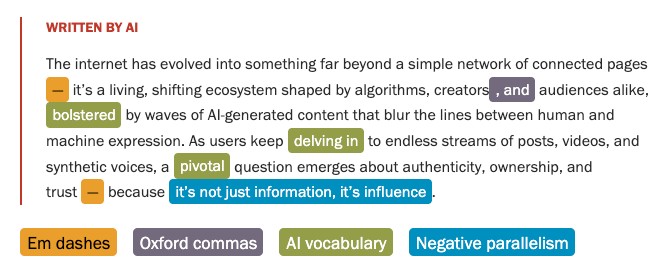
That’s taken from a recent write-up at the Pew Research Center, by the way.
Anyhow you can run my stuff through Pangram and judge for yourself. From my limited experience with the platform, it seems pretty reliable.
Meanwhile, the news this morning is that the president is about to name Jay Clayton as the new “AI czar.”
Clayton has no particular expertise in the realm of AI or digital technology. He is, however, well practiced in the art of covering up for the excesses of well-connected financial firms.
He spent over 20 years at the white-shoe law office of Sullivan & Cromwell — where he represented eight of the 10 biggest Wall Street banks, including Goldman Sachs and JPMorgan Chase while they were under criminal investigation.
Then he became SEC chair during Donald Trump’s first term. It was on Clayton’s watch that the “repo” crisis emerged in late 2019. The big banks got themselves into trouble with exotic financial instruments called repurchase agreements. The Federal Reserve rode to the rescue, printing money to buy Treasuries and mortgage-backed securities from the banks.
We’ll never know how big a bailout was necessitated by this crisis because COVID conveniently came along in early 2020, necessitating an even bigger bailout.
Clayton spent the Biden years back at Sullivan & Cromwell, along with gigs on the boards of Apollo Global Management and American Express.
So far in Trump’s second term he’s spent a year as U.S. attorney for the Southern District of New York — the office of the Justice Department that’s supposed to be a watchdog on Wall Street, heh. Most recently he’s spent the last two months as Director of National Intelligence, Tulsi Gabbard’s old gig.
A cynic might well suspect Clayton’s role as AI czar is to clear the way for an AI bailout at taxpayer expense. After all, It’s coming.


