
Infinitely Human
 Infinitely Human
 “I’ll be honest. I hate AI,” said colleague Chris Cimorelli earlier this year.
Chris wears a number of hats in our shop, and he wears them all well. His public-facing roles are as analyst for Altucher’s Microcap Millionaire and editor of his own 10X Trade Club advisory.
Coming from Chris, this was a startling statement.
He’s a millennial. He has no adult memory of life before the internet.
But Chris reflects how nearly all of us feel about AI at Paradigm Press — or, to be more precise, the way AI is so often abused, even as we recognize its world-changing potential.
Today we’re taking time out from our usual fare to walk you, the reader, through exactly how we use AI here — and, more importantly, how we don’t.
“Frankly, AI scares the s*** out of me,” Chris elaborated. “Not because I think it’s going to steal all our jobs or go full Terminator on us.
“But because from a mental health perspective, it’s genuinely terrifying.
“MIT ran a study on students who use ChatGPT for their essays. The study concluded that students displayed lower brain activity in regions related to executive control and semantic processing…
“AKA understanding words and how to use them.
“Basically, they’re having trouble thinking. Like the most basic cognitive tasks.
“Turns out adopting new technology doesn’t make you smarter. It might actually make you dumber. Gen Z now appears to be the first generation in over a century to score lower on IQ tests and core cognitive tasks such as memory, focus and literacy.”
If you’re paying for someone’s college education right now, you should know that employers are starting to notice all of this.
Earlier this year a New York financier told Financial Times columnist Gillian Tett how he was put off by the new crop of “AI natives.” Their ideas are so shallow that his firm is now steering clear of AI-literate grads in science, technology, engineering and math — and looking for humanities majors instead.
“We want critical thinking, not just AI,” said this individual.
Seems my colleague Chris was well ahead of his time — he was an English major before deciding to pursue this line of work.
Chris’ story is a microcosm of how we approach AI at Paradigm Press.
AI is a tool — a vital one at that. And we’ll show you how we use it shortly.
But Paradigm executive publisher Matt Insley says the essence of what we do — captured in our corporate logo — is “infinitely human.”
That is not the approach of everyone in our industry. I personally know at least two people who got kicked to the curb at a competing firm this summer. That company, as well as others, is pivoting to AI to do the vital work of communicating with readers via the written word.
At Paradigm we think you, our customer, are way too important to treat in such a shabby way.
Imagine if you were to learn that I, or Chris, or Jim Rickards or James Altucher, weren’t… real.
As Chris put it, imagine if “it was all a mirage… a digital clone feeding on historical text samples and fabricating a watered-down, tone-deaf message based on whatever poppycock it decided was relevant that day.
“Chances are, you’d probably tell right away that it wasn’t us. And you’d stop opening our emails.
“Relationships matter. Real thinking matters. We don’t outsource our cognitive gifts or the power of the pen to machines.”
The ideas. The words. Infinitely human. We wouldn’t have it any other way.
But among the wealthy and powerful in this country, it’s a different story…
 AI Can’t Have Sex
In light of recent news, our approach to AI is downright defiant.
Last month, The Wall Street Journal published an Op-Ed by the billionaire investor Stanley Druckenmiller — calling out his former employee, Treasury Secretary Scott Bessent. (Druckenmiller thinks Bessent’s efforts to keep a lid on Treasury rates won’t work.)
A few sharp-eyed readers wondered whether Druckenmiller wrote it — or whether AI wrote it for him.
As reporter Emily Peck at Axios wrote, “The writing is infused with the telltale cadences of the AI-generated one-two punch — for example, ‘If the 30-year must trade at 5.5% to clear, that isn't a crisis. It is an invoice.’ Or this familiar construct: ‘This wasn't liquidity management, it was price management…’”
Asked by the NOTUS website whether he used AI, Druckenmiller replied, “Of course… I write everything using AI now for the same reason I use a calculator when I do math problems."
The guy who published the article had no problem with it. "AI is a fact of modern life,” said WSJ opinion editor Paul Gigot. “The question for us is whether what we publish from contributors reflects an author's original argument, and if the author has the standing and credibility to make it. In Stan Druckenmiller's case, we have had a relationship with him for many years, and nobody can doubt that his Op-Ed is his genuine opinion."
Axios’ Peck sees a watershed here: “The moment could mark a real cultural shift where AI writing is basically all good, at least among a certain set of influential elites.”
We are not influential elites around here at Paradigm. We stand outside “the system” as advocates for everyday people trying their hand at the markets.
And being infinitely human… we know AI slop-copy when we see it.
The fact is that AI is incapable of making the spontaneous mental connections that are essential to human advancement — or as our James Altucher called it years ago, “idea sex.”
“I did an exercise once with a group of people,” he recalled. “I had them come up with their list of 10 ideas. Then I had them join up with the person sitting next to them and they wrote a ‘combination list,’ where they combined the ideas on one list with the ideas on the other.
“The results were genius! I wanted to implement all of the ideas.
“Almost every great advancement in society came as a result of ‘idea sex’ — taking one good idea from one area and combining it with another good idea and having a baby idea.”
“Idea sex” is how we connect with you, the reader.
It was how James and his team came upon the concept of SpaceX’s “Super IPO” this year. The “super” part was the companies supplying SpaceX that had more immediate and more lucrative profit potential.
It was also how Jim Rickards and his team formulated the “American Birthright” — their term for the Trump administration’s scheme to tap the vast energy and mineral wealth underneath federal lands.
Yeah, AI can’t do that. When it comes to “idea sex,” AI is a eunuch.
So how do we use AI in our company, you ask? What is the infinitely human approach? Read on…
 AI: More Than Just Chatbots
The thing is that AI is about so much more than chatbots.
At one of our periodic All-In Summits earlier this year, James Altucher, Jim Rickards and Enrique Abetya emphasized that AI’s true potential lies in the realms of robotics and automation — which hold the key to a revival of American manufacturing.
In addition, several of our editors and analysts are passionate about AI’s potential to accelerate the development of lifesaving drugs.
As for our firm’s day-to-day work, AI tools are central to the methodology in several of our best-selling advisories — including Altucher’s True Alpha and Rickards’ Insider Intel.
AI is capable of sifting through enormous quantities of data that no one person could do alone.
Take Nick Riso — another one of our millennial phenoms. Most of his work takes place behind the scenes, although on occasion you’ll see his byline in our Truth & Trends e-letter.
Before many folks pour their first cup of coffee, Nick is putting AI to work to sift through the vast market in “derivatives” — options, futures, forwards, swaps.
“These are massive data sets,” he tells me, “and they don't all ‘live’ together, so AI is first of all able to take inhuman amounts of it and put it all together in a coherent way.”
From there, AI is able to accurately answer questions he has about the data and then make cross-calculations about a particular company that’s on his radar.
But again, it’s just a tool. In the end, real people sign off on — and take responsibility for — every investment recommendation we make. Infinitely human.
Even the chatbots have their value. It’s just a matter of knowing their place.
I use them for research in my own work every day — if only because the quality of Google search results has gone to pot since around 2019.
But every AI chatbot is built on a model. And with every query I submit, two questions are in the back of my mind…
- How can I trust that the model isn’t overlooking something important?
- How can I trust that the model isn’t “hallucinating” — i.e., making stuff up? (Models do this because their primary purpose is not to unearth facts but rather to mimic human expression.)
I have the advantage of a 20-year journalism background, the first few years of which preceded the internet. As such I possess a well-honed BS detector.
It’s not flawless — no one’s is — but most of the time it’s capable of harnessing a chatbot to deliver what I need, when I need it, subject to double-checking. (When you’re up against deadlines on a daily basis, that matters!)
 AI and Customer Service
No discussion of AI at our firm is complete without a mention of customer service.
In many industries, customer service was a nightmare even before the advent of AI. Which was by design.
In his new book The Reverse Centaur’s Guide to Life After AI, tech writer Cory Doctorow describes how in the past, a customer service rep’s job “was to get yelled at by you, at minimal expense to the company, which is why they earn terrible money and also why they can’t give you a refund, change your plane ticket or compensate you for the fact that your hotel room was covered in meth and dog hair.”
AI takes it to a whole new level. Chatbots “are so much more obviously put in place to simply absorb your frustrations and abuse without helping you.”
Doctorow tells the story of an Air Canada customer who sought a bereavement fare to attend his grandmother’s funeral. Told by a chatbot to pay the full fare then submit an application for a partial refund, that’s what he did.
But when the refund never came through, he got hold of a human rep who told him the chatbot hallucinated the refund policy. Turns out you have to apply before you fly. The guy had to jump through many more hoops, ultimately filing a civil claim, before collecting his refund.
You won’t run into this sort of no-accountability culture if you get in touch with Paradigm customer service.
Sure, you’ll get an automated email as soon as you submit an inquiry via this handy web form; that’s just so you know we got your inquiry and we’ll start looking into whatever is your concern.
But we don’t outsource our customer care to overseas call centers — and you definitely won’t encounter an AI chatbot that will steer you the wrong way. The experience will be infinitely human.
In our line of work, we simply can’t afford to blow off customers the way that so often happens if, say, your new dishwasher breaks or you were shipped the wrong size of shirt.
You need a functioning dishwasher. You need a new shirt. To one degree or another, the purveyors of those products have you over a barrel.
But as Bill Bonner, the founder of Paradigm’s parent firm, has drilled into us for many years… nobody needs a newsletter. Nobody wakes up one morning and thinks, Honey, I should have more newsletters in my inbox!
Information products like ours are the ultimate in “discretionary” purchases. And if we do you wrong, that’s not something we recover from easily, like whoever sold you that wonky dishwasher and ill-fitting shirt.
Our corporate heritage goes back nearly 50 years now and is on to its second generation. You don’t stay in business that long by giving one customer the shaft, moving onto the next and doing it over and over.
No, we do it by delivering compelling ideas… compellingly presented… with an eye toward building long-term relationships with customers who will keep coming back to us.
Everything we do is customer-centered. “How will this affect the reader?” “Why should the reader care?” “Will the reader be able to get into this stock at a good price?”
AI doesn’t care about any of that. We obsess over it. Infinitely human.
And with that, we have just enough time to check today’s markets and field a timely AI inquiry in the mailbag…
 Markets, Mailbag
The big market story today is… well, imagine the U.S. president holding a gun to the global economy and telling the Federal Reserve, Cut rates now or our top trade partners get it!
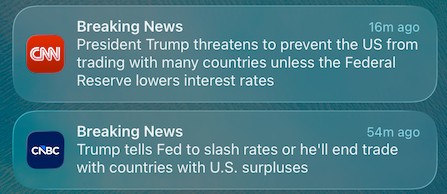
So yeah, that happened.
“Taken at face value,” says a deadpan account from CNBC, “the threat to end trade with deficit-harboring countries is extreme: The U.S. has large trade deficits with dozens of countries, including its top trading partners. The White House did not immediately respond to CNBC’s request for additional information on the post.”
The president posted his threat on Truth Social about 90 minutes after the Labor Department issued the August job numbers. The headline figure was way better than expected — 162,000 new jobs. The official unemployment rate held steady at 4.1%.
Numbers like that make it more likely the Fed would raise short-term interest rates at its next meeting on Sept. 16. Hence, the president’s threat.
For the moment, futures traders still assign a 60% probability of a hike… and that’s proving to be a drag on the stock market at week’s end: The S&P 500 is down about a half percent at 7,712. The Nasdaq’s losses are narrow, the Dow’s steeper.
Precious metals are also pulling back, gold at $4,422 and silver at $65.65. Bitcoin sits a little under $79,000 and Ethereum at $2,440.
U.S. oil futures are down about a buck but still over $90 as the weekend approaches and the low-grade war in the Gulf drags on.
“Dave, I have a question for you as long as you ended your Tuesday edition on the topic of journalism.
“With all of the reading you do and as a professional, how to judge if a column or article is written by a real person or it's AI scribble; especially if it doesn't hallucinate or have the word ‘Madagascar’ in it? I'm always asking that question when I go to various sites, especially YouTube documentary sites.
“I'm first-time writer to you, though I've been reading your intriguing columns for some 12 years now. Thanks!”
Dave responds: Well, a lifetime of reading and writing doesn’t hurt. But there are tells, like the so-called one-two punch described above. (Here’s an article describing a few others.)
If you really want to know for sure, there’s a website called Pangram. You simply paste a bunch of text into a box and it tells you whether the writer is human, a human assisted by AI (and how much assistance) or strictly AI.
I’ve not tried it myself, but I’ve run across it twice in recent days. Have fun!


