
Buffett’s 38-Year-Old Advice
 Buffett’s 38-Year-Old Advice
 It happened over 20 years ago at the Berkshire Hathaway annual meeting in Omaha. Paradigm AI authority James Altucher will never forget the encounter.
He got to talking with a restaurant owner. “Back in 1976,” James recalls, “he’d bought 200 shares of Berkshire.
“A year later, the stock had doubled, so he sold half, took the money and opened a restaurant. He ran it for the next 30 years.”
The other half of the position? He let it ride. “And by the time I shook his hand in 2003, that untouched half had grown into a $12 million fortune.”
Really, the fellow had two fortunes — one for which he worked 30 years, the other for doing nothing.
“I was jealous,” says James. “I wanted to be the guy who did nothing.”
That dovetails with something else James will never forget — a line from Warren Buffett’s annual Berkshire shareholder letter way back in 1988.
Maybe you’ve run across it before: "Our favorite holding period is forever."
➢ As it happens, 1988 is the year Buffett first invested in Coca-Cola. Berkshire’s cost basis is about $3.25 per current share. KO trades this morning for $86.45. That’s 26.6X in 38 years. And that’s without reinvesting the dividends.
All of which brings us to the AI-is-gonna-kill-everyone narrative that gave markets a shudder during September.
You know the broad outlines by now. A researcher at the AI firm Anthropic quit his job in theatrical fashion with a warning that “the people building AI earnestly believe that it could kill us all by the end of the decade.”
Then a senior Anthropic executive chimed in to assign a 10% probability of that outcome. Then Anthropic CEO Dario Amodei wrote an open letter calling on the government to work with the industry to slow down AI development. Sam Altman and Elon Musk concurred.
As we said at the time, a lot of people misunderstood Amodei’s plea. Amodei said “slowdown” and a lot of people heard “pause.”
“There's a wide gap between a hard conversation and a full stop,” James elaborates.
“Building a bigger, smarter model from scratch is what the industry calls ‘training.’
“What Anthropic's CEO was actually asking for was time. Time to test the systems and put the guardrails on them before racing ahead. He wasn’t saying stop. And even if he had been, no lab on Earth is going to pump the brakes and hand a rival the lead.
“Training rolls on no matter what any one executive says into a microphone. The conversation is real. The buildout it's supposedly threatening hasn't slowed by a single server.”
What’s more, James reminds us training is only half the equation. There’s also inference — that is, all the stuff a large language model does when you submit a prompt.
“One of the largest AI inference platforms out there, OpenRouter, has watched its weekly demand climb 12,700 times since January 2024, and nearly double in just the last six weeks.”
This is the activity that rolls on, oblivious to the media chatter.
James’ takeaway: “The crowd is out dumping the market's best names over a story that has nothing to do with what those companies actually earn. That's usually the exact moment worth stepping in — and a window like this never stays open long.”
Two weeks ago in Altucher’s Investment Network, James pinpointed five AI names that sold off during September — and which he advised holding onto tight. Or even buying more shares at a discount.
“Think of the man in Omaha, sitting on a hundred shares he never laid a finger on.”
Out of respect for James’ paying subscribers we’ll identify only one of the five here today — both because James has mentioned it in this space previously and because it issued its quarterly numbers yesterday afternoon.
Micron Technology (MU) is one of the three big names in memory chips — and the only American one. It topped Wall Street analysts’ expectations on both revenue and profit — and it “guided higher,” as the saying goes, for the coming quarter.
But MU shares are down nearly 2% as we write today and the media are squawking: MarketWatch says “unanswered questions” remain about the long-term deals the company has locked in through 2028.
James is unconcerned. As he said here in mid-September, “Inference needs lots of memory.” And inference shows no sign of slowing down. James is happy to buy the dip.
 Diesel Deficit
The diesel squeeze is getting ever more serious.
As of yesterday the “crack spread” between the price of oil futures and the price of diesel had blown out to $122 per barrel. When last we visited the topic a few days ago, the gap was barely $100. Thus, a barrel of diesel now costs well north of $200 now.
Here are some of the latest developments…
- Texas is now allowing the use of “dyed diesel” for trucks. Typically, this tax-free grade of diesel is limited to off-road uses like farm equipment
- “Chinese refiners have suspended exports of oil products to regions beyond Hong Kong and Macao until further notice from Beijing,” says the Reuters newswire
- Russia has extended its ban on diesel exports for another month. The country flipped from a net diesel exporter to a net diesel importer when Ukraine started attacking Russian refineries (with the help of U.S. intelligence targeting).
Rumors persist the Trump administration will resort to its own ban on diesel exports sometime between now and the midterm elections in 34 days.
But as we said last week, the only region that might see price relief as a result is the Gulf Coast, where the bulk of the country’s diesel surplus resides.
In the meantime, U.S. crude futures are up over a buck today, approaching $92. The price hasn’t had a sustained run below $90 since August.
➢ From everything we can tell, a nationwide trucker strike called for today in protest of high diesel prices is a bust. That said, the FreightWaves data firm reports that over the last month, 16 U.S. trucking companies have landed in bankruptcy court.
Meanwhile, Mr. Market still can’t shake his jitters about higher energy prices fueling inflation — and yet again, that’s sending Treasury yields higher.
The yield on a 10-year T-note has jumped to 5.31%. Yesterday we were looking at the highest rate since 2007. Now we’re looking at the highest since 2002.
Reminder: This rate sets the pace for everything from mortgages to corporate borrowing. Not coincidentally, Freddie Mac says mortgage rates just posted their biggest one-week rise in four years — up to 7.28%.
As for the major U.S. stock indexes, not much to say: The Nasdaq is flat from yesterday’s close and the S&P 500 is down about a tenth of a percent at 7,641. For perspective, that’s about 2% below its most recent record close in mid-August.
Precious metals are licking their wounds but modestly in the green — gold at $4,167 and silver at $60.83. It looks as if $60 silver is holding for now.
Crypto is holding its own, Bitcoin just under $84,000 and Ethereum a bit below $2,700.
 “The Very Rich Are Different From You and Me…”
There’s the top 0.1% and then there’s everyone else. Especially since COVID.
It’s been a running theme in these daily missives for over a decade. This week, The Wall Street Journal put some new numbers on it.
Per figures from the Federal Reserve, the wealthiest 0.1% of Americans have doubled their net worth since the end of 2019.
“The year the pandemic started was when the ultrawealthy began to pull away from other rich groups,” says the paper. You can see it in dramatic fashion on this chart…
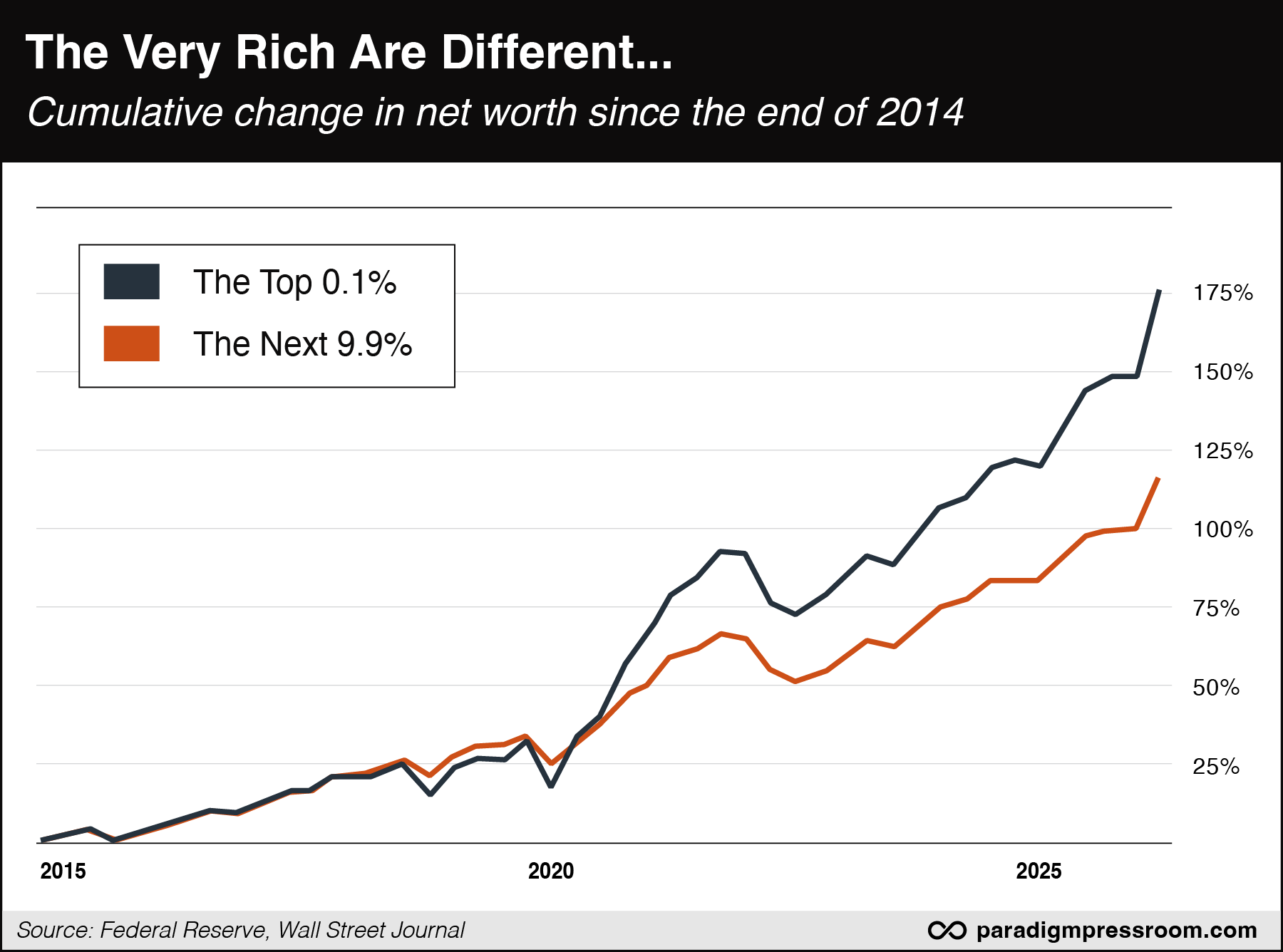
Now… it’s true that others have fared better than that 9.9% since 2020.
In fact, the bottom 50% “has actually seen their wealth rise more than any other group on a percentage basis,” says the Journal — “thanks to a combination of rising home values and pandemic-era government relief that swelled bank accounts and helped pay down debt.”
But hold on. This is not a case of “a rising tide lifts all boats.” Read on…
 A Crucial Caveat
It appears these figures from the Fed and the Journal are not inflation-adjusted. Which makes all the difference.
That brings us back to one of our favorite charts. It shows how the “wealth gap” started blowing out early in the 21st century.
Here the focus is on income and not wealth — but the figures are inflation-adjusted. It was originally brought to our attention by Marc Faber, editor of the renowned Gloom, Boom and Doom Report.
“If I were to look at the average family income, excluding capital gains, adjusted for inflation between 2002–2012,” he wrote, ”it is clear that 90% of these families experienced a decline in real income and another 5% experienced hardly any gains.
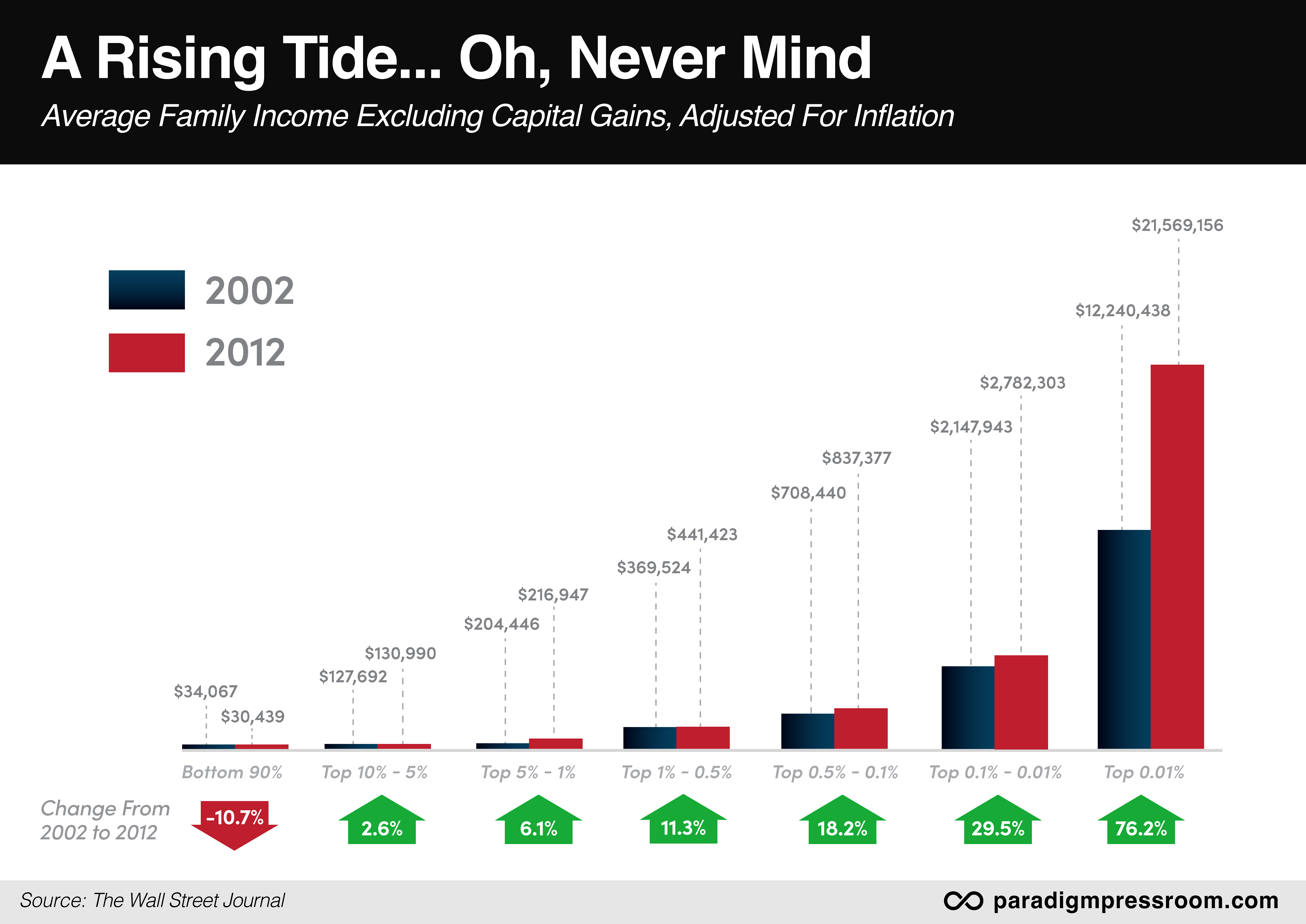
“In fact,” he went on, “it is shocking that only 0.1% of families achieved substantial gains in real incomes.”
Faber did not blame the top 0.1% for their good fortune relative to everyone else. Instead, he put it on the Federal Reserve.
“The Fed's monetary policies have failed to boost the real incomes of most people but have had an enormously favorable impact on just 0.1%...
"In fact, I would argue that the Fed is fully responsible for the fact that 90% of U.S. families have had declining real incomes (inflation adjusted) over the last 10 years or so (as money printing raised the prices of energy, food, education, transportation, health care, insurance, etc.) and have experienced a decline in their net worth. After all, it was the Fed that repeatedly and deliberately created and continues to create bubbles, which benefit only a minority, while hurting the majority."
Alas, there’s no current version of this chart. Your editor has searched high and low. But one of the economists who compiled the chart published a paper on the same general theme, updated through 2022.
His conclusion is that the upheaval wrought by the government’s reaction to COVID made the income disparity even worse than it was before — stimmy checks notwithstanding.
From 2019–2022, the bottom 99% saw their after-inflation incomes grow by 1.0% — compared with the top 1%, who enjoyed 16.1% growth.
Here the blame lies not only with the Fed but also on two free-spending presidents and congresscritters of both parties — who’ve put federal spending on a permanently higher trajectory.
Much of that money has found its way into financial assets whose benefits accrue to… well, those who have financial assets.
No wonder the bottom 50%, with little home equity or stock ownership, feel so left behind. Even if on paper their wealth is growing faster than anyone else’s…
 Mailbag: AI Data Centers
“I’ve noticed more and more articles about data centers and the effect on everyone’s power bills. It isn’t just Paradigm Press bringing this up,” a reader writes.
“I wonder though if water and power usage is really the issue, or just hate on data centers. If we started building a bunch of aluminum smelters (they use a huge amount of power), how would people feel? Would the smelter need to pay for its heavy power usage infrastructure, or would it be like it was 80 years ago when they were built and they may have received a lot of the infrastructure on the backs of ratepayers?
“We used to have a few of those smelters here in Washington state because of our cheap hydropower. But they are all gone now and I don’t know why. Did our rates go down when the smelters left because of a surplus of power? Or maybe that is why so much infrastructure has stagnated since our heavy industry has mostly left, freeing up power for housing growth and smaller businesses.
“There are certainly things to not like about data centers, but I wish they would think about the issues and restrict things generally. If you don’t like a bunch of water being used for evaporative cooling, then ban it, but ban it for everyone doing that. If you don’t like noise from the fans or generators or whatever is making the hum at datacenters, then ban noise above a certain level at a certain distance, but again make that rule for every industry not just data centers.
“Thanks for all you do!”
Dave responds: Well stated. I imagine you’d find much agreement with a Substacker named Connor Boyack.
“It is tempting to file all of this under ‘techlash,’ a nation flinching from the steady march of technological progress (and the infrastructure needed to run it),” he wrote six weeks ago. “But I believe the debate turns on two far more basic questions: who pays, and who decides.”
Meanwhile, you’re right to suspect that data centers are being held to a different standard than other industries.
We’ll show you exactly how in tomorrow’s edition — and try to unpack why that’s the case. Catch you then…


