
Assume the Worst Case
 Assume the Worst Case
 The “AI freakout” touted by the mainstream was not only overblown. It was also short-lived.
As you’ll recall from yesterday’s edition, that was the name The Wall Street Journal’s websitegave to a minor scare that hit AI stocks in the morning. Supposedly the AI gravy train was screeching to a halt because Anthropic’s CEO called for a slowdown in AI development and the CEOs of OpenAI and SpaceX both agreed.
The “freakout” was already over by the time we hit “send” yesterday afternoon. Get a load of the front-page, above-the-fold headline in the Journal’s print edition this morning…
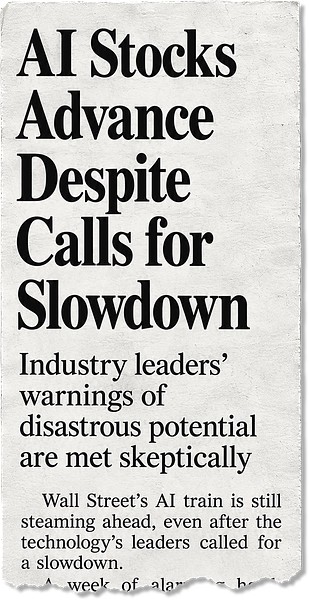
So let’s step back and get some perspective with the help of Paradigm AI authority James Altucher.
“First off,” says James, “let’s make clear what was NOT said:
- “Zero AI companies said they were slowing down development
- “Nobody said that their release cadence was going to be slower
- “And nobody even said they were going to cap capabilities of future AI models.”
What Anthropic’s Dario Amodei committed to… and what OpenAI’s Sam Altman endorsed… was that before a model ships, third-party evaluators with employee-level access would get a look at it.
And yet, the knee-jerk reaction in much of corporate media and social media was a pause to AI development.
Amodei’s preferred word is pace. It showed up over and over in the open letter he posted on his personal website Saturday.
“Pacing,” he took pains to point out, “does not mean halting model training or technical progress.”
That passage made it into the Reuters article about Amodei’s statement Saturday. But it was all but gone from the media’s coverage by Monday once reporters went into “freakout” mode. Don’t let the facts get in the way of a good story, huh?
But let’s assume the worst-case for a moment: “Let’s say AI models were more slowly released,” James says. “Who would this affect?
“Most of the demand for AI computing is for people who want inference. Not for the companies training AI models. Training happens once, but inference is going up in a straight line.”
Inference is what happens every time you type a prompt into ChatGPT or Claude or Grok. More and more people are adopting large language models — and using them more frequently. That doesn’t change.
James says the beneficiaries include…
- Nvidia (NVDA). “Inference needs lots of GPUs”
- Micron (MU). “Inference needs lots of memory”
- Astera Labs (ALAB). “Inference needs millions of connections between the GPUs.”
“And if AI models are truly a risk,” James says, “the risk is from a cybersecurity standpoint.” Which is news for the cybersecurity names, which are bundled up into ETFs like HACK and CIBR.
 Rickards: No Rate Hike (You Heard It Here First)
Jim Rickards is sticking his neck out there: The Federal Reserve will not raise interest rates tomorrow.
The Fed’s Open Market Committee starts one of its two-day meetings today, with an announcement due tomorrow at 2:00 p.m. EDT. Futures traders assign a 93% probability the FOMC will raise the benchmark fed funds rate from 3.75% to 4%.
Jim will take the other side of the trade.
He readily acknowledges that at 3.4%, the official inflation rate is nowhere near the Fed’s 2% target. He also acknowledges the rate will likely be higher still when the September figures come out in mid-October. It’s little wonder conventional wisdom anticipates a rate hike.
“But these are not conventional times,” Jim wrote his Crisis Trader readers this morning.
“The dovish contingent of the FOMC, led by chair Kevin Warsh, understands that higher prices will slow economic growth as consumers drive less or cut other spending to pay for gas.”
And if you’re wondering, politics figure into the equation as well.
“Midterm elections are only 49 days away,” Jim reminds us. “And Kevin Warsh was appointed Fed chair by Donald Trump, who has made his preference for lower interest rates clear.
“It’s nonsense to say that the Fed is not political. The Fed is highly political and knows what the White House wants. It will not bow to White House wishes by cutting rates. But it will do the White House a favor by doing nothing.
“That kind of inside-the-Beltway maneuvering is something Wall Street models and market odds are not good at calculating. But it’s a reality, and it will determine the policy outcome at this meeting.”
But that’s tomorrow. What about the markets today? Read on…
 Here We Go Again
Once again, the market dynamic today is rising oil prices —> rising inflation expectations —> rising long-term interest rates.
Saudi Arabia has shut down its oil export terminal at Yanbu on the Red Sea. Sounds as if the damage to the big east-west pipeline it relies on to bypass the Strait of Hormuz was even more severe than we thought yesterday.
And there’s a squeeze on refined products as well: Exxon Mobil’s big refinery at Joliet, Illinois is offline after a power outage on Sunday. It probably won’t be back in service until the end of the week.
With that, U.S. oil futures are over $105 for the first time in four months. And the yield on a 10-year Treasury note broke through to highs last seen in 2007.
For the moment, the 10-year has pulled back just below the 5% mark. But the psychological barrier has been breached. Bad news for mortgages, corporate bonds and especially for Uncle Sam’s delicate finances.
Late yesterday, Deutsche Bank released a startling analysis summarized by the Financial Times like this: “Foreign investors are now buying more U.S. stocks than government bonds, in a rare move that comes amid fears that inflation and America’s fast-growing debt pile are undermining the ‘risk-free’ status of Treasuries.”
At least for today, rising oil prices and rising bond yields are a drag on the stock market.
The S&P 500 is down close to another half percent today — back below 7,600. The losses in the Nasdaq and the Dow are both closer to three-quarters of a percent.
But precious metals are holding their own — gold just below $4,300 and silver at $63.31.
Crypto is losing ground compared with 24 hours ago — Bitcoin sinking toward $76,000 and Ethereum just over $2,400.
“Bitcoin and Ethereum have both remained relatively stable while stocks have started to fluctuate this month,” says Trading Desk editor Greg Guenthher.
“If the market gets volatile over the coming weeks, we should pay close attention to how crypto reacts. If it can continue to hold its gains and sneak higher while we experience an equities drawdown, we’ll have additional confirmation that the bottom is in.”
 Sign of the Times
Copper theft is becoming so lucrative that since last year, 27,000 feet of cable belonging to the Los Angeles Department of Water and Power has been purloined.
That’s according to a recent investigation by KABC-TV, which points out “that's roughly five miles of cable -- the height of a commercial jet's cruising altitude if stretched vertically. It's also the length of 90 football fields or 165 Olympic swimming pools laid end to end.”
California lawmakers have passed a bill upping the penalties for “organized metal theft.” Its sponsor is Assemblymember Mark Gonzalez — whose LA district includes the Sixth Street Bridge, a repeated target of thieves.
“At night, the bridge has often gone completely dark after streetlight wiring was ripped out,” says the TV station. “According to González, taxpayers have spent $11 million replacing cables stolen from that bridge alone.”
Expect more where this came from given copper prices at all-time highs. There’s a reason we keep banging the drum here for COPX, the big copper-miner ETF…
 Mailbag: 9/11
“That is the best article you could write on 9/11?” a reader writes in response to last Friday’s edition.
That’s all he said. I can’t address any specific complaints because there were none.
“Your best article, Dave!” says an equally non-specific but more favorable reply.
“For me you’re preaching to the choir with your Sept. 11 missive,” says still another reader. “Let me give you what I believe is some real-world history in support of your and James Madison’s hypothesis that war and freedom are incompatible.
“In the mid-20th century Costa Rica decided to dismantle its army. The leader of the country (I can’t recall his name) didn’t think it was conducive to the stability and success of the country.
“Three-quarters of a century later Costa Rica would stand in Central America as the leading light in almost any category you wish to measure: economic, education, democracy, safety, health and welfare, etc.
“I don’t think this is a coincidence and hopefully this may convince some of your readers that there is a better path to successful ends than hegemony.”
Dave responds: I’m only vaguely familiar with this history myself. And Wikipedia’s entry on the subject is sparse.
But I do know that Costa Rica has been spared most of the upheavals that have wracked the rest of Central America throughout my adult lifetime — and I came of age during the Reagan years.
All told there was precious little feedback to Friday’s edition — which I’ve published periodically with updates and revisions ever since the 20th anniversary five years ago. The original rendition generated effusive praise, as did several subsequent ones.
But not this time. Maybe there’s something about the pathos linked to the 25th that made it land with more of a thud.
In contrast, Byron King’s guest edition on Saturday was very well received.
“Pure Genius!! Well written and put together in such a way as to open anyone's eyes,” is one reader’s reaction to Byron’s reflections.
“What a great article!” says another. “This is the most comprehensive article I've ever read regarding 9/11. I love Byron’s descriptions of each disaster site and the bravery demonstrated by so many. And he’s totally right - we still need answers and accountability!”
“Government has always been reactive,” says a third. “It seems to be wishful thinking if we expect proactive results and failed leadership being held accountable.”
On the subject of accountability, there’s also this eight-word email: “So why are we still Saudi Arabia's ally?”
An excellent question. It was also an excellent question a decade ago — when, after much foot-dragging, the feds released the infamously redacted “28 pages” of a joint congressional inquiry.
At the risk of oversimplifying, the report follows a fairly direct money trail from Prince Bandar — Saudi Arabia’s ambassador to the U.S. at that time — to the San Diego-based hijackers who flew American Airlines Flight 77 into the Pentagon.
What’s more, the U.S. military captured an al-Qaida leader in Pakistan in 2002… and found in his contact list the phone number for a cutout company that managed Bandar’s palatial spread in Aspen.
But there was Bandar, two days after the 9/11 attacks, smoking cigars with President Bush on the Truman Balcony of the White House.
Accountability indeed…


