
Echoes of the Dot-Com Bust
 Echoes of the Dot-Com Bust
 Earlier this year it was the stock market’s highflying sector — nearly doubling in less than three months. And then it took a wicked 25% tumble.
“Semiconductors are perhaps the most important industry group in America right now, maybe the world,” says JC Parets — the newest member of the Paradigm team and an ace when it comes to analyzing stock charts.
Now… the price action I just described for the semis might suggest to you that “the top is in” — and even after that 25% drop there’s nowhere to go but down.
But JC says if you zoom out to a timeframe beyond just this year, you find something much more revealing.
“What we're seeing here for the Semiconductor ETF (SMH) is a healthy consolidation over the last few months after a historic run in April and May.”
You can see the sideways chop since the spring on this chart…
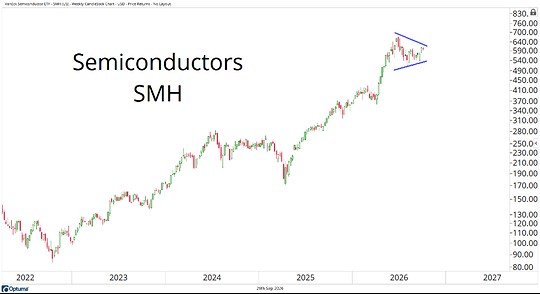
JC characterizes the move this summer and fall as “a well-deserved digestion” after a furious rally.
So where from here for this vital sector? “Historically, these kinds of consolidations resolve in the direction of the underlying trend,” says JC.
“The underlying trend for semiconductors, in case you hadn't noticed, is up.”
That’s why it’s important to look at a longer-term chart and not just this year’s action.
No guarantees, though: “If this consolidation doesn’t resolve in the direction of the underlying trend, and it actually resolves lower, that’s the signal.”
Here, it’s useful to revisit the dot-com bust that began in early 2000. The chip sector suffered as mightily as the rest of “info-tech.”
But that wasn’t necessarily a sure thing at the outset. There was a pattern very similar to the sideways chop we’ve been seeing since midsummer this year.
“This consolidation for the PHLX Semiconductor Index (SOX) should have resolved in the direction of the underlying trend, JC says.
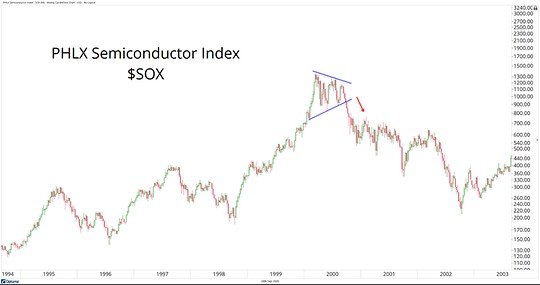
“But it didn’t resolve in the direction of the underlying trend. It resolved lower. That was the signal.
“The great stock market crash after the dot-com bubble ensued, and the rest is history.”
Bottom line now: “We’re seeing a similar consolidation after a similar run,” JC says. “And it should resolve in the direction of the underlying trend, which is higher. If that doesn’t happen, that’s the signal, just as it was in 2000.
“We don't know what's going to happen. Nobody knows anything
“But we do have a signal to watch, and it’ll show us if something has changed with this market.
“The math is on our side, though. And my suspicion is that we’re going to resolve higher, in the direction of the underlying trend.”
Especially if the biggest semi name, Nvidia, closed at a record high yesterday. (And it did.)
 Earnings Are Overrated
(Watch This Number Instead)
Millions of investors will undertake a quarterly ritual starting next week — and many of them will be wasting their time.
Third-quarter earnings season kicks into gear. Many investors who think they’re doing their homework will start digging through revenue beats, margin misses, guidance changes and after-hours stock swings.
But colleague Davis Wilson identifies one number investors should be sure to track…
“Here’s my No. 1 stock market indicator. Most investors never pay attention to it.”
Earnings revisions.
Earnings revisions are the changes Wall Street analysts make to their earnings-per-share estimates. When analysts raise those estimates, they expect companies to make more money than they previously thought.
Davis cites Barclays research showing that stocks with the strongest upward earnings revisions outperformed those with downward revisions by an average of 5–7% annually. Other research has likewise found that earnings momentum and analyst revisions can help predict future stock performance.
“The reason for this correlation is simple,” Davis tells us: “Analysts raise earnings estimates when a company’s business is getting stronger — revenue is growing faster, profit margins are improving or the company is becoming more efficient.
“Investors take these revisions seriously, leading to higher demand for the stock and, consequently, higher stock prices.”
Case in point — the aforementioned Nvidia. As recently as 90 days ago, its consensus next-year EPS estimate was about $12.75. Today, it's roughly $15.70, an increase of more than 20%.
Nvidia isn’t alone. Credo’s next-year EPS estimate has risen from roughly $8.85 to $9.70 over the past 90 days, an increase of nearly 10%.
The good news is you don’t need an expensive Wall Street terminal to follow these changes.
You can track earnings estimates for free on the “Analysis” tab of Yahoo Finance.
“Take it from someone who used to value companies for a living,” Davis concludes — “earnings drive stock prices, and earnings estimates give us our best look at where those earnings are headed.
“It takes less than a minute to check, and it’s the No. 1 indicator I look at before buying a stock.”
“It’s looking like a hump-day reset,”Trading Desk editor Greg Guenthner says of today’s market action.
After notching a record close yesterday, the S&P 500 is down a little over a third of a percent — back below 7.800. The Nasdaq’s loss is steeper, the Dow’s steeper still.
It’s not helping that Treasury rates are back on the rise — the 10-year T-note touching another highest-since-2002 level pushing 5.35%. (Not coincidentally, mortgage rates are pushing 7.5%.) “Patience is required here as the market gets all up in its feelings over rising yields,” says Greg.
Precious metals are getting pummeled — gold in danger of cracking below $4,100, silver already breaking beneath $60. Crypto is struggling, too — Bitcoin back to $83,500 and Ethereum plunging beneath $2,600.
 The Western Front
U.S. oil futures are back over $90 as the other front of the Persian Gulf conflict is heating up — the western one.
For reasons known only to themselves, the Saudi royal family has decided now is a swell time to restart its war in Yemen after a pause of roughly 4½ years.
From 2015–2022, Saudi Arabia waged a genocidal campaign aimed at the Houthi faction of Yemen. The Houthi leaders are loosely aligned with Iran and have controlled much of Yemeni territory the whole time — although there’s a rump Saudi puppet regime that the media still refer to as the “internationally recognized government.”
The Houthis are highly motivated tribesmen who chased two U.S. aircraft carriers out of the Red Sea in 2024–25. In contrast, Saudi Arabia’s military is highly dependent on foreign mercenaries whose commanders are chosen for loyalty and not skill.
“I taught Saudi officers at the Naval War College,” recalls Johns Hopkins historian Michael Vlahos. “They were the most unimpressive naval officers I have ever met,” he tells radio host John Batchelor.
Citing an anonymous U.S. official, Al Jazeera reports the U.S. military has resumed refueling Saudi Arabia’s fighter jets — as it did during the first round of the war under Obama and Trump-45. Saudi Arabian forces were notorious for bombing civilian targets.
If that news is supposed to intimidate the Houthis — whose formal name is Ansar Allah — it’s not working…

Meanwhile, Pakistan and Turkey are supposedly sending troops to Saudi Arabia under a mutual-defense agreement signed in August. Exactly how many troops and what they’ll be doing is still fuzzy.
And you thought this conflict was just between the U.S. and Israel on one side and Iran on the other…
As for that theater of the conflict, the eastern one… it’s possible that Iranian leaders think it’s to their advantage to let oil shipments flow through the Strait of Hormuz.
As we explored here on Monday, the precise amount of oil getting through the Strait remains a hall of mirrors. Certainly this tanker-tracker site shows that volumes remain extremely constrained.
But we’re seeing informed speculation that some governments are paying Tehran a toll to get their crude shipments through the Strait — perhaps as much as 20% of the value of each cargo. (Those who don’t pay continue to run the risk of Iranian drone and missile strikes, even if they’re being escorted by U.S. warplanes.)
Aside from the revenue this toll scheme would generate, there’s another advantage for the Iranian government.
The buzz from Washington for more than a week now is that Donald Trump is likely to restart the hot war after the elections. But as the Quincy Institute’s Trita Parsi sees it, “Tehran is likely — either directly or through one of its partner organizations — to preempt Trump and initiate the third round of the war itself.
“Tehran has already deprived Trump of the ability to control the geography of the war. It may also seek to deprive [him] of its timing.
“The initial attack will likely seek to shock the energy markets, potentially with the intent of dispelling any notion in the White House that Iran’s escalation dominance can be challenged.
“To achieve that shock and shoot up oil prices dramatically, a narrative that the Strait is already open and that Tehran has lost the battle over the waterway is actually helpful to the Iranians. The more the idea of an opened Strait becomes normalized, the more of a shock Tehran will achieve if it dramatically closes it.”
An outlier possibility, for sure — but if it comes to pass, you heard it here first.
Regardless, the war is now at a stage where one sector stands to benefit no matter what comes next. Read on…
 “Big Profits From a Bad Business”
“Refining is a historically bad business,” says Paradigm natural resources specialist Matt Badiali.
“Over the past several decades, refiners’ profit margins averaged about 1–3%. That’s terrible.”
Not that oil companies are poor. It’s just that their other operations usually rake in more cash.
“However,” he continues, “there’s a reason giant ‘integrated’ oil companies like Chevron, Shell and Exxon Mobil all own refiners. Because sometimes refiners print big money. And that’s what’s happening today.”
By Matt’s calculations, refiners were making roughly $32 per barrel a year ago. Today, that figure is about $97.
The culprit is what he calls “destruction from above.” Refineries are enormous, stationary and difficult to protect. The Iran and Ukraine wars have turned them into tempting targets for drones and missiles. To date, Ukraine has struck 24 of Russia’s 34 major refineries. Meanwhile, attacks and disruptions across the Middle East have further squeezed supplies of refined fuels.
Even if oil is flowing more freely through the Strait of Hormuz, damaged refineries don’t magically come back online overnight. We could have plenty of oil… and still not have enough refining capacity to meet global demand for diesel and gasoline.
That works to refiners’ benefit: “If the cost of their feedstock falls while their products stay expensive,” Matt says, “it would increase their profits.”
Recall, refiners make money on the spread between what they pay for crude and what they receive for products such as gasoline and diesel. “If we find ourselves in a place where oil prices fall 20% but distillates only fall 10%, these companies will make even more money than they do now.”
Let that sink in. Oil prices could fall. Fuel prices could fall. And refiners could still make more money.
Matt is recommending speculative plays on two small refiners for subscribers of Real Wealth Insider. The conservative way to play the trend is with an ETF he’s talked up here before — the VanEck Oil Refiners ETF (CRAK), up 33% in three months.
No, it’s not risk-free. The Trump administration has floated banning U.S. diesel exports as it tries to bring down fuel prices ahead of the midterm elections. That could hammer refinery margins in a hurry.
Absent that move, however, refiners could remain highly profitable even if crude oil falls. “The stuff they sell is going for a high price,” Matt concludes, “but the stuff they buy to make their product isn’t.”
 Mailbag: Oil Reserves, AI at Work
We’ll stay in the oil patch to start today’s mailbag…
“For the alleged reopening of the Strait to oil and oil tankers mentioned in Monday's Bullet No. 1, there are a few things that come to mind, especially when it comes to the media going along with Trump instead of embarrassing him.
“There is the usual wanting to keep prices down of course, and at the very least perception influences paper prices. More importantly, I think, we are quickly closing in on the end of the SPR reserves that have been authorized for release.
“If President Trump does not believe there is any further need to release oil from the SPR, then we would see physical supply tighten even further.
“It seems like the administration is somewhat aware of this and has leaned on the Europeans to release some of their reserves to buy them more time. They've managed to say this was done because Russia is withholding diesel exports as a result of Ukrainian strikes on their refineries (while according to Russia they are withholding diesel as a form of sanctions against the West and have more than enough for themselves) NOT because the Strait is still closed.
“But if Trump & co. aren't aware of how bad things are, if they genuinely believe that they no longer need to worry about oil or diesel and the media is playing along to lull them into complacency as a ploy to put him in an untenable position, we may see the inevitable crisis grow to something unmanageable before a lot of people realize what is going on.”
Dave responds: Every indication right now is that we’ll have one more “big” SPR release before the election.
Beyond that, the remaining oil is so sludgy as to be nearly useless — to say nothing of the risk that portions of those salt caverns in Louisiana and Texas might collapse. We’ll see…
“Thank you for JC Parets' article on AI use and its impact on the everyday work of real people,” an appreciative reader writes after yesterday’s guest edition.
“The coverage of AI investment has typically been on the AI companies and their big-brained savant CEOs, data centers, power usage, fake claims of rogue behavior and the like. All important topics, but what about the investment opportunities afforded by AI through mass adoption by millions of workers? What sectors and companies stand to benefit the most? Where are the next transformational productivity gains?
“It may be much harder to pin down where investment opportunities beyond the tech sector will emerge due to AI, but any insights that Paradigm can provide would be most welcome. You're much better on this than mainstream media sources, but I would welcome more of this, please!”
Dave: Rest assured we’re on the case. Whether it’s AI for accelerating biotech development… or enhanced oil recovery… or any number of other endeavors, our editors are on alert.
After all, as we suggested here on Friday, it’s no longer possible to use the “dartboard” approach to AI — that is, make a dartboard with a bunch of random AI names, throw a dart at it and you’re bound to make money whichever name it lands on.
The “easy” AI money has been made. Now comes the part where we as a company have to earn our keep — and your continued trust. Stay tuned…


