
Scary September
 Scary September (Is It Real?)
 There’s something about the “unofficial end of summer” that concentrates the minds of finance types.
Thus, the front-page, above-the-fold headline in this morning’s Wall Street Journal, the day after Labor Day: “Markets’ Hot Days Give Way to Cooler Outlook.”
“In the past couple of months, equity investors cheered soaring profits at big companies, shrugged off jitters in the bond market and nudged megacap tech shares back near records.
“Now, as the post-Labor day stretch begins, new challenges lie ahead, including ever-shifting odds of an interest-rate increase from the Federal Reserve, sky-high expectations after a stunning earnings season and the persistent threat of higher consumer prices as fighting in the Middle East drags on.”
Whatever. All of the issues enumerated in that last paragraph were looming last week and last month. They’re no more or less urgent now than they were last Friday.
Here’s what’s really at issue: “September is the toughest month of the year for stocks,” says Paradigm trading pro Enrique Abeyta.
The Fed, earnings expectations, inflation — those are just an excuse. The real problem is the calendar.
“In the last 20 years,” Enrique tells us, “the S&P 500 has been higher only 45% of the time — and the last 10 years have been particularly difficult.”
And that’s just this century. Going back to 1928, the S&P has slipped an average 1.1% during September.
“Why? Nobody knows for certain. But there are some logical explanations,” Enrique says.
“Think about what happens during summer. People go on vacation, Wall Street trading desks thin out and portfolio managers spend more time away from their screens.
“A 2009 study published in the Journal of Financial Markets examined 51 stock markets and found that trading activity falls during summer vacation periods. Both large and small investors traded less.
“Another study, published in Financial Management in 2017, examined school holidays across 47 countries. It found that stock returns during the month following major school holidays were 0.6–1% lower than during other months.
“The researchers found that reduced investor attention during vacations may cause information to get reflected in stock prices more slowly.
“Then September arrives. Kids go back to school, adults go back to work and portfolio managers return to their desks. And they’re returning with plenty of fresh information.
“Second-quarter earnings season is almost over, and investors have a new set of earnings, guidance and management forecasts to consider. Meanwhile, the third quarter is nearing its end, giving funds another reason to reassess and rebalance their portfolios.”
The most likely outcome this year? Enrique says it’s “highly likely we see (at minimum) some increased volatility and more likely a healthy correction.”
Emphasis there on the word healthy. Bull markets need to pull back now and then, consolidating and catching their breath before the next leg higher.
In the meantime, we’ll address a couple of the aforementioned “uncertainties” in Bullets No. 2 and 3…
 The Oil Price Is Deceiving
U.S. oil futures begin the week over $92 — up nearly a buck to their highest since late July.
U.S. and Iranian forces traded sporadic airstrikes over the holiday weekend — but the concern this morning is renewed fighting between Saudi Arabia and the Houthi faction in Yemen, which is loosely aligned with Iran’s government.
In particular the Houthis hit Saudi Arabia’s Jizan refinery on the coast of the Red Sea — a refinery that’s crucial to Saudi Arabia’s plans to distribute oil through channels other than the Strait of Hormuz.
“Investors shouldn’t focus only on the headline Brent and WTI prices. Those are futures prices,” cautions our macroeconomics authority Jim Rickards.
“The physical market is considerably tighter, particularly when you look at refined products such as gasoline, diesel and jet fuel.”
Which brings us to a problem corporate media are largely ignoring — refining capacity.
“U.S. refineries are running near their limits,” Jim warns, “while Ukrainian attacks continue to damage Russian refining infrastructure.
“The result is growing pressure on refined-product supplies. That’s exactly the kind of pressure that can keep energy prices elevated and feed inflation.”
The impact has been biggest with diesel fuel — which trades at a record premium relative to the price of crude. Yesterday, diesel in California sold for a record-high price of $7.79 a gallon.
Meanwhile, Labor Day gasoline prices were the highest on record — and the White House has hit upon a new message going into the midterm elections…
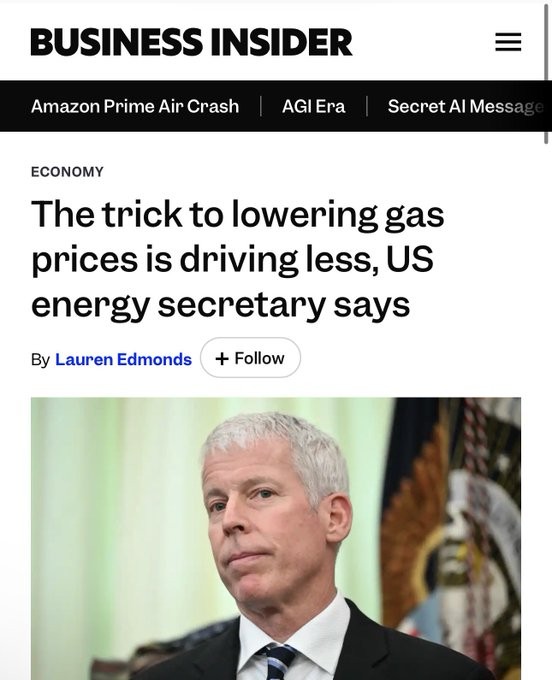
What’s next? Donald Trump delivering a White House address in a cardigan sweater?
 Rickards Calls It Now: No Rate Hike
Meanwhile, you can check the Fed off your list of uncertainties right now: “The Fed is not going to raise interest rates,” says Jim Rickards.
Jim is standing against the consensus here: Looking at the futures markets this morning, traders assign a 58% likelihood the Fed will bump up the Fed funds rate from 3.75% to 4% at its next meeting a week from tomorrow.
“Fed officials are clearly leaning hawkish,” Jim acknowledges. “Kevin Warsh made that apparent in his recent Jackson Hole speech. But leaning toward higher rates and actually raising them are two different things.
“The Fed is not particularly worried about unemployment right now. Last Friday’s employment report only reinforces that view. The economy added a stronger-than-expected 162,000 jobs in August, while unemployment held steady at 4.1% — giving the Fed little reason to worry about a weakening labor market.
“Inflation is another matter.
“It remains well above the Fed’s 2% target, and that’s where policymakers are increasingly focused. Some FOMC members are already leaning toward higher rates, but they’re not ready to pull the trigger in September.
“October is another possibility, but that meeting falls just days before the Nov. 3 midterm elections. I think the Fed will be extremely reluctant to raise rates that close to an election.
“That leaves Dec. 9 as the more likely window for a rate hike.”
In the meantime, Jim likes gold, military stocks and energy stocks to offset your rising cost of living.
The major U.S. stock indexes are starting the week in the red — but not dramatically.
The S&P 500 is down 0.4% as we write, back below 7,700. The Nasdaq’s loss is more modest, the Dow’s steeper. Gold sits just under $4,400, silver a little over $66. Bitcoin is climbing down from the $79,000 level while Ethereum is approaching $2,500.
On Main Street, “uncertainty remains high,” says Bill Dunkelberg, chief economist at the National Federation of Independent Business.
The NFIB is out this morning with its monthly Small Business Optimism Index. The headline number rings in at 98.7 — down from 99.8 the month before, but still above the index’s 52-year average.
The commentary accompanying this report was unusually pointed. “The Iran war lingers on with many promises that the war was about to end, but it didn’t and hasn’t,” writes Dunkelberg and colleague Holly Wade. “This has escalated the cost of energy which raises the price of almost everything. A third (31%) of the owners reported raising their average selling prices and about as many plan to do so in the coming months. This will not help the Fed get inflation to its goal of 2%.”
On the portion of the survey asking respondents to identify their single most important problem, 23% cited “quality/availability of labor” — down from 27% the month before, but it’s clear that good help is still hard to find.
“My problem is that no one wants to work,” says the owner of a services-oriented business in Tennessee. “I have advertised in all the areas I know of, and we have had a total of zero applications. In 30 years of business, this has never happened.”
Taxes and inflation were tied for second on the single most important problem list — both cited by 16%. Everything else was 10% or less.
 Commodities: It’s Still Early
“This is not sustainable,” says Paradigm natural resources pro Matt Badiali.
Matt points us to this chart from Crescat Capital showing that relative to the entire global stock market, the mining industry is the smallest on record — just 1% of the total market cap.
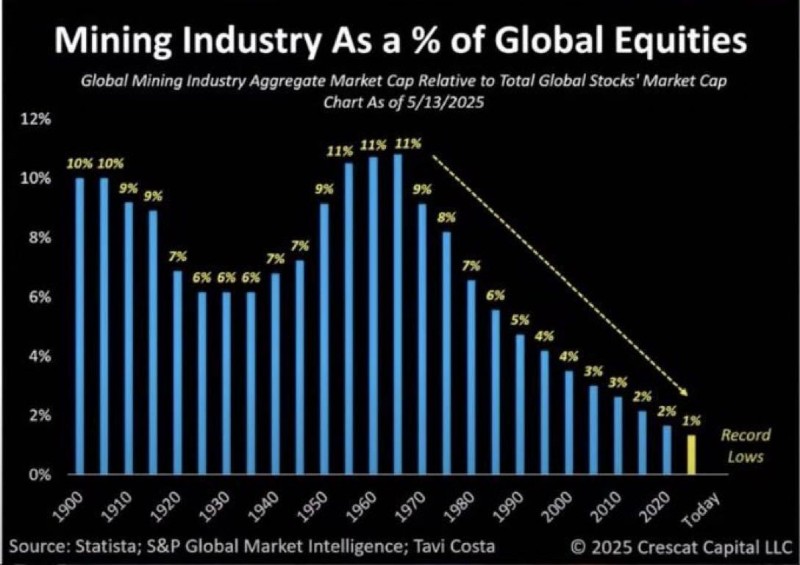
“If everything you use starts in a mine, then you must put capital in the ground and this must change,” Matt continues.
“It's not an ‘if,’ but a ‘when.’ We need to get our capital in place for the when, because when these commodities go, it's big and fast.”
And it’s not just the mining space. It’s also energy and agriculture — the entire commodity complex. The VanEck fund family shares this chart showing how cheap commodities are relative to the S&P 500. (The black line is a commodity index from Standard & Poor’s; the blue line is a commodity index from Bloomberg.)
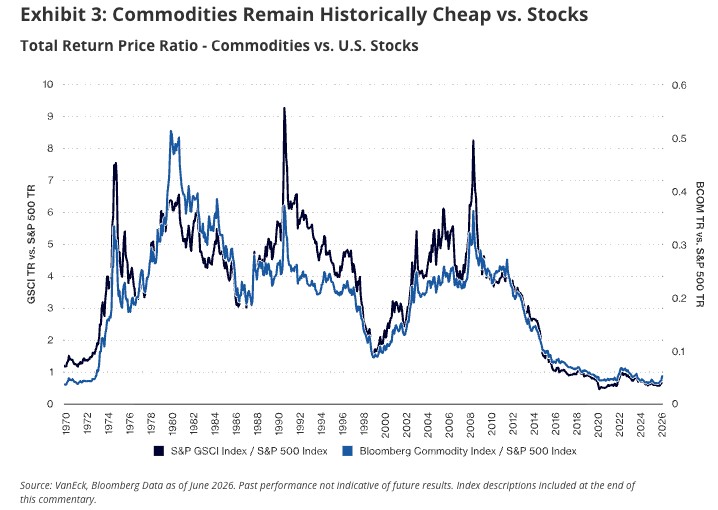
“Comparable extremes have historically preceded commodity outperformance,” says VanEck’s commentary — “as supply tightens and prices revert to the mean.”
 Mailbag: AI Debt, AI Boom
We got several appreciative notes after last Thursday’s guest edition featuring Sean Ring from The Rude Awakening — unpacking the trouble with AI-linked corporate debt.
“Most enlightening,” said one reader. “It explained a lot of things.
“Thanks for the explanation of CDS and how they work. Much appreciated. Keep up the good work.”
Next, a reader invokes the infamous “magazine cover indicator.”
“The attached isn’t in response to anything recently discussed in The 5 but I thought I would include it for a couple of reasons pertinent to your beat,” he writes.
The magazine cover indicator has become stock-market lore for decades. It even has its own Wikipedia entry. Basically it means that by the time a trend reaches the cover of a business magazine, the trend has played out and is about to reverse.
With that in mind…
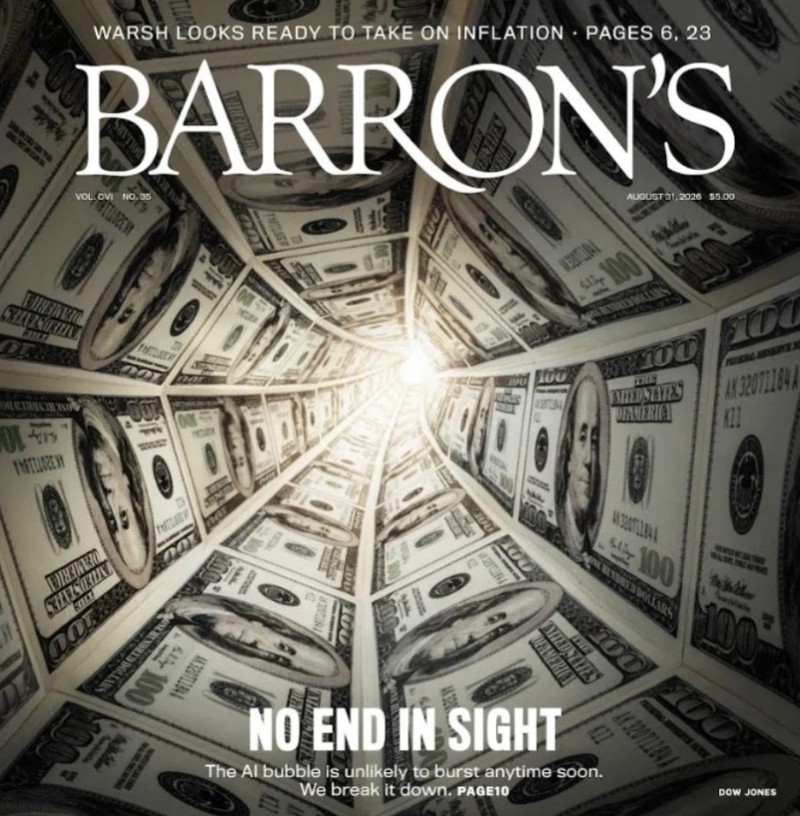
“The obvious signal,” the reader writes, “is their claim there is no end in sight for the AI boom.
“A second is the smaller headline at the top : ‘Warsh looks ready to take on inflation.’
“Given the widespread expectation of a Fed rate hike this month, might ‘unchanged’ be the least expected and hence less crowded trade? If yes, might September, against all seasonality, be a bullish month for the major indexes? Just saying…”
Dave responds: Well, you’ve seen Jim Rickards’ take above. And several other Paradigm experts are of the same mind, no matter what futures traders are saying.
If conventional wisdom shifts over the next week ahead of the Fed meeting, then yes — a September rally is potentially in the cards. We’ll be watching…


