
It’s Still Not Too Late
 It’s Still Not Too Late
 The headlines this morning are about oil back over $100. But “copper’s record-breaking run above $14,500/ton should get everyone’s attention,” says the legendary commodities expert Jeff Currie, who spent nearly 30 years at Goldman Sachs.
In the short term, traders are trying to get ahead of any new tariffs that might be announced by the Trump administration.
But the long-term story is a familiar one if you’ve been keeping up with these daily missives — supply and demand.
The red metal is up 17% year to date.
“Prices keep rising because copper is the most important metal for electrification,” Paradigm’s Matt Badiali reminded his Real Wealth Insider readers yesterday.
“It's so integral to electricity that it has no substitute in many cases.”
Matt directs your attention to a recent report from S&P Global called Copper in the Age of AI. It projects a 50% jump in copper demand between 2025–2040.
But while the report anticipates demand for 42 million metric tons of copper come 2040… production will likely fall 10 million tons short “without meaningful supply expansion.”
Bringing a new mine online is a tedious process: Start it today and you might not be up and running until… well, 2040.
That means for the time being, “most of the new copper supply will come from expanding existing mines, rather than from new mines opening up,” Matt says. “We simply can't bring new mines on fast enough to meet supply needs.”
For the moment, copper mining stocks are still bargain-priced.
“Despite the demand tailwinds behind copper,” says Matt, “the wars in Russia and Iran have recently kept a lid on copper miners' share prices” — as you can see in this chart of COPX, the big copper miner ETF…
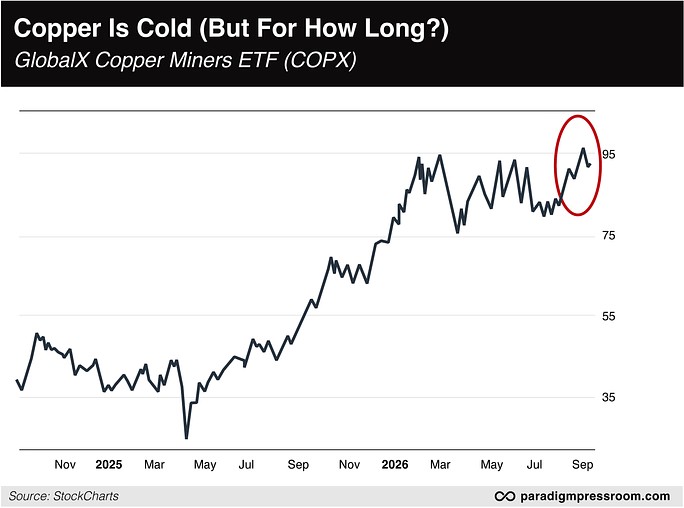
But judging by the quarterly numbers of the biggest companies in the space… that’s about to change.
“For example,” Matt says, “giant miner Teck Resources (TECK) reported EBITDA (earnings before interest, taxes, depreciation and amortization) up 204% year over year. Freeport-McMoRan (FCX) beat earnings estimates by 25%. That was the trend across the copper mining sector.
“I expect the third quarter's results to be even better.”
We’ve mentioned COPX several times so far this year. It’s still not too late…
 Missiles Fly, Oil Soars
“All evidence suggests that both Iran and the U.S. are spoiling to return to full-scale combat operations,” says a tweet from retired Army officer Daniel Davis, now host of a podcast with a growing following.
“Iran knows that to fire on U.S. warships will elicit a major response, and the U.S. knows that to continue hitting civilian tankers in exchange for a military strike is going to spawn an even bigger Iranian retaliation.”
Sure enough, U.S. forces launched more airstrikes against Iranian oil tankers last night — and Iranian forces responded with a heavy missile attack on U.S. bases in Jordan.
It seems the news about the Trump administration wanting to keep a lid on the war ahead of the midterm elections was so last week.
And with that, Brent crude futures — the global benchmark — have indeed gone back over $100 a barrel. U.S. futures are up 3.5% on the day at $96.36, the highest since early June.
And so once more, the familiar pattern: Rising oil prices translate to rising inflation expectations, which translate to rising bond yields.
Oil prices were already jumping yesterday — and the yield on a 10-year Treasury note reached 4.805% — the highest closing level since October 2023.
This morning, the Treasury Department announced it would buy back $6 billion in longer-term Treasury debt — even more than the $4-plus billion Treasury Secretary Scott Bessent was touting last month.
If the idea of today’s super-sized announcement was to keep a lid on yields, it’s not working. The “bond vigilantes” are showing up and expressing a vote of no-confidence in Uncle Sam — with the 10-year yield inching still higher to 4.841% as we write.
The high-water mark in October 2023 was 4.99%. If we move into 5% territory, we’re looking at the highest yield on the 10-year since 2007. And it’s the 10-year that most affects everything from mortgage rates to corporate debt.
For the moment, higher inflation expectations are also translating to a precious metals rally and a stock-market slump.
At last check, the S&P 500 is down a half percent at 7,635, threatening to break below a level that’s held for more than a month. The day’s losses in the Nasdaq and Dow are closer to three-quarters of a percent.
But gold is up nearly 50 bucks and back over $4,400. Silver has jumped nearly 2.5% to $67.26. Crypto is treading water, Bitcoin at $78,625 and Ethereum just under $2,500.
Your editor has been remiss in noting some of the recent winners racked up in Paradigm publications. They include…
- 73% on Fortuna Silver Mines, a long-term holding in Rickards’ Strategic Intelligence
- 30% in a matter of weeks on shares of Peabody Energy in Mason Sexton’s The Map
- 100% in a day for Altucher’s True Alpha, playing call options on a small=cap cybersecurity name
- Gains of 317% and 645% on Intel call options in Chris Cimorelli’s 10X Trade Club (the latter materializing in one day).
 One More Time: Busting a BRICS Myth
The Global South will continue tiptoeing away from the dollar this week — but don’t expect a new global reserve currency anytime soon.
Leaders of the BRICS nations will gather for their annual meeting in New Delhi, India on Friday and Saturday.
As you’ll recall, BRICS is a grouping of the world’s biggest developing economies — Brazil, Russia, India, China and South Africa. Since 2023, those five countries have been joined by Ethiopia, Egypt, Iran, Indonesia and the United Arab Emirates.
“One thing I always keep an eye on is the BRICS’ usual push to reduce reliance on the U.S. dollar and Western financial institutions,” says Paradigm macroeconomics authority Jim Rickards.
“On the face of it, there has been some progress. Russia and China are settling an increasing proportion of trade in their own currencies.
“But this hasn’t been facilitated by the BRICS group itself. Sanctions have forced Russia to move away from the dollar. And in China, the rise in renminbi cross-border settlement in large part reflects increased financial flows between mainland China and Hong Kong.”
Every BRICS summit comes with breathless social-media hype about an imminent alternative to the dollar as a reserve currency. “That’s not happening,” says Jim.
The reason is one he’s emphasized for years now: “The key is not the currency itself, but a bond market in that currency large enough to absorb global savings. The U.S. Treasury securities market is the only market in the world large enough to do that job.”
Thus, dollar-denominated assets still make up 59% of global reserves.
“That does not mean the BRICS and others have been standing still,” Jim cautions. “They are creating payment systems, clearing houses and lending arrangements to shield payments from U.S. interdiction and asset freezes. The latest development in this trend is a Russian ruble stablecoin called A7A5.
“The brilliance of stablecoins is that once the buyer deposits rubles and receives A7A5 tokens, there's little incentive to swap out of the trade. Stablecoins create long-term demand for the underlying currency while giving the token holder a store of value and something that can be exchanged in the cyberworld.”
But don’t get the wrong idea: The dollar’s position isn’t invincible.
“If the dollar is rejected globally,” says Jim, “it won't be for another currency. It will be for gold.
“You don’t need a bond market to own gold. You just own the gold. If you want to see the demise of the dollar, don’t look at foreign exchange rates or interest rates. Look at the dollar price of gold.”
➢ On that score… note that even after a big pullback this year, the dollar price of gold is up 115% from the time Russia invaded Ukraine in February 2022 and Washington froze the Russian central bank’s dollar assets.
 Plot Twist!
It appears the robotaxi that has no steering wheel or pedals does have a manual driving mode.
Let’s back up a bit: Last week, Tesla debuted its Cybercab in Austin, Texas. As it happens, Paradigm’s Davis Wilson, editor of our sister e-letter The Million Mission, is based in Austin and gave one a spin yesterday.
Sure enough, there is no steering wheel or pedals. “The interior consists of two seats and a giant screen in front of you.”
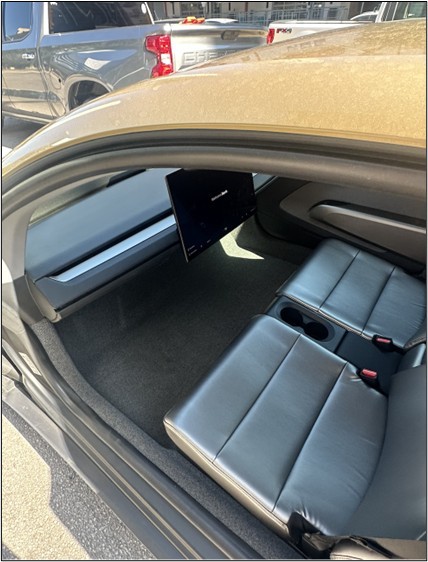 Look ma, no hands! [Davis Wilson photo]
As Davis sees it, the Cybercab delivers both a smoother ride and a more direct route to his destination compared with the Waymos owned by Google parent Alphabet. You can see his full review right here.
Meanwhile, someone else trying out the Cybercab this week made an eye-opening discovery…
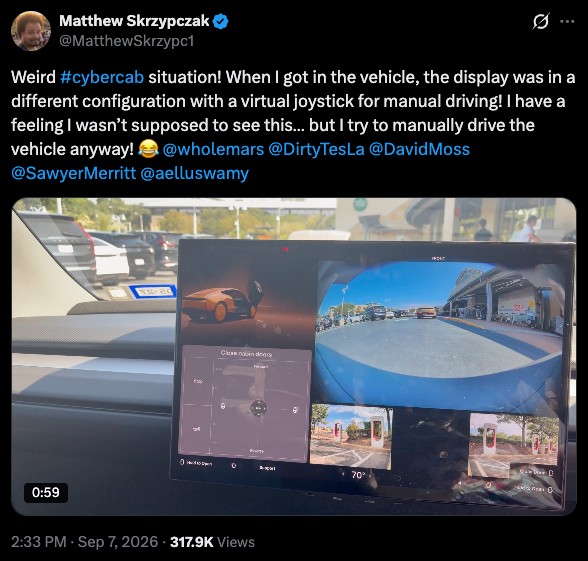
As the Elektrek site reports, “a Cybercab still has to be moved by a person sometimes, whether that’s repositioning it in a depot or nudging it out of a tight spot, and with no wheel and no pedals, an on-screen joystick is how you do it. Tesla has never shown this mode publicly…
“A touchscreen joystick is fine for creeping a car across a parking lot at walking speed, but those controls honestly look awful to use. It’s not a serious answer to the question regulators are actually asking, which is what happens when a driverless car needs a human and there’s no real way for one to take over.”
 Mailbag: Social Security
“The Social Security system is out of containment. It is best to eliminate it. Yes, totally phase it out over the next 50 years or less,” a reader writes after last Wednesday’s edition.
[And this individual hastens to add he’s been collecting a check for 26 years.]
“Those now 40 years old and above — required to stay in. Those 30–40 years old — option to stay or go. Those under 30 — mandatory to go.
“All those required or choosing to go would receive back all contributions they paid in. (Not employer's share, just their own.)
“In 40–50 years, the youngest now would have passed on and the program would be buried, too.
“Those out of the system would receive years of strong propaganda and retirement planning advice making it clear that they have to take care of their own future. The private market will do the job.
“Something would have to be worked out about disability and dependent children but that is just a detail. The monster dies and plagues us no more.”
Dave responds: Hardcore.
But see, you’re proposing a solution — which is the last thing the control freaks and power-trippers want.
It goes back to the original conception of government old-age pensions in Germany under the “Iron Chancellor” Otto von Bismarck during the 1880s.
“Bismarck’s explicit aim,” wrote the historian Ralph Raico, “was to prevent the workers from attaining middle-class status through gradually accumulating private means and then passing them on to their children, in a steady intergenerational embourgeoisement of their families.
“Instead, members of the working class would be made ever dependent on state pensions, for which they were expected to show a fitting gratitude.”
To this day, the U.S. Social Security website has a page devoted to Bismarck…

And so it goes.


