
Altucher: The Tech Sell-off — Fact vs. Fiction
 Altucher: The Tech Selloff — Fact vs, Fiction
 “I’m about to give back all the gains I’ve made this year,” Song Mi-kyung tells the Financial Times.
That’s about $200,000 — not chump change at age 60.
Ms. Song lives in Seoul and is one of millions suffering as the air has come out of the AI trade in general and the memory trade in particular — putting a severe hurt on South Korea’s stock market. As we mentioned on Tuesday, it’s tumbled 34% in only five weeks.
Maybe you’re feeling at least a bit of Ms. Song’s pain?
Yesterday on the Paradigm Press mobile app, our AI authority James Altucher unpacked the recent turbulence in the AI trade.
No, I won’t pester you to download the app if you haven’t already. Not today. James’ analysis at this moment in time is important enough to share as today’s Bullet No. 1.
As he sees it, there’s no single factor at work. Rather there are several — and James will walk us through them one by one.
For starters, there’s the news that Nvidia is putting up $250 billion to help OpenAI build a huge data center in Ohio.
That is, Nvidia is backing the loans that OpenAI is taking out to buy Nvidia’s chips. It didn’t take long for skeptics to emerge and (once again) point out the “circular” nature of Nvidia’s transactions.
“People forget that this is normal in every industry,” James counters. “You help your customers pay for your goods (e.g. car companies own car financing companies) so that your customers can grow and then become bigger customers.
“It's just weird to see this at a $100 billion-plus level. But it is more noise than signal.”
Then there’s the IPO in China of CXMT — an emerging competitor in the memory space to Micron Technologies (MU).
To say nothing of South Korea’s Samsung and SK Hynix. Together those three companies make up the “Big Three” of memory worldwide.
CXMT soared 466% on its first day of trading. Meanwhile, MU and the Korean players tanked — on the theory that the new kid on the block can flood the market and meet the inexhaustible demand for memory that the Big Three can’t keep up with.
“Is CXMT competitive and cheaper?” James asks rhetorically. “Answer: of course not!”
And even if it were, James says Micron retains several advantages…
- An order book that extends through 2028
- A P/E ratio of 5. “For 30 years,” says James, “it hasn’t traded lower than 6”
- A regulatory moat: “Does anyone really think America is going to store all of its memory on Chinese memory chips?”
James’ bottom line: “MU can just use its own cash to buy back the company in a couple of years. That's insane.”
Meanwhile another Chinese firm is supposedly about to muscle in on an AI business dominated by the West.
The Dutch multinational ASML has a global lock on the photolithography machines with which chips are made.
A Chinese upstart is now building its own machines — and the aforementioned CXMT is among the first customers.
But James says the Chinese firm has only DUV or deep ultraviolet machines — a 30-year-old technology. ASML, meanwhile, introduced more powerful EUV or extreme ultraviolet machines starting in 2016.
“ASML has a 20-year head start on this,” James says. “There is no competition.”
Finally, there’s the new flavor-of-the-month AI model from China — Kimi.
Kimi is the product of the Chinese firm Moonshot. It’s an “open-weight” model — available for all to customize and run on their own hardware.
To hear some people tell it, Kimi’s K3 release is as good as Anthropic’s Claude Opus 5 — bad news if a $30 billion newcomer can show up a $1 trillion incumbent. What’s more, if Kimi K3 lives up to its billing, it could even undermine the case for construction of all those AI data centers in the United States.
But after examining both models hands-on, James isn’t buying it: “Kimi K3, let's face it, sucks compared to Claude. I don't care what the benchmarks say…
“For simple app development K3 is taking 20 times as long as Opus 5. 20 times! It means nothing if the results are great if I can't even get the results.”
But even if K3 were as good, “then more data centers will be built,” James says, “because you still need massive infrastructure to support mega demands on open-weight models like Kimi.”
That’s good news for a host of AI players, James says. Nvidia and its GPUs… Marvell Technology (MRVL) and its connectivity capabilities… Intel (INTC) and its CPUs… and Astera Labs and its interconnects.
Put it all together and “each one of these issues turns out not to be an issue,” James says.
Sooner or later he says the market will figure it out. Remember the freak-out 18 months ago when the Chinese AI model DeepSeek burst onto the scene?
You don’t? That’s the point. And if you do remember, you know it had little to no impact on American AI players in the long term.
None of that is to dismiss the short-term pain in the AI trade. But James says we’re in a “sell first, ask questions later” frenzy. And like the DeepSeek frenzy, he believes this too shall pass.
 Rebound Day
The major U.S. stock indexes are rallying today — but not enough to overcome yesterday’s losses.
Before the numbers, let’s unpack the many crosscurrents at work.
First, there’s the AI hyperscalers Microsoft and Meta reporting their quarterly numbers. We won’t belabor the numbers, which you can find anywhere. As we’ve said for several days, Wall Street is starting to focus on whether the billions of dollars these companies are plowing into AI infrastructure will pay off.
In the case of MSFT, confidence is high — and shares are up over 15% on the day. In the case of META, confidence is lost — and shares are down nearly 9%. Up next after the closing bell this afternoon is Amazon.
Then there’s the Federal Reserve — which, to no one’s surprise, left short-term interest rates alone yesterday. If you care, the vote was 9-3.
More interesting was the disconnect that became evident during Fed chair Kevin Warsh’s press conference.
Throughout, he was adamant about getting the inflation rate back down to the Fed’s target of 2%. But asked about why the Fed didn’t raise rates yesterday to work toward that goal, he hemmed and hawed.
(He also frequently answered questions by starting “So…” It’s a tic that betrays a lack of full confidence in what he’s saying. As we’ve chronicled over the years, it also afflicted his two most recent predecessors.)
The bond market took it all to mean that the Fed isn’t really serious about getting inflation down — especially with shooting underway again this week in the Persian Gulf. This morning, the yield on a 30-year Treasury bond is up to 5.21% — another high-water mark last seen in 2007.
As irony would have it, the Commerce Department is out this morning with the Fed’s preferred inflation gauge, called “core PCE.” The number for June rings in at 3.3% — down barely from May’s 3.4% and (as you’ve no doubt noticed) nowhere near the Fed’s 2% target.
➢ Not that we care too much here, but the Commerce Department also issued its first guess at second-quarter GDP growth — a meager 1.5% annualized, well below the 2.3% expected by the typical Wall Street economist, and down from the previous quarter’s 2.1%.
Put it all in a blender, and the S&P 500 is up more than 1% as we write, back over 7,400.
The tech-heavy Nasdaq’s performance is stronger — up 2.5% and back over 25,000. The Dow is the laggard, up less than three-quarters of a percent and still shy of 52,000.
Hats off to readers of Enrique Abeyta’s The Maverick, who’ve booked several wins the last couple of days playing the downside of the market with put options — 48% on the small nuclear reactor firm Oklo Inc.… 48% on Dell Technologies… and 31% on Intel.
For the record, Enrique believes that the recent pullback “is a healthy part of the current bull market” — but it might have a few more weeks or months to go.
Precious metals are trying to stage a rally — gold back over $4,100 and silver up over a buck to $58.65. Crypto is suspiciously quiet — Bitcoin still hanging out just under $65,000 and Ethereum over $1,900.
 War Merger on Hold (for Now)
For the moment it seems cooler heads are prevailing — and the Iran and Ukraine wars are not metastasizing into a single mega-conflict.
Off the top of Monday’s edition we told you how Ukrainian forces attacked an Iranian ship. Ukraine’s president Zelenskyy took credit for the attack and said the ship was hauling weaponry.
Since then, the two countries’ foreign ministers have talked. It seems as if they’re trying to tamp down the tension. Here’s the take from the Iranian side…
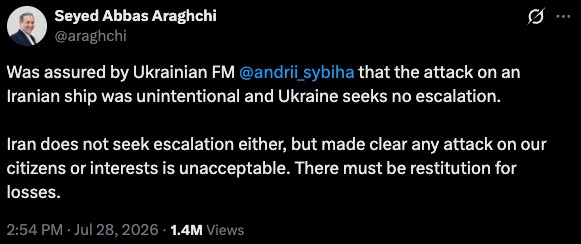
Still, this may not be the last such “incident” of its kind. In fact, Zelenskyy has every incentive to stoke another.
“If the two wars become one,” writes Trita Parsi of the Quincy Institute, “Ukraine ceases to be merely a recipient of American military assistance and instead becomes a direct participant in Washington's war with Tehran.
“By the same token, the United States would no longer simply be Ukraine's principal arms supplier. It would become an active belligerent against Russia through a conflict that stretches from the Black Sea to the Caspian.”
That matters when it comes to domestic politics here in the United States, Parsi tells The American Conservative: “It gives war with Iran another lease on life, it brings the Europeans into the war as well through the merger and perhaps most importantly war with Iran is reframed as defending Ukraine rather than defending Israel.”
In the meantime, U.S. oil futures are drifting lower after the latest U.S. attacks on Iran.
Despite Donald Trump’s threat yesterday to “beat the ****ing *** out of them”... the military analyst Will Schryver tweets that U.S. forces did “little more than launch some token pin pricks against various Iranian targets along the Persian Gulf coastline, and not far inside Iran’s borders.”
At last check, New York oil futures are down about a buck to $83.60.
 Sign of the Times?
OK, we’re not quite done with socialism yet.
What makes this meme interesting is that 1) it includes Donald Trump and 2) it’s circulating on alt-right social media…

 Mailbag: Data Centers
“Seems to me that the siting of data centers is not unlike the siting of nuclear waste repositories,” a reader writes after our latest exploration of the data center backlash last Friday.
“Communities that cry NIMBY will never be good hosts, and that wish should be honored. But with proper economic incentives and other favorable conditions (a grid that can support the power needs, perhaps with an upgrade, and ample water resources), some communities will step up and volunteer to host a data center.
“Is it too much to ask that we solve this issue collaboratively instead of by picking sides and going to battle? Oh well, a man can dream.”
“The powers that be are worried about anti-tech extremism you say? They must be thinking of the late Ted Kaczynski,” writes one of our semi-regulars.
“Of course, when the demands of the voters, the voice of the people, the will of supposed people in charge of the United States of America, amount to nothing more than ‘background noise,’ what other recourse do they have?
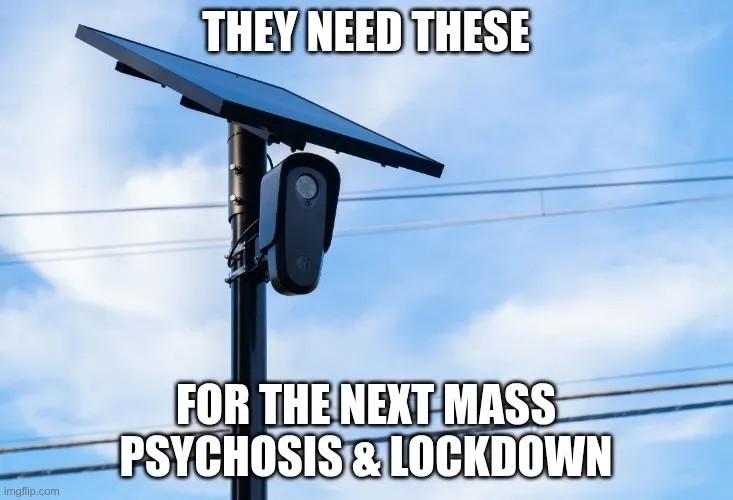
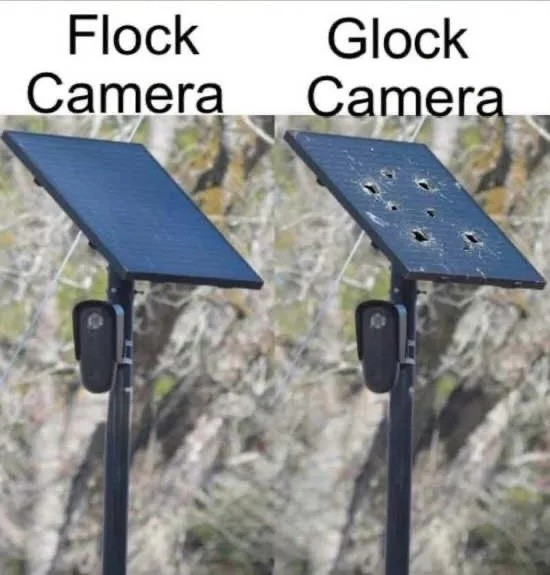
“It's hardly a surprise that we have Fourth Amendment vigilantes cutting down Flock cameras since complaints, petitions and votes seem to get nowhere in the face of the inevitable AI revolution. Truly the power of the vote has eroded far worse than the value of the lobbyist's dollars.
“Of course, once any technology is invented a Pandora's box is opened and cannot be closed, but shouldn't people have some say in how far is too far? Shouldn't they be able to opt out of turning their country into a panopticon watched over by synthetic guards? Or being forced to bid against megacorporations for every last watt of electricity?
“What's most interesting to me is that a wide net with a fine gradient is being cast when looking for supposed extremists. A reaction like that makes me think that some people way at the top are worried about a modern Ned Ludd, or dozens of Ted Kaczynskis starting to come out of the woodwork. Perhaps they're still thinking of that one health care CEO? Maybe they'll feel safe once they are assured of their own control over every street corner.
“In spite of his methods, Mr. Kaczynski made some reasonable points that people ought to fear what the elites would do with an Orwellian surveillance system at their fingertips. We can't wish away the future. AI and data centers are here to stay. But I sure do wish it didn't have to be like this.
“All the best and I hope we don't get put on that list.”
Dave responds: I wondered when a reader might invoke the specter of Flock cameras and how they intersect with AI.
Like the data center backlash, the backlash against Flock cuts across party lines. It was originally portrayed in the media as the province of left-wing anarchist types. Now it’s turning up in the conservative pockets of social media.
If you’re still unsure what the controversy’s all about, you should hear from Glenn Jacobs — once known on the pro wrestling circuit as “Kane,” now mayor of Knox County Tennessee, population 511.000.
On Monday he posted a video on social media urging the county commission to prohibit the use of Flock cameras in Knox County. From the transcript…
While license plate readers have been around for a while, because of AI and vastly increased networking and data retention capacities, these Flock cameras have capabilities not even imagined in the past.
Older cameras only took a photo of your license plate, which was then retained for a short time. Flock cameras take a photo of your plate, but also use AI to catalogue distinguishing features of your vehicle: make, color, model, even bumper stickers. That data is stored in a searchable database for sometimes up to a month or more, depending on the policies of that particular agency. When these cameras are deployed in large numbers, they create a network that can be used to track your movements.
Currently, there is no federal regulatory framework governing these devices in place, and the Tennessee laws regulating them were written over a decade ago. My fear is that [it] may be inadvertently creating a warrantless mass surveillance system and undermining the privacy and Liberty of our people.
Flock Safety might be the most-loathed company in the country next to Palantir. Unlike Palantir, Flock is privately held…


