
The Position of **** You
 The Position of **** You
 It might be the most brilliant financial-planning advice that ever came out of Hollywood.
In The Gambler, Mark Wahlberg plays Jim Bennett — a college professor who racks up huge gambling debts he can’t repay.
As a result, Jim finds the lives of his loved ones under threat from a handful of loan sharks.
During a scene that’s made the rounds on social media in recent years, a loan shark named Frank — played by John Goodman — tells Jim in blunt terms how dumb he’s been with his winnings.
Jim: I've been up two and a half million dollars.
Frank: What you got on you?
Jim: Nothing.
Frank: What you put away?
Jim: Nothing.
Frank: You get up two and a half million dollars, any a**hole in the world knows what to do: You get a house with a 25-year roof, an indestructible Jap-economy s***box, you put the rest into the system at 3–5% to pay your taxes and that's your base, get me? That's your fortress of f***ing solitude. That puts you, for the rest of your life, at a level of f*** you. Somebody wants you to do something, f*** you. Boss pisses you off, f*** you! Own your house. Have a couple bucks in the bank. Don't drink. That's all I have to say to anybody on any social level. Did your grandfather take risks?
Jim: Yes.
Frank: I guarantee he did it from a position of f*** you. A wise man's life is based around f*** you. The United States of America is based on f*** you. You're a king? You have an army? Greatest navy in the history of the world? F*** you! B*** me. We'll f*** it up ourselves.

What Goodman’s character calls “your fortress of f***ing solitude” is what the rest of us call “financial independence.” Or maybe “the millionaire next door.”
Unfortunately, $2.5 million is no longer enough for “your fortress of f***ing solitude” — as your editor said last night in a reply to a post of the movie clip on X.
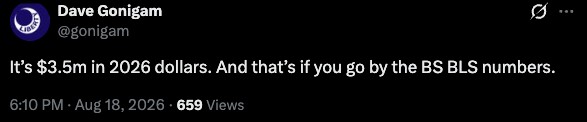
The Gambler came out in 2014. Just going by the official inflation numbers, $2.5 million then is $3.5 million now.
And as we can’t say often enough, the official inflation numbers are doctored through statistical games that economists give fancy names to cover up the sleight of hand. Such as…
- Hedonic adjustments. If the price of a new car goes up, but the manufacturers add new features to the new models, well then the price of a new car hasn’t really gone up, has it?
- Substitution. If you start buying hamburger because steak is too expensive, well, your price of beef hasn’t really gone up, has it?
Seriously, this is how government statisticians think.
Worse, we’re not going back to “normal” 2% inflation anytime soon. We’ve cited the historical evidence regularly since 2023: Whenever the inflation rate sails past 5%, it typically takes a decade to get back to 2% or less. That means we’re looking at elevated inflation into the 2030s.
The impact on your finances — whatever size of pile you’ve got — can be devastating.
Paradigm’s macroeconomics authority Jim Rickards breaks down the numbers: “Just 3% inflation cuts the value of the dollar in half in 24 years and half again in another 24 years. That means in a typical career from age 17 to age 65, the dollar will lose 75% of its purchasing power.
“It takes an amazing combination of hard work, saving and investment skill to beat those odds. With inflation above 3%, the destruction of dollar purchasing power is even greater.”
The good news, such as it is, is that U.S. stock market returns so far in the 2020s have outpaced the cost of living. But for how much longer?
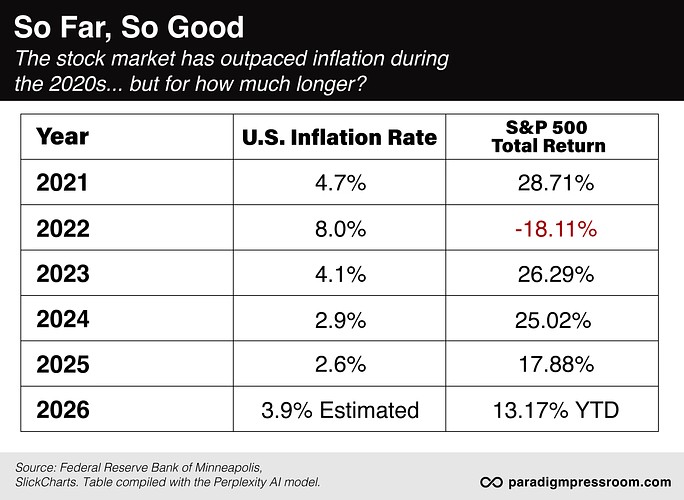
It is unusual for the S&P 500 to generate double-digit returns in three consecutive years. It’s rare indeed for four years in a row — happening only three times in the last century.
Which means that after another year or two, you can’t put your money in an index fund and expect to stay ahead of the inflation monster.
It’s always been our mission at Paradigm to deliver investment ideas that can outperform “the market.”
But the present environment gives us an even more important mission — to deliver investment ideas that will offset a relentlessly rising cost of living.
We thank you for your patronage and your trust. We know that trust has to be earned anew every day.
 Move Along, Nothing to See Here
The Trump administration is using paper clips and rubber bands to prevent the bond market from blowing up.
As noted here yesterday, the yield on 30-year Treasury bonds hit 5.32% this week — the highest since 2007. Rising Treasury rates mean that people aren’t interested in buying the debt of a debt-addicted Uncle Sam who’s racked up nearly $40 trillion in future obligations.
Which is bad enough, but there’s also a snowball effect: The higher interest rates rise, the faster the debt grows.
So this morning the Treasury Department announced Uncle Sam will more than double its buybacks of U.S. Treasury debt.
In recent weeks, these repurchases have taken place every 10 days or so, at a pace of about $2 billion per operation. Per a Treasury Department press release, the plan is to amp up each buyback to “at least” $4 billion starting next month.
“Buying bonds pushes bond prices up and yields down,” Paradigm income-investing pro Zach Scheidt reminds us. “Lower yields ripple into mortgage rates, CD rates and borrowing costs across the board. That's stimulus.”
But here’s the problem: “Stimulus usually shows up when an economy is struggling,” says Zach. “That's not where we are.
“The S&P 500 just hit an all-time high, and hyperscalers are pouring hundreds of billions into the economy.
“Call it what it is: the government using its own buying power to push yields lower in a market that wasn't asking for help.
“This is market manipulation. And manipulation doesn't end well. Free markets correct themselves. Manipulated ones do too, just more violently, once the money or the resolve runs out.”
For the moment, however, the announcement has had the desired effect.
The yield on a 30-year T-bond has fallen from Monday’s peak of 5.32% to 5.2% this morning. For the bond market, that’s a massive move in less than 48 hours.
But how long will it stick?
Recall that Treasury Secretary Scott Bessent intervened at the end of July to prop up the Japanese yen — to ensure that Japanese owners of U.S. Treasuries would be less inclined to dump their holdings so they could raise needed cash.
That too knocked down U.S. Treasury yields — for a while. And then they started rising again.
Each new intervention reeks of desperation. But that’s how it goes when your national debt explodes 68% higher since the onset of COVID and all the mad spending that followed…
 Cancer Breakthroughs and Humanoid Robots
The big stock stories today are in the realms of biotech and robotics.
Shares of Moderna Inc. (MRNA) are up 136% after the company announced a successful trial of an mRNA-based shot for skin cancer.
We won’t dwell on the implications here. Our biotech expert Ray Blanco will have an update later today for Altucher’s Investment Network readers — and we’ll share excerpts here tomorrow.
The other big story comes from China — where shares of Unitree Robotics began trading today in Shanghai, and they promptly soared over 450%.
Unitree is the world’s leading maker of humanoid robots — a realm followed closely by Paradigm AI authority James Altucher.
As he explained it in this space on New Year’s Day, James once wrote off humanoid robots… and then it hit him. “The entire world has been constructed to fit 8 billion 5’8”, two-armed, two-legged humans.
“If you want a robot that can vacuum, make a bed, cook, pack goods, stack shelves, move objects down hallways, climb stairs, open doors and work inside spaces already optimized for people… you don’t redesign the world.
“You redesign the worker. That worker is humanoid.”
The U.S. leader in this space is Tesla. Unfortunately plans for its Optimus robot are behind schedule, with release for consumers and businesses pushed off until next year.
Reason? The huge number of custom components and a wicked-complex supply chain.
Of course, it’s the suppliers to big companies that often deliver outsized gains — something James and his team are monitoring closely as Optimus moves closer to launch.
As for the broad U.S. stock indexes, they’re all in the green today — but not by much. The S&P 500 is up about a third of a percent as we write and back over 7,700.
The real action is in precious metals — gold up $164 and *this* close to $4,500 for the first time since June. Silver’s up 4% to $65.74.
That’s a function of two things we spotlighted in Bullet No. 2. All else being equal, falling interest rates give a lift to precious metals, which have no yield. But at the same time, the Treasury buyback announcement has touched off a flight from the dollar — the U.S. dollar index down more than three-quarters of a percent to 98.85 — the lowest since May. Hot money fleeing dollars is moving toward gold and silver, at least for today.
Digital nondollar assets also appear to be benefiting from dollar weakness. At last check Bitcoin is up nearly $3,800 to $68,360 — and Ethereum is slingshotting its way toward $2,100.
U.S. oil futures are up over 2% to $86.60. The weekly inventory numbers from the Energy Information Administration show that supply of distillates — diesel and jet fuel — are at critically low levels. A gallon of diesel that cost $4.58 in early July costs $5.46 now.
 Comic Relief
Well, as long as we have inflation on the brain…

 Mailbag: Private Credit
“Excellent explanation by Enrique Abeyta as to the difference between the housing bubble and the private equity bubble,” a reader writes in response to yesterday’s guest edition.
“Your clear and concise description of the ‘tells’ in both situations is most helpful. Too many times an author describes the problem but doesn't provide the clues we should be looking for. Thank you Enrique from a longtime subscriber.”
“I want to acknowledge how much I appreciate the market insights as well as your insights into private equity health,” chimes in another. “What you are describing relates to my local agricultural economy with local lenders tightening their evaluations for renewing operating lines of credit.
“Annual operating lines are no longer routinely approved, leaving farmers and ranchers ‘shell-shocked’ and treading water financially.
“In a part of the country hammered by long-term losses created by wildfires as well as our state water resources department threatening water rights curtailments we are faced with a double-edged sword of asset devaluation.
“I hope you continue to analyze the private equity market but go deeper on who is being impacted.”
Dave responds: Rest assured we’ll stay on top of it.
As long as you brought up your region’s farm economy, I went and checked the Rural Mainstreet Index this morning. I don’t do it regularly and maybe I should.
Every month, Creighton University economist Ernie Goss surveys bankers in rural areas of ten states dependent on either agriculture or energy. As with many sentiment indicators, numbers over 50 suggest growth. Under 50, contraction.
The index has spent five of the last six months below 50 — plunging from 52.6 in June to 42.1 in July.
“More than half… of bank CEOs reported that very weak commodity prices will be the greatest challenge to the agriculture economy,” Goss says.
Yes, grain prices are up — but farmers’ input costs (i.e., fertilizer in short supply after the U.S.-Israeli attack on Iran) are up more.
Thanks to all for the notes of appreciation and the on-the-ground insight.


