
“They Need Us and We Can Control Them”
 “They Need Us and We Can Control Them”
 It takes a lot to faze Dylan Ratigan. But then he came face-to-face with how the power structure in this country really works.
A refresher: It was 15 years ago this month when Ratigan went viral for an epic rant during a daily show he hosted on MSNBC.
"We've got a real problem... This is a mathematical fact! Tens of trillions of dollars are being extracted from the United States of America... An entire integrated system — financial system, trading system, taxing system — that was created by both parties over a period of two decades is at work on our entire country right now."
Even now, it’s worth a watch — if for no other reason than to see the worried faces on the support staff in the background!
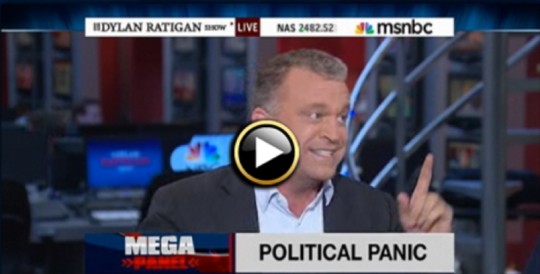
Ratigan didn’t spell out precisely what he meant by “extraction.” But earlier that day the Federal Reserve put savers on notice that they’d be hosed for at least two more years with rock-bottom interest rates on T-bills and money market funds and short-term CDs — rates they’d been stuck with ever since the 2008 financial crisis.
Or maybe he was referring more broadly to the culture of “privatized profits, socialized risk” that led to taxpayer bailouts of the big banks in 2008.
In any event, Ratigan quit the TV news racket about a year after what he called his “primal yell.” In the years since he’s taken on a variety of endeavors aiming to merge his interests in both entrepreneurship and charity. Doing well by doing good, as it were…
Among those endeavors was a business called Helical Holdings. It was the subject of a New York Times profile about a decade ago…
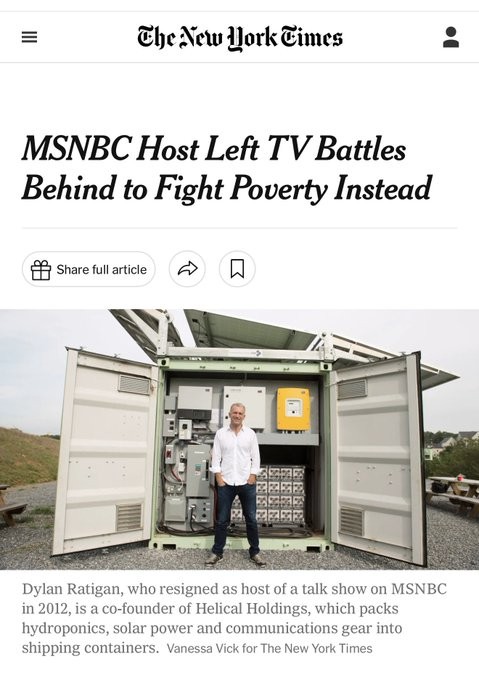
As Ratigan recalled in a post on X last week, “The idea was to turn shipping containers into self-contained resource stations: solar power, water filtration, food production and wireless connectivity.
“Linked together, they could form a distributed infrastructure for basic human needs. We built them in Louisiana and Texas, using local manufacturing and training returning combat veterans to deploy and maintain them.
“The goal was simple: replace dependency with distributed local capacity.”
He got a friendly reception from foundations, corporations and governments. He was especially encouraged when the State Department took a meeting with him.
But the idea never got traction.
“More than a decade later,” he continued, “global resource infrastructure still largely revolves around centralized delivery—moving water, food, power and equipment into places —rather than enabling local production.”
You’d think that especially after the COVID supply-chain shocks, this sort of resilience Ratigan’s aiming for would have an appeal, right?
And then a State Department official took him aside and explained the problem.
As Ratigan recalls, here’s what this official said: “If we control people’s access to food, water, electricity and connectivity they need us and we can control them. If we build a distributed network of resource hubs, they don’t -- and we lose power.”
Ratigan thought long and hard after the encounter.
“That reframed everything. I had assumed the goal of aid was identical to its stated purpose: to solve the problem. By that logic, the best system would eliminate the need for itself.
“But institutions operate under incentives as well. A corporation gains value from being the controlling provider of resources. A charity depends on perpetuating ongoing need. A government program derives influence from administering temporary assistance that can be withdrawn as a punishment for noncompliance.”
Ratigan refuses to be drawn down any conspiratorial rabbit holes. “It simply reflects how incentives align.”
Basically there’s more power and money to be had by managing a problem than by solving it.
I’m not trying to be a downer here. In fact, Ratigan’s lament brings me back to something I wrote about three years ago.
Over the last century-plus, government has steadily supplanted the roles once held by families, churches and neighborhoods. The 20th-century sociologist Robert Nisbet observed that in the year of his birth — 1913 — the only contact most Americans had with the federal government was the Post Office.
But the control freaks and power trippers of the progressive movement acted quickly — the Federal Reserve, the income tax, the nationalization of industry during World War I.
The result was such that by 1953, Nisbet wrote that the burgeoning federal government undermined “intermediate social institutions” like family and church that lent meaning to social life. As those institutions weakened, “loose individuals” became ever more dependent on the state.
Good luck trying to topple the people and the power structure that brought this about. No, the only recourse lies at the local level.
It means forging new social bonds that weren’t there before — getting offline and getting out in “meatspace.” Saying hello to a neighbor you don’t know yet… engaging at a farmer’s market or community festival… finding a group of folks who enjoy the same pastimes you do. Or if the spirit moves you, heading to a house of worship.
Because if this really is a Fourth Turning and harder times are ahead, we’re all going to need support networks close to home…
 Warsh’s Honeymoon
Wall Street has rendered its judgment on the inaugural “Jackson Hole speech” of Federal Reserve chair Kevin Warsh.
It being the fourth Friday of August, Warsh delivered the keynote address this morning to an annual gathering of central bankers in Wyoming.
Remarkably, he pulled off the challenging task we said he was facing in yesterday’s edition.
On the one hand, he talked tough about inflation as if he were Paul Volcker, the Fed chair who slayed the inflationary beast in the early 1980s. “We must be confident that underlying inflation is moving to our objective, clearly and at sufficient speed. Otherwise, we have work to do.”
On the other hand, he was every bit as ambiguous as Volcker’s successor Alan Greenspan — refusing to say what that “work” entails or how the Fed would get inflation back toward its 2% target. “I stand here today committed to a discipline, not to a decision.”
Whaa, you don’t think I’d do something crazy like, you know, raise interest rates, do you? No way am I gonna commit to that!
The mixed messages have led to mixed results across the major asset classes as the week winds down.
The most-followed U.S. stock indexes are in the green — all of them up a little less than a half percent. At 7,765 the S&P 500 is less than 40 points away from its record close notched on Aug 13. All else being equal, that suggests stock traders believe the Fed will leave interest rates alone at its next meeting on Sept. 16.
But bonds and precious metals are telling a different story. Treasury rates are rising across the yield curve — except for the 30-year bond, which is flat at 5.19%. Meanwhile, gold is down nearly $100 and in danger of breaking below $4,500, while silver is down $1.50 to $67.64.
Crypto is still consolidating its recent gains, Bitcoin a little over $79,000 and Ethereum just above $2,500. U.S. oil futures are just over $83 a barrel.
And so Warsh continues to have it both ways, as he has since taking the post in May. Fund manager Daniel Oliver at Myrmikan Capital put it like this earlier in August: “Warsh is having his honeymoon with smiley speeches about how easy it will be to fix his predecessor’s obvious failings.
“He promises an interest low enough to ensure AI gets funding while high enough to contain inflation, the same way politicians promise to cut taxes and also increase public spending.”
 NVDA: Another View
“In my view, the earnings charges and write-downs at Nvidia are a matter of ‘when,’ not ‘if,’” says Dan Amoss, senior analyst in our Jim Rickards unit.
Yesterday we spotlighted Million Mission editor Davis Wilson’s bullish take on NVDA. Today we give Dan the floor for another view.
(It’s at this time we’ll remind you that we don’t enforce a “company line” around here. We expect our experts to reach firm conclusions and defend them — and when they come into conflict, we respect your intelligence enough to reach your own conclusion.)
Dan has taken a deep dive into NVDA’s quarterly numbers and concluded thus: “With the business models for frontier LLMs (ChatGPT and Anthropic) still unproven outside of a narrow, intense fan base of software developers, I'm skeptical those required revenue streams will ever arrive.
“The ultimate buyers and lessors of Nvidia's AI server equipment must find real, paying customers in the real world — outside of the venture capital-funded ecosystem — that will cover the depreciation and operating expenses when these servers get plugged into ‘powered shells’ as they are called.”
Dan says what’s holding up pricing for AI tokens right now is the lack of available electricity. But as more and more data centers opt for supplying their own power on-site with natural gas turbines, he expects that bottleneck to ease.
Meanwhile, “ever more advanced (and impressive!) Nvidia AI servers will come online. That growing supply of AI tokens from ever-more-commoditized LLM models is likely, in my view, to rise much faster than the useful demand for them.”
Don’t get the wrong idea. Dan isn’t saying these dynamics will play out next week or next month. No way does he view NVDA as a short candidate.
Earnings are what drive stock prices — and NVDA’s earnings have been stellar. Dan is simply looking out at the horizon and wondering how sustainable those earnings are…
 Falling Enrollment and Influencer Degrees
Sign of the times: The University of Arizona is closing dorms to cope with falling enrollment.
Not that university officials would ever frame it that way. But three dorms are shuttered this semester — and a fourth has been removed from the university’s housing website.
That’s according to a story posted on Monday at the Arizona Daily Star. Earlier in the month, the newspaper got its hands on some eye-popping enrollment figures: The number of first-year undergrads this semester is down 23% this year, on top of a 19% drop the year before.
What’s more, “while university officials have talked about intentionally wanting to reduce enrollment and be more selective in choosing which students they admit, internal university data show the UA’s acceptance rate for fall 2026 increased in comparison to the last two years.”
It can’t be just Arizona. In a poll late last year, 63% of registered voters said a college degree is no longer worth the exorbitant cost.
“Learn a trade” is the guidance many parents are giving their teenagers these days (including my colleague Adam Sharp at The Daily Reckoning).
And so, in an effort to make itself more relevant, the other big public university in Arizona is now offering a degree program in… how to become an influencer.
For real.
From The Associated Press: “Arizona State University recently launched a new bachelor’s degree in content creation, offered through its Walter Cronkite School of Journalism and Mass Communication.
[The sound you hear in the distance is Uncle Walter rolling in his grave.]
“The curriculum overlaps with that of ASU’s mass communication and media studies degree, with the major departure being a slate of specialized electives on podcasting, studio production and on-camera presence.”
This is exactly what America needs right now! How will teenage girls ever figure out how to hawk beauty products on Instagram and pull in the big bucks from affiliate links without the help of a four-year degree?
Really, there’s nothing else to say — and so we shall move on…
 Mailbag: COVID Counterpoint
As I expected, some readers were triggered by yesterday’s Bullet No. 1.
But we’ll hold off on the feedback until Monday — because after last Friday’s mailbag we got a thoughtful email from one of our longtimers that I haven’t had room for all week.
“Dave, in response to your correspondent — he has bought the Kool-Aid.
“I'm no Trump fan... too many broken promises and too much bluster versus substance, but Trump never recommended ‘injecting bleach.’ That was just media propaganda, similar to the hit the CDC hack put out on Ivermectin. ‘Come on y'all, you're not horses’ or something to that effect.
“Trump had been briefed on what chlorine dioxide could do and was doing to help infected people recover. He was referring to it when he spoke, albeit obliquely. If anyone thinks CD is ‘bleach,’ they don't know chemistry and they're way too gullible. It was wildly successful when it was widely used In Bolivia, taking them from one of the countries with the worst outcomes to the best in South America. No, you haven't heard of it... because it's unpatentable and cheap, and a true wonder ‘drug.’
“Hydroxychloroquine worked and was safe. Ivermectin was extremely effective and one of the safest medications there is. I got the damn Wuhan three times and ivermectin brought me back to normal within seven or eight days and much better after two really awful days. Ivermectin is also cheap. No money for Pharma. See a trend here? But ‘run-death-is-near’... uh I mean remdesivir... was just fine, if you didn't mind the side effect of death, that is.
“Lastly, the ‘vaccine’ he praised Trump for isn't a vaccine by an honest definition of the word. It's an experimental gene therapy. It killed and injured a lot of people. And anyone who took it is at continuing risk of immune system compromise and other complications.
“The idea that people couldn't know they were being bamboozled re the shot, masks, distancing, natural immunity and the shot's safety and efficacy, the effectiveness of ventilators and off-label drugs, etc., is simply wrong. You just had to be skeptical, look at the track record of the so-called public health authorities, especially Fauci, and do some basic research.
“Your correspondent got everything wrong. Trump was snowed. The official response was 100% ass-backward. We were lied to ad nauseam and a lot of people suffered as a consequence. Not just disgraceful... criminal in spades.
“I agree with you. I want to see justice served. The criminally guilty can't be given a pass... period.”
Dave: In remarks a month ago that went mostly unnoticed, Donald Trump appeared to say he has no interest in challenging Joe Biden’s pardon of Anthony Fauci on the grounds that Biden relied on his “autopen” and wasn’t of sound mind at the time.
“The most powerful thing a president has is the power of pardon,” Trump added — suggesting he’s got his own long list of pardons to issue at the end of his term and wants his successor to respect them.
But many other villains of the era never got preemptive pardons — Deborah Birx, Peter Daszak, Rochelle Walensky. What’s stopping an ambitious prosecutor at the Justice Department from preparing cases against them?
We’ll leave it there today. Again, the Iran vitriol is coming Monday…


