
Turning Japanese
 Turning Japanese
 There’s a situation shaping up in markets that Paradigm’s macroeconomics authority Jim Rickards says could turn out worse than the 2008 financial crisis.
On the surface, it looks like an arcane event in the currency markets. But if it blows up, the effects could be widespread. Under the best case scenario, mortgage rates would sail even higher than they are now, and the AI buildout would hit stall speed.
What’s happening is the “unwind” of the “yen carry trade.”
Here’s how Jim explained it yesterday for Strategic Inteligence subscribers…
“Interest rates in the U.S. for medium-term private borrowers with good credit are currently around 6.0%. Until recently, Japanese interest rates were close to zero or even negative.
“A U.S. investor who wanted to finance U.S. manufacturing, engage in a takeover or pursue some other activity requiring capital could borrow cheaply in yen from Japanese banks, convert the yen to dollars and then invest the dollars at a much higher expected return.
“If this arrangement were leveraged 3:1, typical for some hedge fund strategies, or even higher in certain buyouts, a wide spread between the cost of borrowing and the return on investment could produce outsized returns on the financing alone, regardless of any profit on the deal being financed.
“This cheap, leveraged financing method has been driving investment worldwide in the age of globalization. It’s used in China, the EU, emerging markets and U.S. M&A deals, as well as commercial real estate development. The yen carry trade has been one of the engines powering global investment and sky-high asset valuations for decades.”
It all works great – as long as Japanese interest rates stay low and the value of the yen remains stable. Neither of which is happening now.
Suddenly the cost of repaying yen-denominated debt is soaring. Thus the need to “unwind” the carry trade.
“The unwind can be done by borrowing dollars, converting them to yen, paying off the yen loan and continuing the deal in dollars. But if banks won’t lend or interest rates are too high, investors may have to sell assets to pay off the yen loans.
“This leads to pressure to sell stocks and bonds, which can lead to sky-high interest rates and crashing stock markets.”
Key point: Japan is by far the biggest foreign holder of U.S. Treasury securities – $1.14 trillion worth.
If Japan has to sell Treasuries to raise cash, that pushes U.S. interest rates higher. It’s harder for homebuyers to get a mortgage and harder for the tech industry to finance all those new data centers.
And so Treasury Secretary Scott Bessent staged an intervention a few days ago – promising to do “whatever it takes” to stabilize Japan’s currency.
Just to make sure everyone got the message, Bessent attended a cabinet meeting armed with a to-do list that had only one item on it – strategically placed in camera range.
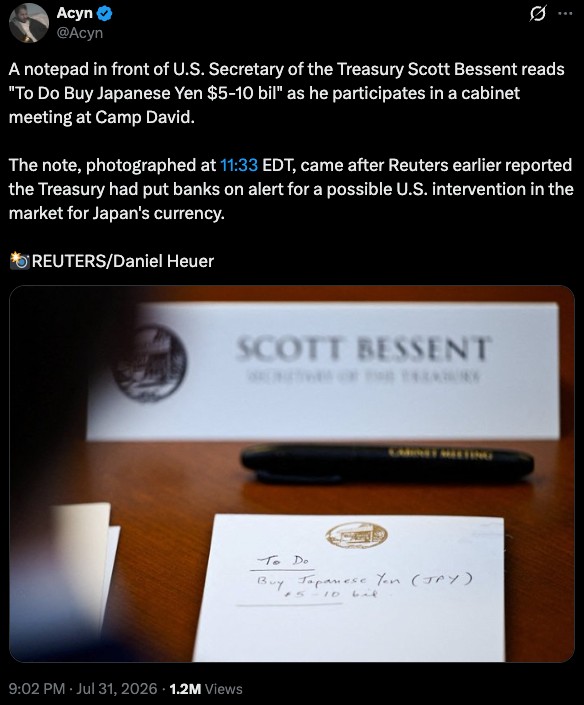
“The U.S. Treasury has now intervened alongside Japan to support the yen,” says Jim – “while Japan is looking to the Federal Reserve’s FIMA repo facility, which would allow the Bank of Japan to obtain up to $60 billion in dollar liquidity against its Treasury holdings.
“That gives Japan another source of dollars without forcing it to dump U.S. Treasuries on the market.”
Jim points out that one of Bessent’s predecessors, Hank Paulson, said the quiet part out loud: “We don’t need them selling Treasuries right now.”
Will it work? “These efforts to prop up currency values when fundamentals point in the opposite direction usually fail,” Jim says.
“In 1992, George Soros famously made about $1 billion betting against sterling when the Bank of England tried unsuccessfully to defend the pound and ultimately withdrew from the European Exchange Rate Mechanism.”
One of Soros’ top traders at the time was none other than… Scott Bessent.
Jim’s conclusion: “Bessent knows the game. He also knows from experience that it doesn’t always work for the side propping up the currency.
“Get ready for the mother of all currency market panics.”
We’ll stay on top of it – including any actionable guidance, should it become necessary – in the days and weeks ahead.
➢ Recovered history: It was around this time two years ago that Japanese officials merely talking about raising interest rates sent shudders through markets worldwide, including the U.S. stock market. You can revisit that history in this back issue.
 How ‘Bout Them Houthis?
U.S. oil futures are up nearly a buck and over $83 as Yemen’s Houthi faction all but controls another strategic “chokepoint” in global shipping.
The Houthis struck a Saudi Arabian vessel in the narrow Bab al-Mandab waterway at the south end of the Red Sea – killing three.
A few days ago, the Houthis – loosely aligned with Iran – declared the Bab off-limits to Saudi Arabian oil tankers. As a result, several tankers have had to transit the Suez Canal and go all the way around Africa to reach their destinations in Asia.
None of this is a surprise to anyone who saw what the Houthis did to the U.S. Navy in 2024-25. We chronicled it in these digital pages…
It’s not an exaggeration to say tribesmen in flip-flops chased two U.S. aircraft carriers out of the Red Sea.
In late 2023, the Houthis began harassing U.S.- and Israeli-linked shipping through the Bab – an act of solidarity with the Palestinians of Gaza. Many vessels had to take that long route around Africa.
U.S. forces tried to inflict pain on the Houthis but to no avail. The Houthis shot down more than 20 MQ-9 Reaper drones at a cost of over $30 million each.
In the spring of 2025, incoming Houthi missiles forced evasive maneuvers on the part of the aircraft carrier USS Harry Truman — sending an F/A-18 fighter jet sliding off the deck and into the drink. And a similar incident took place a few days later.
With that, the Trump administration reached a truce of sorts with the Houthis after 19 months of low-grade fighting. The Houthis remained the effective rulers of the Bab.
The Houthis’ “secret weapon” was a barrage of cheap drones – much cheaper than the U.S. versions.
Here’s a Politico headline from late 2023…
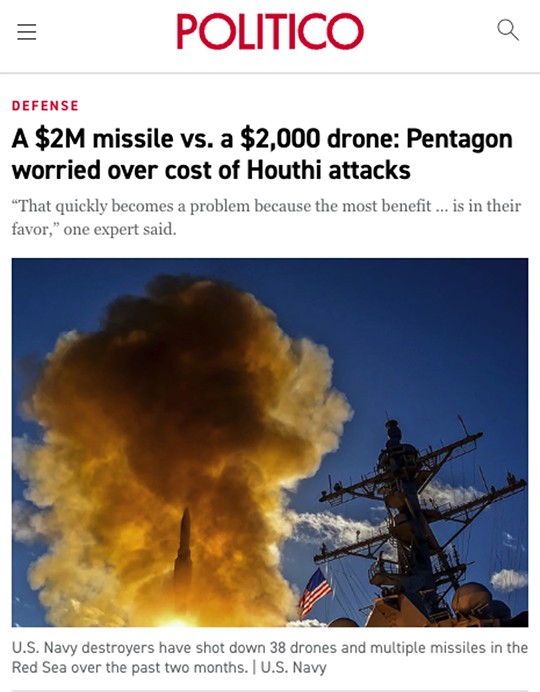
What was happening back then was a preview of coming attractions for the Iran war this year – cheap drones giving fits to a U.S. military that still operates with a mentality that “Big Iron” like aircraft carriers and F-35s can bring any foe to heel.
That’s changing. As we’ve been emphasizing in recent days, the Pentagon is seeking a staggering increase in its annual drone budget – from $255 million to $55 billion.
 The View From Main Street
We take the pulse of Wall Street every day in these 5 Bullets. What about the mood on Main Street?
The National Federation of Independent Business is out this morning with its monthly Small Business Optimism Index. The headline number jumped from 97.4 in June to 99.8 in July – the highest in nearly a year and higher than the index’s 52-year average.
On the portion of the survey where business owners are asked to identify their single most important problem, “quality/availabilty of labor” has shot back to the top of the list – cited by 27% of respondents.
“We struggle to find skilled labor/trades,” says the owner of a construction business in New York State. “Labor is a challenge. We currently rely on older or retired help,” says a retailer in Pennsylvania.
Nothing else comes close on the single most important problem list. Taxes were cited by 16%, inflation by 14%. Everything else was 8% or less.
As for Wall Street, it’s another “meh” day for the major U.S. averages.
The S&P 500 is down fractionally to 7,746. The Dow is essentially flat, just under 54,000. And the Nasdaq is down about a third of a percent, still holding the line on 26,500.
Congratulations are in order for Zach Schiedt’s Income Alliance members – who booked 138% gains in only four weeks yesterday with an options play on the specialty-materials firm ATI Inc.
Gold is treading water at $4,381. Silver is consolidating its gains, back under $65. Crypto is stuck in the mud, Bitcoin at $63,554 and Ethereum at $1,863.
The meat of earnings season is over. The next major economic indicator is the official inflation reading due tomorrow.
 Comic Relief
This is probably a few years old, but for whatever reason it’s resurfacing on social media again. Really, it’s timeless…

 Mailbag: AI Maps, Fiber Recycling
After the “Great Moments in AI” item in yesterday’s edition, a reader writes…
“It astounds me that the junior assigned the task of producing the map showing African countries did not have the presence of mind to make a simple check of the AI generated output using Google Maps.
“It seems no one at State learned anything after getting the Russian word ‘reset’ wrong during Hildebeast’s tenure.
“It just reinforces my belief that these so-called elites are ‘intellectual but idiots’.”
“Is there a company that does fiber optic cable recycling in Ukraine?” a reader inquires after last Friday’s mailbag, which touched on drone warfare.
“Are they seeking investors?”
Dave responds: Good question. For a long time,fiber optic cable recycling has been an iffy proposition even if you’re not in a warzone.
Is it doable? Yes. Is there a payoff for the effort? Not often.
The problem lies in separating the various components of which the fiber is made – plastics, metals, the glass “fractions.” Not easy. Nor are any of those materials particularly high-value.
The technology for fiber recycling is improving on the margins – and companies like AT&T have figured out how to convert old fiber lines into roofing material. But it’s still not economical in many situations.
And when you add the labor costs of gathering all that fiber strung across Ukrainian cities? Forget it…


