
Today’s Issue Is Not About the Midterms
 Today’s Issue Is Not About the Midterms
 There’s a wise old saying about “don’t let politics drive your investment decisions.” But the political calendar? That’s a different story.
As you’re probably aware, it’s 27 days until the midterm election.
No, we’re not going to analyze who has the upper hand or what it means for policy or how policy might shape companies and sectors.
Rather, we’re going to unpack a spooky-reliable barometer for stock market performance.
See, for decades, market sages have dug into the reliable patterns that coincide with election cycles — notably, the fact that presidential elections take place every four years.
In recent weeks, Paradigm’s newest contributor JC Parets and his team have been analyzing nearly eight decades’ worth of market data — and they’ve arrived at a stunning conclusion.
“We’re entering the strongest seven-month stretch of the four-year presidential cycle,” says JC.
Call it the Super Seven rally. It starts with the month before the midterm election — that would be right now — and extends through April of the following year.
You can see it on this chart of the S&P 500, showing the average of every presidential cycle in the post-World War II era — going back to Harry Truman’s first full term starting in 1949.
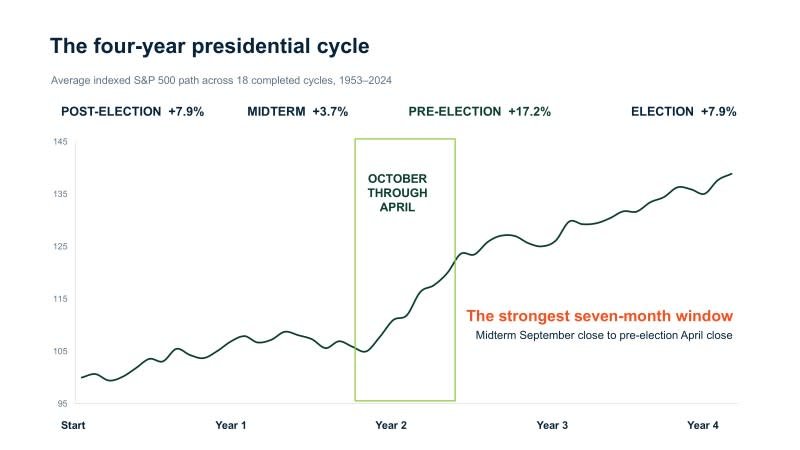
“During this period,” JC says, “the S&P 500 has produced an average gain of 18.3%.”
That performance is substantially better than other October–April periods — in which the average is a much more modest 8%.
Just to be thorough about it, JC’s team studied every seven-month period across this span of nearly eight decades — starting in January, starting in February and so on.
The Super Seven rally of 18.3% contrasts with a mere 5.4% on average.
“Something uniquely powerful appears to be at play at this point in the presidential cycle,” says JC.
Check out the Super Seven rally in every presidential cycle of the postwar era. Out of 19 completed cycles, 18 of them registered positive results. The only loser was a modest 0.8% drop in late 1978–early 1979.
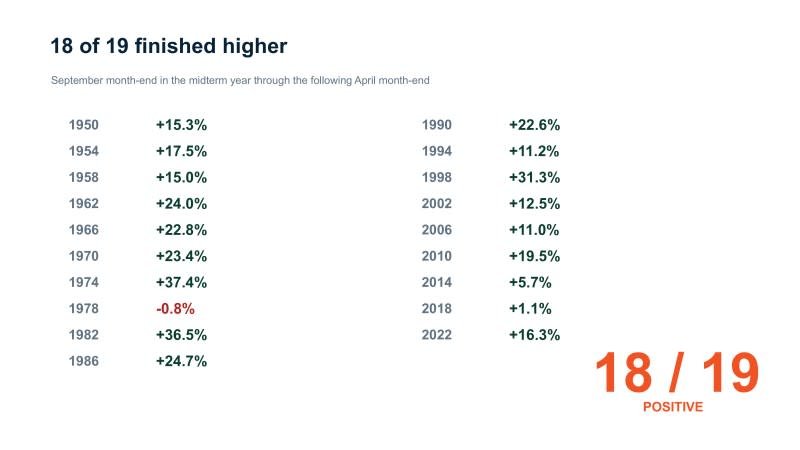
“Meanwhile, some of the winners were enormous,” JC says — “including gains of 37.4% beginning in 1974, 36.5% in 1982 and 31.3% in 1998. That’s an extraordinarily consistent historical tendency.”
The most recent midterms are a textbook example; its 16.3% rise is just below the 18.3% average.
As you might remember, 2022 was a rotten year for stocks overall. But the market bounced off its lows in October — just before the midterms — and didn’t look back.
And JC says all the pieces are in place for another Super Seven rally in late 2026 going into 2027. “The Nasdaq-100 is making new all-time highs,” he reminds us. At the same time, “large-cap technology, growth stocks and high-beta stocks continue acting well, while risk appetite remains firmly intact.
“That’s exactly what we want to see as this powerful seasonal window begins.”
 Now They Tell Us (Bogus Oil Futures)
We’ve been pounding the table on this theme for six months. Finally the Financial Times feels as if it can broach the subject without offending the powers that be.
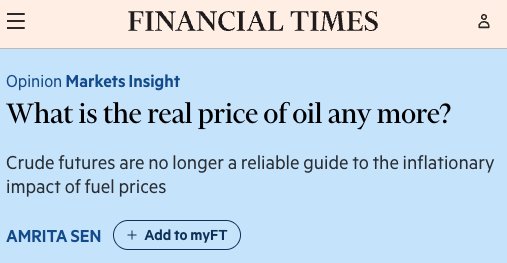
“This year has shown more clearly than ever that there is no single price of oil. The futures contracts quoted everywhere as ‘the price’ certainly can’t be considered that,” says an Op-Ed by Amrita Sen, co-founder of a consultancy called Energy Aspects.
Sen cites figures from Argus Media Group showing that the price of Brent futures — the global benchmark — is only 60–70% the cost of real physical barrels in Asia. Before the start of the Iran war, it was typically more like 90%.
“Not only are futures increasingly unreliable as a proxy for genuine supply and demand,” Sen writes, “they are also no longer useful as a hedge either and further disconnected from the fuel prices that drive inflation.”
And she’s not shy about calling out the White House’s manipulations: “The constant jawboning by the U.S. administration to get prices down has left fewer participants in the crude market, according to our data. The view that the U.S. will do whatever it takes to lower prices before elections has dominated sentiment.
“So despite global crude stocks falling about 650 million barrels since the conflict began, according to Kayrros inventory data, traders are scared to hold long positions — largely because of the volume of bearish headlines coming from the administration, leaving prices at the mercy of algorithm-driven trading.”
We won’t beat a dead horse. It’s just nice to see someone fessing up in a mainstream outlet. If you’re a newer reader and not yet up to speed, our first two Bullets on April 20 are a good place to start.
But even crude futures can’t help screaming higher today in response to the latest headlines from the Gulf region.
The shipping monitor UKMTO reports nine attacks on ships near the Strait of Hormuz during the first week of October. That compares with 13 for all of September.
Separately the shipping-info website gCaptain cites three “maritime security sources” who’ve concluded that last week, attacks on tankers transiting the strait reached their highest level since the war began more than seven months ago.
One of those new attacks came off the coast of Qatar last night. In addition, Iran launched its first attack outside the strait for a month — at a tanker off the coast of Oman.
With that, U.S. crude futures are up nearly 5% to $92.48.
It’s not helping matters that closer to home, Hurricane Isaias is making a beeline for offshore Gulf oil platforms; already 25% of the region’s production is shut in.
Meanwhile, the major U.S. stock averages are modestly in the red — the S&P 500 down less than a quarter percent at 7,787. Treasury yields are little moved, the 10-year note at 5.29%.
Gold is holding the line on $4,100 but silver has slipped beneath $59. Crypto has gotten clobbered in the last 24 hours, Bitcoin well below $83,000 and Ethereum sinking toward $2,500.
It’s been a quiet week for economic numbers but that will change next week with the release of the official September inflation figures. Earnings season also gets underway…
 Big Tech’s Big Nuclear Gambit
Big Tech is throwing billions of new dollars at nuclear power to feed its insatiable appetite for AI data centers. But money can’t solve everything.
This week brought a flurry of multibillion-dollar deals between the AI hyperscalers and nuclear power providers.
- Amazon (AMZN) signed a 20-year power-purchase agreement supporting more than $3 billion in infrastructure investment at the Calvert Cliffs nuclear plant in Maryland, operated by Constellation Energy (CEG). The upgrades will add 190 megawatts of generating capacity
- Google (GOOGL) followed with another 20-year agreement supporting more than $4.3 billion in upgrades spread across 11 Constellation reactors in Illinois, Pennsylvania and New Jersey. Those improvements will add another 890 MW.
- On Monday, the Department of Energy announced a conditional $4.2 billion loan to Vistra Corp. (VST) to upgrade nuclear plants in Ohio and Pennsylvania, adding another 433 MW. Meta (META) has already agreed to support those projects.
In total, those upgrades would bring 1,513 MW additional generating capacity to the grid. That's about the same as one and a half average U.S. nuclear reactors. (For perspective, the nation has 94 operating reactors right now.)
Long before it became mainstream news, we pinpointed AI as “the monster that ate the power grid.”
By now, you’re surely aware Big Tech is confronting a backlash against rising power prices brought on by the rapid build-out of large data centers. We’ve chronicled in recent weeks how New York and Texas have imposed limits on data center development. Pennsylvania is considering a statewide moratorium.
To be sure, expanding the capacity of existing nuclear power plants goes a long way toward easing the AI data center energy squeeze.
But Big Tech's nuclear gambit has one enormous obstacle — time.
These projects involve extended power “uprates.” That doesn’t happen by simply turning up the dial on an existing reactor.
Major uprates exceeding 100 MW typically take five–six years. They require replacing or upgrading massive turbines, generators, transformers and other equipment.
And the supply chain is already strained. Some essential components have very few qualified manufacturers, while specialized equipment can take years to design, build and deliver.
Constellation expects its first Google-backed uprate in 2028, with others continuing through 2032 or 2033. Amazon's Calvert Cliffs upgrades are scheduled to come online between 2030 and 2032. Vistra's regulatory applications extend through 2034. Delays could push project completions beyond then.
Bottom line: Big Tech is committing billions to increase nuclear generating capacity, but the additional power will arrive gradually over the next decade, possibly longer.
Investment takeaway? Last year, many Paradigm readers made handsome gains playing the data center power trend — mostly via the “independent power producers” like Constellation and Vistra that are not regulated utilities.
Our editors are still eyeing a good entry point to start playing these names again. Stay tuned…
 Comic Relief
Here’s a timely one with mortgage rates pushing 7.5% and the median home price taking up nearly five times median household income…

 Mailbag: Fourth Turning
“Dave, I am writing to express my sincere appreciation for your recent response to a reader's inquiry,” says an appreciative note.
From the context, I’m pretty sure the reader is referring to the mailbag of our Sept. 28 edition — in which I harked back to the “Fourth Turning” discussion last year in a 5 Bullets edition I’ve come to call “the cynicism issue.”
(It’s about as personal as I’ll ever get in these daily missives.)
“Your thoughtful commentary resonated with me and provided meaningful encouragement for my personal journey. As someone from a transitional generation, your reflection on the 1980s was particularly insightful. I especially connected to your references of my two fave Founding Fathers.
“I love everything this company generates. All of you resonate with me. I like challenges and caring for my family is now my challenge. Otherwise, I would be living on Walden Pond.
“Thank you for sharing your unique perspective and for your continued support of us — your readers.”
Dave responds: Thank you for trusting our team for guidance with your investing choices.
And thank you for the kind words about “the cynicism issue.”
I noticed you put your business signature at the bottom of your email. It’s always interesting when someone does that and on occasion I’ll even do a quick web search — just to get a glimpse into our readers’ varying walks of life.
Counseling traumatized veterans? You’re truly doing God’s work in this lifetime.
It touches me that you found value in something I wrote — and it’s a vivid reminder for all of us at our firm that, in our own way, we can and do make a difference for the better in people’s lives. Godspeed with the life/family challenges you’re taking on with a full heart.


