
Health Care On Trial
 “The Adjuster” Isn’t the Problem
 If Business Insider is to be believed, Luigi Mangione’s Christmas dinner consisted of “baked Cornish hen.”
The suspect in the murder of UnitedHealthcare CEO Brian Thompson is in federal custody at the Metropolitan Detention Center in New York.
According to a former detainee, Christmas Day is the best meal of the year in the federal prison system — the hen being “a well-cooked delicious little item” along with cranberry sauce and sides of either spinach or macaroni and cheese.
Mangione faces both federal and state charges; more than a year after the murder no trial date has been set.
But it’s not the speed of the wheels of justice that’s on your editor’s mind today…
Imagine pulling up to a gas station. You won’t know the price until you’re done pumping. And the price you’ll pay will differ from whoever’s at the pump next to you — because you have different auto insurance providers.
Sounds nuts, right? But as the financial blogger Karl Denninger has observed for years now, that’s the essence of the U.S. health care system.
That, and its exorbitant cost.
It’s a corrupt, crony capitalist cartel. It extracts substantial wealth from every one of us. If it’s not smashed, it will destroy the U.S. government’s delicate finances and you won’t like what life looks like when that happens. And we’re going to get into all of that today.
Then again, maybe I should measure my words — lest the federal government accuse me of encouraging “an act of political violence.”
Last spring, Attorney General Pam Bondi announced she’s seeking the death penalty for Mangione. That line about “an act of political violence” is hers.
It wasn’t an entirely unexpected development: After the killing in New York just over a year ago, the New York Post reported that the health insurance industry leaned on Joe Biden’s Justice Department to make it a federal case on top of the state charges Mangione faces.
“Sources told The Post that the federal charges came amid pressure from health insurance industry leaders to make an example out of Mangione,” the paper said, “though it was unclear which specific entities petitioned the DOJ.”
In that context, seeking the death penalty is just the next logical step, no?
Maybe you don’t remember, but Thompson’s murder prompted a freakout among the power elite in this country late last year — across the political spectrum.
Government officials and corporate chieftains were alarmed by the social media vibe — everyday folks snarking about “I’m sorry, prior authorization is required for thoughts and prayers,” and Mangione acquiring a certain folk-hero status along with the nickname “the adjuster.”
Joe Biden’s Homeland Security Secretary Alejandro Mayorkas invoked the same language Democrats use when describing Jan. 6: “It speaks of what is really bubbling here in this country, and unfortunately we see that manifested in violence, the domestic violent extremism that exists.”
Donald Trump for his part said, “How people can like this guy — that’s a sickness actually.”
Well of course they were all freaking out: The day of the murder, I observed that the zeitgeist was similar to that which greeted the bailed-out banks and other Wall Street firms during the 2008 financial crisis…

But as I also said a few days later, it comes back to that old truism: When injustices aren’t remedied via the soapbox, the ballot box or the jury box… it should be no surprise when someone decides to resort to the cartridge box.
That’s not an endorsement of Thompson’s murder. It’s just a recognition of reality, a reality captured in this meme that was going around at the time…

In other words, Luigi Mangione isn’t the problem.
 Obscene Cost, Rotten Results
In the days following the murder, corporate media refused to publish Mangione’s “manifesto” – perhaps because it reinforced everyday folks’ gripes with the health care system.
It fell to independent reporter Ken Kilppenstein to make the manifesto available to us plebes to evaluate for ourselves.
No wonder the manifesto was suppressed. Its critique is valid — even if it flubs some of the facts.
“A reminder,” it says: “the US has the #1 most expensive healthcare system in the world, yet we rank roughly #42 in life expectancy.
“United is the [indecipherable] largest company in the US by market cap, behind only Apple, Google, Walmart. It has grown and grown, but [h]as our life expectancy?
“No the reality is, these [indecipherable] have simply gotten too powerful, and they continue to abuse our country for immense profit because the American public has allwed them to get away with it.”
For the record, the CompaniesMarketCap site ranks UnitedHealth No. 19. And according to the Worldometers dashboard, the United States ranks 48th in life expectancy. U.S. life expectancy did fall for about five years in the mid-2010s thanks to “deaths of despair” but Statista tells us the number is now 79.4 years, a record.
But the central critique — obscene cost for rotten results — is sound.
Health-care spending during 2023 totaled $14,570 for every man, woman and child in the United States — far out of proportion to any other country in the world.
The next-highest per capita total after the United States is Switzerland — $9,044 according to 2022 figures from the Peterson Foundation. The average among 12 wealthy countries excluding the United States is $6,850.
Yes, some of those systems are no doubt “socialist,” even more than America’s. But is the U.S. system so superior as to justify more than double the cost?
The question answers itself.
The growth in costs since 1970 has been frightening — up 41x — and we’ll come back to the significance of 1970 later.
Even after adjusting the figures for inflation… the trajectory is out of control.

Using inflation-adjusted figures, per capita health care spending in this country has exploded nearly sevenfold in a little over 50 years.
And no, this is not normal. Read on…
 Why Isn’t Health Care Like Your TV?
Ponder this: Under normal conditions of capitalist advancement, you get progressively better results for progressively lower cost.
In 1955, for example, you could buy a 24-inch black-and-white tube TV for $249.50 — as seen in this vintage Magnavox ad annotated by the tvhistory.tv website.
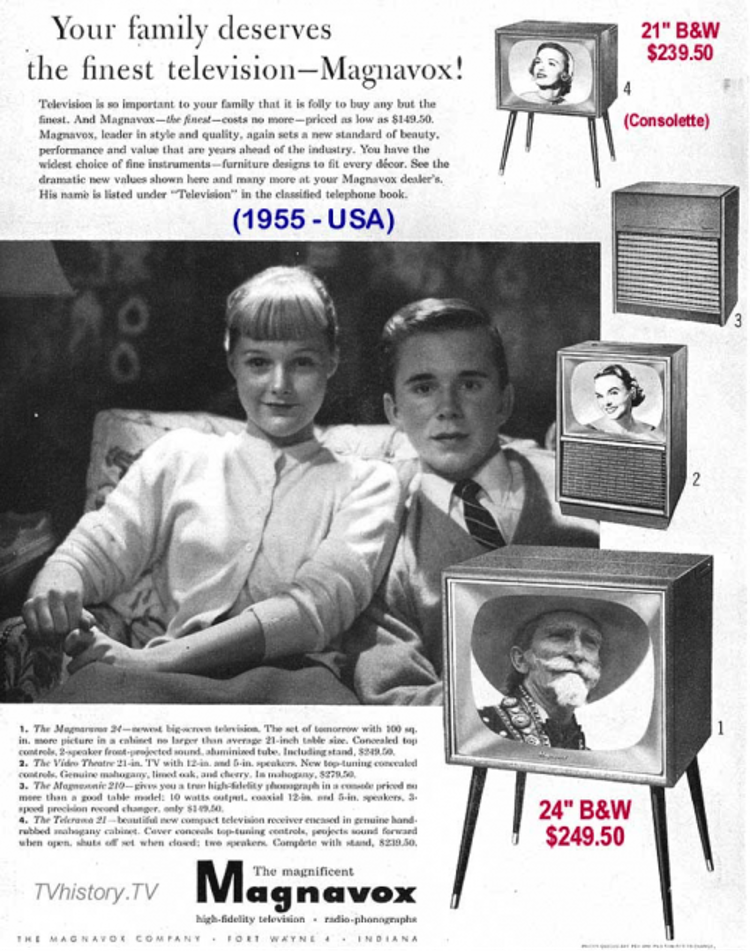
Even using the government’s heavily gamed inflation numbers, that’s $2,930 in today’s money.
Seventy years later you can get a 75-inch flat-screen color TV — triple the screen size, and a movie-style aspect ratio — for as little as $479.99.
But the modern American health care system does not operate under normal conditions of capitalist advancement. It is a government-protected cartel operated for the benefit of insiders.
Rewind again to the ’50s. Here’s the cost of delivering a baby in 1952 at the Santa Monica Hospital in California. The economics writer Charles Hugh Smith first spotted this flyer over a decade ago…
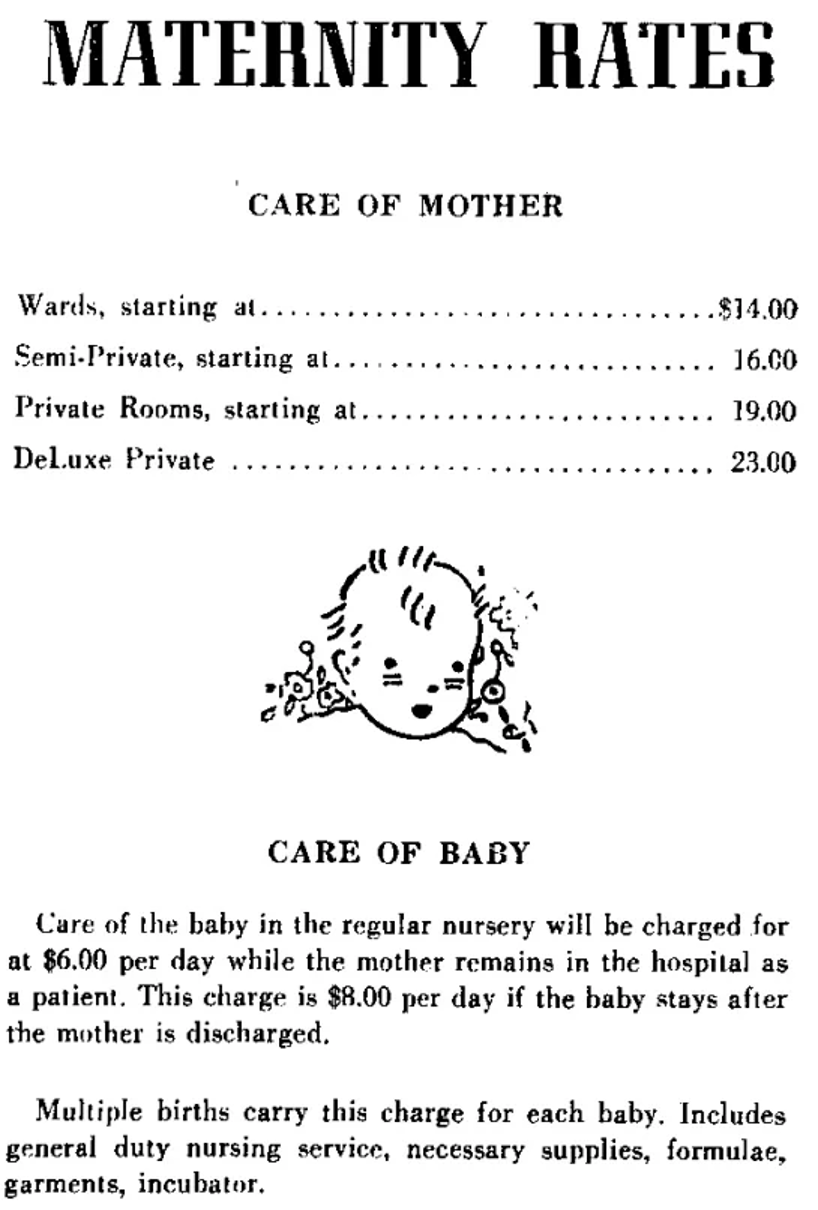
On the back of the flyer we’re told “Obstetrical Service Cost” is $30.
So… Assume that room cost is daily and that both mom and baby will stay for three days. The grand total for a private room works out to $105.
In today’s dollars, that’s $1,243.58 — an amount even the most cash-strapped of couples could save over time and pay in cash.
But the reality today instead is this: A 2023 study by Truven Health Analytics finds that for a woman with employer-provided health insurance, the average out-of-pocket alone works out to $2,224. Insurance covers another $16,084. (The figures are even higher for C-sections.)
If you pay for employer-provided health insurance, you’re covering these extortionate costs. And if you pay income taxes, you’re also covering costs for women on Medicaid that are nearly as extortionate.
These figures are notoriously difficult to track down and pull apart — by design. And it’s not just maternity care. It’s everything.
In 2011, New York Daily News reporter Beverly Weintraub had a scare -- her teenage son choked on a piece of turkey. He spent four hours in the emergency room -- at a cost of $22,214.92.
Well, that’s what the hospital billed Aetna. Aetna paid only $2,885.67 -- an amount to which the hospital agreed. Weintraub’s out-of-pocket was about $800.
“The rates that insurance companies pay,” Weintraub wrote after much investigation, “are negotiated based on what they believe a hospital’s true costs are. But then those rates are jacked up an average of 30-50% to make up for money that hospitals lose in treating patients who don’t have private insurance -- which is the majority of them. So to make up the difference, they overcharge patients who are insured. This practice is called cost-shifting.
“What’s missing from this complex web,” Weintraub added, “is any hint of what the services a patient received actually cost.”
That too, is by design.
 The End of Health Care as You Know It
All of this is outrageous enough. But as we mentioned at the start today, the health care cartel has become so large and so voracious, it threatens to blow up the federal government’s finances.
Medicare (health care for seniors) and Medicaid (health care for the poor) came on the scene in 1965 — part of President Lyndon Johnson’s “Great Society” programs.
By 1970, health care took up about 6.25% of all federal spending.
After 20 years, that percentage doubled. In 1990, health care took up 12.5% of the federal budget.
It doubled again by 2010 — with health care spending taking up a quarter of the federal budget.
The “good” news is that it’s not on a trajectory to double again by 2030. As I wrote a decade ago, something in the system would break catastrophically long before health care took up half the federal budget.
But the percentage sure hasn’t gone down, not much anyway…
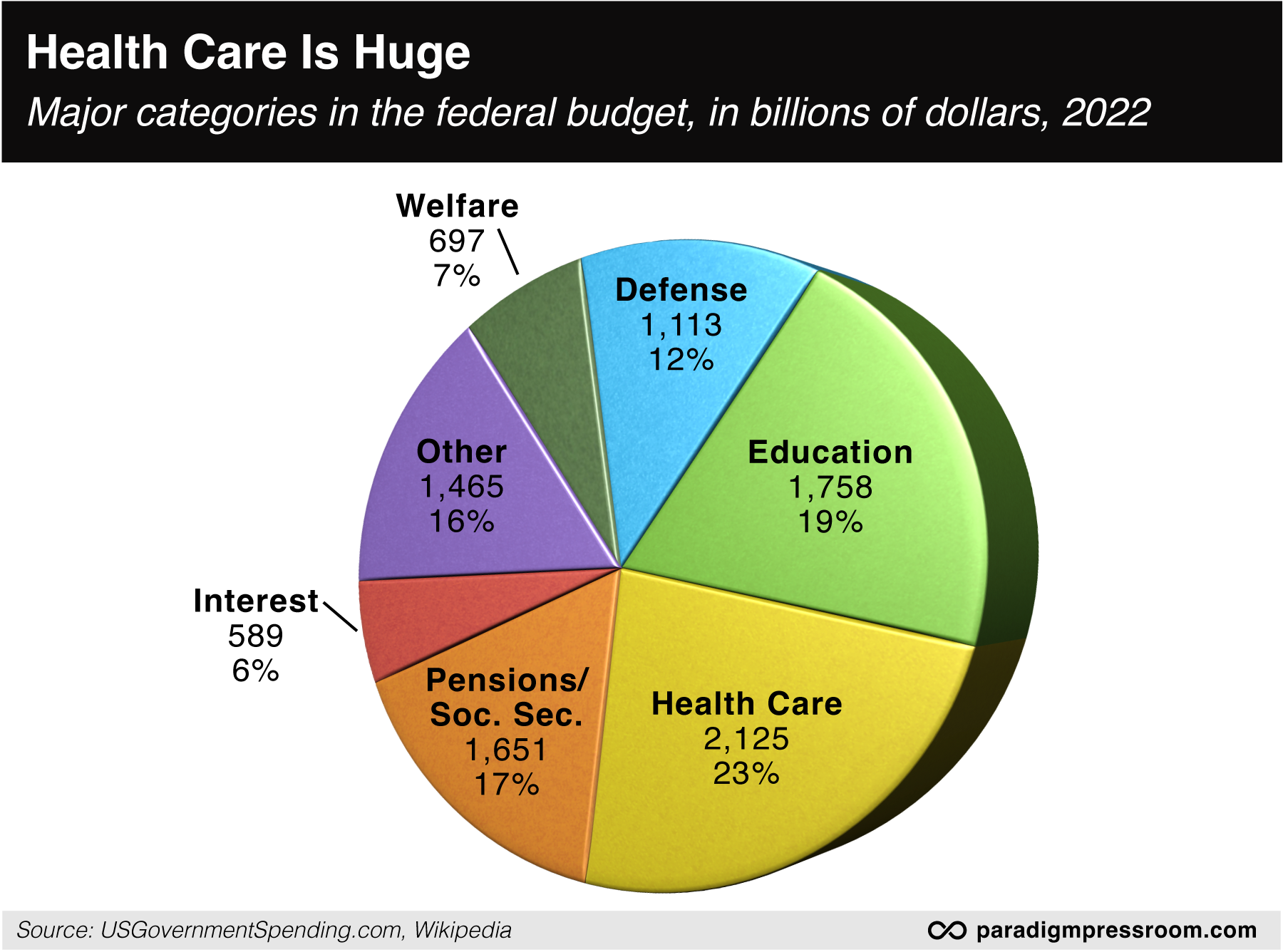
When it comes to Medicare, payroll taxes cover only 36% of the program’s total costs, with premiums paid by seniors covering another 15%. The other 43% comes out of Uncle Sam’s “general fund” — the same bucket taken up by everything from food stamps to fighter jets.
And all of Medicaid spending likewise comes from the general fund.
The problem now is that costs are exploding anew as 2025 turns to 2026.
According to the final statement of Uncle Sam’s finances for fiscal year 2025, total health care spending takes up 35.4% of the federal budget.
That is, from Oct. 1, 2024 through Sept. 30, 2025… the Centers for Medicare and Medicaid Services spent $2.48 trillion. That’s well over one-third of the $7.01 trillion that Uncle Sam spent in 12 months.
That’s because certain line items are growing at an alarming rate. Last spring the aforementioned Mr. Denninger ran the numbers for the first few months of the fiscal year and found Medicare prescription drug spending rising 80% year-over-year. Hospital payments rose 20%. Physician payments, 31%.
“There is no way to tax out of this nor any other way to stop this runaway train other than by taking a meat axe to costs,” Denninger writes.
By his reckoning, smashing the health care cartel would cut costs by 80%. Having a baby would once again be something most couples could pay for with cash, as people did in 1952.
His preferred remedy to achieve this outcome would be to apply antitrust statutes currently on the books.
Maybe that’s the right approach, or maybe there’s a better approach. I don’t know; policy prescriptions aren’t our purpose here today.
What matters today, and what you need to know, is that no one in Washington — on either side of the aisle — is giving this problem the good hard look we just did.
As I wrote a decade ago, the best-case scenario is that a time comes when you can no longer count on the health care system for treatment of chronic disease in the manner to which Americans have become accustomed.
Maybe you’ll still be OK if you get into a car wreck. But otherwise, the money just won’t be there for treatment of conditions like heart disease, stroke, cancer, diabetes, obesity and arthritis.
The worst-case scenario is one in which Uncle Sam’s creditors look at these figures and they decide to bail from their investments in U.S. Treasuries. That would instantly detonate the federal government’s finances.
The gravy train would end for the insurance companies and hospitals and doctors, and that’s a desirable outcome for sure. But you wouldn’t want to get caught in a car wreck until the system managed to reset, somehow.
 The Last Word
I don’t want to end this particular single-subject deep dive on a total downer.
There are efforts on the margins to bring down costs without a total overhaul of the system — and those efforts are investable.
The most obvious one that comes to mind is AI-driven drug development. Without AI, 90% of clinical trials end in failure — and at a typical cost of $2.6 billion over 10 years.
But if scientists can use a well-trained AI to rule out formulations that won’t work before going to the time and expense of a clinical trial… suddenly they won’t be pouring hundreds of millions of dollars into a black hole year after year.
It’s a promising development that the Paradigm team of experts — especially our biotech maven Ray Blanco — is following closely.
But it’s not, if you’ll pardon the expression, a cure-all.
That requires a level of “reform” no one seems willing or able to take on — even if it means, sooner or later, a copycat killer decides to take over Luigi Mangione’s “adjuster” role.


