
Your Bank Wants Your Passport
 Your Bank Wants Your Passport
 Because the U.S. government can’t keep track of who’s in the country legally and who’s not, U.S. citizens are expected to submit to more financial surveillance.
Really, that’s the gist of this news story…
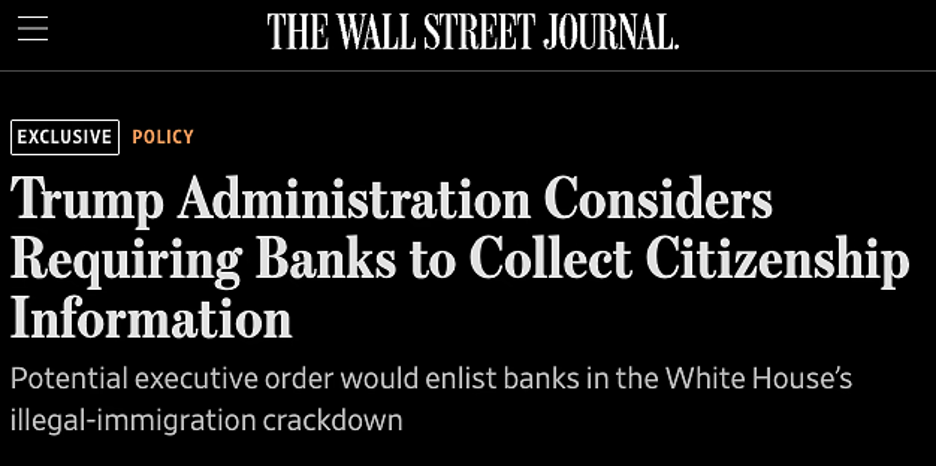
“The Trump administration is weighing a possible executive order or other action,” says The Wall Street Journal, “that would require banks to collect citizenship information from customers, a new front in the administration’s crackdown on immigrants living in the U.S. illegally, according to people familiar with the matter.”
And that’s not just if you’re opening a new bank account. Your existing account might be subject to closure if you don’t cough up a passport, birth certificate or other documents.
The article continues: “The action, which is primarily under review by the Treasury Department, could ultimately task banks with asking for an unprecedented new category of documents, such as passports, from both new and existing customers who want to maintain a bank account in the U.S.…”
It’s another step on the way from “land of the free” to “show me your papers.”
Don’t get the wrong idea. This is not about Donald Trump. Nor is it about illegal migrants. It’s about whatever’s left of your freedom and financial privacy.
Your editor is no Johnny-come-lately to the cause of financial privacy. In 1998, the FDIC under President Bill Clinton proposed a series of sweeping “Know Your Customer” requirements for banks.
As the now-defunct Defend Your Privacy website explained it…
It would require banks and financial institutions to set up customer profiles, then notify government investigators if you "deviate" from your profile. It would require banks to determine the customer's "sources of funds," determine the customer's "normal and expected transactions," monitor customer transactions and identify transactions that are "inconsistent with normal and expected transactions" and report any "suspicious activity" to federal investigators.
I remember writing my congressmembers at the time — Illinois Rep. Henry Hyde and Sens. Peter Fitzgerald and Dick Durbin — urging them to sponsor legislation curbing the proposed rules. The backlash from millions of Americans like me was enough to prod the FDIC to withdraw its proposal after a 90-day comment period.
Unfortunately… the 9/11 attacks gave the feds a new opening to get their way. The rules were written into the 2001 Patriot Act. The control freaks and power trippers never give up.
There’s a line of thought defending this new proposed rule: It would encourage those in the country illegally to “self-deport.”
That is, even with the vast growth in the number of ICE and CBP personnel, it’s nowhere near enough to remove everyone in the country illegally. Shutting them out of the banking system would encourage them to leave the country on their own.
OK, fine. Let’s take that at face value. If the goal is to encourage self-deportations, the simplest and most effective way to do that is to strip illegal migrants of welfare benefits.
And yet… the budget bill that ended the most recent partial government shutdown includes $5 billion in “refugee and entrant assistance” — cash benefits, health care, daycare, job programs.
“After the staggering level of welfare fraud exposed in Minnesota, why on Earth would ANY Republican vote to fund more refugee welfare programs?” wondered Sen. Rand Paul (R-Kentucky). “This is D.C. insanity at its finest.”
In the House, Paul’s fellow Kentuckian Thomas Massie offered an amendment to strip this funding from the bill — only to be shot down by GOP leadership.
The Republican-controlled Congress passed it, Donald Trump signed it… and $5 billion is going down a black hole.
Why would they take a step that obviously encourages people to stay here illegally — and at taxpayer expense?
The only answer that makes sense is also the one that’s most disturbing: The aim is to exploit a crisis atmosphere such that people willingly submit to growing levels of surveillance like this new show-your-papers proposal.
It was a terrorist attack 25 years ago, it’s illegal migration now.
And while it might begin with submitting more papers to your bank, it might well end in a harrowing scenario I spelled out just over a year ago. You might want to revisit it today. Word to the wise…
 Markets Today: NVDA, “Technical Issues”
The mainstream reaction to Nvidia’s earnings amounts to: Is that all there is?
“Nvidia’s Blockbuster Results Fail to Dazzle Investors,” says a representative headline in the Financial Times.
The numbers were great — a 94% leap in profits, record fourth-quarter sales. But as our colleague Greg Guenthner often reminds us, it’s not about earnings but rather the reaction to earnings. NVDA is down nearly 4.7% as we write. That’s proving a drag on the S&P 500 (down over three-quarters of a percent) and the Nasdaq (down 1.5%).
“This is completely normal,” trading pro Enrique Abeyta observes on the Daily Feed section of the Paradigm mobile app.
“When you have well-established trends in a market, the ability to ‘surprise’ is diminished and incremental information becomes confirmatory as opposed to revelatory. This may not drive the stock - or the overall market - in the short run but is BULLISH for the intermediate and long term. Great numbers are great numbers. Don't overthink it.”
“This isn’t about beating the quarter anymore,” adds analyst Davis Wilson, also on the app. “It’s about proving the AI cycle has years left. Demand looks strong through 2026 and 2027. But investors want visibility through 2030. That’s a high bar.” Regardless, “AI infrastructure spending isn’t rolling over. It’s still ramping. I suggest you own the stock.”
➢ Reminder: The Paradigm mobile app gives you access to instant insights like these throughout the day. I learn a lot from it, so I know you will too. Download here.
As we suspected yesterday, $90 is proving to be a powerful ceiling on the silver price. It’s back down to $87.15 as we write. But gold is holding its own at $5,184.
For the record: Amid $90 silver yesterday, CME Group reported “technical issues” that halted trading in metals and natural gas for over an hour.
Not surprisingly, the halt touched off rumors that the exchange was running into trouble delivering physical silver to buyers who wanted actual metal instead of cash settlement — as well as accusations of shenanigans during the time of the outage.
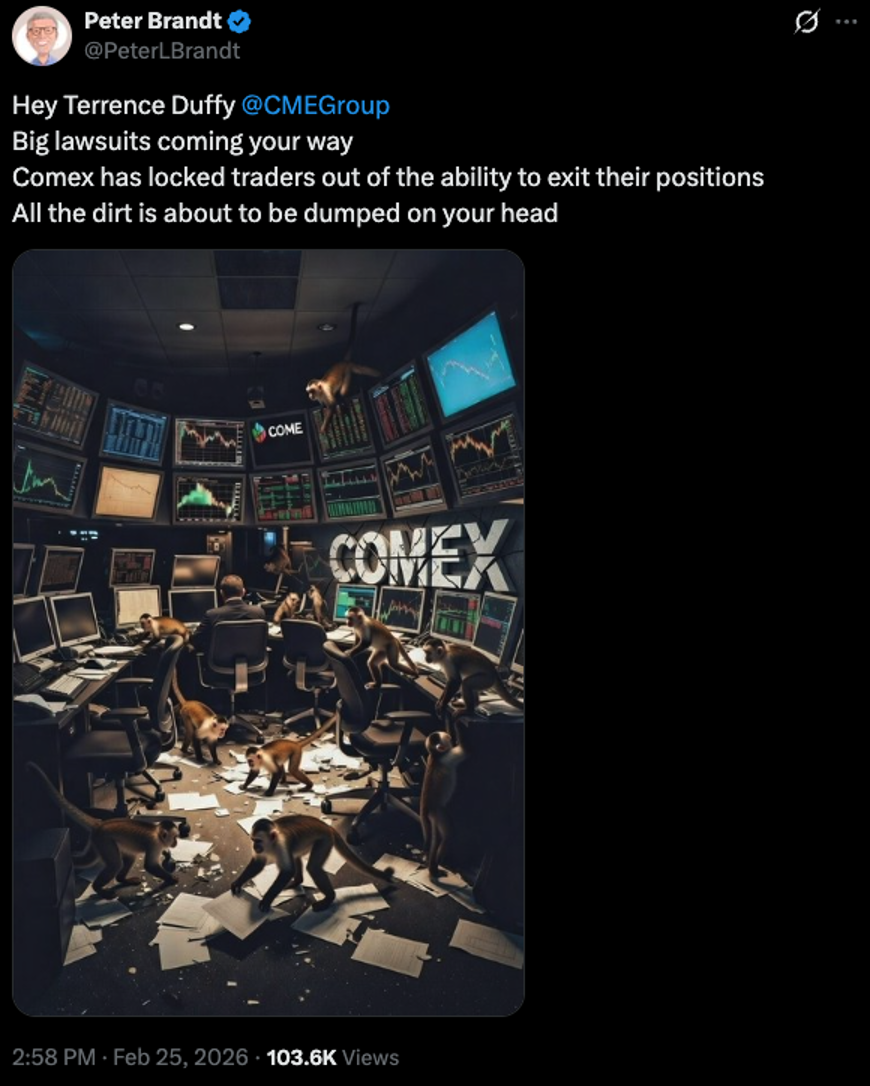
Perhaps litigation will reveal in the fullness of time whether anything untoward was happening. Until then, you might wish to review our latest deep dive on precious-metals manipulation published earlier this month.
Crypto is trying to stage a rebound — Bitcoin over $67,000 and Ethereum over $2,000.
 Oil, Iran and “the Politics”
If the Reuters newswire is to be believed, Saudi Arabia is upping its oil production if a U.S. attack on Iran disrupts the global oil trade.
Citing “two sources familiar with the plan,” Reuters says the kingdom would raise oil exports by about a half-million barrels a day — as it did last year when Washington bombed Iranian nuclear sites.
Today’s the day that more “indirect” talks between U.S. and Iranian officials are taking place in Geneva, Switzerland: The foreign minister of Oman is literally passing messages between U.S. representatives in one room and Iranian representatives in another room.
The talks are taking place amid the backdrop of this Politico story back home…

“Senior advisers to President Donald Trump would prefer Israel strike Iran before the United States launches an assault on the country, according to two people familiar with ongoing discussions,” the story begins.
“The calculus is a political one — that more Americans would stomach a war with Iran if the United States or an ally were attacked first.”
So it’s come to this: “The war is so unpopular, Trump officials are openly saying they’re planning to use Israel to goad Iran into attacking U.S. military assets,” tweets the independent journalist Max Blumenthal.
Gee, if troop morale was already bad on the sewage-strewn USS Gerald Ford before this news broke…
Of course, all of this assumes Tehran would take the bait. And that’s no sure thing.
In the meantime, a barrel of West Texas Intermediate is up over a buck to $66.59. Yes, it’s been higher this month — but not much higher.
 Comic Relief
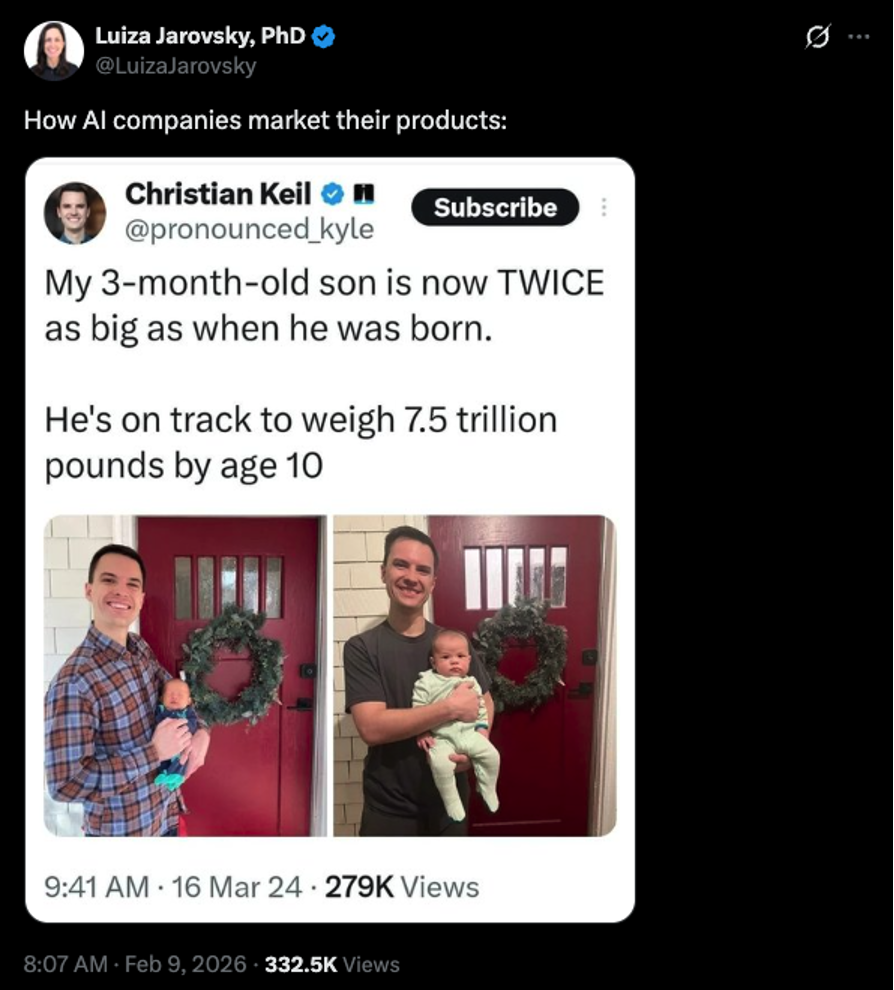
Yes, AI has immense world-changing and wealth-making potential… but there’s also an underlying truth here.
 Mailbag: The Great Taking
We got a lot of response to yesterday’s first two Bullets about The Great Taking and Roth IRAs.
“I enjoy your writing and read 5 Bullets every day. Thanks for your research and willingness to present different points of view,” a reader writes.
[As always, there’s a “but” coming…]
“I disagree with your view that The Great Taking will not happen because of the extensive destruction it will cause. Have you read David Rogers Webb's book? It is well researched and very scary.
“The laws putting The Great Taking in place were written years ago and are still in force, so my assumption is that the algorithms making it possible have already been written into the Federal Reserve's financial code. It will be like what happened to silver as outlined by your colleague Nick Riso. The two scenarios are not exactly the same, but you can get an idea of how it would happen.
“Unless we stop it now, before it gets triggered, by changing the law ASAP, The Great Taking will be so fast and so automated that no human will be able to stop it once it starts. Also, remember that a Great Taking has already happened once in the United States. We call it the Great Depression. David Rogers Webb explains how it was orchestrated in his book.
“I think we need to raise national awareness and a hue and cry.”
“My understanding is that as long as you are not using margin in your equities account, the broker must segregate your holdings from their own,” chimes in another.
“They can only commingle your funds with theirs if you have borrowed against yours. So in case of insolvency, your non-margin funds are safe. See SEC Rule 15c3-3.
“Since IRAs cannot be margin accounts (at least at Fidelity. I don't know about others), they cannot be commingled with a brokerage's funds, so they are safe.
“However, money in a bank is a different story. Your money in your bank account is legally an unsecured loan to the bank. In case of bankruptcy, the bank will do a bail-in and pay the secured creditors first, and you will be last on the list to receive anything back. So you are dependent on FDIC insurance for the first $250,000, and can lose the rest.
“A bank bail-in actually did occur with a small Midwestern bank, as I understand it. But with Silicon Valley Bank, all the big investors were fully rescued (against the rules) because it would have wiped out all of the venture capital money and well-connected individuals.
“Please correct me if any of this is incorrect.”
Dave responds: If the premise of David Rogers Webb and Justin Haskins is correct, everything is on the table — the niceties that you cite notwithstanding. Relatively few people have margin accounts, so that’s not a very big pile of money in the scheme of things.
As for your description of the banks, spot-on.
Speaking of big piles of money, here’s something I concede I did not contemplate when assembling yesterday’s missive. Chew on this…
“Your reasoning for The Great Taking being unlikely is incongruous with your reasoning for the likelihood for the raid on Roths to occur and the key phrase is ‘at least for wealthier Americans.’
“If the ‘All your stonks are belong to us’ scenario of The Great Taking is limited to the top 1%, Denninger's ‘dirty civil war’ argument goes away.
“If you think the roughly $2 trillion of Roth IRA balances would get the attention of Uncle Sugar, the $20–25 trillion of publicly traded stocks and fund shares; $5.5 trillion of government and corporate bonds; and $4 trillion of bank accounts, money markets and CDs held by the top 1% would be utterly irresistible in an emergency.
“They could even let the 1% keep their $12–15 trillion of private equity and $5 trillion in pension and retirement accounts as a consolation prize.
“I am sure the 99% would not take up arms in defense of the 1% having their accounts bailed-in to address the next major crash. It is the rich who should be taking the Great Taking seriously.”
“Are Roth IRAs really subject to the SECURE Act’s 10-year withdrawal rule?” a reader inquires.
“Meaning my children will have to take all the money out of their ‘inherited’ Roth accounts and pay taxes on those distributions? Thank you for your clarification.”
Dave responds: Yes. “Under the 10-year rule, a non-spouse beneficiary is required to fully withdraw the balance of the inherited Roth IRA by the end of the 10th year following the original owner’s death,” affirms the SmartAsset site.
Your children can structure those withdrawals however they want — a lump sum at any time, monthly or annual withdrawals spread evenly across all 10 years, whatever. But it’s gotta be done.
“Taxing Roth withdrawals?” writes our final correspondent.
“Next you will tell me when I get Social Security income, I will pay tax on 85% of the money I put into it.
“Oh wait, never mind. They do that already…”
Dave: That’s a brilliantly succinct summation of yesterday’s Bullet No 2. Well done!


