
Six Years Ago: Peak Fear
 Friday Flashback
 On this day six years ago, the U.S. stock market was reacting badly to a spike in COVID-19 cases in China.
In America, the first infections had yet to be reported. The lockdowns were still weeks away. At this juncture, uncertainty loomed large.
“Health experts question the timeliness and accuracy of China’s official data, saying the testing system captured only a fraction of the cases in China’s hospitals, particularly those that are poorly run,” said the Financial Times.
The major U.S. stock indexes took a spill that day. Nothing major — but mid-February turned out to be the top in the S&P 500.
One expert had the foresight to tell his clients to get out before the carnage.
From a peak of nearly 3,400 the S&P began a sickening slide below 2,200 on March 23.
March 23 was the day everything turned around — and that same expert had both the methodology and the moxie to call the bottom.
On that day, he recommended 13 stocks — all of which could have made you a fortune if you’d acted on his recommendation. At the time, however, his work was available only to private clients paying up to $10,000 a month.
Perhaps in hindsight the turnaround was obvious: On March 23 the Federal Reserve announced it was embarking on an epic spate of bailouts and money printing — or as your editor put it that day, “the 2008 playbook, on a cocktail of steroids, Adderall and meth.”
But at that moment, fear was still rampant. The market opened down big-time that morning. As of midday, the Dow had surrendered all its gains in the last three years.
It took a reliable system and nerves of steel to act on that day.
But when you’ve built up a track record like Mason Sexton’s, it’s not hard. His string of brilliant calls stretches all the way back to the early 1980s — when he called a bottom that marked the start of an epic 18-year bull market in stocks.
Along the way, he also called the crash of 1987… the start of the global financial crisis in 2007… and the end of that crisis in 2009.
Oh, and more recently, he anticipated the market freakout after Donald Trump’s “Liberation Day” announcement last year — and the rally that followed.
This month, he’s stepping forward with a chilling forecast — an event poised to begin exactly one week from today, Friday Feb. 20.
To get the word out, Mason is convening an urgent live briefing this coming Tuesday Feb. 17 at 1:27 p.m. EST.
Why the odd time? You won’t know if you don’t watch.
Signup is free. We’ll email you with everything you need to know to be ready for Tuesday.
 Mr. Market Is Reacting Abnormally
The major U.S. stock indexes are little moved today despite cooler-than-expected inflation numbers. The Labor Department says the official inflation rate is now running 2.4%.
That’s a drop from 3% over the previous four months. So of course the mainstream is chattering about how inflation is steadily returning toward the Federal Reserve’s 2% target, clearing the way for the Fed to resume cutting short-term interest rates.
But hold on: The official inflation rate was even lower — 2.3% — in April of last year before racing higher to 3% in September.
Seems a bit early for the Fed to declare a victory lap and resume cutting rates.
Thus, stocks aren’t reacting with the big rally you might expect whenever the inflation numbers come in cooler than expected. The S&P 500 is up less than 0.2% to 6,845. The Dow’s performance is little better, while the Nasdaq is slightly in the red.
➢ Congratulations are in order for Rickards’ Insider Intel readers, who on Wednesday collected a staggering 1,125% gain playing call options on the mining giant Rio Tinto.
Precious metals are gamely trying to rally after the latest smackdown yesterday. Gold is up 1.2% to $4,979 while silver is up 2.5% and just over $77.
(More about yesterday’s slam below in the mailbag section…)
For once, oil is not rallying going into the weekend. Instead a barrel of West Texas Intermediate is flat at $62.79.
For the last two Fridays, traders bid up crude because they didn’t want to get caught with their pants down if U.S. forces attacked Iran while the markets were closed for the weekend.
But after still another face-to-face meeting between President Trump and Israeli Prime Minister Netanyahu on Wednesday, the outlook is murkier now.
“We have to make a deal with Iran, otherwise it’s going to be very traumatic, very traumatic. I don’t want that to happen, but we have to make a deal,” Trump said yesterday.
Asked about a timeline for a deal, he said, “I guess over the next month… They should agree very quickly.”
As we keep emphasizing, much hinges on whether Trump will capitulate to Netanyahu’s demand that Tehran give up its ballistic missiles with a range of over 186 miles. Tehran will never do that; its medium-range missiles are its insurance against regime change.
 A High-Conviction Crypto Bet
Crypto looks moribund with Bitcoin just under $69,000 and Ethereum at $2,049. But spirits couldn’t be brighter at Bitcoin Investor Week in New York.
Among the speakers: Real estate mogul Grant Cardone, who sold a $75 million private jet last week to buy more Bitcoin.
“Each of these speakers has access to information most investors never see,” writes Ari Goldschmidt of Altucher’s Investment Network, who’s our eyes and ears at this event.
“They talk to institutional buyers. They meet with regulators. They understand the flow of capital behind closed doors.”
On the Paradigm mobile app yesterday, Ari peppered readers with updates like this one:
Matt Hougan, chief investment officer at Bitwise, one of the largest crypto ETF companies. Matt speaks to a lot of financial advisers about cryptocurrency through the course of his work.
A surprising thing he's seen: The temporary 50% drops in crypto doesn't bother financial advisers at all. More sophisticated advisers will ask about how to value Bitcoin and what it should be worth. Bitcoin is 10% of the global store of value (gold) market today. If you look over the last 20 years, the size of the gold market has increased 10X. If that happens again and Bitcoin stays 10% of the gold market, we’re looking at $700,000-plus per bitcoin.
“Walking out of the conference,” says Ari, “I can't help but feel optimistic about the opportunities ahead for crypto. For what it's worth, I've been a buyer of the recent crypto market sell-off, buying small amounts on dips like we're seeing today.”
The next big conference on our radar is PDAC — the metals-and-mining gathering held yearly in Toronto, coming up March 1-4.
Our own Byron King and Matt Badiali will be in attendance and they too will be posting regularly with insights straight from the conference floor on the Paradigm app. If you don’t have it yet, you don’t know what you’re missing: Download it at this link.
 Comic Relief
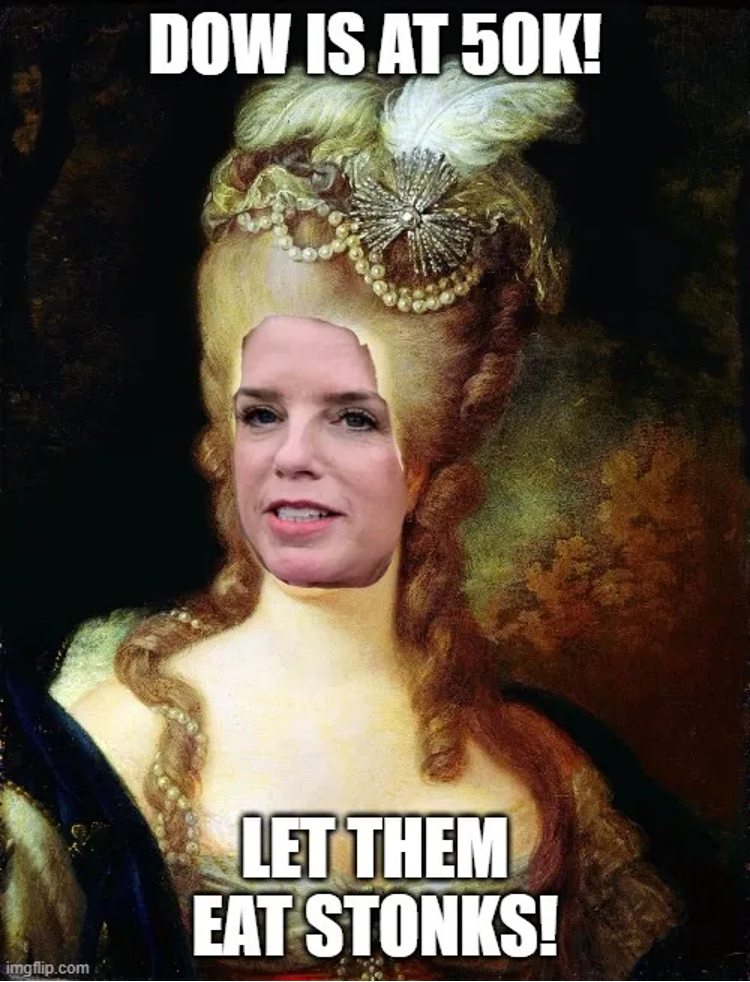
Yeah, after this week’s circus on Capitol Hill, we can’t resist…
 Mailbag: Gold (and Oil) Manipulation
“I would like to thank you for this well written article on ‘The Truth about Gold “Manipulation.”’ Very informative and illuminating. WOW,” a new reader enthuses after yesterday’s edition.
“This is something I always suspected was going on but I never really saw proved or really talked about in any kind of detail like this before.
“It reminds me of a time in recent years where the price of oil per barrel shot up an incredible amount in a period of a year or two. The actual supply and demand for oil during that same time period showed that the price of oil should have remained steady or even went DOWN slightly and not up at all !!
“Similar dynamics were at play there too with the price of oil I am sure.
“I will be looking for your 5 Bullets articles going forward. Keep up the excellent work please with more like this.”
Dave responds: Thank you for the kind words, and welcome aboard. Oil has been routinely manipulated ever since the advent of modern-day oil futures in 1983.
Energy industry journalist James Norman told the story well in his 2008 book The Oil Card. Every so often I have occasion to revisit Norman’s thesis and findings — most recently at the conclusion of the “12 Day War” last year.
While we’re at it, we might as well examine yesterday’s precious metals sell-off.
It commenced at precisely 11:10 a.m. EST. There was no obvious breaking-news catalyst that would instantly tank gold from $5,050 all the way below $4,900 (with an even more extreme move in silver, natch.)
Colleague Adam Sharp at The Daily Reckoning surmises it was a reaction to a Bloomberg exclusive that began thus…
The Kremlin has set out proposals that could see Russia embrace the dollar again as part of a wide-ranging economic partnership with the Trump administration, according to an internal Russian document reviewed by Bloomberg.
The high-level memo, which was drafted this year, details seven points where, in the Kremlin’s view, Russian and U.S. economic interests could converge following a deal to end the war in Ukraine. It sees the two countries working together to champion fossil fuels over greener alternatives as well as joint investments in natural gas, offshore oil and critical raw materials plus windfalls for U.S. companies…
All else being equal, what’s good for the dollar is bad for gold.
Of course, it all hinges on, as the story says, “a deal to end the war in Ukraine.” And how likely is that?
And is it really that good for the dollar?
Today Kremlin spokesman Dmitry Peskov addressed the issue, however obliquely. Depending on whose translation you want to believe, he said that even if a deal comes about, the dollar’s credibility throughout the Global South is already shot.
If the United States abandons this practice of restricting the use of the dollar, then the dollar will have to win competition with other alternative currencies, with national currencies that are increasingly widely used in the world.
Back to Bloomberg’s story. In the final paragraph we learn that Bloomberg’s source for this “confidential Kremlin memo” is… Ukrainian intelligence.
If there’s a link between this story and the slam in precious metals yesterday… well, there are a lot of sketchy someones who were motivated to let the story drop and position themselves ahead of its release. Alas, we’ll likely never know.
The lesson for gold bugs is the same lesson for any asset in which you have long-term conviction, be it a blue chip stock or the thinnest-liquidity crypto: Ignore the short-term noise and hold on tight.
Which is where we’ll leave it for the week. Back tomorrow with our Saturday wrap, including some, er, unusual events in New York City. Then while the markets are closed Monday you won’t want to miss our Presidents’ Day special, packed with some spooky historical recurrences.


