
Unconditional Surrender
 Unconditional Surrender
 File this one under “Life comes at you fast.”
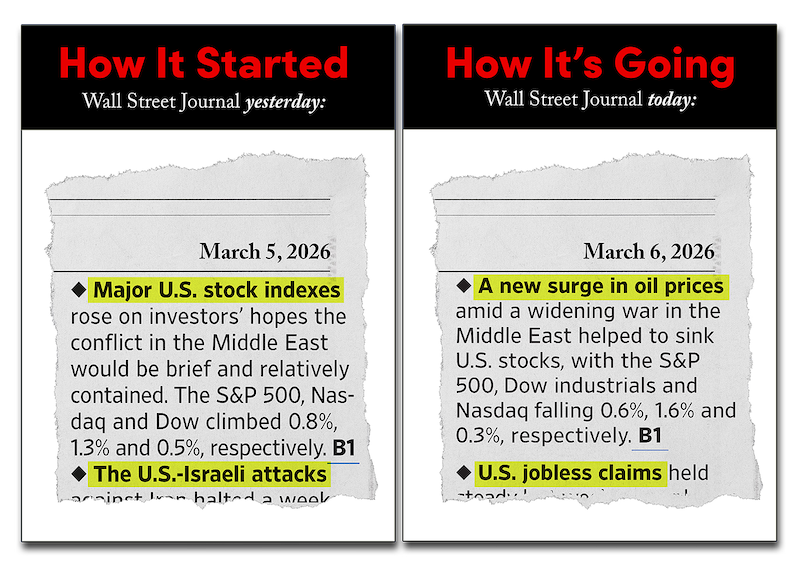
Really, though, The Wall Street Journal’s coverage of the markets this week begs the question: Whatever gave “investors” the notion the Iran war would be “brief and relatively contained”?
At the outset last weekend, we were told it would be over in a matter of days. By Monday, that became four or five weeks. By Wednesday, Pentagon chief Pete Hegseth said eight weeks.
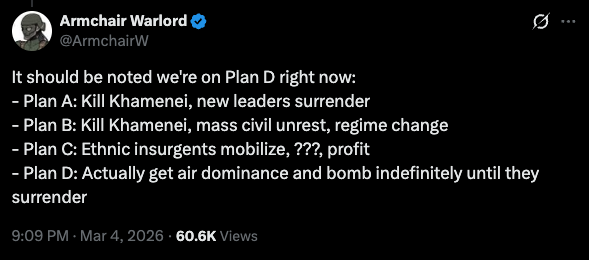
Then yesterday: “U.S. Central Command,” reported Politico, “is asking the Pentagon to send more military intelligence officers to its headquarters in Tampa, Florida, to support operations against Iran for at least 100 days but likely through September.”
Overnight, the energy minister of Qatar warned the Financial Times that every Persian Gulf energy exporter is only days away from shutting down production — and the oil price might leap to $150 a barrel.
Then this morning, Donald Trump trotted out “unconditional surrender” again — a demand that conceivably stretches the timeline well past September.
“There will be no deal with Iran except UNCONDITIONAL SURRENDER!” he said on social media.
And with that, a barrel of West Texas Intermediate has shot up 11.4% to top $90 for the first time since the autumn of 2023. And the stock market is sinking into the red for a second day running.
It wasn’t the first time he invoked that term, by the way. He said the same during the “12-Day War” last summer.
And so we’re compelled to briefly return to a theme we visited back then…
“Unconditional surrenders are so rare they are almost unheard of,” wrote Richard Maybury more than two decades ago.
Maybury is one of the graybeards of the financial newsletter biz — and a veteran of Washington’s dirty wars in Central America during the 1960s. The following is gleaned from his 2002 book World War II: The Rest of the Story and How It Affects You Today.
“In an unconditional surrender, the losers are required to lay down their arms with no guarantees at all. They must simply put their fate in the hands of the winners, and the winners can do anything they please, including hang them.”
President Franklin Roosevelt demanded unconditional surrender of Germany on Jan. 24, 1943.
At the time, the Nazis were on their heels — only a week away from getting totally curb-stomped by the Soviets at Stalingrad.
But FDR’s demand steeled the Germans’ resolve.
“The effect of this brutal formula on the German nation, and above all on the army, was great,” German Gen. Heinz Guderian wrote in his 1951 memoir Panzer Leader. “The soldiers, at least, were convinced from now on our enemies had decided on the utter destruction of Germany.”
On the flip side, unconditional surrender devastated the enthusiasm of the German underground: One of its members, Gen. Franz Halder, lamented he could no longer attract new recruits. As he put it, even Hitler’s fiercest opponents understood that “the same frightful fate awaited us with or without Hitler… The only thing to do was hold out until the end.”
The war dragged on for two more years — with more than one million dead per month.
Then again… the timeline now might be much shorter than anyone expects. Read on…
 It’s All About the Interceptors
“We have got to get this done in the next couple of weeks or we’re going to start getting into some real trouble, because we don’t have enough interceptor missiles and we don’t have enough offensive missiles to sustain this combat for months.”
So says retired Army combat officer Daniel L. Davis, now a senior fellow at the Defense Priorities think tank.
Compared with Washington’s ever-changing war aims, “The Iranian side, their objective is much more attainable and much less complicated — which is to just survive,” Davis says in an interview with Libertarian Institute cofounder Scott Horton.
“It doesn’t matter how many planes you have, how many ships you have, how many the other side has. What matters is how many [interceptor] missiles or long-range drones can you fire in a sustained manner, and how many does the other side have. Because the one that runs out of interceptor missiles first is the one that’s going to be losers.”
Even mainstream think tanks understand that the U.S. inventory of interceptor missiles has been depleted by years of Washington’s aid to Israel and Ukraine.
“The United States either needs to pay the table stakes to build up AMD interceptor capacity or bear the risk of being forced to sit out future conflicts,” said a report issued last December by the Center for Strategic and International Studies.
The report says the 12-Day War alone burned through a quarter of Washington’s supply of THAAD anti-ballistic missile interceptors. Other analysts say the report miscounted and the percentage is even higher.
Fast-forward to this week: According to several South Korean media outlets, the Pentagon has begun talking with the South Korean government about taking some of the THAADs currently deployed on the Korean Peninsula… and moving them to the Middle East.
“I struggle to arrive at a logical conclusion for this gross mismanagement,” tweets the independent military analyst Will Schryver. “It almost seems to be deliberate malfeasance, for reasons I cannot fathom.”
“It is almost impossible for me to see how Israel and the U.S. win this war,” writes John Mearsheimer, the distinguished foreign policy scholar from the University of Chicago.
“It seems that victory for this aggressive tag team requires not only regime change in Iran, but replacing the regime with new leaders who are subservient to Israeli and American wishes. If those two things do not happen, Iran will surely keep its nuclear enrichment capability; keep building ballistic missiles, cruise missiles, & long-range drones; and keep supporting Hamas, the Houthis and Hezbollah.
“The likelihood of this war producing an Iranian regime that is subservient to Israel and the U.S. is close to zero in my estimation.
“For Iran to win, all it has to do is survive and not end up as a pawn of Israel and the U.S. Even if its missile inventory is greatly diminished, its nuclear enrichment capability is crippled and its infrastructure is badly damaged, it matters little if the regime survives or is replaced by a regime that refuses to kowtow to the tag team.”
Don’t dismiss Mearsheimer’s outlook out of hand: He’s the guy who opened the eyes of millions when Russia invaded Ukraine four years ago: His 2015 lecture titled “Why Is Ukraine the West’s Fault?” went viral on YouTube in the days that followed. Later, when the mainstream kept telling us Ukraine was destined for victory and Russia for collapse, Measheimer knew better.
Let’s turn to the markets today…
 Jobs, Gold, Bonds
Aside from the war, there’s a punk jobs report on Mr. Market’s mind.
This morning the wonks at the Bureau of Labor Statistics conjured a loss of 92,000 jobs for the month of February. No one among Wall Street economists saw that one coming: The most pessimistic guess was a 35,000 job gain.
In addition, the job gains in January and December were revised downard by 69,000.
The official unemployment rate ticked up to 4.4%. It’s been hovering between 4–4.5% since mid-2024.
How believable are the numbers? Well, in one sense they’ve been gamed for decades — as we showed one day last summer. (Click here and scroll down to Bullet No. 3.) But ever since the pandemic years, matters have been made worse by the fact that fewer business owners and individuals are responding to the Bureau of Labor Statistics’ surveys.
In any event, the numbers aren’t moving the needle on the likelihood of interest rate cuts by the Federal Reserve: Futures traders still assign a 50-50 probability of one cut by midyear, and not until June.
And so the S&P 500 approaches the end of the week sitting at year-to-date lows — down 1.1% as we write to 6,753. The Nasdaq is holding up slightly better, the Dow slightly worse.
Gold has been stuck in a channel ever since a very odd $400 sell-off during a 12-hour span earlier this week: At the moment it’s up 1.1% or $57 to $5,137. Silver is again proving to be more volatile — up 2.5% or two bucks to $84.19.
Crypto’s midweek gains don’t seem to be sticking — with Bitcoin at $68,429 and Ethereum back below $2,000.
Gold’s activity this week has been curious — and bonds, curiouser. Recall during times of geopolitical and financial stress, hot money usually floods into bonds — pushing prices higher and yields lower.
That’s not happening now: After sinking below 4% last week for the first time since November, the yield on a 10-year Treasury note has shot up to 4.15% — smack in the middle of its trading range the last six months.
We’ve chronicled this before — but as far as foreigners are concerned, U.S. Treasuries are increasingly becoming a toxic asset, seeing how the U.S. government froze the Treasuries held by Russia’s central bank in 2022. Amid a newly volatile geopolitical environment, the fear might be for a similar shock announcement from Washington.
Consulting with Paradigm chart hound Greg Guenthner, a break above 4.3% will likely send the yield substantially higher. On the other hand, a retreat below 3.95% would signal a meaningful drop.
 The Costs of War
For the record, here’s a rough estimate of the Iran war’s cost as lunchtime approaches on the East Coast…
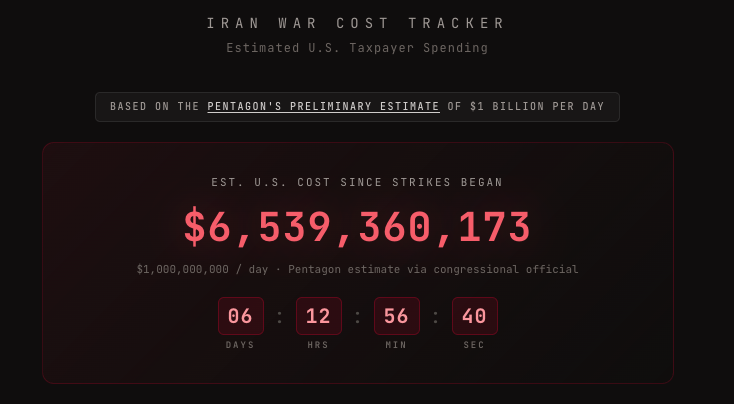
That’s according to the Iran War Cost Tracker.
We don’t know who’s behind the website — a Whois lookup reveals only that it was registered on Monday — but its methodology is transparent and simple: Veteran journalist Nancy Youssef, working these days for The Atlantic, cites a congressional source as saying the early Pentagon cost estimate for the war is $1 billion a day.
But a billion dollars a day pales in comparison with the cost to constitutional government. “The Constitution is a dead letter,” asserts the aforementioned Daniel Davis.
Both the House and Senate voted down war-powers resolutions this week aimed at halting the Iran war without congressional authorization.
Near as we can tell, this is a first in American war-fighting.
To be sure, Congress has not issued a declaration of war since World War II. President Harry Truman crossed a Rubicon in 1950 by sending American troops to fight and die in Korea with no such declaration.
Nor has there been a declaration for any war since. But at least Congress would go through the motions by passing “authorizations” and “resolutions” to make it look as if the legislative branch was doing its job.
And when Barack Obama carried out his regime-change op in Libya in 2011, the Republican-controlled Congress passed several resolutions opposing what he did. Not that it changed anything, but at least it put the legislative branch on record.
Now a Republican-controlled Congress has effectively told the president: “Do what you want, we’re checking out of all our responsibilities.”
This is brand-new territory.
Perhaps realizing what they’re doing, some Republican congressmembers are bending over backward to avoid calling the present situation a war. “We’re not at war right now,” says House Speaker Mike Johnson. “It’s not a war,” says Rep. Randy Fine (R-Florida).

We’ll give the last word for now to Edward Feser, a philosophy professor at Pasadena City College in California: “‘Operation Epic Fury is not a war’ is the new ‘Trans women are women’.”
Love how Feser’s critique scrambles the culture-war divide. Speaking of which…
 Mailbag: Civil War
Let’s turn from overseas war to civil war: We got a handful of reactions to yesterday’s edition…
“Your article overlooked one important aspect of a potential American civil war: the ideological lines are not identified by states or regions.
“The battle would be urban versus rural, not state versus state, eliminating any possibility of a geographic resolution.
“Socialist Democrats occupy the major cities, which dominate states like Illinois, Minnesota, Colorado, Virginia and even New York, putting them into Democrat territory. Conservatives (both pro-Trump and anti-Trump) occupy the rural areas making up 90%-plus of the nations’ counties, dominating what exists of a ‘well regulated militia’ (the original definition, not the National Guard). This makes such a war unlike any of the examples you cited, or any war in history.
“The only hope of a peaceful resolution (before or after mass casualties) is a consensus of tolerance to allow opposing political opinions in a desire for peace, decrying the personal hate spewed by the media and amplified by social media since Trump first won the Republican nomination in 2016.”
”One major flaw in your American blue/red map is your apparent failure to reflect what many (the majority?) believe.
“If and when actual investigations discover the levels of voter fraud, it seems likely that a lot of blue will disappear in favor of red, or at least in favor of a considerable amount of purple. This would seem to suggest that any ‘civil war’ will be much ‘muddier’ than the article portrays.
“My prayer is of course that it won't come to that. One factor that appears to never be considered in your articles is what I will refer to as ‘spiritual implications & effects.’ Speaking as a pastor chaplain, I believe that in reality, this factor carries much greater influence and weight than many think.
“Presuming, as i do, that there is a God who has ultimate oversight on everything, that Influence can decimate all our human prognostications.”
Dave: The map is from the 2024 election. Who asserted fraud in the 2024 election?
Anyway I tried to go out of my way to say that state lines as shown on the map settle nothing.
Living in one of the seven “swing states” from the 2024 election, I’m keenly aware of that fact. And I share both of these readers’ fervent hope that the worst-case scenarios do not materialize.


