
Groundhog Day, Iran Edition
 Groundhog Day, Iran Edition
 Here we go again…

There’s a lot that’s happened in the last 18 hours or so. Let’s try to make sense of it.
Last night, Donald Trump declared a “pause” to a scheme announced only 48 hours earlier in which international shipping would be “guided” through the Strait of Hormuz — but not with U.S. Navy escorts.
Just as well. No one understood the initial announcement. “We’ve really no idea what all this means,” one shipping exec told the Financial Times. “There’s no communications plan, no routing information has been published and there’s no assurance ships will be supported in the event of any attack.”
The “pause” announcement was good to knock down the price of U.S. oil futures decisively below $100 for the first time in a week.
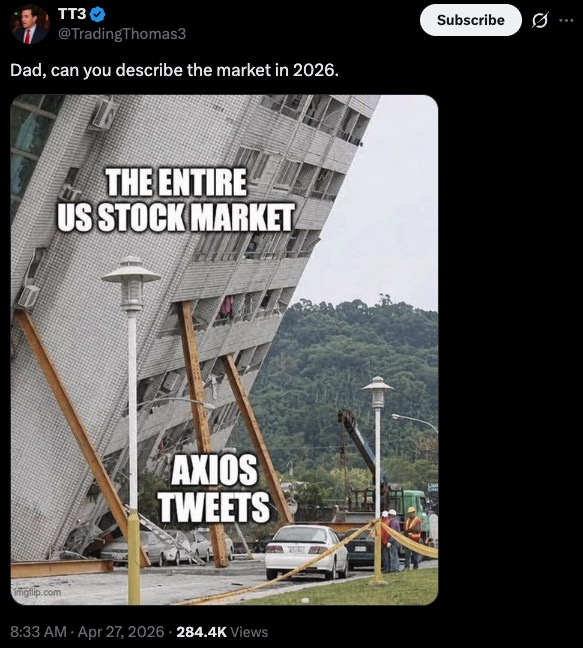
Then early this morning came another “peace is at hand” post from one of the Trump administration’s favorite reporters — Barak Ravid of Axios.
“The White House believes it's getting close to an agreement with Iran on a one-page memorandum of understanding to end the war and set a framework for more detailed nuclear negotiations, according to two U.S. officials and two other sources briefed on the issue.”
Never mind, as Cato Institute scholar Justin Logan tweets, that “Barak Ravid has predicted seven of the last zero peace deals between the U.S. and Iran.”
Crude plunged in a matter of moments from over $98 to under $90.
➢ And par for the course, there was what looks like blatant insider trading ahead of Ravid’s “scoop” — a $920 million bet on falling oil prices that generated $125 million in profit in just 3½ hours.
Meanwhile, stock futures sailed higher — as frequently happens under these circumstances.
A couple of hours later, Trump posted on his Truth Social site that Iran will be bombed at a “much higher level” if there’s no deal.
That reversed the price action in oil — from under $90 back to $96. Still substantially lower than was the case when we were writing to you 24 hours ago. Checking our screens at midday, it’s $95.57.
The major U.S. stock indexes leaped higher as soon as trading opened at 9:30 a.m. EDT.
And those gains are still holding — the S&P 500 up over 1% in record territory at 7,340 and the Nasdaq up 1.6% in record territory at 25,728. (As usual of late, the Dow is the laggard, up 1% and still 200 points away from 50,000.) It helps that there’s been another blowout earnings report from a chipmaker: AMD is up 16.8% after boffo numbers and strong guidance.
Bonds are rallying too, sending yields down. At last check the yield on a 10-year Treasury note is back below 4.36%. What we’ve been noticing in this space is being picked up by others…
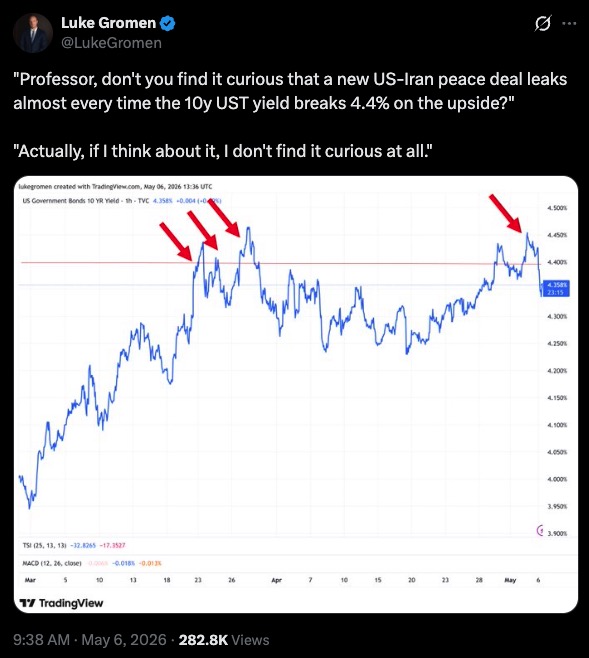
Precious metals are rallying big-time — gold up 2.7% to $4,681 and silver up 5.6% to $76.80. Crypto, however, is consolidating with Bitcoin around $81,500 and Ethereum still a ways away from $2,400.
Meanwhile, all the supply-chain snarls we chronicled again yesterday remain with us: The big Dutch firm Philips says it’s having trouble obtaining helium for its MRI and CT scanners.
“Medical imaging has a huge global footprint and unfortunately indeed with the Strait of Hormuz we saw the vulnerability of the dependency of such a finite material,” CEO Roy Jakobs tells Bloomberg.
And that’s where things stand with the war. Let’s nervously turn our attention to other matters…
 Gold: What’s Next?
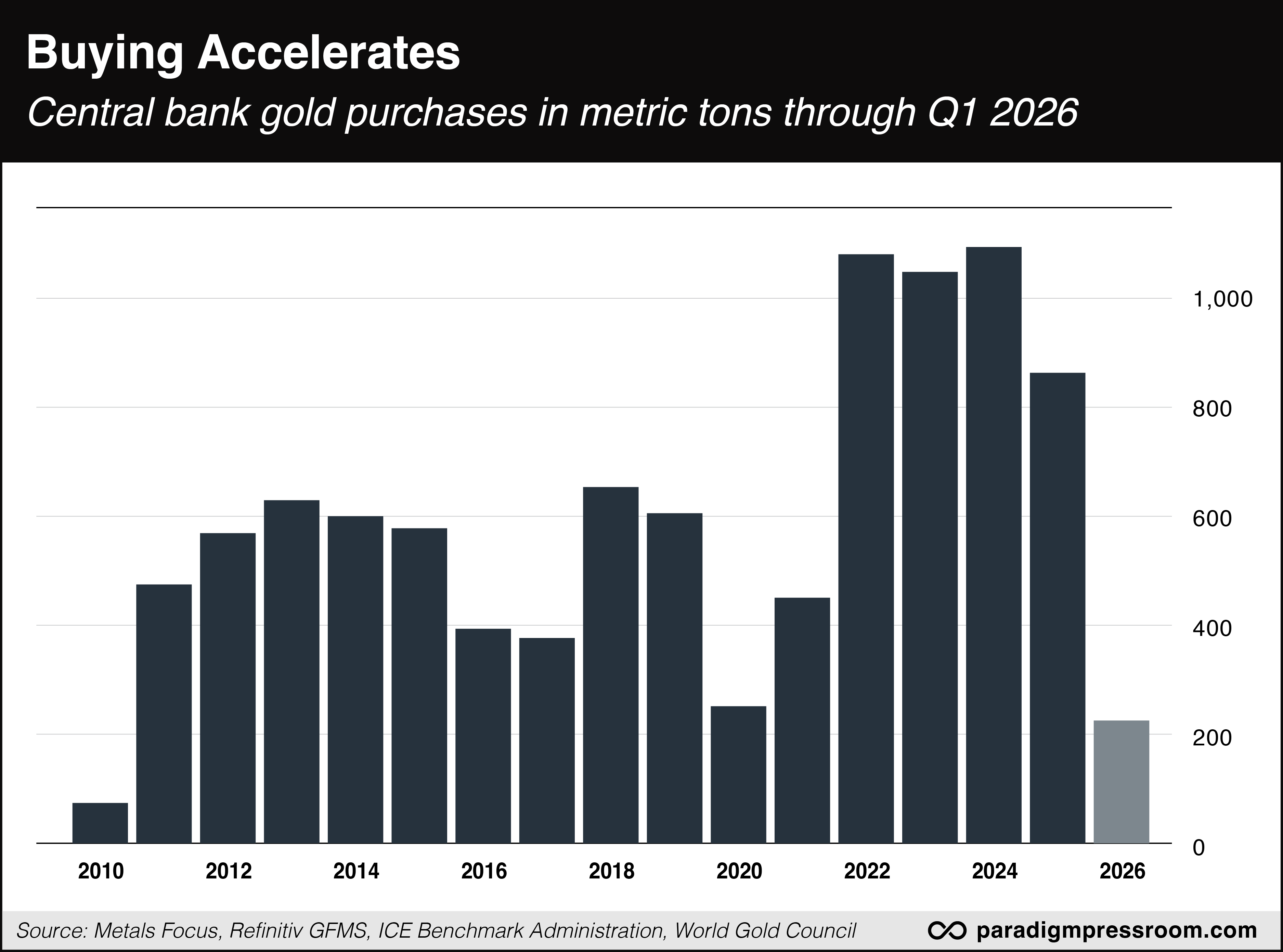
“Central banks picked up their gold buying in the first quarter of 2026,” says Paradigm macroeconomics maven Jim Rickards.
“Elevated central bank buying ramped up in early 2022, after Russia invaded Ukraine. Biden and his EU cronies foolishly confiscated $300 billion worth of U.S. Treasuries owned by Russia's central bank.
“This instantly caused central bankers around the world to buy gold, and reconsider their allocation to U.S. Treasuries. It was the spark that accelerated the current bull run, and there’s no end in sight.”
The World Gold Council reports that the total for the first three months of 2026 is 244 metric tons, the strongest quarterly figure in more than a year.
If the Q1 pace holds for the rest of the year, 2026 will easily exceed last year’s total.
Major buyers in the previous quarter included Poland, Uzbekistan and China.
Key point: China is notorious for underreporting its gold purchases. Officially its gold stash totals 2,313 metric tons. Unofficially it could be at least twice as large.
For reference the U.S. total is 8,134 metric tons — assuming those bars aren’t being leased to foreigners.
But what does any of this say about gold’s investment potential with a third of 2026 already in the rear-view?
Many market observers scratched their heads when the war began… and the gold price fell.
“Gold is supposed to go up when the world gets messy,” observes Money & Power editor (and nationally syndicated radio host) Buck Sexton. “And yet gold has pulled back.”
What gives?
“The truth is when things start to break — and make no mistake, they are — investors don’t sit around calmly rebalancing their portfolios,” is his answer. “They scramble and raise cash, grabbing whatever liquidity they can get their hands on.
“And in a world still running on the U.S. dollar, that means everyone needs dollars. Now.”
As Mr. Sexton sees it, it’s not a gold problem but rather a liquidity problem.
“The war in the Middle East disrupted the global economy. Oil and natural gas don’t move without friction anymore and countries still have to pay for that energy — no matter the price.
“And they can’t pay in gold. They have to pay in dollars.
“On top of that, there’s a slow-motion credit squeeze underway, especially in private markets. Funds that were perfectly comfortable six months ago are suddenly dealing with losses, redemptions and margin calls.
“That’s where gold comes in. Gold is liquid. It’s globally recognized. It can be turned into dollars quickly. So when pressure builds, it becomes a source of cash.
“Simple as that. When cash is king, gold gets sold.”
But don’t lose sight of that chart above. “Even as countries deal with short-term pressure — raising dollars, stabilizing currencies, managing crises — they’re also thinking long term and building a buffer,” Sexton continues.
“They’re dumping gold with one hand… and stockpiling it with the other.”
Deutsche Bank forecasts $8,000 gold by 2031. “As long as central bank demand continues and gold becomes a larger share of global reserves, we could hit that number even sooner.”
After all, “supply isn’t exactly flooding the market. Mining output has been relatively flat and new discoveries are harder to come by. It’s not easy to just flip a switch and increase production.”
 AI, the White House and Hackers
The Trump administration is digging its fingers still deeper into the AI pie.
In yesterday’s edition we told you how the administration has been rethinking its hands-off approach to AI. It seems someone or a group of someones in the White House was freaked out by Anthropic’s new Mythos model. Anthropic says it’s so powerful that it unearthed “high-severity vulnerabilities” in “every major operating system and web browser.” A sweeping new AI executive order might be in the works.
Now comes word that Team Trump is doubling down on a Biden-administration scheme in which major AI firms share their models with the feds before they’re released to the public.
When launched in 2024, Anthropic and ChatGPT parent OpenAI immediately signed on. Now The Wall Street Journal reports that Google, Microsoft and Elon Musk’s xAI have also bought into the policy.
Uncomfortable question: If the feds discover vulnerabilities that these companies managed to overlook, will they tell these companies or keep it to themselves?
In 2017, we chronicled the “Vault 7” revelations of WikiLeaks: The CIA discovered vulnerabilities in the hardware and software produced by American high-tech companies like Cisco.
But rather than say to those companies, “Hey, we found this stuff — you might want to patch it,” they said to themselves, “Hey, what if we use this stuff to jack around with the Chinese and the Russkies and the Iranians?”
The fact that hackers might discover the same vulnerabilities and use them to jack around with you? The CIA couldn’t have cared less.
At the time, Reuters described how as soon as WikiLeaks published the documents, engineers at Cisco were pulled off other projects “to analyze the means of attack, create fixes and craft a stopgap warning about a security risk affecting more than 300 different products…
“That a major U.S. company had to rely on WikiLeaks to learn about security problems well-known to U.S. intelligence agencies underscores concerns expressed by dozens of current and former U.S. intelligence and security officials about the government's approach to cybersecurity.”
This time, the AI giants may never find out what the feds discover until millions of their users are hacked: The 2017 document dump was WikiLeaks’ last major revelation.
 Comic Relief
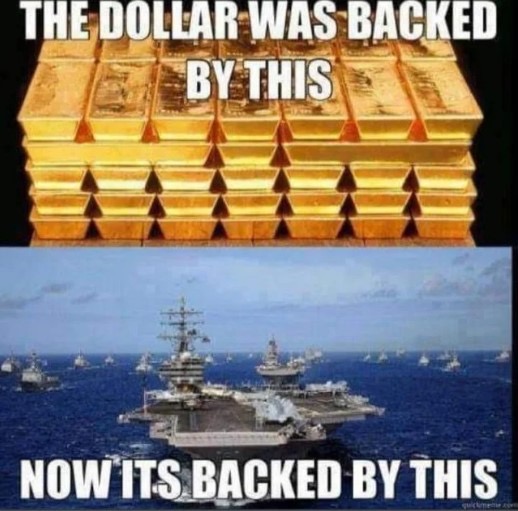
A timely reminder…
 [Hat tip: Ed Steer’s Gold & Silver Daily. I’ve been a subscriber for years.]
 Mailbag: Trader Challenge, ASTS
“I entered your Top Trader challenge selecting one stock, which results in making a mockery of investing in a sense,” a reader writes — “a gamble on long-shot investment.
“I'd rather see something along the lines of selecting five stocks over a fiscal quarter… an investing contest with merit. Just my humble opinion.”
Dave responds: Thank you for the input. Maybe I didn’t emphasize it strongly enough at the outset, but this contest had nothing to do with investing. That’s why we called it the Top Trader challenge.
Once you’re looking at a quarterly timeframe you’re in the hazy dividing line between trading and investing. But we’ll take your suggestion into consideration as we figure out how to mix it up for the next go-round.
Finally, a very short email: “ASTS — Are you still buying?”
To be clear, this is a free e-letter and as such we seldom tackle specific recommendations drawn from our paid publications — out of respect for the paying subscribers.
But… AST SpaceMobile is a workhorse holding in James Altucher’s entry-level newsletter Altucher’s Investment Network. It’s up 345% from the initial recommendation in January 2021. This is hardly the first time we’ve discussed it here.
Yes, the share price has taken a spill since its peak in February. But Ray Blanco — the tech and biotech specialist on James’ team — is as enthusiastic as ever.
In its quest to deliver satellite wireless service to the mobile phone you already have in your pocket, ASTS has an unbeatable advantage — access to the 700 MHz and 800 MHz portions of the wireless spectrum.
“This is the band that actually penetrates buildings,” says Ray — “the signal where your phone lives.” Aspiring competitors are stuck on higher frequencies where service will be less reliable.
Ray added to his personal position after the failed launch of an ASTS satellite last month. It was a one-off failure on the part of the rocketmaker Blue Origin. As he sees it, the fundamental story hasn’t changed.
Indeed, shares are screaming 9.2% higher today on the news that Rakuten — the Japanese conglomerate that was an early investor in the firm — has finished its previously announced plans to sell 15 million ASTS shares. (Rakuten was deep in debt; it needed cash and it was sitting on 20X gains with ASTS.)
ASTS reports earnings next Monday. If you’re an Altucher’s Investment Network subscriber, watch your email (or the Paradigm mobile app) for ASTS updates as they happen.


