
AI Speeding Toward a Brick Wall
 AI Speeding Toward a Brick Wall
 If you care about American competitiveness in the AI space, today’s Bullet No. 1 won’t be easy reading.
Twice last week, we took note of a major change of heart on the part of the Trump administration. The power of Anthropic’s new Mythos model — supposedly unearthing major vulnerabilities in nearly every operating system and web browser — sparked fears within the West Wing of a major AI-enabled cyberattack.
Thus an executive order of some sort is in the works that will result in much more government oversight of the sector.
In addition, Team Trump is doubling down on a Biden-administration scheme in which major AI firms share their models with the feds before they’re released to the public.
Gone are the freewheeling days of 2025 in which Silicon Valley expected Trump and crew to keep their hands off AI.
“We’re going to make this industry absolutely the top,” said the president last summer. “We can’t stop it with politics. We can’t stop it with foolish rules and even stupid rules.”
That was then, this is now: During a recent interview on Fox Business, Kevin Hassett — director of Trump’s National Economic Council — fleshed out what the coming executive order might look like.
“We’re studying possibly an executive order to give a clear road map to everybody about how this is going to go and how future AIs that also potentially create vulnerabilities should go through a process so that, you know, they’re released in the wild after they’ve been proven safe, just like an FDA drug.”
Seriously? The FDA is the model for AI regulation?
For decades, the entire purpose of the FDA has been to impose an extensive and costly regulatory regime — protecting well-capitalized Big Pharma firms that have the resources to shoulder the costs, while freezing out any upstarts.
Of course, it’s all sold to the public as necessary for our safety. That’s even though the system still allows disasters to come to market like fen-phen (a combo of weight-loss drugs) and Vioxx (a painkiller). Both caused major heart problems and were ultimately withdrawn.
An “FDA of AI” would send the industry quickly hurtling toward a brick wall.
This isn’t the first time an agency notorious for stifling innovation and progress has been cited as the model for AI regulation.
In May of 2023, about six months after ChatGPT became a phenomenon, we took note when OpenAI chief Sam Altman was hauled before Congress for a hearing.
He shamelessly played to the sensibilities of his audience at that moment — begging for government regulation and licensing on the grounds that AI might be used to propagate “misinformation.”
“We’re going to face an election next year,” he said. “And those models are getting better.”
One senator suggested a good template for AI regulation would be the Nuclear Regulatory Commission. Altman said the “NRC is a great analogy” for the sort of regulation he supports.
Reality check: The NRC all but killed off nuclear power in this country: Since the 1970s, construction time for new plants ballooned from four years to 14… while plans for 60 reactors were scrapped.
Gee, those 60 reactors might’ve come in handy right around now when AI needs more electricity and the utility industry can’t keep up with the demand. (More about that in Bullet No. 4 today.)
But again, OpenAI was and is an entrenched incumbent in the AI space; it’s in Altman’s interest to use the heavy hand of government to strangle any up-and-coming competitors.
“Adopting an FDA-style regulatory regime for AI would represent a shocking policy reversal by the Trump administration, and a major about-face on how America has approached software, online speech and digital commerce,” says a statement from Neil Chilson at the Abundance Institute and Adam Thierer at the R Street Institute.
The new developments this month mark “a startling turn” from Trump’s previous stance “where he allowed tech companies to do what they wanted without hardly any government oversight,” the Brookings Institution’s Darrell West tells MarketWatch.
Then again, it’s not altogether surprising: The major advocate for the hands-off approach was venture capitalist David Sacks — who left his post as the administration’s AI and crypto czar in March.
Sacks, an original member of the “PayPal mafia” with Peter Thiel and Elon Musk in the 1990s, told Bloomberg he’d “used up” his 130 days as a special government employee not subject to Senate confirmation. (In reality, he was pushed out days after saying the administration should “declare victory and get out” of the Iran war.)
Investment implications?
On the one hand, regulation favors all the big incumbents — both publicly traded ones like Microsoft and Google and the still privately held ones like OpenAI and Anthropic. On the other hand, a lack of up-and-coming competition makes the big incumbents fat and lazy, limiting their profit potential. They become better for short-term trades than long-term investments.
This story is just beginning. We’ll stay on top of it in the months ahead…
 Oil: Reality Reasserting Itself?
Maybe the paper price of oil is moving closer to the real-world price of physical barrels.
U.S. futures are up another 4% today, now over $102 — back to where it was a week ago, before the alleged “scoop” by Axios reporter Barak Ravid about the White House “getting close to an agreement with Iran on a one-page memorandum of understanding to end the war.”
To hear the mainstream tell it, the jump yesterday and today is a function of Trump now pouring cold water on the prospects for a deal, or even for the cease-\fire to hold up.
But really… is he going to restart the war just before he meets with Chinese President Xi Jinping? (Trump lands in Beijing tomorrow.)
More likely that the price of crude futures is coming into closer alignment with the price of “wet” barrels for delivery to customers. We’ve mentioned regularly that this real-world price is closer to $140 or higher — and we’ve also described the long history of how oil futures are manipulated for political ends.
Reality might be starting to assert itself.
Meanwhile, the real-world impacts continue to mount. The following tweet from the owner of an oil-change franchising outfit went viral last night: We present it as a public service announcement in case you missed it.
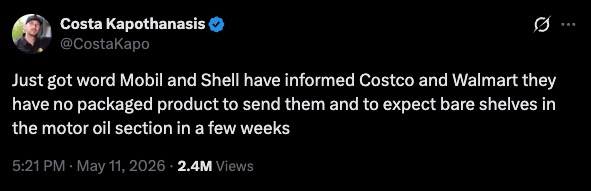
At the same time the mainstream is finally catching up to what we’ve been telling you for weeks…
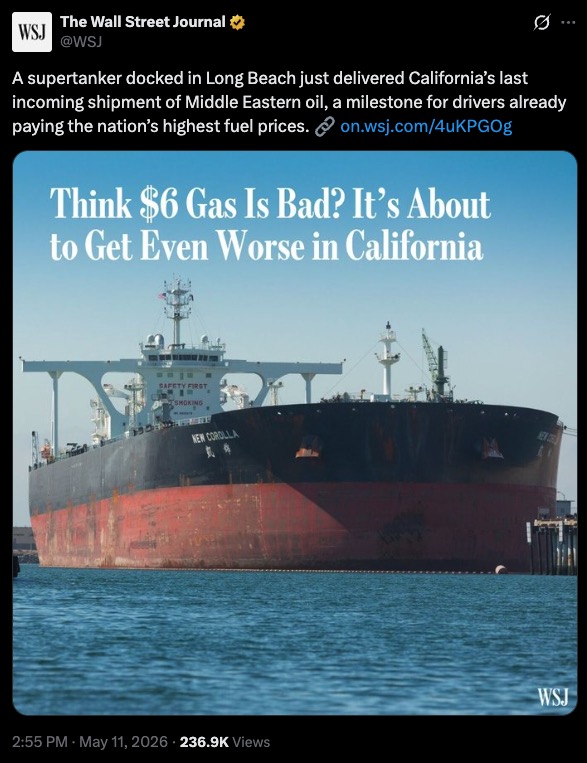
Ummm… we mentioned the supertanker’s arrival a week ago today.
And that was on top of Byron King’s previous exposes in this space — one of them over a month old! — about the dire situation in California thanks to the fact the state is not connected to any major U.S. pipelines and thus relies on imports from the Persian Gulf region.
Byron tells us this week the situation would be even worse were it not for an influx of tankers arriving from the Gulf Coast via the Panama Canal — more in the last two months than during all of 2025, in fact.
The big market-moving story today is the release of the official April inflation figures.
They clocked in more or less as expected — up 0.6% month-over-month and 3.8% year-over-year. That’s the fastest annual pace since May of 2023. Inflation has clearly broken out of the 2.4–3.0% range where it oscillated from mid-2024 until just before the war began.
With that, nearly every major asset class is selling off…
- The S&P 500 is down nearly 1% to 7,344. The Dow’s loss is narrower, the Nasdaq’s steeper
- Treasury prices are falling, sending yields higher — the 10-year note back over 4.4% and the 30-year bond over 5%. (Generally these levels have triggered some sort of conciliatory announcement from the administration about the war, the better to calm down the bond market. We’ll see…)
- Gold is down nearly $80 to $4,655 and silver down nearly 3% to $83.56. (In fairness, silver needs a rest…)
- Crypto is languishing, with Bitcoin sinking back toward $80,000 and Ethereum at $2,260.
 Mood on Main Street
The vibe on Main Street amid the war is similar to the vibe amid the tariff drama just over a year ago.
The National Federation of Independent Business is out with its monthly Small Business Optimism Index. The April reading is 95.9 — basically unchanged from March, marking two straight months below the index’s long-term average dating back to the mid-1970s. Similar numbers emerged in April 2025 after the fright brought on by the president’s “Liberation Day” announcement.
“Inflationary pressures continue to be a challenge for Main Street,” says NFIB Chief Economist Bill Dunkelberg. Gee, ya think?
That said, inflation does not top the portion of the survey where respondents are asked to identify their single-most important problem. Instead “quality of labor” is back on top for the first time in six months; 18% of respondents say good help is hard to find.
“In our rural northern California area,” says a retailer, “qualified/skilled/knowledgeable help is nonexistent. Unskilled is nonexistent.”
“I’m on a livestock farm,” says a Tennessee business owner, “and it is impossible to find help. Any warm body expects $20 per hour for what should be a minimum-wage job.”
“It is difficult to find qualified auto technicians that want to progress in this field,” says a response from New York.
After labor quality cited by 18%, taxes were right behind at 17% and inflation at 16%. Everything else was 10% or less.
 Power Grid: Level 3 Alert
U.S. electric utilities are operating under a rare Level 3 alert — the highest level issued by NERC, the North American Electric Reliability Corporation.
The reason — “data centers unexpectedly dropping load or oscillating demand rapidly, creating reliability concerns,” reports the industry website Utility Dive.
In its own words, NERC warns that utilities “generally did not have sufficient processes, procedures or methods to address emerging computational loads.”
Don’t get the wrong idea: We’re not necessarily staring at widespread blackouts this week. But the organization is ordering its member utilities to take seven steps toward stabilizing the grid and report back on their progress by Aug. 3.
Context: Even before AI burst on the scene in late 2022 we were warning the grid was increasingly unstable. Too many coal and nuclear plants were being retired, and there wasn’t nearly enough solar and wind capacity coming online to take their place.
AI data centers took a situation that was already urgent and made it dire.
Later this month, NERC will be out with its annual “Summer Reliability Assessment” — identifying which parts of the country will be most vulnerable to rolling blackouts in the event of a severe heat wave. We’ve been monitoring this report regularly since 2022, so stay tuned…
 Mailbag: Hantavirus
A couple of readers took the time to write after your editor sounded an early alarm in yesterday’s edition about hantavirus, with an eye toward the events of COVID six years ago…
“A point of clarification on that British Army team parachuting onto Tristan da Cunha,” says one of our regulars — “it has nothing to do with any containment protocols. Remote island with no airport.”
“As a board-certified practicing industrial hygienist,” says another reader, “I feel the hantavirus fears are way overblown and not comparable to a highly communicable respiratory virus like COVID.
“Hantavirus is caused by rodent feces that have become dried on surfaces, and through mechanical processes have been able to become airborne and then inhaled. (Even though rare varieties have some ability for person-to-person transmissibility — such cases still require very close contact between individuals — and therefore population spread is very limited.)
“Appreciate your insights and articles — even though I sometimes disagree — I always find your stuff interesting to read.
“Keep up the good work — and thanks for helping us to be better investors.”
Dave responds: Thanks to both of you for the input. To be clear, I brought it up yesterday not with an eye toward the actual threat but toward the suspiciously alarmist media treatment. After the tyranny and trauma imposed on this land during 2020, I think the wariness is warranted.
One of my must-follows on X in recent weeks is Calvin Froedge, founder of the Marhelm shipping data platform. He says he lost friends in January 2020 when sounding an early alarm about a “novel coronavirus” emerging in China’s Hubei province.
He says he is not ready to sound a similar alarm now. But he’s on alert for evidence suggesting hantavirus was subject to gain-of-function research developing a strain that can be easily spread through coughing and sneezing.
That evidence has not emerged yet… but under the circumstances, it’s wise to keep an eye out.
At the very least, it’s been discouraging and disquieting this week to look up at my screens of international news channels — and once again be greeted by the sight of WHO chief Tedros Adhanom Ghebreyesus.

Really, I’d have been happy to go through the rest of my life never seeing that guy again…


