
SpaceX Is Not a Space Company
 SpaceX Is Not a Space Company
 From Paradigm’s lips to CNBC’s ears…

Way back in January, colleague Davis Wilson at our sister e-letter The Million Mission mused about just this possibility: “What if Elon Musk eventually consolidates all of his companies into one mega-entity?”
Days later, Musk took an initial step in that direction — bringing his xAI artificial-intelligence venture under the SpaceX umbrella.
For the moment, a SpaceX-Tesla tie-up remains in the realm of speculation. And so we’ll keep the focus today on what we know — and there’s a lot to know in the prospectus SpaceX filed with the feds last week ahead of going public 17 days from now.
In yesterday’s edition, our tech-investing pro Ray Blanco spotlighted the standout number in that document: SpaceX sees AI as a $26.5 trillion market, compared with a paltry $370 billion for space.
Today Davis Wilson shares his own insights after pulling apart SpaceX’s S-1 document…
It’s not just that SpaceX sees AI as a vastly bigger market than space: It’s also the fact SpaceX is spending its precious capital accordingly.
“For the three months ended March 31, 2026,” says Davis, “SpaceX spent:
- $1.05 billion expanding its Space segment
- $1.33 billion on Connectivity (Starlink)
- And a shocking $7.72 billion building AI infrastructure.
“That means SpaceX is currently spending roughly 7X more on AI than its actual space operations.
“This completely changes the narrative around the company.
“Most investors still think rockets are the main story. The S-1 strongly suggests AI increasingly is.”
All that spending would be impossible without Starlink. “Rockets and AI generate the headlines — but Starlink generates the cash flow,” says Davis.
The “Connectivity” division of SpaceX — dominated by Starlink — generated $7.2 billion last year in adjusted EBITDA (earnings before interest, taxes, depreciation and amortization).
“Meanwhile,” Davis tells us, “SpaceX’s Space segment lost $657 million in 2025, while its AI segment lost $6.4 billion.
“In other words, Starlink is increasingly funding the rest of Elon Musk’s empire.” As such, Davis thinks “Starlink may ultimately be the most important business inside SpaceX.”
Meanwhile, the integration between SpaceX and Tesla is already tighter than you might think.
Davis unearthed the following from SpaceX’s filing…
- “Tesla owns 18,990,195 shares of SpaceX Class A common stock
- SpaceX obtained goods and services from Tesla of $11 million in 2023, $4 million in 2024 and $144 million in 2025
- xAI obtained goods and services from Tesla of $191 million in 2024 and $506 million in 2025
- Tesla has directly and indirectly purchased advertising on SpaceX’s X platform
- Even the cost of Elon’s jet usage is split between SpaceX and Tesla.
“The lines between these companies are becoming increasingly blurred,” says Davis — making that mega-merger more and more plausible. “Maybe one day my prediction will come true — Ticker Symbol: ELON.”
Davis is on the fence about whether he’ll actually buy once SpaceX starts trading June 12 as SPCX.
“But at the very least,” he says, “I now understand what I’d actually be buying.
“And no… regardless of what most people think, it isn’t a rocket company.”
 Here We Go Again (Again)
All evidence to the contrary, the “war’s almost over” trade is in play for a second straight day.
At last check, U.S. oil futures are down over 4% at $90 on the nose. That’s even though there’s still no “deal” between Washington and Tehran that would bring the Iran war to a conclusion.
Even if the two sides can somehow come to terms on uranium and the Strait of Hormuz, Tehran wants Israel to stop bombing Lebanon — and there’s no sign Israel is willing to let up. (Remember when Donald Trump “forbade” Israel to attack Lebanon last month?)
And so shipping through the strait remains at a trickle relative to when Washington and Tel Aviv launched the war three months ago.
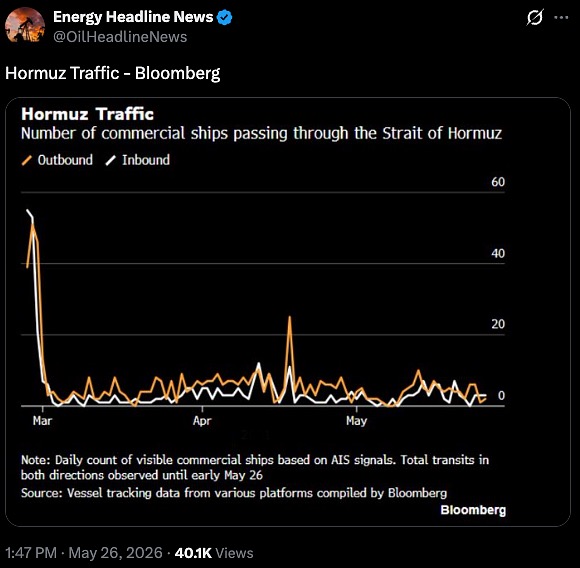
Meanwhile, the major U.S. stock indexes are taking a breather — the S&P 500 and Nasdaq down fractionally from yesterday’s record closes.
Paradigm readers are savoring a handful of gains racked up by the editors just yesterday…
- Greg Guenthner’s Trading Desk readers collected 435% in just over a month playing call options on the red-hot space name Redwire
- It took less than three months for Altucher’s Investment Network readers to collect 140% on the chipmaker Astera Labs
- Microcap Millionaire readers bagged 382% in less than a year on Navitas Semiconductor
- Chris Cimorelli’s 10X Trade Club readers pulled in 123% in less than four months with call options on Enphase Energy.
Precious metals are getting clobbered again despite the “war’s almost over” atmosphere. Gold is down $64 to $4,442, a two-month low. And silver’s off more than two bucks, retesting its May lows at $74.63.
Crypto remains stuck in the mud, Bitcoin under $75,000 and Ethereum at $2,060.
 AI Regulation Rethink
For the record: The Trump administration is pulling back on its plans for heavy-handed AI regulation.
Earlier this month we told you how the White House’s thinking underwent a major transformation since last year: Gone was the president’s talk about how AI is too important to burden “with foolish rules and even stupid rules.” Instead, National Economic Council Director Kevin Hassett started talking about AI being regulated “just like an FDA drug.”
Your editor was appalled at the prospect. The FDA is the last thing that comes to mind when you think about innovation and competitiveness.
But last Thursday, at nearly the last minute… Donald Trump called off a signing ceremony for an AI executive order that had been in the works for weeks.
As he explained it, he doesn’t want to get in the way of the American AI industry’s advantages over China.
“I really thought that could have been a blocker, and I want to make sure it’s not… I don’t want to do anything that will get in the way of that lead.”
It appears David Sacks still holds sway in this administration even though he’s stepped back from his role as the White House AI and crypto czar.
Sacks stands for the hands-off approach that was the administration’s stance last year. “There’s a very visceral negative reaction here because we know how damaging that would be to innovation,” he said recently on the All In podcast that he co-hosts.
As it happens, Sacks still has a voice within the White House as co-chair of the President’s Council of Advisors on Science and Technology.
One wonders if Sacks has been getting input from Elon Musk now that it turns out SpaceX is mostly an AI company: Both men belonged to the original “PayPal mafia” during the 1990s…
 Your Bank Won’t Ask for Your Passport After All
OK, it looks as if you won’t have to present your U.S. passport just to open a bank account.
Three months ago we sounded the alarm as the Trump administration was poised to issue a sweeping executive order forcing banks to collect information about their customers’ citizenship status.
In theory it was aimed at cracking down on illegal migration. In practice it was a huge step toward a show-me-your-papers society for law-abiding citizens. You would have had to cough up a passport or birth certificate not only to open a new bank account, but even to keep your existing one.
It appears the White House has dialed back on the proposal. Not because of pressure from the public — but rather pressure from the banking industry, which blanched at the new paperwork requirements.
The final executive order, issued last week, merely directs banks to “make a person’s immigration status an explicit part of a bank’s assessment of whether a customer poses a money-laundering risk,” according to The Wall Street Journal.
Clear as mud, right?
At least we know this much: Unlike the original proposal, whatever enforcement takes place won’t be visible to the customer.
Well, unless the bank decides you “pose a money-laundering risk” and closes your account.
Which is a potentially greater risk than you might think.
Under previous instances of unclear federal mandates, JPMorgan Chase shut down everyone from porn starlets to gun-shop owners to crypto bros.
It could easily start happening again — and all because the U.S. government can’t keep track of who’s in the country legally and who’s not.
 Mailbag: Intergenerational Warfare
“Dave, I don’t think it is an ‘I got mine’ philosophy,” a reader writes on the subject of boomer attitudes toward younger generations. “I believe it’s more that we see the waste in the name of equality.
“Government establishes student loans for everyone. It lowers standards and provides loans that have no bearing with what the degree will produce, e.g. $200,000 in loans for a job that won’t earn the student $50,000.
“Schools lower entrance standards in the name of fairness, knowing full well the student will not make it past the first year. This extra money is gravy for them. It doesn’t cost much to carry a student that will flunk out the first year.
“So what do they do? Build more extravagant buildings that aren’t really needed. Add extra courses in new disciplines to attract more students that will suffer. Add more administrative staff and cut back on the quality of teaching staff. That makes the degree weaker, resulting in lower ranking for the programs.
“Students suffer and are behind the eight ball if they even make it to graduation.
“I went to a smaller university ranked No. 3 nationally in engineering. The total expenses including food and housing for the four years were approximately $15,000 per year. Starting salaries for graduates were approximately $9,000 per year. That’s 60% of the total expenses.
“The ratio is now 20% for engineering grads and their ranking in engineering is No. 53. But they added many liberal arts programs in order to diversify the student body. They also spent $200 million on a performing arts theater for the 30 or so music majors. God knows what the ratio is for music majors.
“A few ideas:
- Make universities liable for a majority of student defaults. They knew the loans wouldn’t be paid
- Limit total loans to two years of average starting salary for their planned degree. Annual loans would be limited to a percentage based on the number of credits scheduled. If a student plans on a six-year program, they are limited to 1/6th of the loan total per year. No front-end loading.
“I know these ideas are unrealistic for a government that can handle its own finances, but I do believe it is what makes us boomers cynical about people not handling their own finances with student loans, credit card debt, etc. They are just used to low interest money being available with no regard to how they will pay it back.”
Dave responds: So you raise many valid points about how government intervention has messed up higher education… but then you put the responsibility on the students?
We now have two generations of Americans for whom it was impossible to pay for college by flipping pizzas part time — but they were also told they’d be condemned to a life of penury if they didn’t get the sheepskin.
All they did was respond to the incentives, perverse as the incentives were. And that’s on them?
The simplest fix — not a panacea, but a good start — would be to make student loans dischargeable in bankruptcy again. They were until 2005 — until Joe Biden shepherded the change through the Senate and George W. Bush signed it into law. Bipartisanship!


