
It’s All Over
 It’s All Over
 The current bull market in U.S. stocks began nearly four years ago. And one market sage is convinced it ends tomorrow.
First, let’s review how we got here.
You’ll recall there was the COVID crash in early 2020… then a steep recovery for the rest of 2020 and all of 2021 as people took their stimmy checks and plowed them into the stock market.
But as soon as the calendar turned to 2022, the market took a big hit — the S&P 500 tumbling from 4,800 to 3,600 in about 10 months. That’s a 25% drop, and anything greater than 20% meets the conventional definition of a “bear market.”
The bottom came on Oct. 12, 2022. A few weeks later, AI burst into public consciousness with the release of ChatGPT 3.5.
It’s been up, up and away ever since — albeit with the inevitable steep pullback here and there.
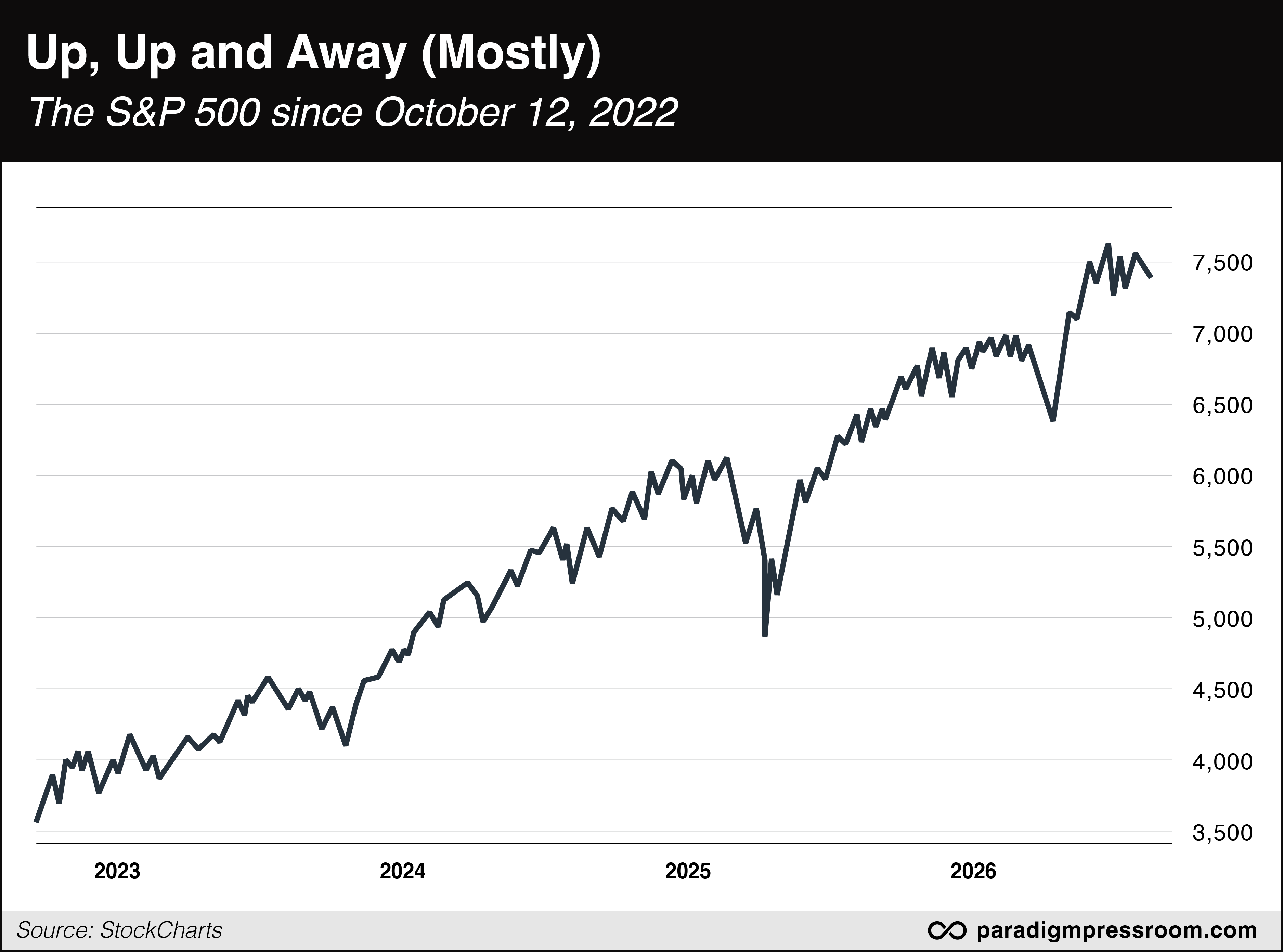
You’ll notice the market’s been moving sideways the last two months. The S&P peaked just over 7,600 on June 2 — and hasn’t revisited that level since.
The AI trade is looking tired, for a handful of reasons…
- As we mentioned last week, Google reported its quarterly numbers. Since late 2022, Google and the other “hyperscalers” have been rewarded every time they said they’re upping the amount of money they’re plowing into AI infrastructure like data centers. But last week, Google was punished instead — the share price tumbling 6% in a day
- The semiconductor stocks, measured by the Philadelphia Semiconductor Index (SOX), are in a bear market — down 25.8% from their peak only five weeks ago (including a 5.4% drop today as we write). Even the mighty Nvidia isn’t immune — its market cap shrinking such that it’s surrendered its crown as the world’s biggest company to Apple
- South Korea’s stock market — dominated by the memory-makers Samsung and SK Hynix — also peaked five weeks ago and it’s down 34% since. On several days (including today) the market has shut down altogether as “circuit breakers” kicked in to stop the bleeding. And that puts a hurt on the dominant U.S. memory name Micron — down another 10% today.
“The market is extremely fragile right now,” affirms Mason Sexton, editor of The Map — an assessment with nearly 50 years of market experience behind it.
His string of brilliant calls stretches all the way back to the early 1980s — when he called a bottom that marked the start of an epic 18-year bull market in stocks.
Along the way, he also called the crash of 1987… the start of the global financial crisis in 2007… and the end of that crisis in 2009.
More recently — and you might want to scroll back up to that chart above — he nailed both the drop and the recovery from the “Liberation Day” tariff announcement last year and the start of the Iran war this year.
Key point: Neither of those big drops constituted a “bear market” — that is a 20% drop or more. The bull market was still intact.
But for a variety of reasons, Mr. Sexton assesses that tomorrow will be at least the beginning of the end for the bull market that began in October 2022. And as he sees it, tomorrow might very well be the end — with a steep drop throughout August and September.
 Oil Supply Takes Another Hit
Oil prices continue to fall despite a big hit to Saudi Arabia’s oil exports.
Of course, Saudi Arabia’s oil exports were already constrained by Iran all but closing the Strait of Hormuz. But the kingdom could still rely on a pipeline that moved oil from the eastern portion of the Arabian peninsula to the Red Sea port of Yanbu on the western side.
No longer — not since Saudi Arabia’s puppet government in Yemen relaunched its war against Yemen’s Houthi faction a couple of weeks ago. The Houthis have declared the slender Bab al-Mandab waterway closed to Saudi shipping.
Result: Figures from the analytics platform Vortexa show that Saudi Arabia’s crude oil loading volumes at Yanbu have plunged 40% in recent days. The only reason they haven’t collapsed altogether is that the kingdom still has access to an Egyptian pipeline — and tankers can avoid the Bab by traveling north to the Suez Canal.
But in the market for U.S. oil futures, the only thing that matters is that U.S. and Iranian forces have stopped lobbing drones and missiles at each other (and Donald Trump hasn’t amped up the war rhetoric).
The paper price for a barrel of West Texas Intermediate sits at $81.46 — down more than 10 bucks compared with last Thursday.
As for the major U.S. stock indexes, it’s a mixed bag: The S&P 500 is up less than a quarter percent at 7,428.
The Nasdaq is holding up well — down a modest 0.15% — despite the downdraft in the chip and memory stocks. And the Dow is up 1%.
Precious metals are losing ground, gold at $4,038 and silver down a buck to $57.31. The story in crypto is similar, Bitcoin sinking toward $63,000 and Ethereum back below $1,900.
The Federal Reserve begins one of its two-day policy-setting meetings today — with the outcome announced tomorrow. Paradigm macroeconomics authority Jim Rickards anticipates the benchmark fed funds rate will be left unchanged at 3.75% — which is where it’s been since last December.
That’s because Jim says the Fed under its new chair Kevin Warsh is badly split — one faction that wants to cut rates to prop up the economy and another that wants to raise rates to contain inflation.
Under the circumstances, Jim says the new Fed chair Kevin Warsh will prevail on his colleagues to split the difference — “do nothing, wait for another month of data and keep the door open to a policy change in September.”
Speaking of Jim…
 Was It Something We Said?
OK, this wasn’t on our bingo card for 2026…
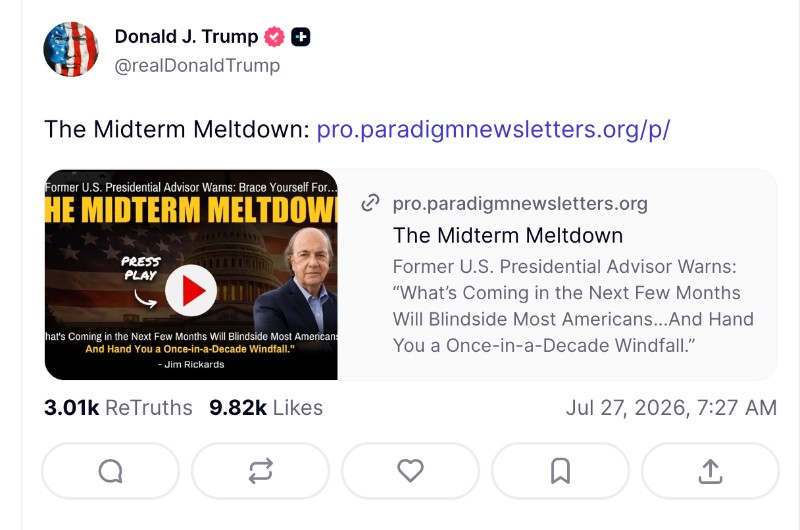
Yes, that’s the president of the United States… linking on his Truth Social platform to a sales promotion for Jim Rickards’ flagship publication, Rickards’ Strategic Intelligence.
It happened early yesterday morning during one of the president’s periodic bouts of binge-posting.
Hey, what can we say? We’re financial publishers. We’re in the business of ideas that grab people’s attention.
So far, the media haven’t picked up on this development — not much, anyway. There’s one online outlet that seems hostile to Trump but whose write-up on this story was very fair and down-the-middle.
Moving on…
 Follow-Up: The Fort Knox Fake-Out
In 18 months the Trump administration has moved from “We must audit Fort Knox!” to “Trust me, bro.”
When Elon Musk was still heading up the White House’s DOGE effort in early 2025, he seemed receptive to public pressure for a full-on audit of the U.S. Treasury’s gold bars held at Fort Knox, Kentucky — which would have been the first since at least 1953.
Musk even suggested a live video walkthrough — and on four occasions, Donald Trump said he welcomed the idea.
But our own Jim Rickards was quick to throw cold water on the notion. At best, he said it would be a meaningless photo op. And in the end, not even that much happened for reasons we explored in June of last year.
You’d think the administration would at least offer some respect to citizens who wonder whether some or all of the gold is gone — or even if it’s all there, whether it’s been leased to foreigners.
But no. Treasury Secretary Scott Bessent was interviewed recently by Fox News host Jesse Watters. Watters asked, “Have you visited Fort Knox?”
“I haven’t,” Bessent answered. “People on my staff have. The treasurer has been to Fort Knox, and I’m happy to say all gold is present and accounted for.”
“There you have it,” Mike Maharrey writes for the Money Metals website: “The fox guarding the henhouse says the hens are all accounted for. Case closed!”
Our only hope now is a measure in Congress called the Gold Reserve Transparency Act — and it doesn’t appear to have much momentum. Only five House members have signed onto the measure, and that was over a year ago.
And it probably won’t be reintroduced in the next congress because the lead sponsor — Rep. Thomas Massie (R-Kentucky) — was taken out by special interests in the primaries this past spring.
 Mailbag: Socialism (Continued)
“The U.S. is already socialist,” a reader writes as we share more responses to last Thursday’s edition.
“What does the federal government spend the most on and regulate the most? Education/student loans and health care. Both primary concerns of any socialist state.”
Dave responds: Hold that thought, we’ll come back to it…
“As you document Republican accusations against Democrats of supporting communism, how would you characterize the Trump administration's buying spree of favored private companies?” writes another.
“Five percent here, 10% there and pretty soon 51% altogether: ‘public ownership of the means of production’ just as Karl Marx advocated in The Communist Manifesto.”
Dave: It is problematic in the extreme (even as it has been rather profitable for some of our subscribers). And as we chronicled on Saturday, it’s not very popular either.
Our final correspondent wishes “to illustrate a much more foundational problem.
“My first reaction to your piece wasn't concern about socialism. It was concern about fear.
“Your article frames ‘socialism’ as the great threat facing America. That framing misses the more immediate danger: the accelerating concentration of economic and political power into fewer and fewer hands.
“Whether one calls the system capitalism, socialism or something else becomes almost secondary if ordinary citizens continue losing agency while political actors increasingly centralize wealth and influence.
“Ironically, your article acknowledges the real issue when it quotes ‘Election Wizard’ describing the frustration of younger generations. Millennials and Gen Z aren't simply embracing socialism because they've suddenly become students of Karl Marx. Many have concluded that the current system isn't working for them. Housing, health care, education, wages and the ability to build a secure future are all moving further out of reach.
“That deserves serious examination rather than simply warning about socialism.
“Paradigm often excels at questioning conventional narratives, yet this piece adopts one of today's dominant political narratives almost wholesale. Republicans increasingly portray socialism as the existential threat to America, while Democrats portray authoritarianism as the existential threat. Both narratives generate fear. Neither asks the deeper question: Why are so many Americans losing confidence in the institutions that govern them?
“From my perspective, the fundamental issue is neither socialism nor capitalism. It is extraction versus creation.
“We have built an economic and political system that increasingly rewards the extraction of wealth, influence and power rather than the creation of broadly shared prosperity. That dynamic can exist under governments calling themselves capitalist, socialist or something in between.
Labels matter far less than outcomes.
“My concern is that we no longer possess the social cohesion necessary for a healthy republic. When citizens are encouraged to fear one another more than they question the incentives embedded within the system itself, polarization deepens. At the same time, the underlying concentration of wealth and power continues largely unabated.
“If the discussion remains ‘capitalism versus socialism,’ we risk debating labels while ignoring the systems that are actually destroying America.
“You have the opportunity to elevate the conversation rather than reinforce another cycle of political fear. I hope you'll consider doing so.”
Dave: That’s exactly why I included the strategic-empathy remarks from “Election Wizard.”
So allow me to elaborate on your own outstanding reflections with a few words addressed specifically to anyone reading this who’s a boomer — especially if you wrote in and said basically that millennials and Gen Z need to just pull themselves up by their bootstraps.
You need to understand that the world facing young people today is not the world you faced as a young person yourself.
Yes, inflation hit hard in the 1970s. And the early ’80s recession sucked. But you were able to pay for college by flipping pizzas nights and weekends… you were able to buy a starter home for only two or three times your annual pay… and the health care sector had not yet become the extractive monster it’s become today.
The 45-and-under set isn’t so lucky. They’d be happy to climb the ladder of success that you did — but all too often they’ve discovered someone knocked out the first three or four rungs.
Try to see where they’re coming from.
It’s the least you can do if your GI Generation parents refused to do so for you…


