“Inflicting Maximum Damage and Pain”
 “Inflicting Maximum Damage and Pain”
 One day in the spring of 2014, we published an issue titled “The 18-Month Nationwide Blackout.”
It was actually the second of two parts. In the first, we spotlighted the revelation that the previous year, snipers shot up the Metcalf electrical substation in Coyote, California — not far from San Jose.
The impact on the power grid was minimal — but by many accounts, that was just a lucky break. (To this day, the case remains unsolved.)
Over those two days we also took note of a government report that said, "Destroy nine interconnection substations and a transformer manufacturer and the entire United States grid would be down for at least 18 months, probably longer."
That’s just nine substations out of 55,000 total nationwide.
You can imagine the scale of civilizational breakdown if the lights went out for a year and a half. (Or maybe not. Normalcy bias is a powerful thing.)
A few days ago, The New York Times Magazine reprised this history…
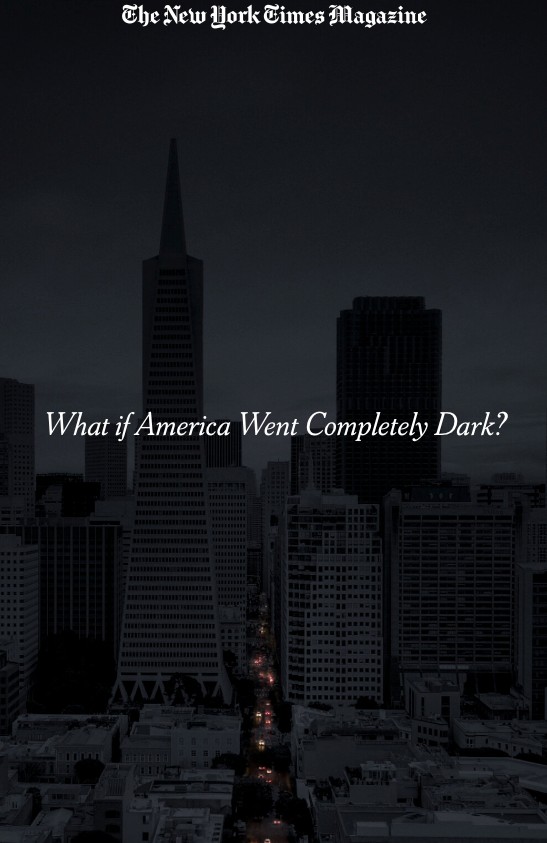
… albeit with startling detail about the Metcalf saboteurs’ meticulous planning.
And it advanced the story by spotlighting the critical shortage of electrical transformers — a problem even if the grid stays up because so many aging transformers need replacing. It turns out many of the largest ones have to be built painstakingly by hand.
But we have to ask: What took the NYT so long?
Again, we’re not Johnnies-come-lately to this issue. Three years after the Metcalf revelation in 2014, our firm shelled out $80,000 to acquire copies of a book called Lights Out to distribute to readers.
Authored by Ted Koppel, the longtime anchor of ABC News Nightline, it was sobering stuff.
“If an adversary has as its goal inflicting maximum damage and pain on the largest number of Americans, there may not be a more productive target” than the power grid, he wrote.
“If a highly populated area were without electricity for a period of months or even weeks,” he added, “there is no master plan for the civilian population.”
Now and then we’ve also spotlighted the everything-connected-to-everything-else nature of the grid — laid bare by the Northeast blackout of 2003. A software glitch at an Ohio control room ended up knocking out power to 55 million people in eight states and the Canadian province of Ontario.
We also have to ask: Why is the NYT bringing all this up now?
After all, the paper sets the agenda for the rest of the legacy media — and much of the alt-media for that matter. It’s going to be all over the place for a while.
Yeah, I know. It’s becoming “a thing.” People are more aware of the power grid’s fragility as brownouts and blackouts become more common. I started pounding the table about it here four years ago, when an industry white paper spurred me to buy a generator.
Too, people’s minds have been concentrated by the advent of AI data centers, with their prodigious power demands. (This e-letter was also early to the party on that issue.)
The conspiracy minded will surely say the article is “predictive programming” — softening up the populace for a grid-down event that a nebulous they will either let happen on purpose, or make happen on purpose.
But the article does allow for cautious optimism toward the end — describing a new kind of transformer technology, and suggesting that rather than one big solution imposed from the top down in Washington, “the best solution to a fragile grid may look like a lot of little interventions, distributed widely.”
Hear, hear. Best to conclude this bullet on that hopeful note.
And we’ll reinforce the guidance we’ve been sharing now and then since 2022: Even in a short-term outage, no electricity means no credit/debit cards and no power to the gas pumps. Keep a wad of cash, keep your tank topped up and keep your battery-powered devices charged.
 A Game of Economic Chicken
U.S. crude futures are set to end the week over $86 — the highest all month — even though the shooting portion of the Iran war is supposed to be over for a while.
Two days ago on social media, Donald Trump declared an “Economic D-Day” against Iran.
In addition, Treasury Secretary Scott Bessent said it’s unlikely Washington will restart large-scale combat with Tehran — pivoting instead to a new round of economic sanctions, “measures like have never been seen in the history of the economic isolation of a country.”
Whatever. How many more sanctions can they impose at this point?
The announcement sounds a lot like the announcements that came out of the Biden administration and the European Union targeting Russia. The EU in particular has declared 21 packages of sanctions on Russia since the invasion of Ukraine 4½ years ago. But go figure, Moscow is no closer to capitulation now than it was at the start.
And so begins a game of economic chicken: “The U.S. is betting it can strangle Iran's economy to the point where Iran will concede defeat before the U.S. is forced to do so,” writes John Mearsheimer, the renowned foreign policy scholar from the University of Chicago.
“At the same time, the U.S. is working overtime to deal with inflation and rising bond yields, which are caused in good part by the Iran war, and which have the potential to badly damage the U.S. economy. Iran is effectively betting that continuing to limit the flow of oil and gas out of the Strait of Hormuz will threaten the US economy to the point where Washington, not Tehran, will cave first.”
“This economic escalation is not even remotely likely to succeed on the timeline or at the cost Bessent & co. assume,” writes our former colleague David Stockman, who served as President Reagan’s budget director for five years.
“That’s because Iran remains substantially self-sufficient in food and many essentials, retains residual oil revenues through black-market channels and pre-blockade floating cargoes and can endure prolonged isolation far longer than the already-strained global refined-product markets — especially diesel and jet fuel — can tolerate continued severe supply curtailment.”
Maybe Bessent realizes as much.
Otherwise, why would he be badgering Chinese leaders to join in the sanctions? “Keep in mind, the Chinese get 50% of their energy from the Gulf. So, it would do them a big service to get with the program,” he said on CNBC.
(“Get with the program”? Diplomacy doesn’t appear to be Bessent’s strong suit — in contrast with Reagan’s Treasury Secretary James Baker.)
And don’t rule out a return to shooting, says Trita Parsi of the Quincy Institute: “Iran fears surrender more than war.”
Meanwhile, Bessent’s failed maneuvers in the bond market this week continue to give a lift to non-dollar assets.
- Gold is set to end the week at a three-month high approaching $4,600
- Silver is set to end the week at a two-month high over $69
- Bitcoin is approaching three-month highs over $77,000
- Ethereum is pushing $2,400 for the first time since April.
At the same time yields on Uncle Sam’s debt continue inching higher — approaching where they were on Monday before Bessent said he’d amp up buybacks of Treasury paper. The 10-year note is nearing 4.74% while the 30-year bond is up to 5.28%.
The major U.S. stock indexes are trying to claw back some of their losses earlier in the week — but they’re likely to end the week in the red. The S&P 500 sits at 7,669. (Perspective: That would have been a record close less than three weeks ago.)
 Death of Local TV (Avoid These Stocks)
Broadcast television is done. Like, as an industry. Forever. Its horse-and-buggy moment arrived this week.
As you might know, your editor worked in the TV news trenches for 20 years. I made my exit in 2007 — just as the internet was starting to change the advertising landscape in a big way.
Local TV has been in steady decline ever since. But there’s one thing that kept it viable, even if TV stations could no longer generate the fat 35–40% profit margins of days gone by — campaign commercials.
As younger people turned away from TV, the remaining audience was concentrated among older demographics — people who happen to vote in the highest numbers. Thus, TV stations could count on a steady influx of campaign cash every two years.
That all changed on Tuesday night with a shock election result in Florida.
The winner of the Democratic primary for U.S. Senate was a state lawmaker named Angie Nixon — proud member of the Democratic Socialists of America, collecting 56% of the vote.
Her opponent was retired Army Lt. Col. Alexander Vindman — a former National Security Council aide who was the star witness against Donald Trump during Trump’s first impeachment in 2019.
As you might expect, Vindman was the favorite of the party establishment — and he had the campaign coffers to dominate, raising $16.3 million compared with Nixon’s $975,000.
And get a load of the ad budgets, as recounted by Theodore Schleifer of The New York Times.
“Vindman spent 36 times as much on ads as Angie Nixon, per AdImpact data. The loser here spent $2.2 million and the winner spent just $60,000, with zero spent on broadcast or cable.”
Read that last line again.
It’s a whole new world when a U.S. Senate primary candidate spends nothing on TV ads and wins by a 56-44 margin.
Yes, Nixon has an uphill battle against a Republican opponent in a red state. That’s not the point. The point is that Nixon’s win is the death knell for local TV stations’ cash cow. If not tomorrow, then likely before the 2028 presidential campaign cycle begins.
The days are numbered for the pure-play broadcast stocks — especially the top three station owners Nexstar (NXST), Gray (GTN) and Sinclair (SBGI). Make sure they’re not lurking somewhere in your portfolio.
 Comic Relief
Because no one believes the official inflation figures anymore…
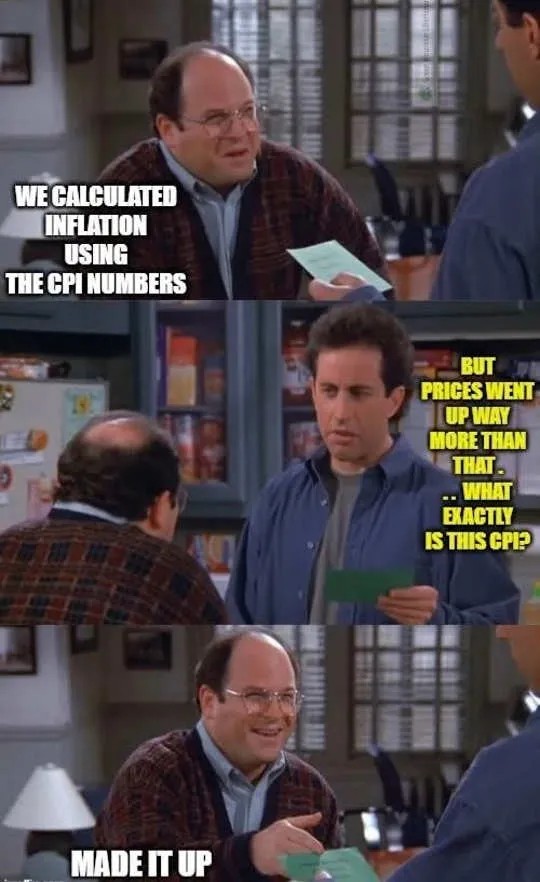
By the way, a new and rare podcast interview just dropped featuring economist John Williams of Shadow Government Statistics. He’s the guy who runs the inflation and job numbers the way the feds did decades ago, when they were still honest. I’ll be sure to listen and share highlights next week.
 Mailbag: Unfinished COVID Business
“Your Biased COVID Viewpoint” says the subject line of a reader email responding to last Friday’s edition.
“Dave, you must live somewhere far from international travel to have such a viewpoint on COVID and the lockdowns. 20/20 hindsight is convenient to such a position.
“I personally knew and cared about five people who died of COVID within a month of the lockdowns starting (both before and after). The cities with international airports near the coast were most affected, and especially in NYC, which is a short distance from where I live.
“Blaming anyone other than Trump for the majority of the carnage is really not even close to correct. I know you mentioned blaming Trump, but you are blaming him for the wrong reason. Here are his transgressions:
- Ignoring advice as early as January to shut down incoming international travel. COVID was already starting to be reported as an issue, and erring on the side of caution could have saved lives AND avoided much of the lockdown hysteria.
- Once he closed the international travel down, he only stopped it from China. But people, especially citizens, would find a way to come via Middle Eastern country airports or other routes into NYC instead of LAX or SFO. Additionally, he didn’t stop incoming travel from Macau, where all his rich friends go to gamble.
- Time and time again Trump espoused his stupid ideas instead of listening to his experts: bleach injections? Hydroxychloroquine? Etc.
“The one thing he did right was developing the vaccine.
“Most actions are driven by fear, and yes, the lockdowns were an overreaction when looking in hindsight. But nobody knew whom would be affected badly…what was known was that NYC was running out of ICU beds and places to store the dead. It seemed apocalyptic at the time.
“Could they have reopened sooner? I believe so, but Trump used this event politically as he always does: Sow division and confusion. He and his cult followers bought into this so well that my son was assaulted by people he considered friends simply for being worried that going out with them could cause him to bring COVID back to our home and it might cause my death. And the death of my wife, as we are older, and my wife has some of the conditions that were noted as bad for getting COVID.
“Worst president EVER! And I am a recovering Republican (can’t say I like the Democrats much — woke definitely went too far)”
Dave responds: So… you’re not even asking for a pandemic amnesty. That’s hardcore.
In the autumn of 2022, Brown University health economist Emily Oster penned an article for The Atlantic — kinda-sorta apologizing on behalf of her fellow control freaks and power trippers, saying it was time for all sides to forgive and forget.
"Treating pandemic choices as a scorecard on which some people racked up more points than others is preventing us from moving forward,” she wrote. “We have to put these fights aside and declare a pandemic amnesty."
Of the most draconian measures, she simply said, “We didn’t know.”
As the Substack blogger known as El Gato Malo wrote at the time, “The precautionary principle does not state, ‘Every time you get scared, do the most radical thing you can think of if it feels like safety’ — that is precisely what it warns against.”
These issues are not in the past, and we can’t afford to put them there. They still matter.
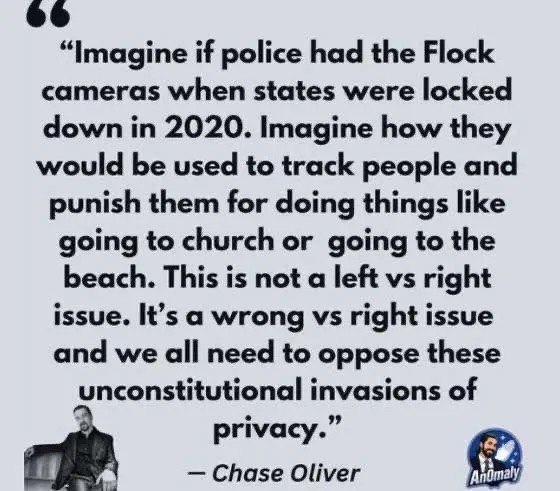
We give the last word today to Chase Oliver, the Libertarian Party’s 2024 presidential candidate…