
Elon Calls out “Fake News”
 Elon Calls out “Fake News”
 It’s getting prominent play in The Wall Street Journal — and Elon Musk says it’s fake news.
The gist of the story is that Tesla is about to spin off the Chinese portion of its business. As the thinking goes, a spinoff would smooth the way with regulators in both Washington and Beijing whenever Musk gets around to merging Tesla and SpaceX.
Musk’s response is emphatic.
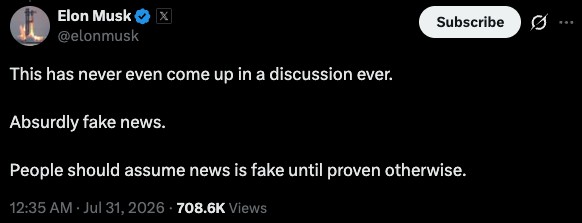
“Until proven otherwise”? Does that mean he’s leaving the door open?
Really, the most interesting thing here is that it’s now taken for granted that sooner or later Musk will bring TSLA and SPCX under the same umbrella.
Six months ago, it was a totally far-out notion — which is why Paradigm editors like Davis Wilson, Ray Blanco and our AI authority James Altucher were telling their readers it was at least plausible and maybe inevitable. We aim to stay ahead of the curve.
But before the merger happens, Musk has some unfinished business in the wake of SpaceX’s IPO.
“Everyone covered the SpaceX IPO as a number, and I get why,” says James Altucher. “Over $1.7 trillion valuation, biggest IPO ever, Elon now worth more than Bezos, Zuckerberg and Ellison combined. Which is the kind of sentence that doesn’t even sound real when you say it out loud.
“But I’ve been in and around markets for 25 years now, long enough to know the headline number is never the story. The story is what happens after.
“Getting rich and having capital to deploy are two completely different things, and Elon just crossed from one into the other,” James says.
“$180 billion doesn't sit in an account collecting interest, not for a guy who's spent his whole career doing the same thing over and over: Cash out, then pour it into the next bet before anyone else sees it coming. He did it with PayPal money. He's about to do it again.”
James is well aware that SPCX’s share price has tumbled since the IPO, and likewise for the space sector as a whole. If you hold these names, he gets your apprehension.
“I’ve lived through enough of these cycles to recognize the pattern by now — a sector runs too far ahead of itself, cools off and everyone treats the cooldown like the whole thesis just died.
“It didn’t.
“I still believe AI and space are where the next decade of real wealth gets built, and every time I’ve seen a pullback like this one, it’s turned out to be where the opportunity was hiding, not where it went to die.”
So where is the opportunity hiding now?
“I’ve been digging into that question all week,” James tells us — “and what I found is enough that I’m doing something I basically never do on a weekend.”
James is convening an Emergency briefing this Sunday Aug. 2 at 7:00 p.m. EDT. At that time, he’ll walk you through the opportunity before it becomes front-page news.
You can reserve your spot at this link: We’ll follow up with an email spelling out everything you need to know so you’ll be ready Sunday night.
 The Harder They Fall
“When you combine ignorance and leverage, you get some pretty interesting results,” quipped Warren Buffett once.
Wall Street is abuzz this morning about the sudden downfall of a wunderkind hedge fund manager named Leopold Aschenbrenner.
In his mid-20s, he was managing over $20 billion in assets at his firm, Situational Awareness. And then came the tumble in AI stocks this month.
He owned a lot of the most familiar names — Nvidia, Micron and so on. But he leveraged those holdings 4:1 — borrowing money in hopes of amplifying his gains. When gains turn to losses, the losses are amplified too.
“When your lender believes their money is at risk, they can demand additional collateral.
If you can't provide it… your investments get sold to repay the loan,” writes colleague Davis Wilson at The Million Mission. (It’s a short and worthwhile read, including how Aschenbrenner became a phenom at a tender age.)
And so Aschenbrenner’s shares now belong to Ken Griffin’s Citadel hedge fund — who for all intents and purposes bought a bunch of quality AI companies at a handsome discount.
On a couple of levels, the whole thing bears a certain resemblance to an episode in 2021 — when a fund manager named Bill Hwang got too far out over his skis and likewise got a margin call. He had to shut down his firm, Archegos Capital Management.
But there are a couple of key differences: Hwang’s mismanagement put a scare into Wall Street because a couple of his lenders — big overseas banks like Credit Suisse and Nomura — were left holding the bag. Nothing of the sort happened this time.
In addition, Hwang was sentenced in 2024 to 18 years for fraud and racketeering; he’s out on bail while he appeals his conviction. As far as we can tell, no one accuses Aschenbrenner of anything other than hubris.
 Thought for the Day
Just to add to our Flock camera discussion at the conclusion of yesterday’s edition…
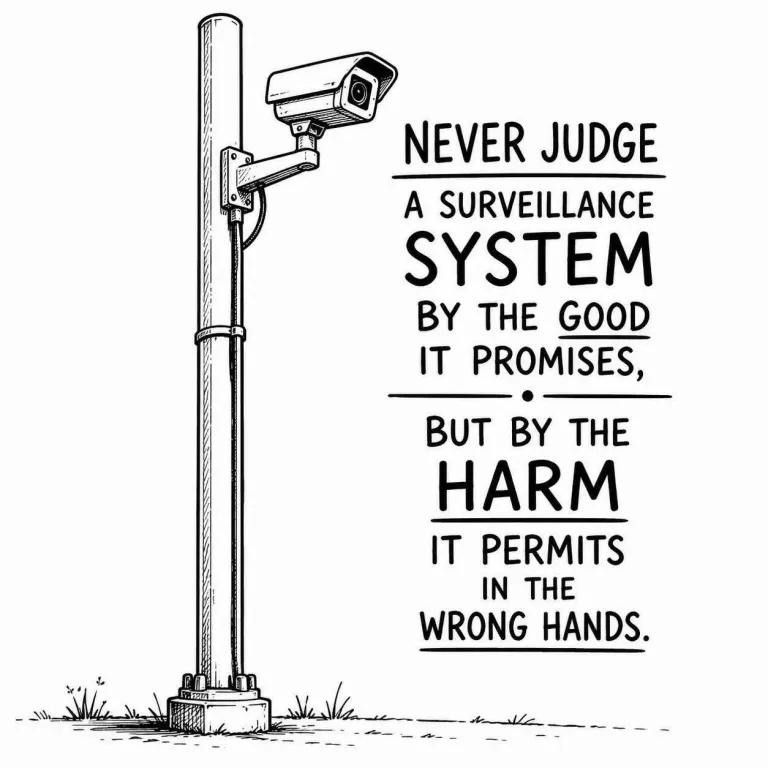
 Mailbag: Data Centers
“Something about all the data center struggles that plague the news really puzzles me,” a reader writes as we continue to follow up from last Friday’s edition.
“Communities are fighting to ban data centers because of energy costs and noise pollution. And data centers are able to sue successfully in some cases to be allowed to build anyway. Not good for either side. And so far it looks like one side or the other must lose. No one has come up with a win-win.
“Everyone wants the good things AI can bring (medical research advancements, for one). But no one wants to live near one. (Landfills are similar — we need them but who wants to live right next door to one?)
“But rather than fighting a win-lose heated battle, isn't it possible that more brainstorming can be done to see how to find the win-win instead?
“The energy crisis data centers create is a real problem, but my impression is that a solution has been found to deal with that. If a data center wants to build, they have to provide their own energy infrastructure solution rather than straining the pre-existing local infrastructure beyond its capabilities.
“But it seems like the noise and vibration problems haven't been addressed, so that remains a sticking point causing communities near data centers a great deal of stress. But can't the same approach be taken with noise and vibration pollution that is used with energy?
“You can build a data center as long as you either (a) locate it far enough from any population so that noise and vibrations can't harm anyone or (b) the part I haven't seen suggested yet — you can build your data center near the population as long as you provide a proper solution for the known emotional costs to people of the constant sound and vibrations that data centers generate (sound-absorbing walls around the data center perimeter, perhaps, plus whatever else might be needed).
“If a complete enough solution doesn't yet exist, then the onus is on the data centers to figure one out.”
Dave responds: All good thoughts. If only it were so easy.
Even the energy component of the equation remains problematic when data center operators supply their own power “behind the meter” and don’t connect to the power grid.
For instance, Elon Musk wanted to spin up his Colossus data center in the Memphis area quickly. So he brought in natural gas turbine generators that under ordinary circumstances are illegal to use as a primary source of electricity because they don’t meet emission and noise requirements. He didn’t apply for the necessary permits — knowing the application would be denied for that reason.
“There are very few people who want a power plant in their backyard,” Musk acknowledged ahead of SpaceX’s IPO.
And then there’s the whole water question — but we’ll have to leave that for another day. Because goodness knows the story isn’t going away…
 Earnings Season: Mixed Verdict
The jury has delivered a mixed verdict on the AI buildout — at least as far as it impacts the Big Four “hyperscalers.”
Amazon was the last of the four to deliver its quarterly numbers after the closing bell yesterday. As far as Mr. Market is concerned, there are no worries about the company’s continued spending on AI infrastructure and whether it will pay off in the long haul. AMZN shares are up nearly 15% on the day.
So Amazon and Microsoft got a big thumbs-up for their spending plans… while Meta and Google got a big thumbs-down.
As James Altucher sees it, even this mixed verdict puts to rest any talk of a bubble in AI.
“When the housing bubble burst, you could get in a car and go look at it,” he told Altucher’s Investment Network readers yesterday. “Whole subdivisions in Florida and Nevada with nobody living in them, streets and driveways and mailboxes and no people. That's what a popped bubble leaves behind, a pile of something nobody wants.
“Computing can't be held. Companies rent it by the hour, and when the hour is gone it's gone. So the customer tells you every month whether they meant it.
“Microsoft's finance chief told investors that demand keeps running past the capacity they have. Then she raised her forecast anyway.
“Microsoft went from 20 million paying AI subscribers to 30 million in three months, 10 million more seats in 90 days. You don't add that many unless the first 20 million kept theirs.
Meta is spending just as much. It hasn't told anyone yet what's coming back. Microsoft showed the receipts.”
That goes a long way to explain the mixed verdict.
“In 2009 there were empty houses,” James concludes. “Today I go looking for them and I can't find any. I find companies that can't build fast enough, customers who keep renewing and contracts already signed for years most people won't be patient enough to wait out.”
As for the broad U.S. stock indexes today… they’re all in the green, but just barely.
At 7,444 the S&P 500 is on track to end the week higher than it ended last week — Wednesday’s big drop notwithstanding. It’s a similar story for the Nasdaq, back above 25,000. But the Dow has a long way to go to make up for Wednesday’s fall even though it’s back over 52,000.
Among the big movers is Apple, down nearly 9% after delivering its quarterly numbers. Seems an ongoing shortage of chips from Taiwan Semiconductor makes it hard for the company to meet demand for its signature phones, tablets and computers.
Congratulations to Alan Knuckman’s Weekly Wealth Alert readers, who collected 100% gains yesterday on the remaining half of their Bristol Myers Squibb trade. (The first half was a 50% winner a week ago today.)
The bond market remains on edge about inflation: The yield on a 10-year Treasury note is over 4.73%, getting *this* close to its highs of 18 months ago. The 30-year bond is even worse — up to 5.27%, another high last seen in 2007.
Rising rates are translating to falling precious metals: Gold is down $60 to $4,042 and silver is off more than $1.50 to $57.36.
Crude is up nearly 3% to $85.86 even though U.S. forces did not conduct airstrikes on Iran last night. Traders are likely positioning themselves in case the airstrikes resume over the weekend while the market’s closed.
Crypto can’t get any traction, Bitcoin at $62,464 and Ethereum at $1,855.


