
Musk’s Biggest Ambition
 Musk’s Biggest Ambition
 The sooner this technology is perfected, the sooner the societal stress over data centers is dampened.
For over six months now, we’ve been waxing enthusiastic in these pages about the potential for data centers in space — delivering the AI “compute” the world demands with 24/7 solar power.
Data centers in space won’t compete for scarce electricity with existing homes and businesses. They won’t suck up prodigious amounts of water for cooling. They won’t generate noise that keeps neighbors up at night.
The existing power grid simply can’t accommodate the current buildout of data centers. Something’s gotta give.
“Data centers already eat electricity like a small country. And AI adoption isn't slowing down. It's going vertical,” affirms Paradigm AI authority James Altucher.
In yesterday’s Altucher Confidential, James said energy is the single biggest constraint on AI — and whoever solves the energy problem wins the AI race. Not whoever has the smartest model or the most sophisticated chips.
“You can build the most powerful artificial intelligence the world has ever seen. Give it a name and a personality. And it will sit there doing absolutely nothing — because you can't plug it in…
“The grid we have was not built for this. It was built for air conditioners and refrigerators and the occasional Christmas display. It was never built to run a digital civilization.”
But data centers in space? They can be purpose-built to meet all their own power demands.
“If even part of AI compute moves up there, we're looking at a brand-new layer of infrastructure underneath the entire economy,” James goes on. “The way railroads were a layer. The way the internet was a layer.”
As we’ve chronicled since last fall, Elon Musk is the biggest enthusiast of orbiting data centers. And James says Musk has put a number on their economic potential.
$1 quadrillion. With a Q. That’s 1 followed by 15 zeroes. A thousand trillion.
To be clear, James is extrapolating from something Musk said at Tesla’s most recent shareholder meeting.
“Elon said AI and robotics could grow the global economy ‘by a factor of 10 or maybe 100.’ Run the low end against world GDP and you land on $1 quadrillion.
“And here's why Elon can say it with a straight face: This doesn't apply to one product. It applies to everything he is building,” James goes on.
“The robotaxi network. The Optimus humanoid robots. Grok, and whatever comes after Grok. Every one of those runs on compute. And compute runs on power.
“So the real bottleneck across his entire empire is power. Always power. Solve power, and you don't improve one product — you unlock all of them at once.”
Really, energy is Musk’s biggest ambition. Because everything else stems from that.
Musk is keenly aware of all this as he prepares for SpaceX’s IPO on Friday, June 12. Remember that his xAI venture and the Starlink satellite network both operate under the SpaceX umbrella. Energy is key to all of it.
“He's taking an entire ecosystem public,” says James. “And if you've watched Elon operate for 20 years, you know exactly what he does next. When something is critical to his plans, he does not politely wait for the market to hand it to him. He buys it. He partners with it. Or he pulls it inside the tent.
“He did it before. He'll do it again.”
With that in mind, James has been digging into one small company that’s key to Musk’s ambitions.
“It already works with SpaceX. It already has real, functioning technology in orbit — today. It’s NOT a household name. You've never seen it on CNBC. Most professional investors couldn't tell you what it does. But it is sitting on precisely the kind of technology a man building a trillion-dollar AI empire cannot afford to be without.”
If you’re a Microcap Millionaire subscriber, you’re already hip to what James is talking about.
 $6 Gasoline
The national average gasoline price sits at $4.56 a gallon, according to AAA — and Paradigm natural resources pro Matt Badiali says $6 is in view this summer.
“The only good news is that high prices cure themselves,” he wrote for yesterday’s Daily Reckoning. “It just takes pain and time.”
Matt sees parallels between the present moment and the summer of 2008 — the first time gas prices eclipsed $4 a gallon.
“We stopped driving and conserved when we could,” he recalls. “We carpooled. When we went out to run errands, we ran ALL of them at once. And we changed our plans to accommodate the extra expenses.”
Result: Fuel consumption fell 21.5% between December 2007–May 2009. (OK, it helped that millions of people were thrown out of work in the “Great Recession” and had nowhere to commute. But you get the point.)
And that $4 gas in the summer of 2008? It was well under $2 by early 2009.
“The price fell off so much, so quickly because at the time, 60% of the demand for oil came from personal automobiles,” says Matt. “And if we all stop driving, there’s plenty of oil again.
“Today, light-duty vehicles (cars, SUVs and motorcycles) use 52–60% of U.S. oil demand. That means personal vehicles still have a major impact on demand. And when driving becomes a luxury, a huge swath of the country will conserve.”
By the way, that $4 a gallon in 2008 translates to $6.34 today. With the Strait of Hormuz still all but closed, Matt thinks we’re on our way there. “All over the world, governments are burning through strategic oil reserves. The reality is about to come crashing home this summer.”
You can offset those high prices with gains in your portfolio. Matt says you can consider the United States Gasoline Fund (UGA) — an ETF that tracks the gasoline price via options. Or the VanEck Oil Refiners (CRAK). Refiners have to grapple with rising oil prices, yes, but they still sport handsome margins.
[Dave’s disclosure: I own a small position in CRAK.]
Meanwhile, In the short term, U.S. oil futures are sinking big-time — down over 6% and back below $98 for the first time in over a week.
Supposedly that’s because Donald Trump says U.S.-Iran talks are in their “final stages.” (Gee, where’ve we heard that before? And were there suspicious trades ahead of that remark?)
From everything we see, the Iranian side is signaling that no talks will take place while the annual Muslim pilgrimage to Mecca is underway. If so, that means nothing happens until after May 30.
As Nvidia goes, so goes the whole stock market? Kinda feels like it.
Nvidia reports its quarterly numbers after the closing bell today. NVDA isn’t just the biggest company in the world. It’s a bellwether for chip stocks. Lately, chip stocks have been a bellwether for the tech sector. And tech has been a bellwether for the whole market.
All of these things touched record highs last Thursday — only to hit an air pocket since. The reaction to Nvidia might well set the tone for everything else in the coming days.
And what will drive the reaction? Davis Wilson at our sister e-letter The Million Mission says investors want to know three things…
- “Does the AI investment boom still have legs?
- “Can Nvidia maintain its dominant position as competition ramps up?
- “Any updates on selling chips to China following CEO Jensen Huang’s recent Beijing summit alongside President Trump?
“Tonight’s earnings call will set the tone for the entire AI market heading into the second half of the year.”
In the meantime, the broad market is in the green today on the aforementioned “war’s almost over again” trade.
The S&P 500 is up nearly 1% to 7,422. The gains in the Dow and the Nasdaq are even stronger.
Likewise bonds are rallying, sending yields down — the 10-year Treasury note at 4.58% and the 30-year bond at 5.12%. (Those levels are still very high by recent standards.)
Precious metals are licking their wounds, gold back over $4,500 and silver approaching $76. Crypto is also staging a modest rally with Bitcoin back over $77,000 and Ethereum above $2,100.
 About Those Retail Sales…
We don’t have a lot of economic data points this week — so it’s worth stepping back to examine the bigger picture when it comes to one of the most-reported numbers out there.
We mention the retail sales figures each month. Frequently we mention how they’re not adjusted for inflation.
So what would you see if they were adjusted for inflation? The folks at Statista did just that this week.
“Between April 2021 and April 2026,” writes Statista’s Felix Richter, “monthly retail and food services sales (adjusted for seasonal variations, holiday and trading day differences) increased by 24.3%.
“While that sounds like the economy must be humming along nicely, sales were essentially flat when adjusted for inflation.”
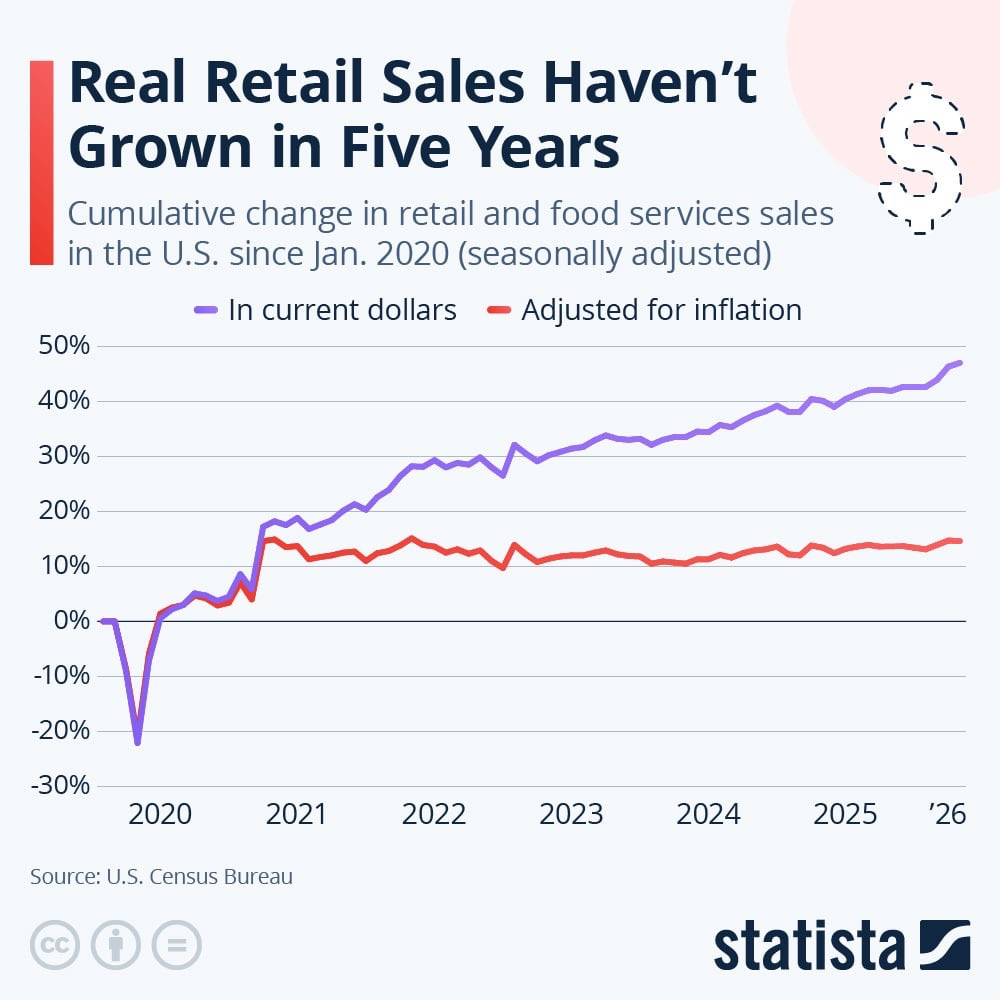
“From a positive perspective,” he continues, “that means that Americans haven’t really cut back on their purchases despite the financial pain that inflation has inflicted on many households.
“From a more negative viewpoint, it means that Americans are spending (a lot) more to keep the same living standard, which is not just bad for consumers but also for retailers trying to actually grow sales.”
Worse, over the last five years wages haven’t kept pace with the official inflation rate. Wages almost caught up with prices as the calendar flipped from 2025 to 2026 — but then came the Trump-Netanyahu “excursion” into Iran and once again price increases are running away from wage increases.
Worse still, the official inflation rate understates your real increase in the cost of living.
Maybe you already know that intuitively… but we should emphasize this point more often: Federal statisticians have been monkeying with the inflation numbers for decades to make them seem better than they really are.
Here are the two major techniques, with supporting examples…
- Hedonic adjustments. If the price of a new car goes up, but the manufacturers add new features to the new models, well then the price of a new car hasn’t really gone up, has it?
- Substitution. If you start buying hamburger because steak is too expensive, well, your price of beef hasn’t really gone up, has it?
Seriously, this is how government statisticians think.
Result: In mid-2023 the official inflation rate was about 4%. But economist John Williams at Shadow Government Statistics runs the numbers the same way the feds did in the 1970s — and by that yardstick inflation was running at a 12% clip.
 Comic Relief
As long as we’ve had AI and resistance to AI on the brain in recent days…

 Mailbag: AI Data Centers, Again
“Dave, I can't be the only reader who is on the fence about these AI data centers,” a reader writes as we continue to get feedback from last Friday’s edition.
“Your writers have made it abundantly clear that they will gobble up enormous amounts of power and water. It's the ‘jobs' part of the equation that seems to be missing? I can assume there would be quite a few construction jobs as these huge warehouses are erected and they will need enormous HVAC and power switching systems.
“BUT what happens after they're built? Just a couple of guys waiting around for things to break down? Or is there a real need for the technically savvy to be inside testing, running, repairing and what not?
“So will they create 100/200/500/1,000 jobs after commencing operations or are they just great big power-sucking empty warehouses?”
Dave responds: Well, let’s return to Maine — the first state where a moratorium on data center construction reached the governor’s desk.
As we mentioned at the end of April, Gov. Janet Mills vetoed the bill because there was no carve-out for a data center already under construction in the town of Jay. She said it would bring 800 temporary jobs and 100 permanent ones.
Presumably that 8:1 ratio is consistent regardless of the project size?
We’ll leave it there for today — except to note that the largest headline on the front page of today’s Wall Street Journal is: “Americans’ AI Rebellion Grows, Fed by Energy Costs, Job Losses.”
Hey, you heard it here first!


