
SpaceX and… Smoothies?!
 SpaceX and… Smoothies?!
 Picking up where we left off with yesterday’s Bullet No. 1… there’s a concerted effort to lure anyone and everyone down the primrose path of the SpaceX IPO.
Including customers of Erewhon, an upscale grocery chain in the Los Angeles area renowned for its smoothies.
On social media, venture capital lawyer Morgan Barrett posted this screenshot from his Erewhon app. Look toward the bottom, after the free-smoothie promotion…
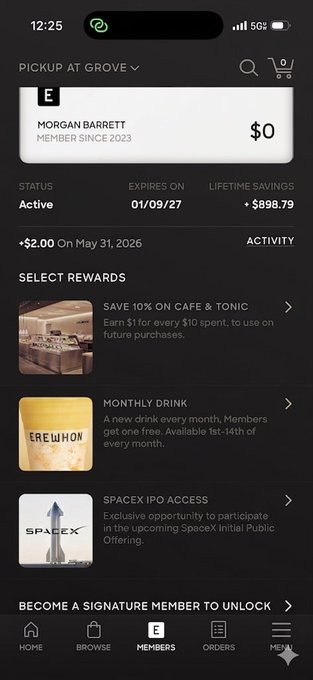
Mr. Barrett knows better. And anyone who watched Paradigm’s exclusive event this afternoon — The SpaceX SuperIPO Summit — also knows better. (Miss the event in real-time? You can watch the replay immediately at this link.)
Don’t get the wrong idea. SpaceX is a great company.
But as we’ve taken pains to say in recent weeks, great companies rarely make for great buys on IPO day — which in the case of SpaceX is Friday, three days from now.
“Here’s the thing about an IPO. By the time you and I can buy a share, the people who were going to get rich already did,” says Paradigm AI authority James Altucher.
“The early Silicon Valley money. The insiders. The venture funds that wrote checks when SpaceX was a few sheds and a prayer in the Texas scrub.
“June 12 is their exit. The bell rings, the door opens and they walk out through it — with your money.
“Then there's the small matter of size. SpaceX will be worth more than a trillion dollars the instant it lists. You do not get a 30-bagger out of a trillion-dollar company.
“The explosive, generational, change-your-bloodline gains were handed out years ago, quietly, to people you'll never meet.
“So buying SpaceX on IPO day is like sprinting to catch a train that left the station in 2015. You'll arrive sweaty and slightly poorer, and the train will be gone.”
Still… SpaceX-adjacent profit opportunities remain. And opportunities like these can be enormously lucrative, as we’ve seen time and again over the last 30 years.
“Personal computers? Microsoft and Intel did just fine. The small suppliers around them did far better,” says James.
“The internet? Cisco was the Nvidia of its day, a monster—and a handful of unglamorous infrastructure plays you've never heard of ran circles around it.
“Social media? Facebook was a perfectly good investment. A tiny ad-tech company most people couldn't name returned roughly 20 times more.”
And so it goes with SpaceX. But not in the way you might think.
This comes back to the biggest takeaway from SpaceX’s S-1 filing with the feds late last month: SpaceX is not a rocket company.
The company sees space as a $370 billion market. It sees AI as a $26.5 trillion market.
Thus it’s investing nearly eight times as much capital in AI as it is in space ventures.
That much we know now. We’ll know much more come Friday when shares start trading.
“The moment SpaceX goes public,” says James, “it has to open its books.
“Every supplier. Every partner. Every quiet little company sitting on a patent Musk can't execute his plan without. All of it disclosed, filed and picked over by every analyst on Wall Street within the hour.
“Right now, those companies are invisible. Cheap to buy. Ignored. After Friday, they won't be.”
James’ takeaway: “Don't buy SpaceX on IPO day…. Find the small, unglamorous companies Musk has already cut deals with — the ones holding technology he needs and can't replicate.
“Do it before the SEC filing does the work for you, because the window to be early slams shut the instant that bell rings.”
Better yet, you can let the Paradigm team do that work — which was the whole point of our SpaceX SuperIPO Summit this afternoon.
James along with Jim Rickards and Enrique Abeyta are hot on the trail of a SpaceX supplier with the potential to 30X your money in the next two–three years.
For three experts who are frequently at odds… this is an extraordinary moment of consensus.
Especially because they agree we’ll likely never see an explosive pre-IPO opportunity like this ever again. (Really, when will Elon Musk take another company public?)
Follow this link for the details — because if you wait until after the IPO Friday, it’ll be too late.
 The End Is Not Near (Yet)
If market history is any indication, last week did not mark the near-term top for the S&P 500.
The S&P notched a record close one week ago today. And then it took a hard spill on Friday amid the big tech sell-off.
It was the first time in nine weeks that the index ended a week in the red. In data going back to 1950, there’ve been 20 instances of the S&P registering nine winning weeks in a row.
Paradigm trading pro Enrique Abeyta spotted this table from Charlie Bilello, chief market strategist at the Creative Planning firm, showing the index’s subsequent performance all 20 times.
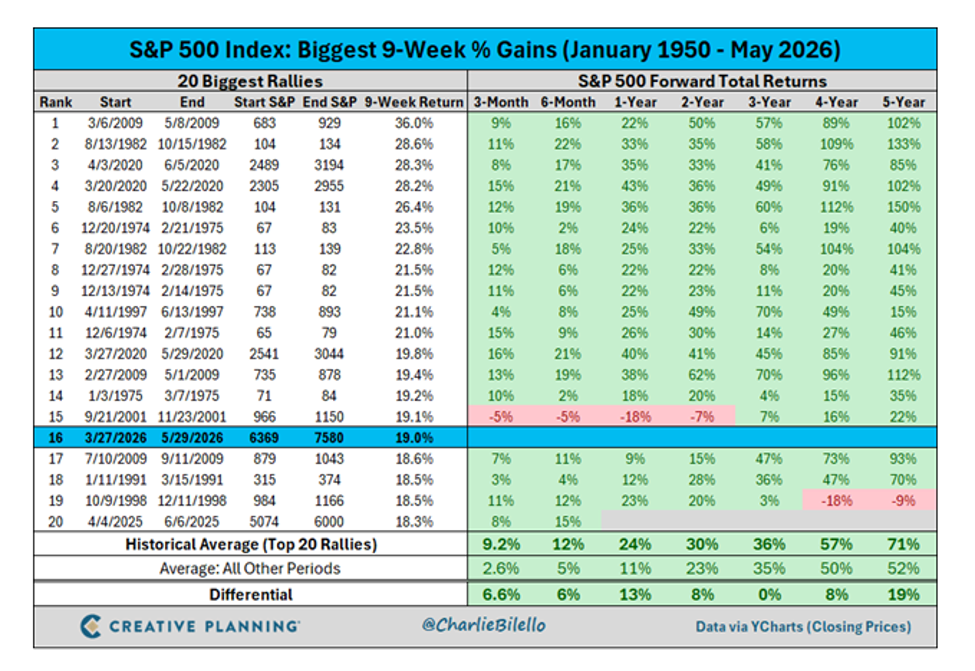
Out of those previous 19 times, “only ONCE was the index lower in the next three months, six months, one year and two years,” says Enrique.
“That time? The peak of the internet bubble.”
As we mention now and then, Enrique believes the AI boom is destined to end in tears — but not yet. And this table backs up his case.
For now, he says “we will go with the other 18 times.”
That said, Friday’s whoosh is underway again after a brief respite yesterday.
As of early afternoon, a renewed rush out of semiconductor stocks has sent the S&P 500 down 1.75%, back below 7,300 for the first time since early May (when 7,300 was a record). At this point the index sits about 4% below that record close a week ago today.
The Nasdaq is down 2.85%, also back to early May levels of a little over 25,000.
The rush for liquidity extends to the precious metals: Gold is down $78 to $4,251 — its lowest since a late-March washout. And at $64.77, silver is down nearly 5% and about to break below its 200-day moving average.
Bitcoin is likewise selling off, but at just over $61,000 it remains above last Friday’s levels. It’s a similar story for Ethereum at $1,635.
While Wall Street was flying high until the last few days, Main Street has been feeling low for weeks.
The National Federation of Independent Business is out with its monthly Small Business Optimism Index. At 95.3 the May number is the lowest since the autumn of 2024. Since the Iran war began the index has been mired below its long-term average. And we do mean long-term; the NFIB began conducting this survey during the Nixon administration.
“Despite the enthusiasm around AI, the overall picture is divided,” says NFIB chief economist Bill Dunkelberg.
“More small-business owners are struggling with significant and unpredictable hikes in fuel prices, which are more challenging for small businesses to pass on to their customers compared to their larger corporate competitors.”
Asked to identify their single most important problem, 19% of survey respondents cited taxes — followed by 18% citing inflation. Labor costs have surged into third place, cited by 14%. Not coincidentally, good help is still hard to find, with 13% citing “quality of labor.”
 China “Saving the Oil Market”
With the latest skirmish between Israel and Iran retreating into the rear-view, U.S. oil futures are down nearly 4% and back under $88 for the first time in 10 days.
As we mentioned, oh, about 10 days ago, Big Oil execs are warning that oil inventories both domestically and overseas are being drained at a record pace — and something’s gotta give, likely this month. At that point, a senior VP at Exxon anticipates oil soaring to $150.
But for now it’s not just an inventory drain that’s keeping a lid on oil prices despite the biggest supply shock in history.
It’s also China — the world’s biggest oil importer.
A surprisingly worthwhile Bloomberg story informs us that China “slashed inbound shipments by almost 40% in May compared to last year’s average, according to Vortexa Ltd. The reduction is enough to offset anywhere between a third and a fifth of the barrels lost to the war, depending on the estimates used.”
For the time being, China is no longer adding to its enormous strategic petroleum reserve. Its chemical production is drawing on coal instead of oil as a feedstock. And China’s huge electric-vehicle boom is helping trim gasoline consumption.
Result: China’s refinery throughput has retreated to levels last seen during the early days of COVID in 2020.
What’s the motivation of Chinese policymakers? And when might they change their minds?
Your guess is as good as ours. As one quip on social media puts it, China is “straight up saving the oil market and no one knows why or how long they will do it for.”
 Follow-Ups
For the record: The company behind ChatGPT wants a cut of that sweet, sweet liquidity flowing through Wall Street — just like SpaceX and Anthropic.
OpenAI filed its IPO yesterday — one of those “confidential” filings, which means we learn about it only because someone tells the media the paperwork has been sent to the Securities and Exchange Commission.
That’s what Claude maker Anthropic did last week and indeed it’s what SpaceX did in early April.
The IPO’s precise timing is up in the air: In a cryptic statement issued after the news broke, OpenAI said “it may be a while” because there are still “things we want to do that are likely easier as a private company.”
For the time being, Wall Street is treating Apple’s big AI foray as just a souped-up Siri.
Yesterday brought Tim Cook’s keynote address at Apple’s annual Worldwide Developers Conference — his last as CEO before handing the reins to longtime deputy John Ternus.
“Siri AI,” as it’s been dubbed, really is a breakthrough of the sort that James Altucher has been describing to readers in recent weeks. Its “agentic” AI makes it vastly easier to, for example, buy concert tickets than it is now.
But there are still regulatory hurdles to clear: For now anyway, Siri AI won’t be available in the European Union on iPhones and it won’t be available in China at all.
Perhaps for that reason, Apple shares closed down nearly 2% yesterday — and amid the tech sell-off today they’re down another 3.7%. But that’s likely short-term noise — both for AAPL and its “secret supplier” revealed recently to James Altucher’s Microcap Millionaire subscribers.
 Mailbag: Florida Tax Referendum (Continued)
“I think it’s a disgraceful political stunt that could have disastrous results,” says the first email we’ve gotten forcefully opposing the referendum that could slash property taxes for millions of Floridians starting next year.
“I live in Clermont, Florida. One of the most likely responses from local governments will be to cut salaries and numbers of first responders, teachers and government workers. Next they will cut contracts to companies that mow our roadsides and others.
“One of our major industries is tourism and already we are losing Canadian tourists. Prices at our theme parks are out of reach for the average family. Our governor has said he wants tourists to pay more. Tourists don’t vote except with their wallets.
“For years now our state government has been taking away power and freedom from local communities. This is just another step to take away our freedoms by the Big State.”
“When residential real estate taxes decrease, the local county and municipal governments that currently benefit from real estate taxation in Florida will look elsewhere for funding,” says a more measured but still skeptical email.
“They will not reduce personnel or services. The permit fees for construction will go up. The local tax on utilities will go up, especially water and sewer costs. Businesses will face increased fees for annual zoning compliance or occupational permits. In growing communities, construction and rehabilitation permitting will slow and fees will increase. The result will be a decline in growth, both residential and commercial.
“On the other hand, a homeowner with limited income will be able to retain their Florida lifestyle residence a little longer. However, people who live on Social Security and a little savings are going to find insurance costs and inflation will displace them soon anyway.
“When the effective cost of owning a home decreases, the sales of new and used residences increase, which will be a boon to the residential and commercial real estate brokers. No doubt the ancillary services to real estate will benefit from that growth also. Furthermore, the tax on the sale of real estate will no doubt be increased to help offset the decline in annual tax revenue.
“The county and municipal governments will, of course, use whatever laws they have to increase sales taxes on goods and services. The major burden of county and municipal taxes will fall on the commercial property builders, owners and tenants. Eventually, that will result in higher prices paid by the consumers.
“The result will be a progressive tax with more of the total tax burden being paid by individuals who spend more of their income (and savings) on goods and services, both through increased sales taxes and increased costs of doing business.”
We’ll give the last word to someone who supports the proposal: “I am an 87-year-old Florida property owner.
“The taxes keep going up every year. I realize my property goes up in value. However, that is not spendable, and I'm not interested in selling and renting or moving into a home or with my children.
“You never really own your home.You rent it from the government for the rest of your life. I got this property paid for but I can't just live here. And enjoy I have to pay.
“A sales tax hits everybody, including non-property owners, tourists, even people just traveling through the state. I have no problem with a higher sales tax. I believe the cost to me and other homeowners will be less than the property taxes.”
Dave responds: It’s a basic and indisputable objection: A property tax “means all of us are renters — none of us are homeowners,” said a homemaker in 2012, when we were chronicling a failed attempt to abolish property taxes in North Dakota.
While it was mostly Florida readers who weighed in on the Florida referendum, we also heard from someone in Texas — where property taxes tend to be high.
He too said he’d be quite content to pay higher sales taxes instead. Considering that the rate is already 8.25% in most major cities (and even smaller ones like Abilene and Odessa), that’s saying something.
By now I’ve done a fair amount of research into how the tax burden varies from state to state — not least because it was something my wife and I factored in when planning a move over a decade ago.
My broad conclusion? Outside the bluest of the blue states where nearly everything is sky-high, it’s all a trade-off. They’re gonna get you one way or another…


