
When Trust Is Broken
 When Trust Is Broken
 Donald Trump is at risk of repeating one of Joe Biden’s biggest blunders.
After Russia invaded Ukraine in 2022, Biden and his national security adviser Jake Sullivan thought it would be a clever idea to punish Moscow by freezing $300 billion in U.S. Treasuries held by the Russian central bank.
Executing that freeze was easy-peasy.
U.S. Treasuries “are held on a digital ledger controlled by one or more depositories around the world,” says Paradigm macro maven Jim Rickards — who knows the plumbing of this system inside-out from his days at Citibank. “There’s not much more to it than a phone call or a few keystrokes.”
The freeze had zero impact on Moscow; Russia’s economy chugged along just fine in the years immediately following.
But the freeze had the instant effect of undermining foreigners’ confidence in U.S. Treasuries.
We’ve said it before and we’ll say it again: Leaders of other governments around the world started to think, If it can happen to the Russians, it can happen to us too.
“The reason reserve managers have such confidence in Treasuries as a reserve asset is that the U.S. is perceived to have a strong rule of law,” Jim told his Strategic Intelligence subscribers yesterday. “Yes, it’s easy to freeze the securities, but the U.S. won’t do so except after due process of law or a national security emergency.”
But neither of those contingencies applied in the case of Russia during 2022.
And they don’t apply in the case of Iran now. But that’s not stopping the Trump administration.
A few days ahead of the deal supposedly reached between Washington and Tehran this past weekend… the White House threatened to seize $24 billion of U.S. Treasuries owned by Iran.
“These assets,” Jim explained, “would be used to finance the reconstruction of war damage caused by Iran to U.S. allies in the Persian Gulf, such as Kuwait and Bahrain.
“You can debate the wisdom of these proposals, but you cannot debate the fact that the U.S. is destroying trust in its own rule of law,” Jim says.
“Countries around the world, including major Treasury securities holders such as South Korea, Taiwan, Japan, Saudi Arabia and China, are watching these developments in Russia and Iran and asking themselves if their own holdings of Treasuries are safe.
“What if the U.S. doesn’t like what one of those countries is doing in foreign policy? Will the U.S. seize their securities too?”
Another point we can’t emphasize often enough: The 2022 Russia freeze touched off a worldwide scramble for a different reserve asset — gold.
For years, Jim has said that unlike Treasuries, “gold is a physical nondigital asset that cannot be stolen, frozen or seized provided it is in safe storage.”
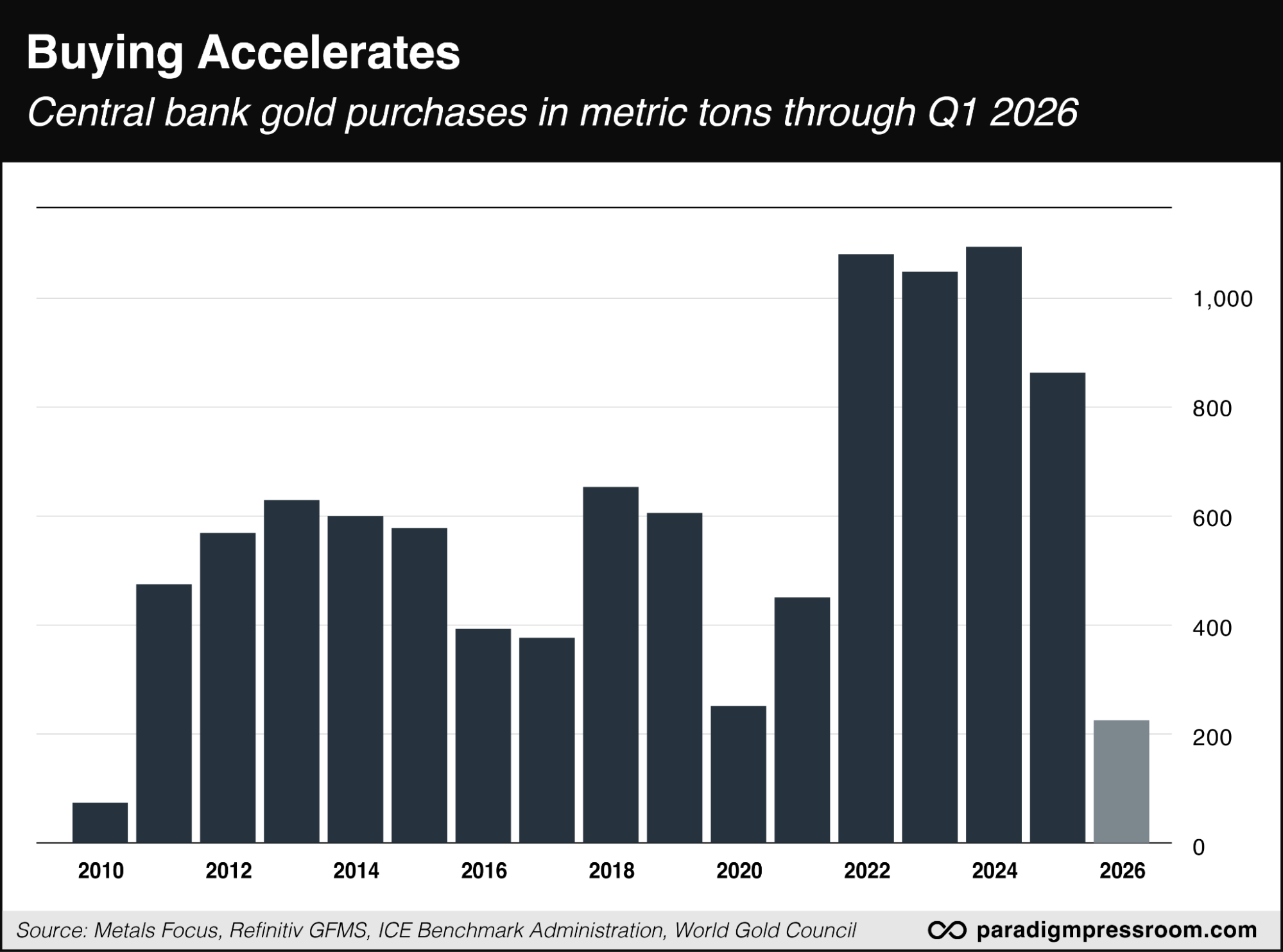
As such, global central banks started stacking gold at a record pace in… 2022.
It sticks out like the proverbial sore thumb on this chart. And if the first-quarter figures for 2026 are any indication, this year’s buying will exceed 2025’s total.
And as we mentioned a few days ago, gold has just overtaken U.S. Treasuries as the biggest asset held by global central banks.
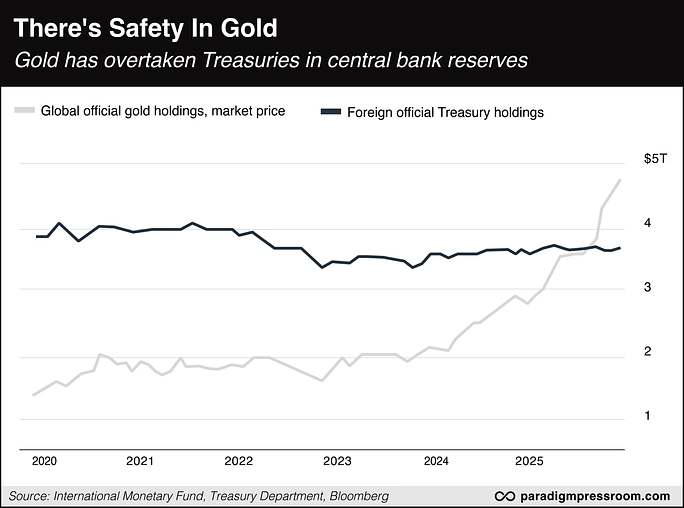
It’s no coincidence the gold price soared from about $1,800 at the time Washington seized Russia’s Treasury holdings to about $4,250 at year-end 2025.
What’s the outlook for the dollar price of gold going forward? Jim returns for insight in Bullet No. 4, after we take up other matters…
 SpaceX Gains, Other Tech Names Lose
The share price of SpaceX has sailed past $200 on its third trading day — up 57% from Thursday’s listing price of $135.
In after-hours trading yesterday, SpaceX added an amount to its market cap that equaled the entire market cap of Starbucks. As one skeptic pointed out, Starbucks generates twice as much revenue as SpaceX.
Once the market opened today, SpaceX’s total market cap exceeded that of Amazon… and it soon surpassed Microsoft as well. At $2.8 trillion, SpaceX is now the fourth-biggest U.S. company. (Nvidia holds the crown at just over $5 trillion. For now.)
We’re definitely in the “IPO hype” phase. That’s the first of five phases to SpaceX’s likely trajectory over the next year as described here yesterday by colleague Davis Wilson.
Some of the social media chatter is out of control. “A no-brainer 100X” says one rando — unaware that SpaceX would then be 10 times the size of the U.S. economy.
On the flip side, skeptics declare SpaceX is a firm that’s still “basically pre-revenue” but “trading like a meme coin.”
True that. But as John Maynard Keynes quipped a long time ago, “The market can remain irrational longer than you can remain solvent.”
Just ask the “Tesla shorts” who kept betting against Elon Musk’s other big company throughout the 2010s…
For the moment, it sure looks as if hot money is flowing into SpaceX at the expense of many other tech-adjacent stocks.
While SpaceX is up 11.5% on the day, the Nasdaq Composite is down about 0.6%. And the red-hot-until-recently Philadelphia Semiconductor index (SOX) is down 3.8%.
Nvidia is down 1.75% as we check our screens, Microsoft 2%. IGV, the big software ETF, is on its heels again, down 1.62%.
The S&P 500 is off about a quarter percent at 7,536. The Dow, with relatively limited tech exposure, is up 1% in record territory over 52,000.
Precious metals are consolidating yesterday’s big gains — gold at $4,341 and silver just over $70. But crypto is losing ground, Bitcoin well below $66,000 and Ethereum back under $1,800.
 Hormuz: “You Go First.” “No, YOU Go First”
For the second day in a row, major shippers are making clear they’re in no hurry to resume transiting the Strait of Hormuz — “deal” or no deal between Washington and Tehran.
The CEO of the world’s biggest tanker operator says shipowners will likely hold off for weeks.
“What will have to come in place is not just a simple ,agreement between the relevant countries, but it has to be material and translated into the real situations in the Strait of Hormuz, so that shipping lines can make themselves comfortable to go through,” Mitsui OSK Lines CEO Jotaro Tamura tells the Financial Times.
That’s on the heels of the statement we mentioned yesterday from Maersk, the No. 2 container-ship operator in the world — which pointed out that when it comes to the U.S.-Iranian agreement, “publicly available details are still limited.”
That remains the case today even though Vice President Vance says President Trump and Iranian Parliament Speaker Mohammad Bagher Ghalibaf have “digitally” signed the agreement. No confirmation on that from the Iranian side.
For that matter, there’s confusion coming from within the U.S. side. Trump said Sunday the U.S. blockade on Iranian ports had been lifted… but in an advisory to merchant ships yesterday, the U.S. military said it remains in effect “pending execution” of the agreement.
Is this just a case of the left hand not knowing what the right is doing? Or is the military defying the orders of the commander in chief? (Just asking — wouldn’t be the first time.)
No wonder the shippers are so skittish.
But hope springs eternal among oil traders. U.S. futures are down another five bucks on the day. At $75.64 they’re the lowest since the early days of the war last March.
 Gold $10,000 (But Maybe $3,600 First)
The bad news about gold is that Jim Rickards won’t rule out gold sinking to $3,600. But he says even today’s bid of $4,341 is “an excellent entry point.”
Yes, gold is down significantly from the late-January record — when front-month gold futures reached $5,355. But that’s not unexpected. And $3,600 would be completely normal on the way to much higher prices.
It comes back to something Jim was told over a decade ago by the legendary commodities trader Jim Rogers: “No commodity goes from a baseline to a permanently new high without a 50% retracement along the way.”
Jim Rickards demonstrates how that worked with gold’s bull market in the early years of this century: “Using the 1999 price of $250 per ounce as a baseline and the 2011 peak of $1,900 per ounce, gold had gained $1,650 per ounce in the prior bull market.
“Applying Rogers’ 50% rule, a drawdown of $825 per ounce would satisfy the condition. Subtracting $825 from $1,900 produces a target bottom of $1,075 per ounce.”
Turns out gold bottomed around $1,050 in mid-December 2015. In 5 Bullets’ predecessor e-letter, the two Jims called the bottom nearly to the day.
Now Jim does the math for the present situation: “We can reasonably date the start of the current bull market from Oct. 1, 2023, at a price of $1,845 per ounce. (Gold prices moved relatively little from 2019–2023.) The market peaked at $5,355 in January 2026. The dollar gain in that period was $3,510 per ounce.
“A 50% drawdown of that amount is $1,755 per ounce. Subtracting that amount from $5,355 would produce a price of $3,600 per ounce to meet the 50% drawdown that the Rogers method would predict…”
All that said, Jim won’t rule out that we might have already seen the bottom for this cycle — $4,110 last week. Chalk it up to “the volatile nature of commodity trading in general and gold in particular,” he says.
“If you own gold, hang on. If you’re looking to buy gold, this is an excellent entry point.”
Either way, expect “substantial gains,” Jim concludes — “as a new bull market finds its legs, moves decisively past $5,000 per ounce and ultimately heads toward $10,000 per ounce — and potentially higher.”
 Mailbag: DXYZ
A handful of alert readers wrote in during the last 24 hours to shed light on the complaints from yesterday’s mailbag that had your editor stumped.
The complaint was that Paradigm in general and/or James Altucher in particular had recommended shares of Destiny Tech100 Inc. (DXYZ) — the closed-end fund that was a proxy of sorts for SpaceX before SPCX went public last Friday.
Turns out it was in the portfolio of our now-defunct entry-level newsletter Technology Profits Confidential. Ray Blanco recommended it in 2024.
Later that year we shuttered the newsletter and folded it into Altucher’s Investment Network. Some of Ray’s picks made it into the Altucher portfolio — but DXYZ was not one of them. Of the cast-off names, Ray made clear in his final dispatch for TPC that “I won’t be continuing coverage of these plays moving forward. Be sure to plan your exits from these stocks accordingly.”
“I personally did well on it,” says the reader who brought this to our attention — “and sold it when additional info became available and price started to go down after the hype.
“You should just tell your readers that timing is of essence when sell alerts are coming, even if international users like me can’t subscribe to text alerts (at least now we have the app - for which I am very grateful).
“Thank you for all the hard work you guys are doing to help us navigate as best as possible the news in the markets.”
Ah, but there’s more to the story…
“My first-ever encounter with Paradigm was a video I viewed around Christmas 2025,” writes another reader who sheds additional light.
“In the video, I’m pretty sure, James Altucher either recommended it, or sure made DXYZ sound like a logical or attractive way to get in on the SpaceX IPO and avoid trying to get actual shares of SPCX. So I bought some.
“Don't get me wrong, I made money on it but then it sort of languished and I sold it. But to act like this was a non-event with Paradigm is wrong. It’s the whole way I got involved with James Altucher to start with. Maybe go back and take a look at the videos you guys were pumping out back then and see if you don’t run across some old footage?
“May I also respectfully suggest that perhaps you more judiciously create and send out videos and articles and conduct summits. I have been overwhelmed by the sheer volume and, at times, they actually appear to contradict one another. Or, at the very least, I find myself having to read them or watch them repeatedly to try to sort out the minor differences between them to make sure you guys haven’t changed your stance. (DXYZ is a good example.)
“I don’t mean to be a whiner, but I am starting to wonder if I’m just not cut out for the Paradigm investment world. I do have an MBA from Purdue, so it seems odd that I can’t keep up better. Might it be your style of delivery or, again, the sheer volume that makes it difficult for me and maybe others?”
Dave responds: OK, got it now. DXYZ was an “unofficial” pick mentioned in a sales promotion for Altucher’s Investment Network.
Those picks often fly under my radar here. They’re not something I can easily look up like the formal recommendations made in the monthly issues and special reports.
They’re also a relatively new thing for us. Perhaps we’ve been a touch cavalier in the way we treat them — relative to the formal recommendations in the paid publications, which of course are thoroughly screened, vetted and monitored. I’ve flagged this matter to the Paradigm leadership team; thanks for bringing it to my attention.


