
Celebrate the Second!
 Celebrate the Second!
 “The second day of July 1776 will be the most memorable epoch in the history of America,” wrote Founding Father John Adams — in a letter to his wife, Abigail.
I am apt to believe that it will be celebrated by succeeding generations as the great anniversary festival. It ought to be commemorated as the day of deliverance, by solemn acts of devotion to God Almighty. It ought to be solemnized with pomp and parade, with shows, games, sports, guns, bells, bonfires and illuminations from one end of this continent to the other, from this time forward forever more.
No, not the Fourth, Adams believed. The second, 250 years ago today.
It was on July 2, 1776, that the Continental Congress, meeting in Philadelphia, passed a resolution offered nearly a month earlier by Virginia’s Richard Henry Lee…
Resolved, That these United Colonies are, and of right ought to be, free and independent States, that they are absolved from all allegiance to the British Crown, and that all political connection between them and the State of Great Britain is, and ought to be, totally dissolved.
The delegates had spent much of the previous week debating Lee’s resolution. Meanwhile, the actual Declaration of Independence languished — having been submitted by Thomas Jefferson back on June 28.
Only after Lee’s resolution passed did the delegates get down to debating and editing Jefferson’s document — which they adopted on the Fourth. Whew.
Then there’s the matter of whether the Declaration was signed on the Fourth.
The overwhelming historical evidence is that the signing took place on Aug. 2, once the final draft had been put on parchment.
That said, late in their lives both Adams and Jefferson swore up and down it was signed on the Fourth. The 20th-century Princeton historian Julian Boyd, who spent over 35 years editing The Papers of Thomas Jefferson, was likewise persuaded — but he remains in the minority.
As long as we’re in the weeds here, we should (briefly) return to the inalienable/unalienable thing.
I referred in Tuesday’s edition to our “inalienable” rights — much to the consternation of a longtime reader who pointed out the language of the Declaration says “unalienable.” He asserted there’s a huge difference. An AI search told me there was no meaningful difference — but that didn’t square with my memory of a lecture I listened to long ago.
Now another reader weighs in: “As a copy editor/tech editor for 60 years, I was predisposed to ask the same question way back in school days. The answers I always got were exactly what AI was telling you. The words mean the same.
“In my professional opinion, they even mean the same today; anyone trying to build a case for a distinction is simply ‘making a distinction without a difference.’”
I subsequently managed to locate the lecture recording. Turns out my memory was faulty and the AI take is correct. As the late libertarian scholar George H. Smith said in the 1980s…
You may have noticed that although we usually say inalienable rights spelled with an “i” the Declaration speaks of unalienable rights spelled with a “u.” Does this difference reflect a subtle change in meaning? Most likely not. It probably reflects what we call today a typographical error.
Jefferson used the word inalienable in his original draft. Where and how the “i” became a “u” is anyone’s guess.
No matter. Whichever word you use, the meaning is the same — and essential to the Founders’ vision. Smith again…
Jefferson and other radical Whigs believed that human beings have natural rights. Natural rights are rights we were born with, rights we enjoy in virtue of our nature as human beings. These rights do not rely for their validity on any person or government. And no person or government can legitimately violate them or take them from us.
Natural rights seemed so obvious to many 18th-century Americans that the Declaration calls them self-evident.
Natural rights have nothing to do with majority rule — which too many miseducated Americans believe to be at the heart of the American experiment.
No. Your inalienable rights are rights that no majority — no matter how large — can ever take away from you.
That’s something to celebrate and preserve — today, and on the Fourth and on every other day as well.
 Meta’s Lies, OpenAI’s Backdoor Bailout
“Facebook is a big fat liar,” declared our AI authority James Altucher today on the Paradigm mobile app.
When we left you yesterday, the big tech news was that Facebook parent Meta planned to lease its mushrooming data-center infrastructure to outside customers — that is, getting into the same business as Amazon Web Services, Microsoft Azure and CoreWeave. META shares leaped almost 10% on the day while CRWV tanked hard.
“Let's get this straight,” says James: “META is not selling compute and companies that sold off are going to bounce back hard.
“First off, META has paid tens of billions of dollars to CoreWeave, Google and others to BUY compute from them. In fact, META's demand for compute has been so great that Google has had to ration them.
“The idea that they have excess compute is ridiculous, particularly when they can't even buy enough compute to meet their own demands.
“So why was this news leaked? To get the stock price up so they can sell shares at inflated prices to buy compute.”
James says he’d be a “strong buyer” of companies that took a hit from the news yesterday — CoreWeave as well as memory makers Micron and SanDisk.
Checking our screens CRWV and MU are down another 3.5% on the day… while SNDK has shed another 11%. META has given up nearly half of yesterday’s gains.
Meanwhile the big tech news today is ChatGPT maker OpenAI pitching the federal government on a backdoor bailout.
“OpenAI has discussed giving a 5% stake to the U.S. government,” reports the Financial Times, “as the $852 billion AI startup seeks to clear political obstacles by securing financial buy-in from the Trump administration.”
Giving. Yes, how magnanimous on the part of OpenAI co-founder and CEO Sam Altman. What have we peasant taxpayers done to deserve this splendid humanitarian gesture?
“Giving the government an ownership stake,” the article goes on, “could help secure good relations with the administration and would mark an attempt to address political blowback by sharing the wealth generated by AI with the public.”
Wealth? OpenAI is losing money hand over fist — depending on who you want to believe, $21 billion during 2025, more than double the 2024 total.
As one sober assessment on X puts it, “This is bullish if you now assume that the government will be very incentivized to make sure AI doesn’t fail…
“This is bearish if you assume that OpenAI is having some serious issues and now the U.S. gov will have to hold the bag when things don’t work out.”
As you’ll recall, OpenAI has filed for an IPO with the Securities and Exchange Commission. But the latest scuttlebutt is that the offering will be pushed back into 2027. One theory is that a delay would improve the odds of the company reaching Altman’s goal of a $1 trillion valuation at the time it starts trading publicly. Stay tuned…
 About the Job Numbers…
With a three-day weekend starting tomorrow, the government is out with its monthly jobs report a day early.
The wonks at the Bureau of Labor Statistics conjured 57,000 new jobs for June.
On the one hand, that’s not an awful number — not with the U.S. border having been more or less sealed since the spring of 2025. We no longer need 150,000 or more new jobs each month to keep up with population growth; several experts think 30,000 is adequate.
On the other hand, no one among dozens of Wall Street economists was expecting a number this low. In addition, the robust numbers for May and April were revised down — and not by a little.
One eye-opener in the report was a monthly decline in the number of leisure-hospitality jobs. Really? With the World Cup going on in 11 U.S. cities? OK then…
The official unemployment rate ticked down to 4.2%.
Your editor is always suspicious of the headline job numbers. Like the official inflation rate, they’ve been subject to statistical tinkering over the last 40-plus years.
There are a couple of numbers the statisticians can’t game, and they don’t look good…
- The labor force participation rate — the percentage of working-age adults either working or looking for work — sits at 61.5%. Aside from the COVID disruptions of 2020, the number hasn’t been this low since June 1976, just ahead of the Bicentennial
- The employment-population ratio sits at 59.0%. It does not sit at 50-year lows — but it’s been dropping like a stone for six months.
In theory, the lower-than-expected headline number of 57,000 should be cooling expectations that the Federal Reserve will raise interest rates later this year. And in theory, that should be giving the stock market a lift today.
Instead, the major U.S. stock indexes are a decidedly mixed bag.
At last checkthe Nasdaq was down over a half percent, the Dow up over three-quarters of a percent and the S&P 500 pancake-flat at 7,484.
Instead, it’s the precious metals enjoying an across-the-board rally — gold up $95 to $4,125 and silver up two bucks, just a penny away from $61. Crypto is also bouncing, with Bitcoin well over $61,000 and Ethereum approaching $1,700.
U.S. oil futures have sunk nearly another buck to $67.70 — where it was on Day 3 of the Iran war.
The latest drop comes despite Vice President Vance telling an interviewer that the purpose of the 60-day “memorandum of understanding” is merely to buy time “to sort of refill the world’s oil economy” after which the Trump administration would “see where the hand is.”
Does Vance think no one in Tehran will see this interview?
 Comic Relief
Well as long as we had air conditioning on the brain in yesterday’s edition…
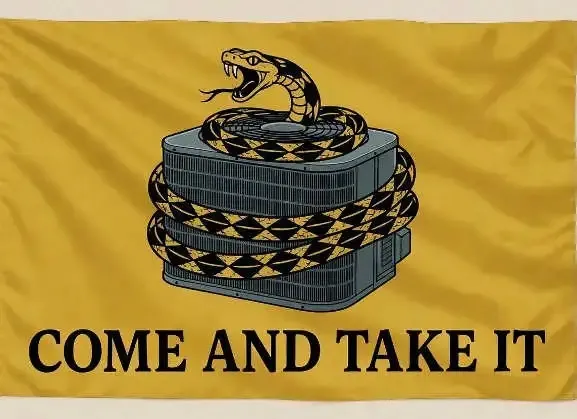
 Mailbag: Pipelines, American Comeback
“Perhaps you can help me with something. Why would anyone, other than Iran, ship oil (or anything else) through the Strait of Hormuz in 24 months?” a reader inquires.
“I would think they would be actively expanding pipelines and other infrastructure to bypass this chokepoint in the future — rather than be held hostage by Iran anytime they want to do so.
“I would certainly see Saudi Arabia as leading this and helping the Gulf states, if needed, bring it to fruition. Nothing else makes long-term sense, but I am surprised that there has been no news around planning for a long-term ‘Hormuz alternative.’
“Love your work!”
Dave responds: It’s in the works. Or at least there’s some jawboning.
Last week the CEO of the French oil giant Total said “we must invest in pipelines to bypass the strait, which is an absolute priority." It wasn’t clear whether he was speaking of his own firm or if he was using the royal “we” addressing the industry as a whole.
In any event, pipelines aren’t a panacea.
Iran made a strategic decision during the hot-war phase this spring to conduct only theatrical pinprick attacks on Saudi Arabia’s Yanbu oil terminal — which handles the crude coming from an east-west pipeline crossing the kingdom.
If Tehran had decided to attack for real, the impact would have been catastrophic — taking another 5 million barrels of oil a day off the market.
Too, as our own Byron King points out, oil pipelines don’t solve the “Hormuz problem” for liquefied natural gas, helium, sulfur, fertilizer and so on.
“Can I share yesterday’s 6th Bullet with friends and family?” a reader writes after yesterday’s extended edition.
Adds another: “I have never read such a positive, encouraging article in any of the
many financial newsletters to which I subscribe. Thank you, Ray Blanco.”
Dave: You can always share the material we publish at our daily e-letters. They’re free content intended to supplement your paid subscription.
We knew Ray’s piece would be a hit. Going into the holiday weekend, we’re cross-posting it at several of our sister publications. The handiest link to give to friends and family is today’s Rude Awakening. Enjoy!


