
War’s Back On?
 War’s Back On?
 Gee, what were we saying in the middle of yesterday’s edition? Oh yeah, don’t rule out a few ceremonial U.S. airstrikes late this afternoon or tonight.
U.S. Central Command says it struck 80 Iranian targets overnight.
Maybe it’s not so ceremonial now. Of the ceasefire that’s been formally in effect for the last three months, the U.S. president says, “I think it’s over.”
So how did we get here?
As mentioned yesterday, the latest trouble began with two attacks on ships that tried to transit the Strait of Hormuz without Tehran’s permission.
No one was hurt and the damage was minimal. The attacks were intended to “send a message” about who’s in charge of the strait.
As the Iranian side sees it, the “Memorandum of Understanding” between Washington and Tehran gives Iran sole responsibility for traffic going through the strait.
Here’s the language both sides signed onto: “Upon the signing of this MoU, the Islamic Republic of Iran will make arrangements using its best efforts for the safe passage of commercial vessels, with no charge for 60 days only.”
There’s nothing in there about how Iran must revert to a prewar state of free navigation for all — which seems to be what the U.S. side is demanding.
(Reminder: The strait was free for all to navigate before Trump and Netanyahu started the war on Feb. 28 with a sneak attack while negotiations were ongoing.)
Washington’s initial response to the shipping attacks was to yank the waivers that allowed Tehran to sell oil to foreign buyers — a move Tehran was almost sure to interpret as marking an end to the MoU.
Then came the U.S. airstrikes — during the official mourning period for the previous Supreme Leader, Ayatollah Khamenei, which doesn’t end until his burial tomorrow. That’s sure to enrage both Iranian leadership and the population at large.
For the moment, Iran’s response has been limited to airstrikes on U.S. targets in Bahrain and Kuwait — a move that retired CIA officer Larry Johnson believes is perhaps calculated to give Washington a chance to back down.
“If the U.S. continues the strikes,” Johnson writes at his website, “then I expect Iran to expand its targets to include Mowafaq al Salti airbase in Jordan and possibly Israeli airfields.
“At this point the MoU is hanging by a thread.”
And so U.S. oil futures priced under $69 on Monday are priced over $74 today.
Whoop, make that nearly $76. Because as we write the Energy Information Administration is out with its weekly U.S. inventory figures. It’s grim stuff, especially with this latest turn of events.
The government’s Strategic Petroleum Reserve sits at another low last seen in 1983. Fully 1.9% of the remaining crude in the SPR was drained just last week — when peace kinda-sorta reigned.
Private-sector inventories fell another 0.9% last week. The giant oil terminal at Cushing, Oklahoma saw only a slight drawdown — but it’s still very near “tank bottoms” beyond which there’s not enough crude to reliably feed the pumps and pipelines.
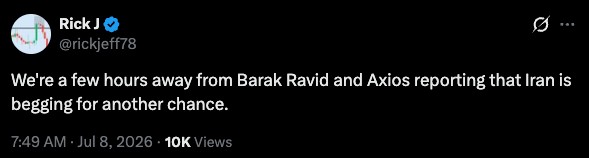
Between the war and the inventory numbers, it all looks bullish for crude — although a few hardened cynics are expecting another rug pull…
This would be a good time to review some numbers that we explored at the start of the war.
“It’s useful to know just how much of the global output of key energy and other commodity supplies comes from the Gulf,” Jim Rickards wrote his Insider Intel readers yesterday.
“The numbers are astounding including 34% of the trade in crude oil, 19% of global output of liquified natural gas (LNG), almost 30% of liquified petroleum gas, 13% of chemicals and fertilizers, 19% of refined oil products and about 10% of global aluminum.
“There are no easy substitutes for any of these outputs. The U.S. and Russia may increase their oil exports somewhat but LNG, chemicals, fertilizers, aluminum and refined oil products (gasoline, diesel, jet fuel) are not easily replaced if at all.
“Markets have yet to internalize the continuing danger of the Iran war situation and the impact on demand for crude oil and distillates,” Jim concludes.
Although maybe that process is starting today, as we’ll see in Bullet No. 2.
 Yahoo Goes Doomer
“There’s an Urgent Sign of an Impending Market Collapse,” reads the subject line of an email your editor got this morning from Yahoo.
I’m not accustomed to Yahoo as the deliverer of doom. So out of curiosity I clicked on the link and up came an article from the Futurism site.
It was a profound disappointment. It said a valuation metric called the “Shiller CAPE ratio” sits at 41. “Said another way, investors are paying $41 for every $1 of average annual profits the S&P 500 has generated over the past decade.”
The Shiller CAPE’s historical average is 17.3. Thus the present situation is “more or less the financial equivalent to the tide receding before a freak tsunami.”
Only two possible outcomes, we’re told: “Either earnings actually catch up to the pie-in-the-sky AI fantasies, or the market closes the gap between financial valuation and productivity the hard way.”
Whatever. Your editor is well aware that the Shiller CAPE sits at nosebleed levels. What the author purposely omitted from his article — because it didn’t comport with the narrative — is that the Shiller CAPE was even higher at the peak of the dot-com bubble.
It was over 44 compared with today’s 41. So there’s still some ceiling here.
We’re as certain as the Futurism author that “the hard way” is coming sooner or later. But not right now — and the tell is that Yahoo picked up an article like this. It’s when you see only bullish articles — and the only remaining bears are a few cranky contrarian newsletter editors — that’s the time to worry.
All that said, the stock market is reacting poorly to the resumption of the war — however long or brief it turns out to be.
Among the major indexes, the biggest hit by far is to the Dow Industrials — down nearly 1% and approaching 52,100. Monday’s record high over 53,000 is but a memory. Next worst is the S&P 500, over three-quarters of a percent and closer to 7,300 than 7,400.
But for a second day running, the tech-heavy Nasdaq is shrugging off concerns from Asia. South Korea’s benchmark KOSPI index slid another 5%. It’s met the threshold of a “bear market” in that it’s down 20% from its (very) recent peak.
And while the Nasdaq has been in the red yesterday and today, the sell-off hasn’t been anywhere near as severe. At last check, the Nasdaq Composite is down three-quarters of a percent at 25,633. It’s down 5.3% from its peak in early June. Not good but not disastrous.
Bonds are selling off alongside stocks — on the theory that a renewed war will goose inflation. As prices fall, yields rise: The 10-year Treasury note is up to 4.56%, the highest since mid-June.
As yields rise, precious metals become less attractive. Gold is down 2%, approaching $4,000 again… while silver is down 4.2% to $57.31.
Crypto can’t hold onto its recent mojo — Bitcoin retreating toward $61,500 and Ethereum about to crack below $1,700.
 Free Money
Whether or not it’s a good idea for the country… it’s free money for someone you love, and it compounds from an early age.
On Monday, Donald Trump formally rolled out the “Trump Accounts” made possible under the Big Beautiful Bill passed last year.
“Eligible children can receive a $1,000 investment account at birth,” writes colleague Davis Wilson. “And given enough time, that initial investment could compound into hundreds of thousands — or even millions — of dollars.”
The money will go into an index fund that tracks the broad U.S. stock market.
“Using historical S&P 500 returns,” says Davis, “if your family never contributes another dollar, the government's initial $1,000 could grow to roughly:
- $6,000 by age 18
- $15,000 by age 27
- $243,000 by age 55.
Those numbers only mushroom further if parents and grandparents contribute to the account (maximum $5,000 per year).
Yes, there are a few more details and logistics to cover about who qualifies and how. Davis runs them down for you on Monday’s edition of our sister e-letter The Million Mission.
 Stupid Bureaucrat Tricks
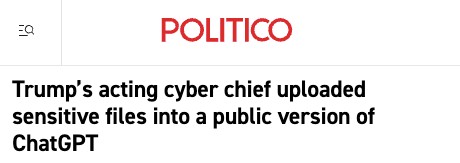
Props to whoever crafted this headline: Sometimes the most straightforward, deadpan telling is the one that makes you say, “Holy s***!”
Yeah.
Citing four sources within the Department of Homeland Security, Politico reports that last summer, Madhu Gottumukkala — the acting director of the Cybersecurity and Infrastructure Security Agency — “uploaded sensitive contracting documents to the public version of ChatGPT.”
None of the files was classified. “But the material included CISA contracting documents marked ‘for official use only,’ a government designation for information that is considered sensitive and not for public release.”
Everything uploaded to ChatGPT is assimilated by ChatGPT into its knowledge base to answer other people’s questions in the future. Those files are now a matter of public record.
Accountability, you wonder?
Back to the article: “Cybersecurity sensors at CISA flagged the uploads this past August, said the four officials. One official specified there were multiple such warnings in the first week of August alone. Senior officials at DHS subsequently led an internal review to assess if there had been any harm to government security from the exposures, according to two of the four officials.
“It is not clear what the review concluded.”
Well, except for the fact Gottumukkala is still on the job 11 months later. That much is very clear.
 Mailbag: Agitating About Apple
“Dave, so glad you talked about Apple and its demise for user-friendliness,” a reader writes after the mailbag in yesterday’s edition.
“They continually ‘upgrade’ the iPhone with no warning and no explanation of how the ‘improvements’ function. As an investor I love the stock. As a user I'm extremely frustrated and disappointed.
“Don't always agree with you but love your column.”
“Apple had and has many chances to make their technology better that they missed,” writes another reader with a good example.
“They should have long ago standardized device control (apps on your phone interacting with third-party devices) so that rather than having separate apps with different functionality from every manufacturer, they would provide common interfaces to register/enable/connect to devices of different kinds.
“It’s ridiculous how many apps I have, and having to search through apps to remember which one controls something as simple as a power switch, and then discover it requires logging in again with a password I haven’t had to use, etc., etc. — it’s just a big fail.
“And for those who would say it’s too hard or would stifle innovation I’d point to printers… when you get a new printer you may have to install a driver, but the UI, command-P to print, etc., are standardized. Different printers support or don’t support features like double-sided printing, but you don’t have to remember a password or a special UI for any given printer, regardless of manufacturer.
“I could go on.
“One of many misses.”
Dave responds: Interesting analogy. I will say that connecting wirelessly to a printer these days is way easier than it was with a wired connection 30 years ago. Some things do get better!


