
AI Needs a Rescue
 AI Needs a Rescue
 The first trial balloon about a bailout of the AI industry… went over like a lead balloon.
We chronicled it at the time: Back in November an executive at ChatGPT maker OpenAI spoke at a conference about her company getting taxpayer-backed loan guarantees.
A federal backstop like that would “really drop the cost of financing,” enthused CFO Sarah Friar.
The backlash was… well, furious is an understatement. Friar had to walk back her remarks on LinkedIn.
Within hours, White House AI czar David Sacks nixed the idea. “There will be no federal bailout for AI.”
But Sacks’ role in the White House has diminished since then. And the Trump administration has abandoned its hands-off approach to AI.
Which brings us to what seems like another trial balloon — this one floated by Vice President Vance.
Reminder: Vance has a history in Silicon Valley. After giving up his law career he became a principal at one of Peter Thiel’s firms. He accepted funding from venture capitalist Marc Andreessen and ex-Google CEO Eric Schmidt.
“The president is supportive of the United States owning these big AI companies,” Vance said last week during a podcast interview.
On the surface, that sounds like what the feds have already been doing over the 18 months — taking ownership stakes in everything from Intel… to U.S. Steel… to rare-earth firms like MP Materials.
But then Vance added something curious: He said Donald Trump “likes the idea as sort of a sovereign wealth fund idea.”
That sounded like an off-the-cuff remark. It was not. OpenAI has an entire white paper proposing a “public wealth fund” whose proceeds "could be distributed directly to citizens, allowing more people to participate directly in the upside of AI‑driven growth, regardless of their starting wealth or access to capital."
Is your BS detector going off? Good. Read on…
 USA SWF?
It’s here we should pause to acquaint you (or reacquaint you) with what a sovereign wealth fund is.
Basically a SWF is a government-owned investment fund that can hold everything from stocks to bonds to real estate or even hedge funds.
Many SWFs got their start with bountiful mineral or energy wealth. The biggest in the world is Norway’s, a $2.1 trillion colossus organized in 1990 with surplus revenue from North Sea oil.
Many Americans first learned about SWFs during the early phases of the 2008 financial crisis — when the oil-rich Abu Dhabi Investment Authority plowed $7.5 billion into Citigroup. At the time, it was a lifeline for Citi, but in the end it wasn’t enough; Citi took a bailout from the U.S. government and Abu Dhabi booked a loss.
But a SWF isn’t entirely a “foreign” concept: The Alaska Permanent Fund, formed in the 1970s as Alaskan crude started flowing to the lower 48 states, is now $80 billion strong.
Here’s the problem with Uncle Sam establishing a SWF.
As perhaps you’ve noticed from the preceding examples, governments typically create a SWF when they have a generous surplus of revenue.
As you’re likely aware, the U.S. government does not have a surplus.
In fact, going into the Iran war, Uncle Sam’s annual deficit relative to the size of the economy was the biggest in history outside of a war, financial crisis or pandemic. Here’s one of these charts we can’t share often enough…
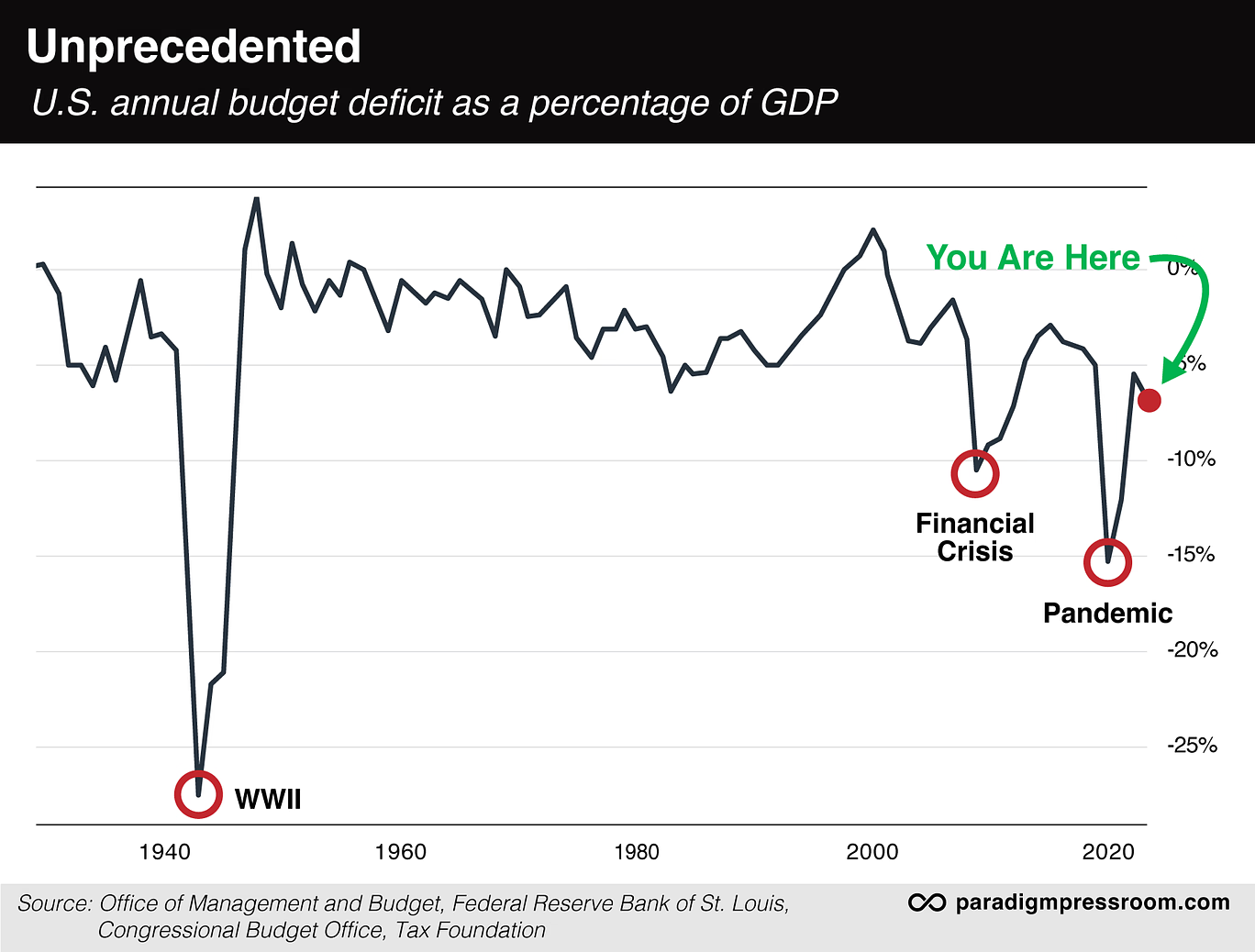
So where’s the seed money for the SWF supposed to come from?
OpenAI proposes that it come from AI companies themselves. Which sounds good in theory until you realize that precious few AI companies turn a profit — certainly not OpenAI and the other chatbot makers.
So how exactly is a SWF supposed to work under that circumstance? How would everyday Americans “participate directly in the upside of AI-driven growth”?
They would not.
“A sovereign wealth fund, which almost always comes along with not having a huge deficit and debt and/or great commodity wealth, is a terrible idea for the USA,” tweets AQR Capital chief Cliff Asness. “More taxes to pay for [an] utterly corrupt ideologically whacko government to play with (I say this in a bipartisan way).”
Economist Don Johnson of the MacroEdge firm is even more blunt: The purpose of the SWF chatter is to obscure the fact that AI companies will be in line for taxpayer bailout — like the banks in 2008. “I love that we’re rebranding TARP 2.0 (for AI companies) to sovereign wealth fund.”
Back then it was sold to the people as absolutely necessary to prevent the financial system from collapsing. Now it’ll be sold as absolutely necessary for America to keep its technological edge over China (and, secondarily, to prop up the stock market should it start to falter).
There’s a lot more to say about the subject, but we’ll leave it here for today. Just wanted to get the topic on the record.
Because it will come up again…
 Update: SpaceX-Tesla Tie-Up
This whole SpaceX-Tesla merger thing is getting legs — five months after colleague Davis Wilson first suggested it.
From Paradigm AI authority James Altucher: “I've never seen this before. Elon Musk just exercised 300,000,000 options of Tesla (TSLA) and he DID NOT SELL A SINGLE SHARE.
“This is very unusual and extremely bad from a personal finance perspective
“In general when someone exercises options, they lock in a profit at that point (in Elon Musk's case, it’s a $116 BILLION [!] profit.) Once they lock in the profit, they have to pay the taxes on the profit even if the stock goes down from there.
“In other words, when they actually sell the shares they may no longer have a profit or they may have a much smaller profit, BUT they still have to pay the full tax amount.
“NOBODY ever does this. I can't even think of another time in history where someone exercised a significant amount of stocks and held on to every single share.
“SO WHAT DOES THIS MEAN? Elon needed the shares (and soon!) to get more control over Tesla. Before this exercise of shares, Elon controlled 13% of Tesla. Now this brings him up to 20% control of TSLA shares. With that much control it is unlikely anyone can outvote Elon on a major decision.”
Gee, what major decision might be on the horizon?
James’ answer: “Elon is going to propose a SpaceX-Tesla merger (‘That might make Elon's life a little easier’ — the COO of SpaceX recently stated) and he wants to make sure there are zero issues. So he is giving himself much greater controlling interest even though he will have to pay tens of billions in taxes even if it could cost him billions in overpaying the taxes.
“That's how much it’s worth it to him to merge these two companies.
“Who will benefit? SpaceX? Unclear. Tesla? Unclear.
“All of the suppliers to this mega-merged company? Absolutely. And then some.
“These are the companies we are focused on right now,
“Again, I have never seen anything like this. But this is Elon playing chess on a board that includes: rockets to Mars, internet for the entire world, autonomous vehicles, humanoid robots, 100,000 orbital AI factories and obviously much more.”
SpaceX is in the red today, as is the Nasdaq and the S&P 500.
The red on the Nasdaq is a lighter shade than it was yesterday but at last check it’s still down nearly a half percent to 25,478 – approaching its lows of earlier this month. The S&P 500 is down a tad to 7,355 while the Dow is once more showing green. (SpaceX is down about a half percent but still above its opening price of $150 last Friday.)
The market’s next big catalyst comes after the close today – when chip darling Micron reports earnings. MU is among the semiconductor names that have soared to nosebleed heights the last couple of months. We shall see…
The picture in precious metals is positively fugly. Gold is down 3% and has sunk below $4,000 for the first time in seven months. Silver is down four bucks to $57.31, a level last seen in December.
No joy for crypto, either – Bitcoin has now been cut in half from its October 2025 peak, under $60,000 for the first time since October 2024. Ethereum has sunk below $1,600.
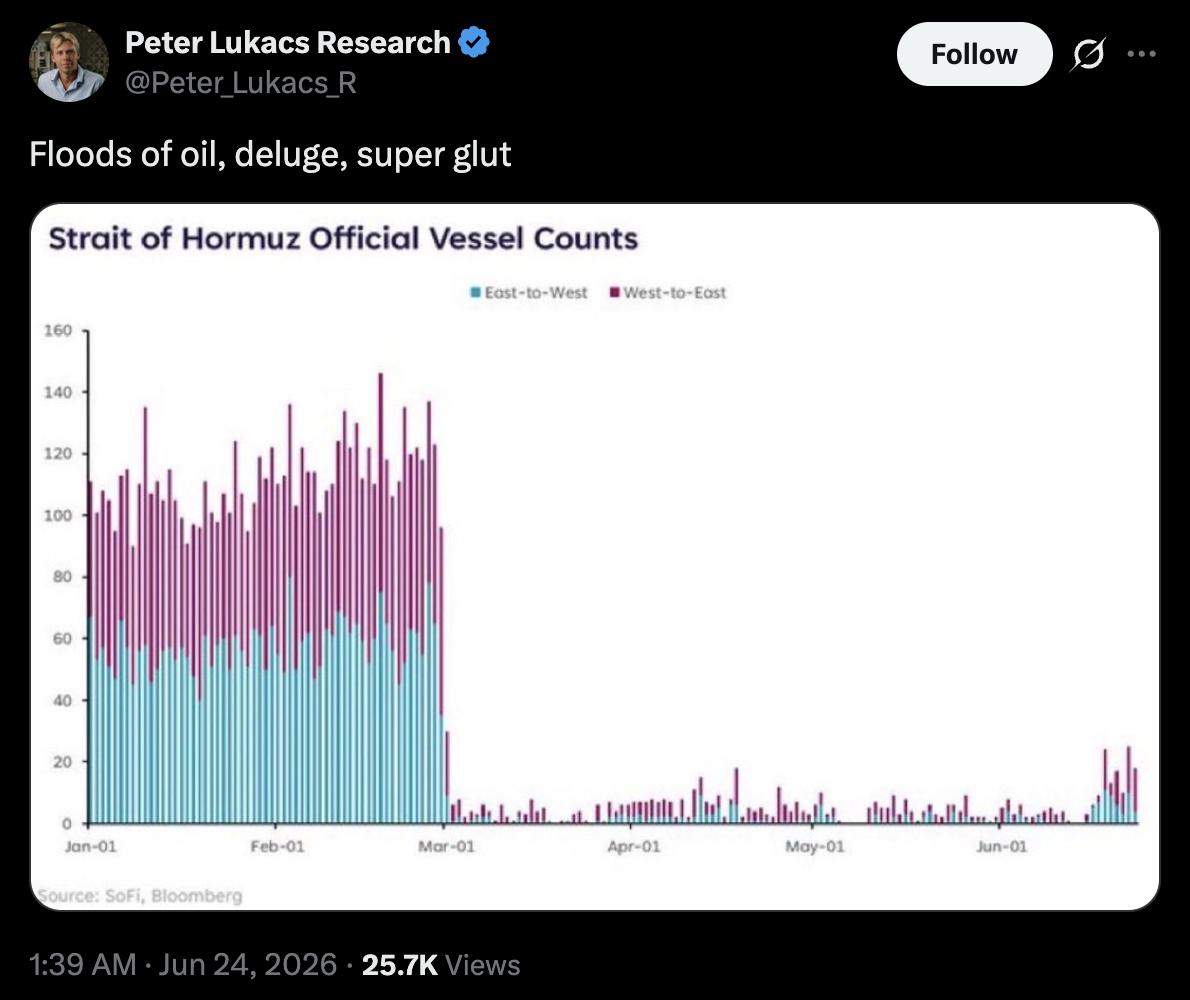
As for oil… here’s a visual to help reinforce what we said yesterday about shipping volumes through the Strait of Hormuz…
Meanwhile the U.S. Energy Department’s weekly inventory numbers show that another 9 million barrels were drained from the government’s Strategic Petroleum Reserve. At 331 million barrels, the SPR is the lowest it’s been since 1983. Inventories at the big private terminal in Cushing, Oklahoma now total 19 million barrels – basically the “tank bottom” we warn about now and then.
And none of it matters to U.S. oil futures – down nearly three more bucks today and approaching $70, another level last seen in early March when the Iran war was getting cranked up.
 Financial Fathers, Continued
Now for something to pass on to the next generation.
Ahead of Father’s Day last week, our weekly editorial meeting took an unexpected turn: The Paradigm editors rose to a challenge from our trading pro Enrique Abeyta, whose son just turned 13: What’s the one piece of financial advice you’d give to a 13-year old?
The answers were terrific, as Sean Ring chronicled in last Friday’s Rude Awakening.
Logistical considerations didn’t allow me to take part in the discussion. I was a little surprised no one brought up a piece of advice that precedes pretty much all the other excellent guidance that was on offer.
Avoid consumer debt.
In his 2007 book Crash Proof, money manager Peter Schiff drew a critical distinction between good debt and bad debt…
Capital debt, or investment debt, refers to loans made to businesses to finance capital formation, such as an automobile manufacturer building a new plant. Such loans benefit society and lead to higher living standards. The earnings the automobile company gets from its increased production enable it both to pay the interest on the debt and to repay the principal. Anything left over represents profit, which is the return on investment that a business deserves for taking risk and for successfully combining the factors of production.
Society benefits in several ways. Consumers now have more cars, workers have more jobs, savers earn interest and get their principal back and the business earns a profit, which can be used to finance still more capital investment.
Consumer debt, in contrast, refers to money lent to individuals to finance consumption. Such loans represent a waste of scarce savings that might otherwise have gone to finance capital formation. When individuals borrow to consume, there is no income-producing asset acquired. Therefore, the loans can only be repaid out of reduced future consumption.
Society does not benefit, since such loans do nothing to increase the supply of consumer goods and actually do the opposite, as borrowers consume goods that would otherwise be available for nonborrowers. Although consumer loans ultimately enable savers to be rewarded with interest, assuming they are paid, they are of no benefit to society as a whole. In fact, by redirecting savings away from capital investment, they actually undermine the higher living standards that might have been achieved in their absence.
I bolded the bits in the final paragraph to underscore a wider consideration: Every action we take in life ripples out to the rest of the world — often in ways we might not see or understand on a surface level.
To be clear, Schiff didn’t characterize all consumer debt as bad. For instance, a car loan is perfectly fine if that’s what you need to get to work; you’re paying for it with wages you couldn’t earn without the vehicle. It’s not fine if you’re having a midlife crisis and craving a convertible.
Anyway, just wanted to submit that guidance for young people on top of all the other outstanding counsel offered by my colleagues!
 A (Real, Physical) Mailbag
Today’s mailbag section is a little different. It’s not an email sent to our inbox. It’s snail-mail — and gifts — addressed to Paradigm’s Baltimore-area headquarters.
He runs a small manufacturing firm in New England… he’s a faithful Jim Rickards reader… and he looked forward with anticipation to our America 76/26 event earlier this month in Philadelphia.
“I attended Villanova University — missed Pope Leo by one year — and spent lots of time in Philly,” he writes.
“Traveled back last year to take close-up photos of the Liberty Bell to model and create the tooling for this celebratory piece to share in our country’s semiquincentennial celebration! Let’s hope for another 250 years of a FREE and democratic republic.”
And he sent a dozen or so of these zinc die-cast Liberty Bell keychains.
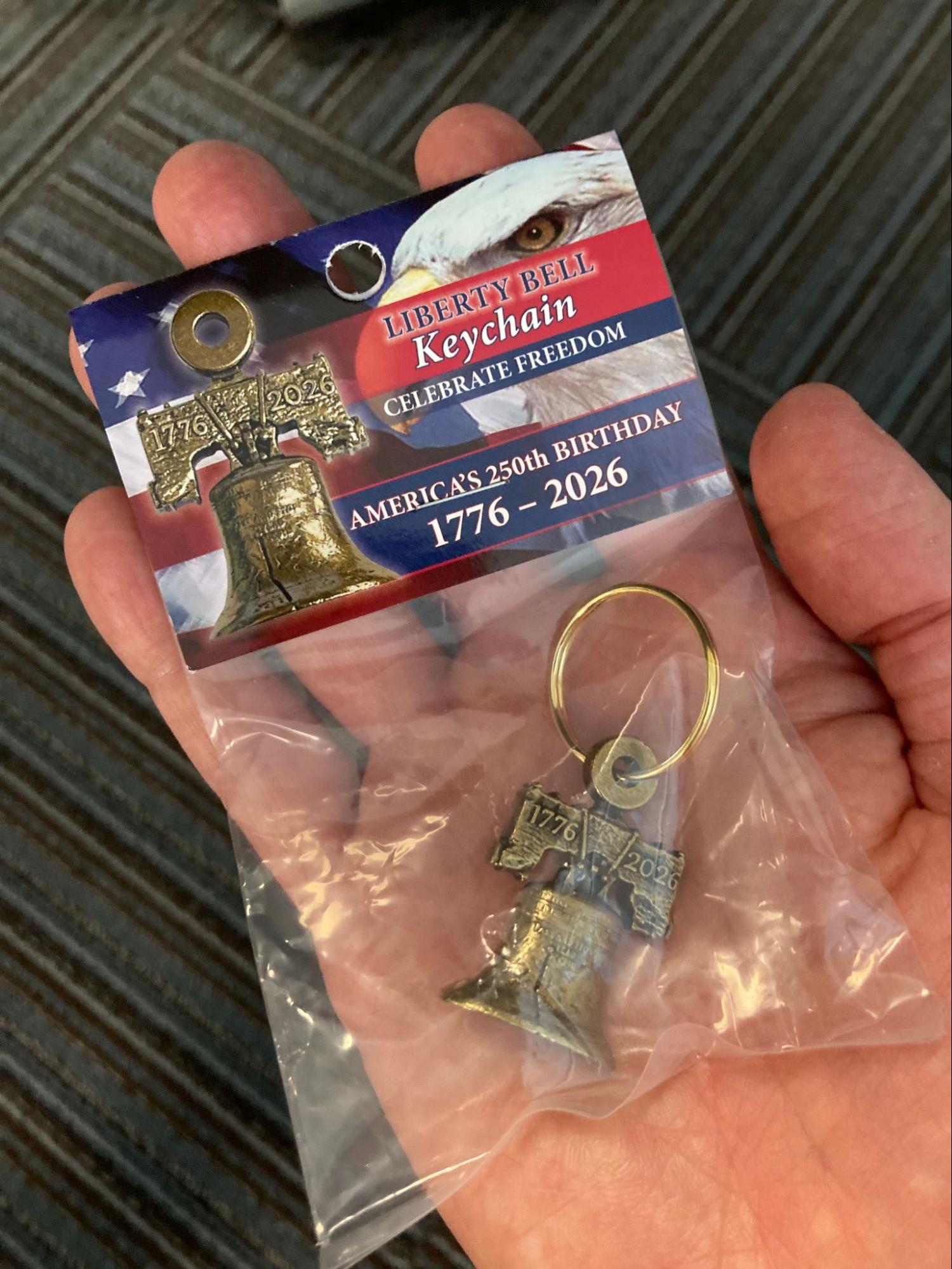
“Proudly Made in USA,” the packaging says on the back. No trivial trinket, this.
We thank him for his generosity.
“Appreciate all of your insights and ideas,” he added in a P.S.
And we thank him for a reminder of why we do what we do.


