
This Isn’t the Endgame
 This Isn’t the Endgame
 Perspective: A week ago yesterday, U.S. oil futures traded for under $69. For a while this morning, they were over $81.
That’s what the resumption of the Iran war has done.
As you might recall, Donald Trump projected at the start of the war in early March that it would last four–five weeks, although he allowed that the U.S. military has the “capability to go far longer than that.”
Asked yesterday about the resumption of U.S. bombing, he said, “We were in Vietnam for 19 years. We’re here for four months.”
Moving the goalposts much?
Jim Rickards’ subscribers aren’t surprised. In early June, he told Insider Intel readers that Trump’s only options were surrender, stalemate and escalation.
“Surrender won’t happen because the political damage to Trump and the loss of face are too much for Trump to bear,” he said. “The Iranians won’t agree to anything that makes Trump look good. Why should they? They’re winning the war.
“Stalemate, in the form of a ceasefire, may continue, but that won’t reopen the Strait of Hormuz.”
Which left only one remaining option — escalation.
“Now that Trump has made that choice, investors need to understand that escalation is not an endgame,” Jim says.
“The U.S. can destroy more targets and inflict enormous damage on Iran, but turning that destruction into victory is another matter entirely.
“The administration’s apparent strategy is to use overwhelming American military power to raise the cost of the war until Iran accepts U.S. terms.
“The problem is that destroying targets and winning wars are two different things.
“History offers little evidence that strategic bombing by itself can force a large and determined country to surrender. Germany failed to bomb Britain into submission during the Battle of Britain. Allied bombing destroyed much of Germany, but victory required Allied armies advancing from the west and the Red Army from the east. The United States spent years bombing North Vietnam without achieving its political objectives.
“Airpower can destroy military assets, degrade infrastructure and impose enormous costs. But bombing is not the same as victory.
“The economic consequences are cumulative,” Jim goes on.
“Every damaged facility takes time to rebuild. Every barrel released from reserves eventually has to be replaced. Every additional disruption to shipping adds cost and uncertainty to the global supply chain.
“The danger is a chain reaction that moves from an energy shock to higher inflation, from higher inflation to tighter monetary policy and from tighter monetary policy to a sharp stock market decline and recession.”
In his original write-up, Jim said escalation would produce the worst economic consequences of Trump’s three options.
“Trump has now chosen that path,” says Jim.
As the day wears on, U.S. crude futures are pulling back toward $79 as the president has walked back his notion of imposing a toll on Strait of Hormuz shipping.
When we left you yesterday, he’d said Washington would charge a toll for vessels wishing to transit the strait — a sum equaling 20% of the value of the vessel’s cargo.
The amount was far greater than anything the Iranian government tried to impose. Nor was there any announcement about how Trump would enforce his wishes.
Perhaps sometime in the last 24 hours, someone sat him down and told him U.S. warships would have to transit the strait and be sitting ducks for Iranian drones and artillery.
And so today brought an Emily Litella “Never mind” moment.
As Trump posted on his Truth Social site: “Based on highly productive conversations with Middle East leadership, I have decided to replace the 20% United States Reimbursement Fee with Trade and Investment Deals that the various Gulf States will be making into the United States.”
No, he didn’t specify which states or any amounts.
In case you’re keeping score: The war cost Uncle Sam $103 billion through the end of June.
That’s according to Stephen Semler of the Center for International Policy, who’s examined everything from government data to open-source intelligence to media reports. The figure, he says, is “larger than all but three countries’ military budgets.”
By his reckoning, nearly half the total — $46.7 billion — has gone for weapons. Another $28.5 billion has gone for operations and another $20.3 billion for losses of damaged or destroyed bases and other assets.
And those are only the direct costs. Semler did not account for veterans’ care or the interest on the national debt that the war will accrue…
 Bank Earnings! IBM! Inflation!
Aside from the war and oil prices, it’s one of those days when there’s an enormous amount of market-moving news — and noise.
For starters, earnings season is underway. In recent years, the release of JPMorgan Chase’s quarterly numbers has marked the “traditional” start of earnings season.
But this morning, not only did JPM release its numbers. So did all of the biggest commercial banks — Bank of America, Citi, Wells Fargo. Oh, plus Goldman Sachs on the investment banking side.
We won’t belabor the numbers since you can see them anywhere. Suffice to say Wells Fargo is the only one of the bunch whose shares are in the red. Goldman is up over 7.5% at last check.
But then there’s IBM — whose shares are down 23% on the day after numbers that fell short of expectations.
CEO Arvind Krishna says last month, clients swore off IBM’s software and infrastructure offerings — plowing money instead into hardware like memory chips. “While we anticipated some supply chain related impact in our expectations, we did not anticipate the magnitude of the capex reprioritization.”
This morning in The Map, Mason Sexton told his readers the price movement is a “severe market overreaction… These software deals were not lost to competitors; they were merely delayed.” From where he sits Big Blue is “a generational buying opportunity.”
[Note well: Do not freelance this if you’re not one of his subscribers. Mr. Sexton’s strategy relies on precise entry and exit points as well as moving stops. We’re just passing along his insight.]
And then there are the June inflation numbers — which at this point look hopelessly out of date.
If the Labor Department is to be believed, consumer prices fell 0.4% from May to June — helped by a 9.7% drop in gasoline prices.
Thus, the official year-over-year inflation rate climbed down from 4.2% in May to 3.5% in June.
As always, any resemblance between these figures and your own cost of living is purely coincidental. And from the vantage point of this week, the drop in energy prices looks like ancient history.
For whatever it’s worth, Kevin Warsh is delivering his first testimony to Congress this morning as Federal Reserve chair — promising that “if we get policy right — and we will — the inflation surge of the last five years will be a thing of the past.”
His heart is presumably in the right place — but history is not on his side.
Put it all in a blender and you have a decidedly mixed picture for the major U.S. stock indexes.
The Dow is modestly in the red — mostly because IBM is one of its 30 component stocks. The S&P 500 is up about a quarter percent while the Nasdaq is up three-quarters of a percent and back over 26,000.
Bonds and precious metals are staging a stronger rally. The yield on a 10-year Treasury note sits at 4.58%. Gold has bounced off the $4,000, sitting at $4,062. Silver’s up over a buck to $58.64.
Crypto is trying (again) to break out — Bitcoin approaching $65,000 and Ethereum within sight of $1,900.
 Data Center Vibe Check
New York is the first state to enact a statewide moratorium on AI data centers.
Gov. Kathy Hochul will sign an executive order today — a one-year pause “giving us the time to establish the nation's strongest protections for ratepayers, our communities and our energy grid,” she promises.
The order is less sweeping than a bill that passed the legislature last month; Hochul has not yet decided whether to sign it.
“The order will take effect immediately,” says The New York Times. “It is not expected to affect the data demands of back-office financial services, hospitals or universities.”
Lest you think the political backlash is only a blue-state thing… last month Texas Gov. Greg Abbott “released sweeping regulatory recommendations on data centers,” reports the Texas Tribune.
Abbott has a laundry list of AI priorities when the legislature returns to Austin next year — including a requirement that new data centers add power generation to the state’s grid and that they cover their own grid interconnection and infrastructure costs.
In addition, Abbott wants to nix the sales tax exemption for data centers — an incentive he labels “outdated” and “unnecessary.”
By one estimate, the Texas state government would collect another $3.2 billion in sales tax revenue over the next two years if the exemption goes away.
Meanwhile, a Bloomberg analysis finds a decidedly bipartisan bent this year in the campaign ads criticizing data centers.
“Since December, 25 federal and gubernatorial candidates have run ads either promoting their own opposition to data centers or slamming their opponent for supporting these complexes,” says Bloomberg’s summary of the analysis.
“Twelve — nearly half — are Republicans.” That’s even though the Trump administration is promoting data center expansion.
“We’re seeing this play out on both sides,” says Clifford Young of the Ipsos consulting firm. “Americans believe the system is broken. Republicans tend to be more anti-establishment today than Democrats, so this is an easy softball in this electoral cycle.”
 Money Miscellany
The mood on Main Street is improving measurably.
The National Federation of Independent Business is out with its monthly Small Business Optimism Index. At 97.4, the headline number is the highest in four months — and close to the survey’s long-term average going back to the mid-1970s.
“Lower fuel costs provide welcome relief for businesses as well as consumers, with firms anticipating improved operating conditions over the next six months,” says NFIB chief economist Bill Dunkelberg.
(Well, the survey was conducted last month.)
“While there have been improvements in the overall environment,” he adds, “high interest rates and modest economic growth are causing owners to approach hiring and capital spending with caution.”
On the often-revealing portion of the survey where respondents are asked to identify their single most important problem, 21% said inflation. “[We] will not attempt any growth or expansion of services until inflation and price increases are reduced,” says the owner of a construction firm in Indiana.
Tied for second place at 19% were taxes and “quality/availability of labor” — which means good help is still hard to find.
Everything else was in single digits, including “poor sales” which had been a growing problem earlier this year.
For the record: Yesterday Donald Trump signed an executive order shrinking the size of two national monuments in Utah.
Presumably the move will open up the lands to mineral development as part of the “American Birthright” agenda that Jim Rickards has been telling his readers about for the last year and a half.
We’ve been anticipating this specific move since the spring of 2025: There’s a fascinating backstory harking back to the Clinton years.
 Thought for the Day?
Y’know, you could interpret this social media post at least a couple of different ways…
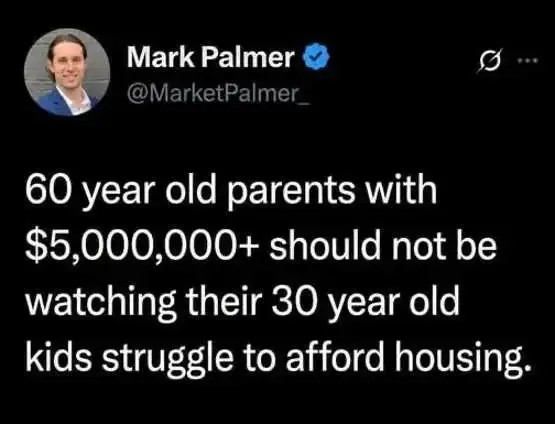
But rather than incite any generational warfare in the mailbag, we'll leave the interpretation to you.


