
One Chart to Live By
 One Chart to Live By
 There’s a chart I’ve been obsessing over for a few days. It’s time that you take a good look at it.
Here’s how it appeared on X, courtesy of a Swiss money manager named Thierry Borgeat. Study it closely…
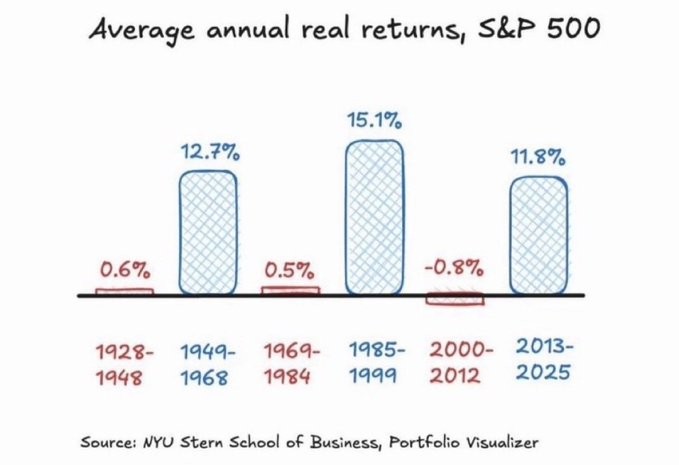
Borgeat’s point is that the conventional wisdom about how you need to stay in the market for the long haul — because the market goes up an average 7% a year after inflation — rarely works out in real-world experience.
“Notice the rhythm. A golden era, then a dead one,” he says. “Feast, famine, feast, famine.”
“Everyone who started investing after 2009 has only known the feast,” Borgeat goes on.
“Buy the dip worked every single time. Not because it's a law. Because you happened to live inside the blue bar.”
On one level, I’ve known this overview of market history for years…
- If you bought at the top just before the 1929 crash, you didn’t get back to breakeven until 1954
- The Dow industrials peaked at 1,000 in 1966 — and couldn’t surpass that level for good until 1982
- The dot-com bubble burst in early 2000, at which time the S&P 500 was around 1,500. The index returned to that level in 2007 and then came the financial crisis. The 1,500 level wasn’t surpassed for good until April 2013. Brutal.
But seeing the visuals really brings it home — especially when you realize we’re now 13 years into the current blue bar. We’re closer to the end of this bull run than the beginning.
Note well: That chart shows the returns after inflation.
Recall the research we’ve been citing regularly for a few years now: Once inflation sails past the 5% mark — as it did in 2022 — it typically takes a decade to get back to “normal” 2% inflation of the sort we experienced during the 2010s.
So we’re looking at elevated inflation levels for the rest of this decade and into the 2030s. That means the stock market has to rally that much more to overcome the inflation rate — and for your portfolio to stay ahead of the cost of living.
Very few portfolio managers are preparing their clients for this outcome. They’re operating under recency bias — assuming the 2% inflation of the 2010s will return any day now.
Bottom line: You can’t invest in an index fund and hope your portfolio will stay ahead of a rising cost of living. Not now.
 Trump Wants a Toll
U.S. oil futures are starting the week over $3 higher — $74.72 — now that it’s becoming obvious to everyone that peace in the Persian Gulf is no longer “at hand.”
U.S. airstrikes hit Iranian oil infrastructure over the weekend. Iranian airstrikes hit U.S. bases in Bahrain, Qatar and Kuwait (as they did in March).
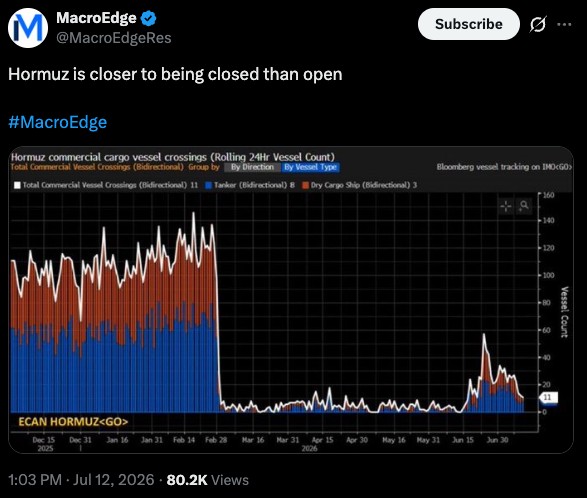
Then Tehran announced it was shutting down the Strait of Hormuz. This morning Donald Trump tried to one-up Tehran by resuming the U.S. blockade of Iranian ports — and by insisting that Washington will charge a toll for vessels wishing to transit the Strait of Hormuz.
Per Trump’s declaration on social media, the toll will equal 20% of the value of every vessel’s cargo — far more than the toll Tehran seeks to impose.
How he intends to enforce the toll, he did not say.
By the most authoritative count we can locate, only three vessels transited the Strait of Hormuz in the last 24 hours, and only one of those was an oil tanker. Here it is on a chart going back to last December…
“Think about what actually happened to the world's energy infrastructure these past four months,” says Paradigm’s Zach Scheidt, writing late last week for Rickards’ Insider Intel.
“Iran's strike on Qatar's Ras Laffan complex knocked out a sizable portion of the country's LNG capacity, and that damage will take several years to repair. Refineries, terminals and loading facilities across the Gulf took similar hits.”
At the same time, “there’s a secondary issue that will need to be addressed with stockpiles.
Governments and companies hold reserves of crude and refined products. Gasoline, diesel, jet fuel. Those reserves got drained hard in the first months of this war. The IEA directed the release of 400 million barrels. Governments around the world tapped strategic reserves to keep the lights on and the trucks moving.
“Every one of those barrels has to be replaced.
“So you have normal economic demand, and stacked on top of it, a second wave of demand from everyone who needs to refill what they burned through. Meanwhile, supply is constrained by infrastructure that takes years to rebuild.
“The setup we’re looking at here is rare. You have structural supply damage that takes years to repair, a second wave of demand coming from every reserve that needs refilling, all while the market keeps pricing in a peace that hasn't actually arrived.”

Don’t count out the highflying semiconductor stocks yet.
The benchmark Philadelphia Semiconductor Index (SOX) is down 15% from its nosebleed peak on June 22 — but Zach Scheidt, this time in a briefing for Altucher’s True Alpha, says Micron Technology (MU) is changing the game.
Last week, “Micron poured the first concrete at its new fab in Clay, New York, and announced a fresh round of investment aimed at strengthening the U.S. semiconductor supply chain.
“The commitment runs up to $3 billion and lifts the company's total domestic investment target through 2035 from $200 billion to more than $250 billion. Roughly $500 million of it goes to GlobalWafers to expand wafer development and manufacturing in Texas, paired with a 10-year supply agreement for raw silicon wafer capacity.
“Micron's New York facility will be the largest semiconductor manufacturing site in U.S. history.
“The market noticed. Shares surged as much as 9% intraday, and the buying spread to semiconductor equipment makers and related stocks. By Thursday's close the Nasdaq had climbed 1.3% as the AI trade was able to plant its foot firmly on the ground, preparing to regain momentum.”
Yes, semiconductors are notoriously a cyclical business — like the oil business, subject to both spectacular booms and epic busts. But “nobody breaks ground on the largest chip plant in American history if they think the demand is a mirage,” says Zach.
“Concrete is a confession that management firmly believes in the next decade of development, and it says it just as loud as any earnings call could.”
No, it’s not an all-clear to pile back into chip stocks. “We have to see how this rebound materializes,” says Zach. “The fact still remains that plenty of money walked out of the AI trade for the time being.”
And still more is walking out today, with the SOX down over 4.5% as we check our screens.
Those losses in the chip stocks are dragging down the Nasdaq — over more than 1.25% as we write and back below 26,000.
The S&P 500 is holding up better, down two-thirds of a percent at 7,527. The Dow is off a third of a percent, back under 52,500.
Bonds are reacting badly to the trouble in the Persian Gulf: Rising oil prices translate to rising inflation expectations which translate to rising interest rates. The yield on a 10-year Treasury note is up to 4.61% — not far from the 4.66% of last May, which was a 16-month high.
Precious metals are getting clobbered, too: Gold is off nearly 3% and back under $4,000 while silver is down 3.8% to $57.49.
Crypto is holding its own, Bitcoin over $62,000 and Ethereum a little under $1,800.
There’s Still Life in the Semis
Don’t count out the highflying semiconductor stocks yet.
The benchmark Philadelphia Semiconductor Index (SOX) is down 15% from its nosebleed peak on June 22 — but Zach Scheidt, this time in a briefing for Altucher’s True Alpha, says Micron Technology (MU) is changing the game.
Last week, “Micron poured the first concrete at its new fab in Clay, New York, and announced a fresh round of investment aimed at strengthening the U.S. semiconductor supply chain.
“The commitment runs up to $3 billion and lifts the company's total domestic investment target through 2035 from $200 billion to more than $250 billion. Roughly $500 million of it goes to GlobalWafers to expand wafer development and manufacturing in Texas, paired with a 10-year supply agreement for raw silicon wafer capacity.
“Micron's New York facility will be the largest semiconductor manufacturing site in U.S. history.
“The market noticed. Shares surged as much as 9% intraday, and the buying spread to semiconductor equipment makers and related stocks. By Thursday's close the Nasdaq had climbed 1.3% as the AI trade was able to plant its foot firmly on the ground, preparing to regain momentum.”
Yes, semiconductors are notoriously a cyclical business — like the oil business, subject to both spectacular booms and epic busts. But “nobody breaks ground on the largest chip plant in American history if they think the demand is a mirage,” says Zach.
“Concrete is a confession that management firmly believes in the next decade of development, and it says it just as loud as any earnings call could.”
No, it’s not an all-clear to pile back into chip stocks. “We have to see how this rebound materializes,” says Zach. “The fact still remains that plenty of money walked out of the AI trade for the time being.”
And still more is walking out today, with the SOX down over 4.5% as we check our screens.
Those losses in the chip stocks are dragging down the Nasdaq — over more than 1.25% as we write and back below 26,000.
The S&P 500 is holding up better, down two-thirds of a percent at 7,527. The Dow is off a third of a percent, back under 52,500.
Bonds are reacting badly to the trouble in the Persian Gulf: Rising oil prices translate to rising inflation expectations which translate to rising interest rates. The yield on a 10-year Treasury note is up to 4.61% — not far from the 4.66% of last May, which was a 16-month high.
Precious metals are getting clobbered, too: Gold is off nearly 3% and back under $4,000 while silver is down 3.8% to $57.49.
Crypto is holding its own, Bitcoin over $62,000 and Ethereum a little under $1,800.
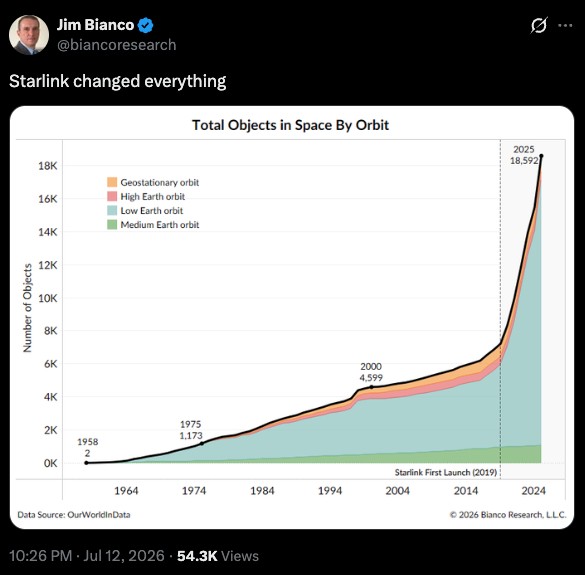
 Startling Stat
The sky started changing dramatically when Starlink began launching its satellites in 2019…
 Mailbag: Data Centers
We got an appreciative note after Friday’s edition deconstructing a New York Times article strongly implying that people who oppose the construction of data centers are dupes of the Chinese and Russians.
“Dave, thanks for rooting out Nina Jankowicz. That pretty much says it all for the validity of the source.
“And NYT, enough said there too - a bunch of mainstream nonsense to create for fear and division.”
Dave responds: I can’t help wondering if we’re at “peak data centers” here in the summer of 2026…
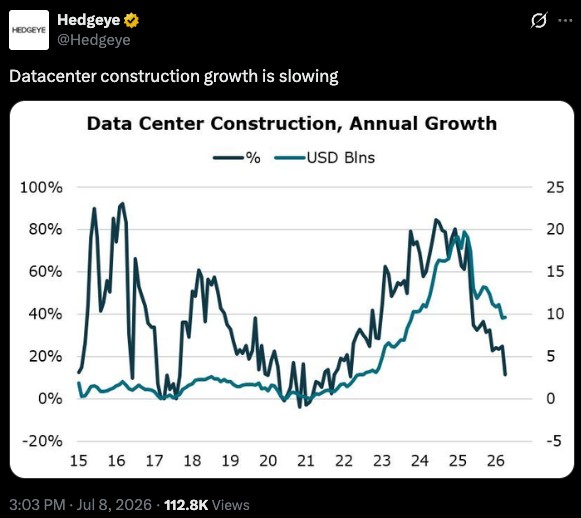
As I said 18 months ago (and again last week), AI faces two huge constraints that digital technology has never grappled with until recently — limited capacity in the U.S. electric grid and the rising cost of borrowed money.
By now, everyone knows about the electricity part. And today’s Wall Street Journal acknowledges the cost of financing: “Over the past several weeks, the investment-grade corporate bond market has struggled to absorb a combined $75 billion of bond issuance from Nvidia, SpaceX and Amazon.com.”
The so-called hyperscalers like Amazon, Google and Meta can no longer tap their free cash flow for the data-center buildout. So they need to take on debt.
And it sounds as if Wall Street is approaching a threshold where it says no more.
To be continued…


