
AI Data Centers and Chinese Stooges
 AI Data Centers and Chinese Stooges
 If you oppose the construction of an AI data center in your neck of the woods, then you must be a dupe of the ChiComs and the Russkies and the Iranians.
Seriously, that’s the gist of a front-page New York Times article today.
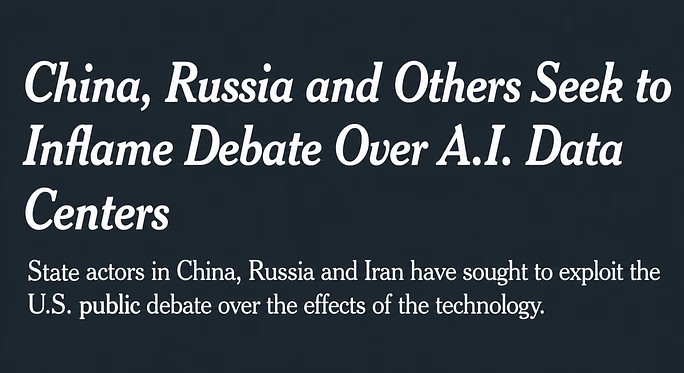
The key paragraph: “China, Russia and, to a lesser extent, Iran have sought to use state media outlets to turn the controversy over data centers in the United States into ‘a domestic fracture point,’ according to a new analysis by Alethea, a threat intelligence company, which identified scores of articles and posts on social media this year.”
Here’s one meme by way of example…
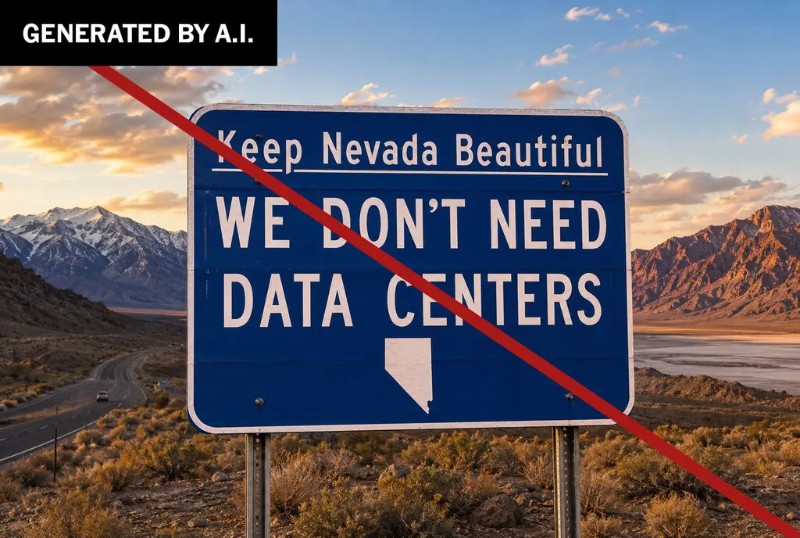
So… what’s this Alethea outfit all about? The article doesn’t really say. It just assumes we should accept the company’s claims as credible.
Based in Washington, D.C., Altethea Group “is a technology company helping the Fortune 500, private companies, democracies and nonprofits protect themselves from harms stemming from disinformation, misinformation and social media manipulation,” the company states on its LinkedIn page.
Hmmm…
Perhaps for understandable reasons, Alethea does not identify its major clients. So it’s hard to evaluate whether the company is a neutral observer here or if it’s got a significant conflict of interest.
But Alethea does have a somewhat well-known former employee — Nina Jankowicz, named by the Biden administration in April 2022 to head up a “Disinformation Governance Board.” Its purpose — strong-arming social media platforms to censor posts that met with White House disapproval.
The backlash against this budding Ministry of Truth was so severe that Jankowicz resigned after just three weeks and the board was disbanded.
As it turns out, Jankowicz was on Alethea’s payroll as “director of external engagement” for a few months before her appointment. And it seems Alethea founder Lisa Kaplan is all on board with U.S. government efforts to combat “disinformation.”
“Disinformation will become the next iteration of warfare,” Kaplan said during a 2020 podcast interview. “The government should identify vulnerable populations and develop support plans.”
Yeah, The New York Times said nothing about any of this by way of background.
We’ll deconstruct what the paper did instead in Bullet No. 2…
 Anatomy of a Narrative
What the Times did instead was take Alethea’s research at face value to slyly impugn the motives of people who oppose data center construction.
Behold this remarkable passage early in the piece…
These campaigns, whose impact on public opinion remains to be seen, have raised alarms in Washington, where AI is seen as a top issue heading into this year’s midterm elections.
The foreign efforts appear intended to stoke the debate over data centers that has united political figures across the political spectrum — from Sen. Bernie Sanders of Vermont, a progressive, to Stephen K. Bannon, the erstwhile adviser to President Trump.
“Foreign actors aren’t manufacturing American debates over the future of AI, they are exploiting them,” said Jessica Brandt, a former official with the Office of the Director of National Intelligence who tracked foreign influence efforts during the Biden administration.
The goal, she added, is to “deepen our divisions in order to dent our appeal and weaken us from within.”
See what they did in these four paragraphs?
First, there’s a clause buried in the middle of a sentence where you’re liable to overlook it that says the “impact on public opinion remains to be seen.” Can’t play up a detail like that too much when you’re trying to foment a moral panic.
Then, they’re limiting the respectable boundaries of debate, within the 40-yard lines on a football field. You don’t want to be associated with looney-tunes like Bernie Sanders and Steve Bannon, do you? Especially BOTH of them, right?
And finally they bring on some chin-stroking “disinformation” expert (from the Biden admin, natch) to trot out the hoary old narrative about foreign governments “sowing discord.”
Remember that? It was all the rage a decade ago when Russia supposedly unleashed Facebook bots and Twitter trolls on the American populace to poison our civic dialogue.
To be sure, this narrative has been building for weeks. I just didn’t expect to see it front and center in the one corporate news outlet that sets the agenda for the rest.
For starters, none other than Kevin O’Leary of Shark Tank fame has invoked the Chinese-stooge argument.
As we mentioned in May, O’Leary is bankrolling a massive data center project in rural Utah that’s met with huge backlash. A couple of weeks ago, he accused two Utah organizations and their leaders of being linked to the Chinese government — an accusation for which he offered no supporting evidence and which he ultimately walked back.
Also last month, OpenAI generated publicity when it claimed Chinese operatives were using its ChatGPT platform to create anti-data center content for social media. But even the guy who led the investigation for OpenAI conceded that “neither campaign appears to have gained much authentic engagement.”
Then there was Sen. Tom Cotton (R-Arkansas), the 24/7 warmonger who sent a letter last month to acting Attorney General Todd Blanche: “Alarming reports indicate that a network of foreign actors, led by the Chinese Communist Party, is attempting to manipulate U.S. policy and public opinion on data centers.”
As the writer Leo Hohmann pointed out, Cotton “offered no proof, just innuendo.”
Which is more or less what The New York Times did as well. But now that the Times is running with it, you’re going to see it everywhere for a few days.
But the data center backlash isn’t going away. We’ll tackle some other angles — including the potential investment implications — next week.
Oh, I’m also going to dunk on The Wall Street Journal later in today’s edition, but first let’s turn our attention to the markets…
 Markets Today: Good Timing
The big market story today is the well-timed Wall Street debut of SK Hynix — the giant South Korean chipmaker.
SK Hynix is one of the “Big Three” manufacturers of memory, along with South Korea’s Samsung and America’s Micron. Formed in 1983, it will start trading on the Nasdaq today as SKHYV, which will be shortened to SKHY next Tuesday.
The company announced it would list on the Nasdaq back on June 24 — which happens to mark the recent peak in its Korean-traded shares. The share price has since cratered 25%. A new influx of cash from American investors would probably be pretty welcome about now.
For a few weeks, savvy market watchers have looked upon South Korea’s benchmark KOSPI as a potential harbinger for America’s red-hot semiconductor sector.
The American chip benchmark, the Philadelphia Semiconductor Index (SOX) peaked on June 22 at 14,634. It bottomed on Tuesday at 12,300 — a more modest 16% drop — and trades today a little over 12,900.
The broad U.S. indexes are little moved as the week winds down — the S&P 500 up barely 10 points at 7,554.
Monday will be potentially quiet too, but Tuesday is the start of earnings season and the Labor Department will issue the official inflation numbers.
The week has brought a staggering number of big wins in several Paradigm portfolios. This is in no particular order. With any luck I’m not leaving anyone out here…
- 102% on ConocoPhillips call options in Rickards’ Insider Intel
- 146% on International Seaways in Rickards’ Strategic Intelligence
- 77% in only four months with put options on FXE, the big euro currency ETF, for PRO-level readers of Rickards’ Strategic Intelligence
- A staggering 1,000% on Adobe call options in 10X Trader
- 50% on Magnite Inc. in Paradigm Mastermind Group
- 29% on Robinhood in The Income Alliance, our options-selling service
- And a clean 1,000% on the space name Rocket Lab in Ray Blanco’s Catalyst Trader.
That last one is a prime example of sound money management: After four years and three months, it’s no time to get greedy. Ray says the thesis behind RKLB is changing now that it’s acquiring the satellite communications firm Iridium. It introduces a level of risk that wasn’t there before. And so Ray advised his readers to sell half the position and let the rest ride.
Checking in on non-dollar assets, gold appears set to end the week just barely above $4,100 but silver will probably wind up below $60. Meanwhile, crypto appears to be hanging onto its most recent gains — Bitcoin approaching $64,000 and Ethereum a shade under $1,800.
 Oil and World War III
Oh, now the nation’s leading business newspaper tells us…
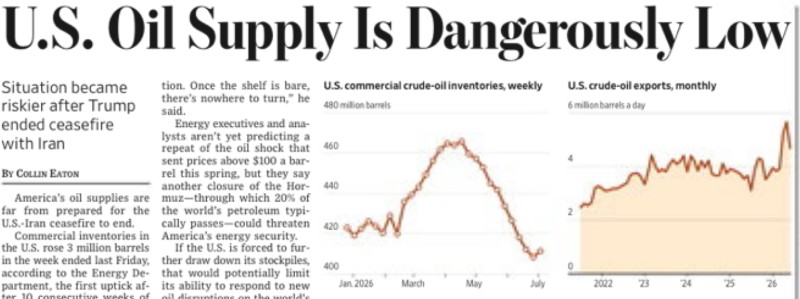
Memo to The Wall Street Journal: The situation was risky before Donald Trump ended the ceasefire with Iran.
For months, we’ve been spotlighting the ongoing drain from both private-sector inventories and the government’s Strategic Petroleum Reserve. (If you’re a newer reader, here’s a good place to get caught up quickly.) Why the mainstream decided to start worrying this week is anyone’s guess.
Meanwhile, the feds have nixed plans for oil futures that would trade on weekends.
As we mentioned at the time, CME Group — which oversees the most widely used U.S. commodities exchanges — announced last month it would launch an oil futures contract that trades round the clock.
That includes weekends. As we’ve spotlighted since at least 2024, major U.S. airstrikes in the Middle East tend to come over the weekend — when markets are closed and there’s no chance of a knee-jerk reaction.
The new contract was supposed to start trading as early as today. Yesterday, the Commodity Futures Trading Commission said Oh no you don’t.
Usually the CFTC allows CME Group to “self-certify” new futures contracts. And that’s what CME Group sought to do here — until CFTC chair Michael Selig slapped it down yesterday in blunt terms.
"CME's decision to disregard the commission's effort to undertake a reasoned analysis of the critical issues at stake is wholly inappropriate,” he said — “and necessitates commission action to stay the certification.”
Now the whole thing will be subjected to what the CFTC calls a “thorough review.”
Betcha it doesn’t survive that review. The White House needs a window every weekend to wage war without impact on the oil price. (And of course, a “peace is at hand” announcement for the resumption of trading on Sunday night…)
For the moment, traders are buying into Donald Trump’s declarations that Iran is once again “desperate” to make a deal. U.S. crude futures are down a little over 1% to $71.30.
We can’t let the week pass without acknowledging the possibility Washington will soon be waging a two-front war.
At a NATO summit in Turkey on Wednesday, Trump nodded in approval at Ukraine’s recent drone strikes on Russian oil refineries. In addition Trump authorized Ukraine to start building Patriot missiles.
“It’s an escalation,” he said, “but it’s also an escalation that could help lead to an end.”
Or it’s an escalation that could lead to further escalation — like Russian airstrikes on NATO’s Baltic states, whose airspace Ukraine is using to send those drones into Russia.
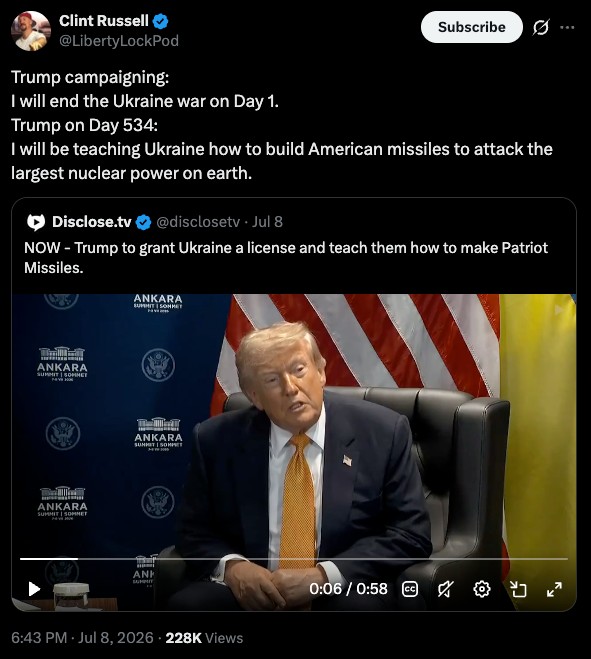
“Diplomacy is dead and this is now Trump’s war,” tweets the Norwegian political scientist Glenn Diesen, author of several books about Russian foreign policy.
“How to fight and defeat the world’s largest nuclear power in a fight for its survival? We will now see massive escalation as we move toward total war.”
Or at the very least, Moscow could step up its shipments of S-400 air defense missiles to Iran — along with targeting intelligence on U.S. forces in the Persian Gulf.
 Mailbag (Teaser)
“How do you measure demand for compute?” a reader writes after yesterday’s guest edition featuring Ray Blanco. “Who are the players that provide the current answers?”
Unfortunately Ray’s out of pocket today and I can’t get a ready answer. But those are great questions worthy of follow-up next week.


