
Gasoline, Stocks and the Elections
 Gasoline, Stocks and the Elections
 Ugh — it’s 106 days until the midterm elections.
Donald Trump is not on the ballot, but his administration’s policies are.
A few months ago, plans were to have Trump campaign as aggressively as if it were a presidential election year. “He’s going to campaign like it’s 2024 again,” said White House chief of staff Susie Wiles last December.
Then Trump launched a war against Iran. The national average gasoline price shot up from $3.07 at the end of February to $4.61 by Memorial Day.
“The single most important determinant of the outcome of the midterm elections may be the price of gasoline at the pump,” says Paradigm macroeconomics maven Jim Rickards.
“That’s easy for Americans to understand because they see it every day. The price of gas is a good proxy for inflation in general because everything you buy gets delivered to your store or your door by a vehicle that runs on gasoline or diesel.”
For a while, the good news for Trump was that gasoline prices were trending down amid a ceasefire and a tentative deal with Tehran — back to $3.91 by Independence Day.
From the standpoint of electoral politics, that’s good enough for an incumbent president. “Americans care more about the trend than the level,” Jim says.
But the war’s been back on for more than a week. Gas is back over $4. And while there’s still a long time between now and Election Day, there’s zero sign of de-escalation right now.
That said, Trump can — and does — still hang his hat on the stock market.
“Trump has increasingly cast Wall Street's gains as a measure of his presidency, treating record stock prices as proof that his policies are working,” says the Reuters newswire.
“Trump routinely cites a rising stock market as a signal of a thriving country, raising the theme during meetings with global leaders, at rallies, even at military ceremonies. In June, before awarding three servicemembers the Medal of Honor, the highest U.S. military recognition, Trump told his audience, ‘The stock market just hit a new all-time high, the 401(k)s are at a new all-time high and oil is dropping like a rock’.”
But this too is problematic, Jim tells us: “Lower-middle-income and poorer voters, in many cases, don’t even have 401(k)s. They’re not impressed by claims about the stock market.
“Markets are also extremely volatile. Stock indexes can go from all-time highs to declines of 30% or more in a matter of weeks. That happened in early 2020. We’re not saying that will happen now. We’re simply pointing out that it could, in which case Trump’s message could turn to mud in a heartbeat.”
Which brings us back to a fascinating chart we share here from time to time.
It comes from Bespoke Investment Group. It compares the performance of the Nasdaq Composite during the 1990s dot-com boom and the current AI boom.
It sets the starting point for the dot-com boom with the introduction of the Netscape web browser in December 1994… and the starting point for the AI boom with the rollout of ChatGPT 3.5 in November 2022.
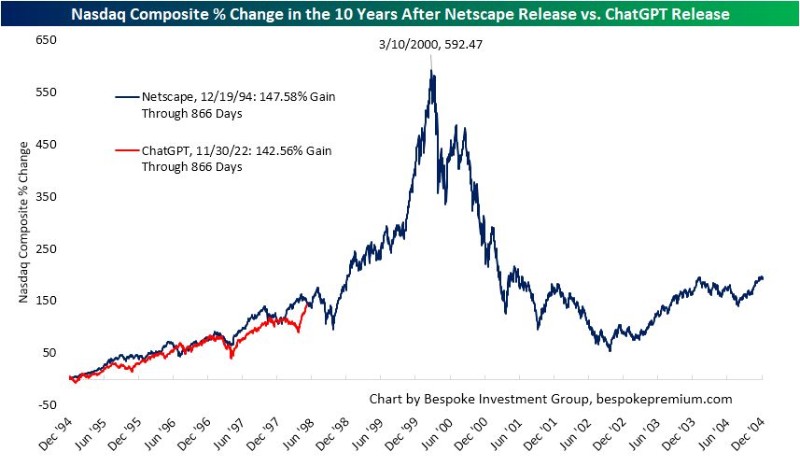
More than 3½ years after ChatGPT burst into public consciousness, the two lines on this chart have tracked — well, not perfectly but spooky-close. For instance, the “Liberation Day” tariff scare of 2025 tracks neatly with the “Asian contagion” of 1997 — when markets were jolted by currency crises and bank runs overseas.
Which brings us to the present moment — or should we say, roughly this time in 1998.
The Nasdaq closed over 2,000 for the first time on July 20 that year. From there, it took a steep tumble. Markets were freaked out by the Russian government defaulting on its debt — which set off a domino effect that ultimately took down the U.S. hedge fund Long Term Capital Management. The Nasdaq bottomed on Sept. 1 at 1,475.
The index took a 26.5% spill in six weeks. Ouch.
Of course, as you can see on the chart, the Nasdaq went on a tear after that — more than tripling over the next 18 months as the dot-com boom turned into a bubble.
But if the two lines on this chart continue to track as tightly as they have up till now… that won’t help Donald Trump at all in the second half of 2026.
The Nasdaq touched an all-time high of 27,093 on June 2 — and it’s been chopping sideways since. No guarantees of a 25% spill from here… but all the same it can’t be ruled out.
“Supporters wish Trump and Republican candidates well,” Jim Rickards concludes. “But placing your policy chips on the stock market casino can easily become a losing bet.”
[Editor’s note: If you’re reading this, then you still haven’t accessed the file drop that Jim Rickards recently authorized for you.
As a result, your access key is currently on hold and scheduled for deactivation.
Click here to learn how to activate now.]
 Rising Oil, Rising Rates
U.S. oil futures have sailed past $85 for the first time since mid-June as global oil flows become more and more constrained.
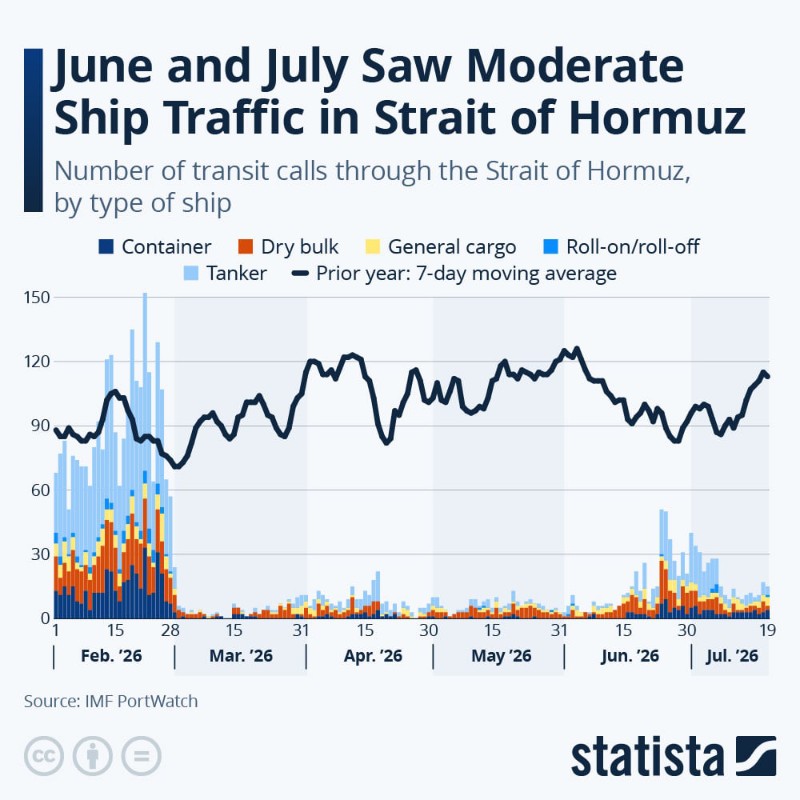
U.S. airstrikes continue to target the Iranian coastline. Iranian airstrikes continue to target U.S. bases in Bahrain, Qatar and Kuwait. Iranian forces are also taking aim at oil tankers that attempt to transit the Strait of Hormuz without their permission.
At the risk of beating a dead horse, here’s another chart of the traffic — or lack thereof — transiting Hormuz.
Also, for the first time since the war’s earliest days in March, Tehran claims to have struck an Amazon data center in Bahrain — a claim that no one is denying.
And all of this is happening at a time when Ukraine’s drone attacks are starting to pinch Russia’s oil production and exports.
“Ukraine has developed a new capability. Its drones can now hit targets 1,500 miles into Russia. And their targets are refining and storage,” says Paradigm natural resources pro Matt Badiali.
“Ukraine’s drones have hit so many refineries that Russia — the world’s third-largest oil producer — now has to ration fuel. It suspended diesel exports for the rest of July and began importing gasoline from India.
“The U.S. and Ukraine are following the Allied war plan from World War II in their respective conflicts. The Allies crippled Germany’s war machine by bombing its fuel lines. You can’t move a tank without diesel, and you can’t fly planes without jet fuel.
“Modern economies are exactly the same. You can cripple an economy by simply making fuel prohibitively expensive.”
Once more, rising oil prices are translating to rising inflation expectations — and rising interest rates.
The yield on a 10-year Treasury note is up to 4.62% today. Aside from a day or two in mid-May, the 10-year yield hasn’t been this high in 18 months.
In other words, the bond market is getting nervous. Previous episodes like this during 2026 have prompted some sort of conciliatory gesture from the Trump administration toward Tehran — the better to bring down oil prices, bring down inflation expectations and ultimately bring down interest rates and the cost of financing Uncle Sam’s gargantuan debt.
Right now, that prospect is not in view. Trump says Tehran is desperate for a deal… but he has no interest in one.
 ASTS: Antacid, Anyone?
Volatility, thy name is AST SpaceMobile.
As you likely know, ASTS is a favorite of several Paradigm editors. If you’re an ASTS shareholder, you also know it’s induced many Maalox moments over the last two months — starting at $90, sailing past $130, sinking to nearly $65, rising again to nearly $90, sinking to $55.
Oh, and it’s up nearly 11% today at $63.60.
We got a concerned note from a reader last week: “Please tell me I’m sane and someone else is at least doing and feeling the same way because I’m sick to my stomach right now literally.”
In the first place, we’ll tell you to follow the guidance of whatever paid publication you subscribe to. But we can also pass along the following analysis from colleague Davis Wilson of our sister e-letter The Million Mission.
The most recent sell-off came with an out-of-nowhere announcement that current shareholders were being diluted big-time.
“Very few investors expected AST SpaceMobile to announce a $1 billion convertible note offering, which is why the stock sold off so sharply,” Davis says.
“That said, I think it's important to separate the financing from the business. AST isn't raising money because demand disappeared. It's raising money because building a global satellite network requires enormous amounts of capital.
“Do I like the dilution? No. Has it changed my long-term thesis? No.
“Short term, this is a painful reminder that speculative, pre-cash-flow companies can be extremely volatile.”
As for today’s market action, the chip stocks are leading a revival of the major indexes.
The Nasdaq composite is up 1.3% — but that’s still not enough to get back over the 26,000 level. (Again, that sideways chop mentioned in Bullet No. 1). The S&P 500 is up 0.9% and back over 7,500. And the Dow is up nearly 1% and comfortably back over 52,000.
Precious metals are likewise rallying — gold up 1.6% to $4,072 and silver up nearly 4.5% to $58.61.
Bitcoin sits over $66,500, the highest since early June. The story with Ethereum is similar at $1,925.
 Comic Relief
This might be old-fashioned Photoshop as opposed to AI — but regardless, it’s making the rounds…
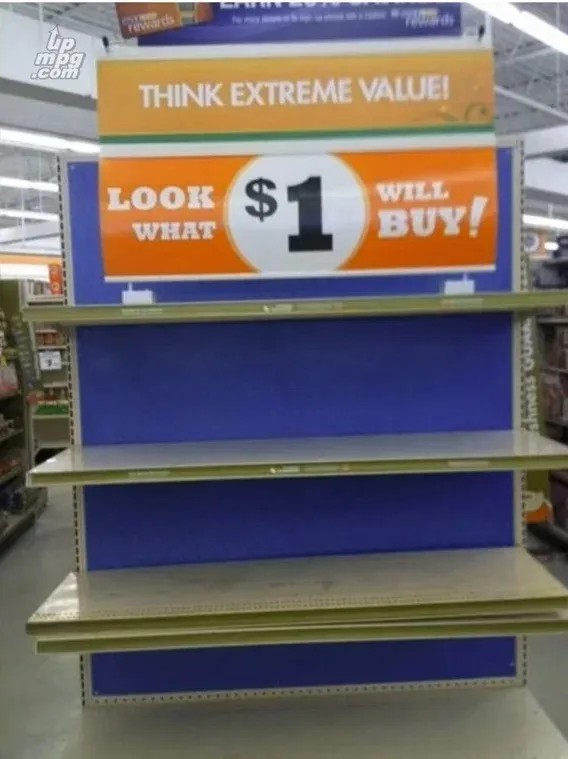 That said… it’s been nearly five years since Dollar Tree gave up on its “everything’s $1” pledge that was good for 35 years — moving its baseline price point to $1.25.
 Mailbag: Conflicts of Interest, China Gold
After yesterday’s edition tackling both Donald Trump’s well-timed trades and the early access to his social media posts now up for sale to banks and hedge funds, a reader writes…
“It depends on how you define ‘conflict of interest.’ In Trump's mind, nothing he or his family does can be a conflict of interest, so nothing to see here — LOL.”
Dave responds: Well, yes.
I hesitated to even take on the topic yesterday — a reticence that probably came through in the restrained tone of my prose. In the current fraught political environment, there’s a razor-thin line between being provocative and being pointlessly polarizing.
But really… what Trump and family are doing is the stuff of late-stage degenerate empires. And I’d say that if it were a Democrat doing it, too. (Which reminds me — I’m still incensed at how the social media giants suppressed the Hunter Biden laptop story.)
“Dave, why isn't the Western financial press talking about the Hong Kong clearing system for gold (Bloomberg: HAU) that goes live in four days?” a reader inquires.
“This is big, BIG news. The Shanghai Gold Exchange, using Hong Kong as its storefront, is challenging LBMA and COMEX as the global price maker for gold, with no paper market and contracts fulfilled in physical metal. (China is halting ‘paper gold’ trading, while expanding Hong Kong vault capacity to 2,000 metric tons).
“Additionally, with settlement in offshore yuan (CNH), China's currency is about to get overnight street cred with implicit gold backing, similar to the privilege the USD enjoys from its ‘petrodollar’ status.
“Anyone remember Xu Luode, chairman of the Shanghai Gold Exchange, remarking in 2014, ‘When China has the right to speak in the international gold market, the true price of gold will be revealed.’ Well, China is finally de-rigging the paper casino and kicking out the three-card monte dealers. Zero Hour is upon us.”
Dave responds: Clearly you’re a long-term reader. “Zero Hour” was a term we coined way back in 2013 to describe a future point in time when the price of physical gold you hold in your hand would break dramatically higher from the heavily manipulated “paper price” commonly quoted in the media (and here, for that matter).
No one will be more delighted than I to be proven wrong here… but I’m skeptical that we’re looking at some sort of imminent game-changer.
It is certainly true that China is more or less reinventing the process of clearing and settling gold trades — bypassing the rigged systems of London and New York. But to what end?
In a recent commentary, Chris Powell of the Gold Anti-Trust Action Committee raised an uncomfortable question, invoking a long-ago comment of our own Jim Rickards along the way…
… even fans of the monetary metals who will welcome a challenge to the London and New York gold rackets may do well to wonder: Why wouldn't China itself have reasons to manipulate the gold market it has created, to use it to attack the currencies of its adversaries or to help place the yuan at more convenient levels of valuation? After all, China already openly rigs the yuan market every day.
In 2009 financial and geopolitical analyst Jim Rickards was allowed to remark on CNBC, "When you own gold you're fighting every central bank in the world":
The enemy of your enemy is indeed your friend — sometimes, and maybe for a while. But why should any gold advocate think that the totalitarian regime in Beijing is any more trustworthy than the corrupt regimes in London and Washington?
It all comes back to a wonderful line from James Norman’s book The Oil Card: “Nation-states behave with logics, moralities and imperatives all their own. Who can know them? When these elephants rage, we pygmies are trampled. It pays to know when to get out of the way.”
Whatever and whenever the outcome, it won’t hurt and will probably help to have physical precious metals in your personal possession.
No, not in a safe-deposit box at a bank. As Jim Rickards has said for years, the moment you want that metal the most will be the moment the government calls a bank holiday…


