
Look Who Stole Elon’s Playbook
 Look Who Stole Elon’s Playbook
 After Elon Musk’s SpaceX went public last month, the most-hyped IPO in the hopper has to be OpenAI.
And why not? OpenAI is the company behind ChatGPT — the company that put AI on the map.
Exactly when the company goes public is a bit of a black box. The latest buzz is early 2027.
Why not now, ASAP?
After all, as Paradigm’s macroeconomics authority Jim Rickards points out, OpenAI is “reportedly aiming for a valuation approaching $1 trillion. That’s not quite as high as SpaceX, but it would make OpenAI one of the three or four most valuable companies in the world based on market capitalization.”
But… at the same time, OpenAI “seems to be losing the AI race to more nimble competitors such as Anthropic, Google and Amazon. Those companies have their own problems, but their AI appears more robust than what we’ve seen from OpenAI.”
Maybe those pros and cons balance out and maybe not. But “OpenAI CEO Sam Altman has a trick up his sleeve,” Jim wrote his Insider Intel readers yesterday.
“It’s not better technology or faster processing. Altman has never struck me as much of a technologist, or even a particularly good business manager. He’s more of a promoter.
“His latest trick to advance OpenAI’s IPO prospects is to rely on government support.
“According to reports and my own sources, Altman is seeking an arrangement that would give OpenAI a stronger foundation and potentially boost the stock price when the IPO arrives.”
There’s the answer to your “Why not now?” question.
“The backstory comes from none other than Elon Musk,” Jim continues.
As well it should. As you might recall, Altman was only one of several people who launched OpenAI in 2015. Among the others was… Elon Musk.
The two had a falling-out no later than 2020, when Musk hit out at what he thought was OpenAI’s lack of transparency. By 2024 Musk sued OpenAI — accusing it of abandoning its nonprofit mission to develop AI for the betterment of humanity. (Musk lost the case in a jury trial two months ago.)
Musk’s immense success “is too complicated to reduce to a simple formula,” Jim says. “But there’s no doubt that part of his wealth came from realizing that some of the most successful business plans are those that can somehow attract government subsidies.
“Tesla is a good example. Electric vehicles have existed for well over a century. Internal-combustion engines overtook them in the early 1900s.
“So why do we see so many Teslas on the road? One important reason is that buyers benefited from generous federal tax credits. A tax credit is not a deduction. It’s a dollar-for-dollar reduction in your tax liability.
“Those incentives substantially lowered the cost of buying a Tesla and helped drive demand.”
In addition, don’t forget SpaceX is — among other things — a major federal contractor. Uncle Sam accounts for about 20% of SPCX’s revenue.
Altman is keenly aware of all of this. Which brings us back to the news earlier this month that he’s pitching the federal government on a backdoor bailout.
To be precise, the proposal is that Uncle Sam take a 5% stake in OpenAI.
“If such an arrangement materializes,” says Jim, “it could help smooth regulatory concerns surrounding future AI releases and strengthen OpenAI’s relationship with Washington.
“Not only that, but once OpenAI is public, government ownership could increase the likelihood of future government contracts and other forms of official support if needed.
“It’s one of the oldest financial plays in the book. Give Altman credit for learning to feed at the government trough, just like many others before him.
“The timing of this development is no coincidence,” Jim continues.
“OpenAI’s prospective IPO was already running into difficulties that could affect the company’s valuation, or even the timing of the offering itself.
“Wall Street had begun asking an obvious question. OpenAI can spend billions of dollars on chips, data centers and development, but where are the revenues?
“How does OpenAI generate enough revenue to pay the interest and principal on the debt it’s incurring to fund its expansion?
“Supporters say the equity raise will pay off the debt. Fine. But what’s in it for the new shareholders? More debt? Dilution? And even if OpenAI preserves shareholder equity, how does it grow the business?
“It’s also not clear that OpenAI’s business model is scalable. You can always produce more products by spending more money. But the secret of successful tech investing is finding businesses that generate enormous revenue with relatively little incremental spending once the fixed costs have been covered.”
Jim’s bottom line: “The countdown to the OpenAI IPO has begun. There’s a great deal standing in its way and good reason to believe the eventual valuation may fall short of today’s hype.”
We’ll stay on top of the story for the rest of 2026…
 Markets Today: Caution Flag
“It’s time to raise the caution flag,” Trading Desk editor Greg Guenthner warns about the semiconductor sector.
“I’ve joked about how the chip stocks never go down — which has mostly been true over the past few months. These were our undisputed market leaders, ripping higher almost every single day.
“But Taiwan Semiconductor hit the wire earlier this morning. The numbers were great — TSM beat estimates and raised its full-year guidance. But… the stock is down! Sellers are hitting TSM, dropping shares nearly 5%.
“A stock dropping on what appears to be a strong earnings report is usually a bad sign. But in this case, I’m paying extremely close attention to how the sector behaves today. Most of the chip stocks are lower in sympathy, building on yesterday’s losses. But if this move extends lower into the end of the week, it could signal that we’re finally moving into a consolidation/corrective phase for the semis.
“That’s not a terrible turn of events, especially if we get some decent rotation into some other areas of the market.”
Indeed, for the moment the rush out of chip stocks is not translating to a broad sell-off.
The Philadelphia Semiconductor Index is down another 4.5% today, adding to yesterday’s losses. But the tech-heavy Nasdaq Composite is down a more modest 1% and still holding the line — barely — on the 26,000 level.
The S&P 500 is down about a quarter percent at 7,549. While it’s been over six weeks since the index notched a record close, today’s level is only 0.8% lower than the all-time high of 7,609 recorded on June 2. The Dow, meanwhile, is slightly in the green.
Gold has lost its grip on $4,000 — down $71 to $3,988 at last check. Silver has shed another $1.76 to $55.90, a level last seen around Thanksgiving.
Crypto is taking a rest after its recent rally — but Bitcoin is still over $64,000 and Ethereum not far off the $1,900 mark.
 Notes on the War
U.S. oil futures popped back over $80 this morning for the first time since mid-June — at a moment when it seems the Iran war could spread well beyond the Persian Gulf.
For starters, fighting flared up this week between Saudi Arabia and Yemen’s Houthi faction for the first time since 2022.
Saudi Arabia’s puppet government in Yemen bombed the airport in Yemen’s capital Sanaa — at a time when Houthi leaders were flying home from the funeral for Iran’s Supreme Leader Ayatollah Ali Khamenei. The plane had to reroute and land at a different airport.
The Houthis responded by firing missiles and drones at a Saudi Arabian airport.
It’s a dicey time for this conflict to rekindle — just as the U.S.-Iran ceasefire has collapsed. Yemen could easily become another front in a broader war. Reuters reports that Tehran is asking the Houthis to close the narrow Bab al-Mandab waterway if Washington bombs Iran’s power grid.
Closing the Bab, at the southern end of the Red Sea, would close off another avenue of transit for oil from the region.
Then there’s the looming conflict between two countries that both count themselves as Washington’s allies — Israel and Turkey.
Former Israeli prime minister Naftali Bennett — who’s seeking to oust Benjamin Netanyahu next October for the second time this decade — describes Turkey as “the new Iran.”
Meanwhile, hawkish think-tank types write Op-Eds in The Wall Street Journal asserting that “while neutralizing the regional threat posed by Iran, the U.S. and Israel must ensure that Turkey doesn’t take its place.”
Why the agitation from Israeli politicians and pro-Israel pundits?
“The clash of regional strategic objectives between Turkey and Israel has been rising since the overthrow of longtime Syrian ruler Bashar al Assad in December 2024,” writes the veteran foreign policy scholar Ted Galen Carpenter at antiwar.com. “Ankara and Tel Aviv have maneuvered to control the successor regime of Ahmad al-Shaara.”
Carpenter warns there’s a very real prospect of “two foreign clients that U.S. leaders consider important assets creating a massive disruption in an already volatile, extremely dangerous region.
“Trump administration policymakers need to take immediate steps to avoid that nightmare.”
The worst-case scenario is a merger of the Iran war and the Ukraine war.
On his Substack feed, former Navy SEAL Matthew Bracken points out that only 500 miles separate the northernmost reaches of the U.S.-Iran conflict zone from the southernmost reaches of the Russia-Ukraine conflict zone. (Turkey happens to be in the middle.)
The United States and its NATO allies furnish weapons to Ukraine to fight Russia… while Russia provides ISR (intelligence, surveillance, reconnaissance) data to Iran to fight U.S. forces.
“We are entering a new and extremely dangerous era of proxy warfare,” Bracken writes, “where principal antagonists use a compliant vassal state as a launching pad to strike their enemies with missiles and drones.”
Let’s pray Bracken’s worst-case scenario doesn’t come to pass. “It's only a matter of time,” he says, “until a U.S. Navy warship is struck by an Iranian missile and sunk. In comparative historical terms, it's 1914, on the eve of world war.”
 Update: Trump Dollar
Whelp, now we know what the Trump dollar coin looks like.
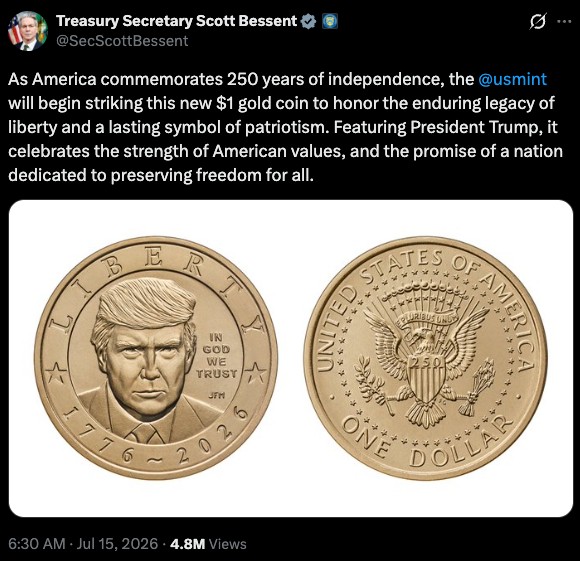
OK, first off, calling it a “gold coin” is a bald-faced lie you’d expect from the Biden administration. It contains no gold, nor any other precious metal for that matter. A Treasury Department flack tells The Wall Street Journal it will have “a gold-like finish.”
Anyway, we’ve been waiting for this moment since it was first reported last October that a $1 coin featuring Donald Trump’s visage was in the works. Supposedly it was to be introduced in time for the America 250 celebrations, but obviously it’s behind schedule. Turns out they won’t be available till fall.
As far as we can tell — no one is saying so explicitly — this is a commemorative issue, not intended for general circulation. Good thing, too: For decades, dollar coins for everyday use have been a bust with the public — and the feds haven’t produced any new ones since 2011.
Back when we first mentioned this in October, Politico pointed out that “Congress has imposed various restrictions on the ability of Treasury to feature living people and living presidents on currency. It’s not clear whether the latest Trump coin envisioned by the Treasury Department would run afoul of those laws.”
Looking at the news coverage of the last 24 hours, it’s still not clear.
Assuming this coin does come to pass, it will be the second to feature the face of a living president. The first was a commemorative 50-cent piece issued for the nation’s 150th anniversary in 1926 — featuring Calvin Coolidge alongside George Washington.
 Mailbag: DST
The U.S. House’s vote to adopt year-round daylight saving time — spotlighted during yesterday’s edition — prompted a couple of readers to write…
“As long as we've been alive and from experience most likely, long after we are gone, the Earth rotates in relation to the sun at 15 degrees of longitude per hour,” says one. “Somebody before our time set Greenwich, England, as the 0 degree longitude. Standard time best reflects the laws of physics as we've come to know them.
“An idiot with some clout here in Georgia actually introduced a bill to put us on Atlantic time [one hour ahead of Eastern]. If you don't like the way daylight hours are scheduled for you or your business, change your hours!”
“Year-round DST is not ‘bad news’ IMO,” says another. “To me, there'd be one more reason on the ‘maybe let's leave the country’ pile if it had gone the other way.
“I don't need light in the early morning; I want more daylight when I'm out of work. My thoughts come out of years living in Upstate NY and SoCal.
- “If I'm gonna cook a barbeque dinner party on the deck for my friends, and I have to wait for us all to get off work and get here, I'd rather be grilling and serving in the golden hour than in the dark.
- “If I'm gonna fix my car in the driveway, I don't wanna do 30 minutes of it at the crack of dawn before work, then spend 15 minutes securing tools back in the shed, then wash up and get on the button-down, to drive to work in the light just to resume the same when I get home, and be scrambling to beat the sunset before it all becomes a thousand times harder (and some things impossible) under work lights.
- “Wanna go to the lake or the beach after work? I'm sure not going before work. And I'm not doing either in the dark.
- “Commuting to work in morning dark and dusk is WAY more pleasant than driving with the early sun glaring and blinding you — both directly and off the windows and chrome of other vehicles. Evening commuting in the light when the sun is higher overhead highly reduces the glare and direct sun into the windscreen. But especially when it's early... the direct sun is super offensive to my tired eyeballs. Cloudy and rainy commutes are like Godsends.
“In fact, I've noticed that in every mid- and small-sized city I've ever lived in, the ‘rich side of town’ has always been the east side — and my hypothesis for why they might have evolved that way is that those residents preferred to commute to town with the sun at their backs in both directions. Since they can afford to gentrify to meet their preferences... maybe they did.
“We do MUCH more for ourselves and with our families after work than before. Let's put as much daylight on those hours as we can.
“Maybe some farmer somewhere will argue with me about his roost. Apparently you also will since you labeled the outcome as ‘bad’. Food for thought.”
Dave responds: It all comes down to what constitutes a “reasonable” hour for sunrise and sunset.
If you define it as 7:00 a.m. or earlier and 6:00 p.m. or later — which seems sensible given the human body and its circadian rhythm — cartographer Andy Woodruff concluded some years ago that the least-worst solution is year-round standard time. (You can see all of Woodruff’s map goodness at this link.)
In the meantime, your editor makes do with a dawn-simulator clock. (I like the ones from this outfit — spendy but effective. No, it’s not an affiliate link.)


