
Elon’s (New) Plan for World Domination
In the electronic dictionary that came installed on my desktop computer, the word “compute” appears only as a verb:
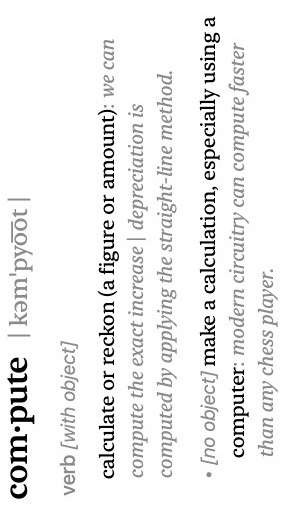
But soon — if you haven’t already — you’re going to hear it used as a noun. Constantly.
From Elon Musk’s Grok AI engine…
"Compute" as a noun refers to computational resources or processing power — basically, the "brainpower" (CPUs, GPUs, memory, etc.) that computers use to run calculations, train AI models or handle heavy tasks.
It's like treating "compute" as a measurable thing you can have more or less of, rent or run out of — similar to saying "We need more horsepower" for an engine.
But it’s not just a trendy new usage. Paradigm tech investing specialist Ray Blanco says compute is rapidly evolving into a desirable type of currency — and Elon Musk is positioning himself to corner the market in it.
The concept is so cutting-edge that we’re breaking from our usual format today to bring you Ray’s compelling case. The following was first published on July 1 for readers of Altucher’s Investment Network.
Elon’s Secret Currency
There is a new currency being minted right now — and almost nobody can name it.
It isn't gold…
It isn't the dollar…
It isn't even Bitcoin.
You can't hold it in your hand, you can't bury it in the backyard, and your bank won't let you deposit it.
But every AI lab on the planet is fighting for it.
Every government on Earth is now stockpiling it.
And the man building the biggest reserve of it just pulled off the largest IPO in human history.
The currency is compute.
If that word sounds like jargon, stay with me a moment — because once you see it, you can't un-see it.
It changes how you should think about where the next decade of wealth gets created.
The Line That Gave It Away
A couple of years back, the heads of the big AI labs started talking in a strange new way.
They stopped talking about software. They stopped talking about apps.
They started saying things like "it all comes down to compute."
At first it sounded like Silicon Valley nerd-speak. It wasn't.
What they were admitting is that the bottleneck on artificial intelligence — the one thing standing between their models and something far more powerful was raw processing power. The chips. The electricity to run them. The physical infrastructure to house them.
Pour in all the dollars you want; what every one of them actually needs is the thing at the end of the pipeline: compute.
When the most powerful companies in the world start measuring their strength not in dollars but in a single scarce resource… that resource has become a currency.
We've Seen This Play Out Before
In 1870, the resource that took over the world was oil. And one man understood something his competitors didn't.
John D. Rockefeller realized the money wasn't really just in the oil itself. It was in controlling the whole chain — the refineries that turned crude into something useful, the pipelines that moved it, the distribution that put it everywhere.
He didn't just sell the currency of the industrial age. He owned the machine that minted it.
That machine was Standard Oil.
And a hundred and fifty years later, history is rhyming.
Today the strategic resource isn't crude pumped out of the ground. It's compute. And once again, the real fortune won't just go to the people who simply use it. It'll go to whoever controls the refinery — the chips, the power, and the fabs that turn sand and electricity into intelligence.
So the question that matters is simple: who's building the new Standard Oil?
The Rockefeller of the AI age
I'll give you a hint.
He already controls the railroads. Now he's coming for the refinery and the power plant.
Rockefeller's empire was built on controlling how the currency moved. Over the past year Elon Musk has assembled the one thing no one else on Earth has — and he’s building exactly the way Rockefeller did.
Start with the transport layer. Elon controls the rockets that haul mass to orbit and Starlink, the network that pipes the output back down. In a world where compute is the currency and the refinery is migrating to space, that is the chokepoint — and while every rival is left negotiating for a ride, Musk owns the freight line.
The rockets are his railroads. Starlink is his pipeline.
Now for the two other pieces.
The first is a project he calls Terafab. This is the refinery.
A refinery that takes a raw resource and turns it into the high-value fuel everyone fights over. Terafab will take silicon and turn it into chips: the refined, scarce fuel of the AI age, the thing nations now guard like enriched uranium. Whoever controls the refinery controls the fuel supply for the entire industry.
But fuel sitting in a warehouse doesn't do anything. You have to burn it. And that's the second piece — the data center, the power plant where chips and electricity get fused into the only thing anyone actually wants at the end: compute. The refinery makes the fuel. The power plant turns the fuel into the currency.
That's a Standard Oil strategy.
Musk isn't trying to win one link in the chain — he owns the railroad, he's laying the pipeline, he's building the refinery, and he's building the power plant. Every rival who wants to mint this currency has to come through infrastructure he controls.
Which leaves just one question.
Where It Gets Strange
Where do you put a power plant that devours that much electricity — and throws off that much heat?
For two hundred years the answer was "wherever the resource is." For the compute age, I think the answer is going to surprise people: off the planet.
This is a thread we’ve been pulling on for a while.
We call it the Great Migration — the slow, inevitable shift of heavy compute up into orbit, where solar power is unlimited, where the cold of space solves the heat problem for free, and where you're not fighting cities and regulators for land and electricity.
The same man building the refinery already owns the only fleet on Earth that can cheaply move mass into space.
Connect those dots, and the SpaceX IPO stops looking like a rocket story. It starts looking like the opening move in a plan to mint the world's most important currency — and to do it somewhere no competitor can easily follow.
The Proof Is In How the Powerful Are Behaving
You don’t have to take my word that compute is the new money.
Governments now treat advanced chips the way they once treated enriched uranium — with export controls, with watch lists, with national-security reviews.
Nations talk openly about how much compute they have versus their rivals, the same way the old powers once counted oil reserves and gold bars.
When a country starts measuring its strength in a unit, and starts hoarding that unit, and starts forbidding its enemies from getting it, that's a currency.
And currencies, unlike fads, don't go away. They get more entrenched. The early holders get richer the longer the game runs.
What This Means For You
You can’t open an account and buy a pile of compute.
But you can own the refinery and the picks-and-shovels that feed it — the chip designers, the power and energy plays, the thermal and fabrication names, and the orbital infrastructure that becomes the future foundation for it.
That’s the map we’ve been laying out. The names are already in our portfolio. Keep watching.
For today, I just want you to walk away with this one idea:
Oil was the currency of the last century.
Compute is the currency of this one.
And the man minting it just went public.
The people who understood Standard Oil in 1880 didn't need to be geniuses. They just needed to see the pattern before everyone else did.
We're at that same moment again… right at the start.


