
$40 Oil?!
 $40 Oil?!
 “Get Ready for $40 Oil — Hear Me Out” was the headline to a piece penned last week by Paradigm trading pro Enrique Abeyta.
Provocative, for sure. Maybe he was even trying to get a rise out of oil bulls like… well, myself.
“What if the market is already pricing in a world none of us is ready for,” he asked — “one where oil trades at $40 a barrel?”
At the time of the article seven days ago, U.S. oil futures were still hovering near $80.
Yesterday, they fell below $70.
So let’s follow the breadcrumbs…
The case for $40 oil centers on the world’s two biggest oil consumers — the United States and China.
Earlier this month we mentioned how China slashed its oil imports after the Iran war began — so much so that it offset as much as a third of the barrels lost to the Strait of Hormuz’ closure.
“China spent the last 20 years preparing for exactly this scenario,” Enrique says. “While much of the world focused on maximizing efficiency, China focused on maximizing flexibility.
“The country invested heavily in electric vehicles, liquefied natural gas infrastructure, refining capacity, coal-to-liquids technology, strategic petroleum reserves and alternative energy systems.”
Those are heavy-duty, long-term investments. How likely is it that China will go back to its old ways once global oil flows normalize?
Meanwhile, the United States is less vulnerable to oil shocks than in previous decades because of bountiful shale oil. Twenty years ago, no one expected America to become the world’s No. 1 crude producer. But it did in 2018.
“During the recent crisis, the U.S. wasn’t scrambling to secure foreign supplies,” Enrique says. “In many cases, it was helping supply the rest of the world.
“For the first time in modern history, the world's largest energy importer and one of the world's largest energy producers may both be moving toward a future where oil matters a little less than it once did.
“If that happens, the biggest surprise of the next decade won't be that oil went higher. It will be how much lower it ultimately went.”
Thus, Enrique’s conclusion: “I believe there’s a real possibility that crude oil trades below $40 per barrel within the next three years.”
Still not persuaded? There’s precedent: Look at what happened less than 15 years ago.
For most of the period 2011–2014, crude traded in a range between $80–110.
But by early 2014, the U.S. shale patch — only a few years old then — had blundered into massive overproduction. The OPEC nations cranked up their own production to squeeze their new American competition. Meanwhile, based on the history told in James Norman’s book The Oil Card, it’s highly likely the Obama administration engineered a takedown of the oil price to punish Russia for seizing the Crimean Peninsula from Ukraine.
In June 2014 crude still traded for over $100. Less than two years later, it bottomed at $26.
All that said… before we get to $40 oil, we might still be in for a face-ripping rally from current levels.
For that part of the story, we move today’s mailbag section up from its usual slot to Bullet No. 2…
 Oil: A Reader’s Frustration
“I've been kind of annoyed with the media headlines and market response in regards to the negotiations going on with Iran for almost a week now,” writes one of our regulars.
This individual doesn’t write often, but when he does he always puts thought into it.
“Assuming that the success of the negotiations is a sure thing, we've got the demining of the strait of Hormuz, which is scheduled to take a month. Then assuming insurance companies are again willing to take on risk immediately, once all the ships stuck there leave it'll take them perhaps another month to get to their destinations.
“Taking Trump at his word that we're going to be ‘out of reserves in four weeks,’ that leaves us about a month of being ‘out of reserves’ before shipments once again begin reaching their destinations. A month of being out of reserves sure doesn't sound like about $75 per barrel of oil making any sense at all.
“Now adding some reality to that mix, where there is not only a possibility of the negotiations failing, but a significant chance of them failing, there seems to be no acknowledgement of any such possibility of failure either in the mainstream reporting or in the market prices!
“Now that a week has almost passed since the announcement of the talks, we've got some progression of events that there still seems to be no reply to in the markets. Namely that the traffic through the strait is still heavily restricted by Iran on account of Israel still having military forces in Lebanon, and now the Iranians walking out of negotiations after Trump continued to threaten them.
“I can only look at the prices and come to the conclusion that either the Dead Internet Theory also applies to markets or that the 'smart money' and insiders are so sure of the success of negotiations that they are actually not taking into account the high likelihood of things going wrong after Trump has been promising this would be over in two more weeks for a few months now.
“Thanks for letting me vent about the slow-motion track wreck playing out in real-time.”
We thank the reader for his input. Your editor’s response follows immediately…
 The Messy Road to “Normal”
Jeez, what a doomer. A real panican you are.
I jest, of course.
Ever since Trump’s 39th announcement of a peace deal two weeks ago, I’ve taken pains to sprinkle these daily missives with reminders that…
- Traffic through the Strait of Hormuz remains a fraction of its prewar level
- Even if traffic through the strait returned to prewar levels tomorrow, it would take months to unscramble everything else that the war scrambled (production shutdowns, ships that aren’t located where they’re needed, etc.)
- Israel could at any time monkey-wrench the agreement, to which it is not a party. (Israeli troops continue to occupy southern Lebanon.)
- U.S. crude stockpiles continue to dwindle. The government’s Strategic Petroleum Reserve is its smallest since 1983. The big private-sector hub at Cushing, Oklahoma is at “tank bottom” levels; if refilling doesn’t start within days, the terminal will be physically incapable of pumping and transferring crude.
And yet… the drop in crude prices this month is the steepest on record outside of the COVID lockdowns in the spring of 2020. I feel your pain, dear reader.
Some of it is the aforementioned plunge in Chinese crude imports.
But a lot of it sure looks like a deliberate attempt by the Trump administration to distort the price signals that oil should be sending. (I’m not singling out Trump here. As we’ve chronicled many times before, the feds have fiddled with oil futures regularly for over 40 years.)
When the world normally produces 103–106 million barrels of oil per day… and when up to 15 million of those barrels are shut in… and when the oil price is still under $100…
… well, that’s going to encourage the world to continue consuming oil at more or less its prewar pace.
Put another way, prices didn’t rise enough to make you change your fuel-consumption habits.
And so the reserves are running on empty.
Earlier this year in a series of podcast interviews, I listened to several oil-industry experts anticipating what the world would look like once some sort of peace deal was in place.
Their consensus was that oil prices would fall steeply on the announcement of a deal… and then when physical reality started to bite, prices would start to take off again.
These weren’t screaming randos on the internet shoring up my own confirmation bias. They’re sober, respected figures in the industry.
Bottom line: We might well be headed long term to a world of $40 oil. But for the moment I’m not selling my oil stocks even though they’re now trading at prewar levels.
Oh, and I’m also making sure our vehicles at home stay topped up…
 Markets Today: Summertime Stumble?
If history continues to rhyme, the stock market is headed for a summertime stumble.
Every once in a while we spotlight a chart from Bespoke Investment Group. It compares the performance of the Nasdaq composite during the 1990s dot-com boom and the current AI boom.
It sets the starting point for the dot-com boom with the introduction of the Netscape web browser in December 1994… and the starting point for the AI boom with the rollout of ChatGPT 3.5 in November 2022.
As far as we know, the chart was last updated about two months ago…
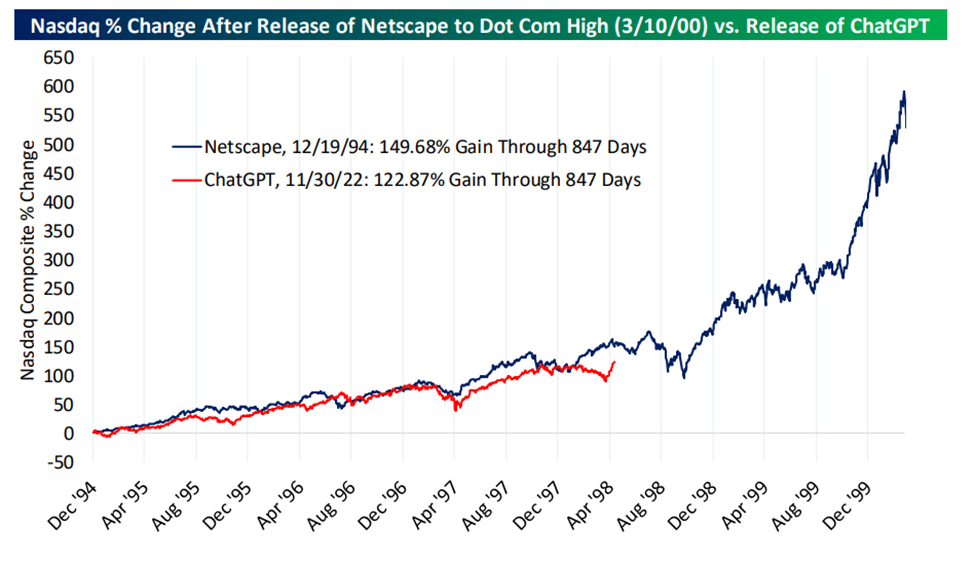
Now… look at what happened in the late summer and fall of 1998. The market had a big scare when the Russian government defaulted on its debt — which had a domino effect that took down the American hedge fund Long Term Capital Management.
From a peak of just over 2,000 in mid-July, the Nasdaq sank below 1,450 by early October — nearly a 30% drop in less than three months.
If the pattern continues to hold — and to date, it’s been uncanny — look for a slide to begin next week or maybe after Independence Day before the index stages a recovery in mid-September.
The big market stories today are Micron and inflation.
Chip darling Micron reported its quarterly numbers after the closing bell yesterday. They blew away the expectations of Wall Street analysts. MU shares are up 10.5% as we write — but still shy of their record close Monday.
You might think the tech sector would be rallying hard under that circumstance — and you’d be wrong. Checking our screens the Nasdaq is down over a half percent on the day, adding to the previous three days’ losses, at 25,369.
The S&P 500 is up about a third of a percent at 7,383 — more or less the midpoint of its trading range the last two months. The Dow, meanwhile, is powering nearly 1.5% higher into record territory, approaching 52,600.
➢ The biotech sector has been very kind to Paradigm readers in the last 24 hours: Microcap Millionaire readers booked a 530% gain on one pick... while Catalyst Trader readers collected 120% on another. In both cases the editors advise selling half the position while letting the rest ride.
Gold has clambered its way back over $4,000 for the moment and silver is inching higher at $57.87. Bitcoin remains under $60,000 and Ethereum well below $1,600.
The Commerce Department came out this morning with “core PCE,” the Federal Reserve’s preferred measure of inflation.
It rings in at 3.3% year-over-year — not a surprise to Wall Street economists, but still the highest since October 2023 and nowhere near the Fed’s 2% target.
With that in mind — as well as the new Fed chair Kevin Warsh saying he’s laser-focused on “price stability” — futures traders assign a 60% likelihood the Fed will raise short-term interest rates by September.
 Sen. Warren Gets Kinky
Something weird happened yesterday on CNBC…
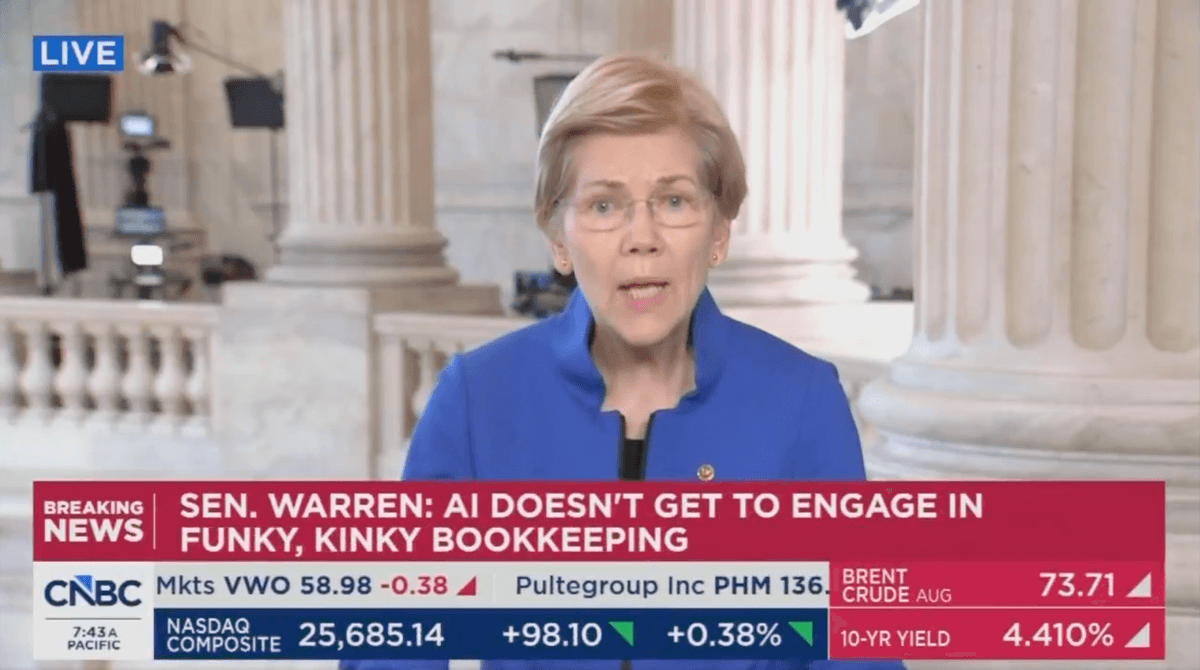
During a live interview, Sen. Elizabeth Warren (D-Massachusetts) said, “AI doesn't get to engage in a bunch of funky, hinky bookkeeping.”
Somehow the cutline thrown up on the screen a few moments later changed “hinky” to “kinky.”
The interwebz had plenty of fun with it.
One of the more family-friendly takes came from longtime Paradigm Press friend and mining/energy financier Rick Rule: “The only entity that gets to engage in funky, kinky bookkeeping is the government.”
Word…


