
American Pride
 American Pride
 “I’m in love with America,” says a visitor to the United States, one of the many here for the World Cup.
Earlier this month we took note of the many visitors — mainly from Europe, but not exclusively — who are wowed by the sights of this vast land, and sharing their impressions on social media.
To be sure, a lot of it has to do with America’s consumer culture. Costco, Walmart, Buc-ee’s stores. “Oh, gawd damn!” said a Norwegian fellow entering a Bass Pro Shop.
But it’s more than that. Many of them are venturing beyond the cities whose stadiums are hosting the matches.
“With each wide-eyed video of travellers documenting their first encounters with everything from roadside convenience stores to ranch dressing, fans are highlighting the real America — one that's rarely portrayed in films and TV, has nothing to do with politics and that many visitors often miss,” says freelance travel writer Jeff Bogle.
“Along the way, they're not only reminding those of us who live here of the many quirks that make this country special; they're also helping us fall back in love with it,” Bogle writes in an article for a foreign outlet — the BBC.
"Many U.S. citizens have been feeling down on their country, and sad that their nation is seen in a negative light overseas," says clinical psychologist Charlotte Russell — a Brit who runs a website called The Travel Psychologist.
"With the negative news in the run-up to the World Cup… seeing people actually enjoying the U.S. and its people feels more intensely joyful."
Bogle — who interviewed Russell — concurs. “After consuming so many of these social media posts and videos, I find myself overwhelmed with a sense of national pride that I haven't experienced for some time.”
Which brings us to a reader survey we’re conducting this week.
Going into the 250th anniversary of the nation’s founding this Friday… we have two simple questions to ask you:
- Where in America are you from?
- What makes you most proud to be an American?
You can click here to submit your answers at this web form. We’ll share your answers here tomorrow.
Yes, there’s a money-and-markets angle to all of this. But we’ll get into that as the week goes on…
 War’s on, War’s Off
And now for something that’s probably fake news…
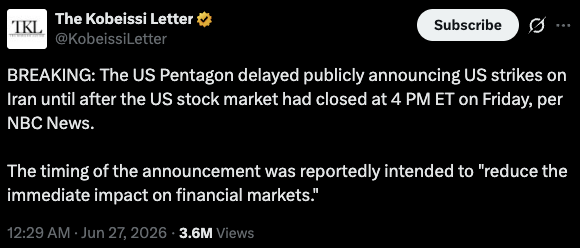
It’s got the ring of plausibility to it. Major military action by Washington often comes after the markets close on Friday afternoon. That’s been the case throughout Donald Trump’s second term, as well as Joe Biden’s term before it.
Problem is, there doesn’t seem to be an article corroborating the claim on NBC News’ website. Google News and two AI engines come up dry.
Conceivably it was something a reporter ad-libbed Friday night during NBC Nightly News? The Grok AI engine speculates “it could be from a recent TV segment, live blog update or subscriber/paywalled NBC article not fully indexed [on the web] yet.”
Again, it’s highly likely the announcement of airstrikes on Iran was in fact timed for after the market close.
But applying my old-school journalism sensibilities — honed during 20 years as a TV news producer and manager — I’m calling BS on the claim that someone in the Pentagon acknowledged as much to NBC News.
In any event, the Axios site was up to its old tricks yesterday — reporting just before futures markets opened for the week that Washington and Tehran would stop the shooting.
As a result, U.S. oil futures begin a new week more or less where the old one ended — about $70 a barrel.
Amazing how that works. It’s as if Washington can wage war only on the weekends, lest it throw markets for a loop.
But hold on: On Thursday, CME Group — the outfit that oversees the most widely used U.S. commodities exchanges — announced it would launch an oil futures contract that trades 24/7.
It’s a smaller contract — only a tenth of the size of the existing “Micro WTI” futures contract — thus targeting the retail crowd, not the pros. CME Group also recently launched a one-ounce gold contract that trades ‘round the clock.
"Our new WTI and Gold futures provide regulated products that are right-sized and available 24/7, ensuring traders can manage exposure whenever news breaks,” says CME Group’s Derek Sammann.
In the meantime, here’s your first reminder this week that traffic through the Strait of Hormuz is still nowhere near normal.
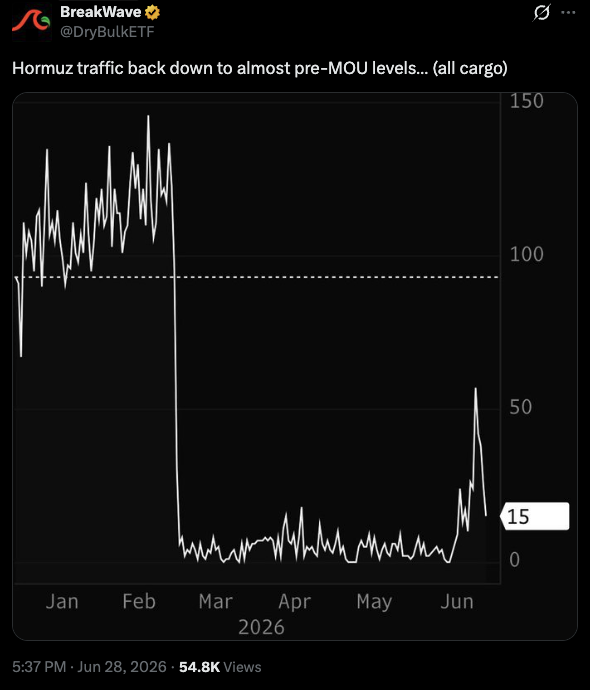
By the way, Axios’ story — citing U.S. officials — says U.S.-Iranian talks are supposed to resume tomorrow. So far, no confirmation from the Iranian side.
 Strange Day
Last Thursday brought “one of the strangest sell-offs of the entire year,” says Paradigm trading pro Enrique Abeyta.
“In just 27 minutes, the Nasdaq-100 plunged nearly 1,000 points while the S&P 500 erased roughly $1 trillion in market value.
“And this was all without a single major headline explaining the move.
“The Nasdaq opened nearly 1% higher before suddenly tumbling almost 3% in less than half an hour!
“It's a reminder that today's market is operating in a very different environment. Record levels of investor enthusiasm are colliding with record amounts of uncertainty about AI, inflation and interest rates.
“When that happens, volatility can seem to appear out of nowhere.”
All of the Paradigm editors are aware of this potentially delicate situation. For now, it’s a watch-and-wait affair. But if that changes, keep an eye on your inbox and/or the Paradigm Press app for actions to take.
The volatility is in retreat as a new week begins.
Among the major U.S. indexes, the Nasdaq Composite is leading the way — up nearly 1.5% to 25,670. The S&P 500 is up over three-quarters of a percent and back over 7,400. The Dow is the laggard — up only a half percent but that puts it in record territory over 52,000.
Precious metals are losing ground, gold only 25 bucks over the $4,000 level and silver about to crack below $58. Bitcoin remains stuck under $60,000 and Ethereum under $1,600.
➢ For the record: The U.S. Supreme Court just ruled 5-4 that Donald Trump cannot fire Lisa Cook — one of seven members on the Federal Reserve’s Board of Governors. The majority opinion says to preserve the Fed’s independence, it was Congress’ intention to limit the president’s power to remove Fed governors. (The Fed hasn’t been truly “independent” for decades, if ever, but that’s another story…)
File this one under “the market climbing a wall of worry”: The Bank for International Settlements says the AI boom is setting the stage for a prolonged “investment bust.”
The Switzerland-based BIS — sometimes called the central bank for central banks — is out with its annual economic report, spotlighting the $1 trillion that Microsoft, Google, Meta, Amazon and Oracle plan to spend on data centers from 2025 through year-end 2026.
The report says there are “instructive parallels” between the present moment and previous booms and manias — such as the buildout of canals and railroads, and more recently the 1990s dot-com boom.
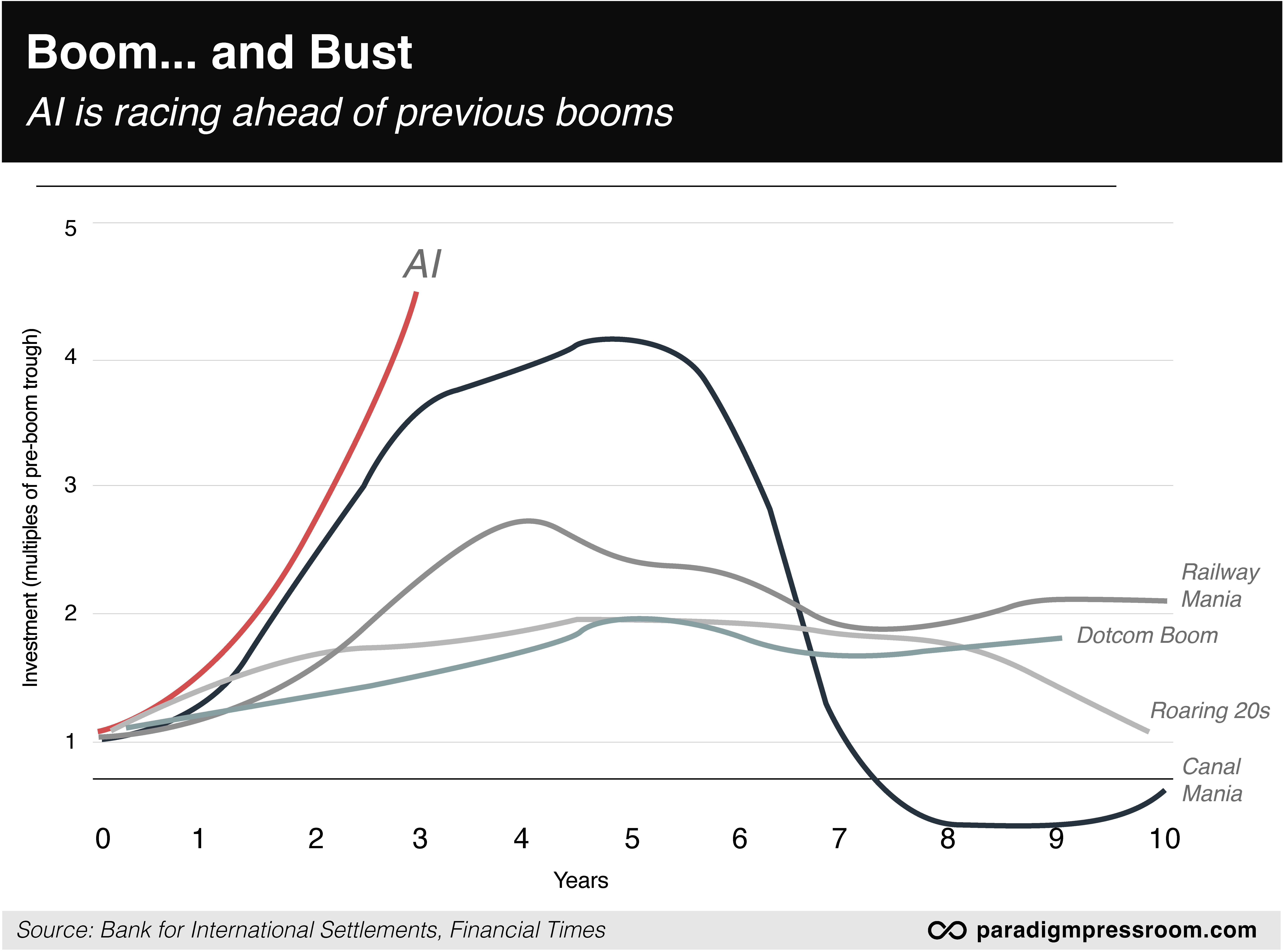
The report says in each case there was “a genuine technological breakthrough that attracted capital in excess of what commercial returns could ultimately justify” — leading to “an eventual reversal in investment, including economywide recessions.”
From where we sit, this is one more indication that the AI boom still has legs before the inevitable bust.
It’s when the experts become convinced that the boom will go on forever that you should start to worry…
 What the Street Doesn’t See (MU)
Micron Technology shares are up 1,000% in the last 18 months — and James Altucher is telling Altucher’s Investment Network readers to hold on tight.
As mentioned here last Thursday, MU delivered boffo quarterly numbers — revenue up 346% year over year, gross margins now 85%.
And James believes Wall Street is still underestimating its potential — for two reasons.
One is that MU has insulated itself from the chip industry’s notorious boom-bust cycle. “The company has now signed 16 long-term supply agreements with customers, covering 2026 through 2030 — take-or-pay deals, meaning customers commit to minimum purchases and pay deposits upfront.
“Forty percent of revenue is now contracted through 2030, locking in Micron’s highest margins in history for years to come” — even when the inevitable turn comes.
Meanwhile, the most intensive demand for AI no longer comes from the “large language model” chatbots. It comes from agents — the kind of AI that can execute tasks for its users. Agentic AI “requires roughly 50 times more memory,” says James.
And that’s before humanoid robots become all the rage: Tesla’s Optimus robots will sell for under $20,000 — putting them “within reach of midsize manufacturers, not just the Fortune 500.
“Micron's CEO mentioned robotics as a new demand driver on this week's earnings call,” says James. “Not a single analyst brought it up during the Q&A segment. Nobody has gone back to run the numbers yet.”
All of this as MU trades at 9.5 times forward earnings — compared with 20.8 times for the S&P 500.
“The people who buy it 18 months from now, after agents are running every enterprise software stack and Optimus is on factory floors and Wall Street has finally rebuilt its demand models, will wish they had owned it today,” James concludes.
 Mailbag: $40 Oil
On the subject of oil sinking to $40 in the next three years — broached in last Thursday’s edition — a reader writes…
“I think there will be a reassessment by countries that are dependent on fossil fuels to determine if that remains their future.
“Now knowing just how easy it is to cause a major disruption in deliveries by countries like Iran and Indonesia, a shift to renewables may be prudent. If the countries holding the reserves come to the same conclusion, they will recognize that their oil reserves are going to become worth less and less as time goes on.
“OPEC is finished as a monopoly (if it ever was one), thereby eliminating production caps, so oil-producing countries will race to increase production to take advantage of these higher prices.
“Whether that will result in $40 oil, I don’t know, but wouldn’t it be ironic if President Trump went down in history as the president that did the most to further the cause of renewables?”
Dave responds: For the moment, we still lack the technological breakthrough that will wean the world off oil for large-scale transportation.
Yes, China is putting its population in vast numbers of electric vehicles (powered in many cases by coal!)... but beyond personal transportation there’s still no substitute for diesel, jet fuel and bunker fuel for ships.
Meanwhile, a prediction of $40 oil isn’t the same thing as saying oil will stay at $40.
Below $60, production for many American firms becomes a money-losing proposition. If they start to cut back… well, it’s that old saying in the commodity space about how “the cure for low prices is low prices.”


