
Crank up the (All-American) AC
 Crank up the (All-American) AC
 So you’ve probably heard about the heat wave in Europe. But maybe you haven’t heard about the crackdowns on people who — God forbid — want relief from the heat.
“Air conditioning is very rare in European homes,” says CNN — present in only one of every five households. In the U.K., it’s only one of every 10.
“Many residents ride out the searing heat with the help of electric fans, ice packs and cold showers.”
“It was my luck,” writes Matthew Petti at Reason, “that I arrived in Britain to pick up my master's degree just before a heat wave hit” — with daytime highs of 95 Fahrenheit.
It’s not that people across the Atlantic relish suffering through the heat. It’s that Europe’s control freaks and power trippers want people to suffer.
“A combination of environmental regulations, NIMBYism and cultural snobbishness have slowed down Europeans who want to buy an AC unit,” Petti writes.
For instance…
- Homeowners with AC are subject to periodic inspections in several countries — including Hungary, Slovakia and Greece. The inspections cover everything from energy usage to noise to historic preservation rules
- For several years, Spain and Italy have ordered public and commercial buildings to keep the thermostat no lower than 81 and 77 degrees Fahrenheit respectively during summertime
- In Switzerland’s Geneva canton, homeowners must prove a medical need before they can install AC.
Of course, these rules are frequently “for thee, but not for me.”
Last Friday the European Commission’s headquarters building in Brussels shut down the AC “due to extreme weather conditions” — but only on the seven lowest floors. The senior staff on floors 8–13, including EC President Ursula von der Leyen, stayed cool as cucumbers.
Complained one of the lower-floor staffers to Politico: “It’s like feudalism.”
And then there’s the U.K. — where people have been ordered to remove AC from their homes even as temps soar past 100 Fahrenheit.
Local officials “have told residents to take down their cooling units over concerns about carbon dioxide emissions,” reports the conservative-leaning GB News channel.
The rules are frequently confusing and contradictory — setting up “situations where units are fitted believing they comply with rules, only for council enforcement teams to turn up and demand their removal.”
In London’s Camden section, inspectors told a resident to “permanently remove” two cooling units from the rear of the property, saying they violated the neighborhood council’s “cooling hierarchy” policy.
The homeowner appealed the decision — only to be told to open second-floor windows for ventilation. When the homeowner raised concerns about crime and the risk of a break-in, the inspectors then pointed out “the absence of ceiling fans” in the home — even though there’s no explicit requirement for ceiling fans.
In the end, the homeowner won an appeal — by pointing out the property did have solar panels, thereby assuaging the busybodies’ “climate” concerns.
And that’s just one example of many in Great Britain. The situation is so absurd it’s become the stuff of memes…

No wonder Europeans visiting the United States for the World Cup seem so happy — especially now amid our own heat wave.
“I've been getting a kick with news stories of foreigners visiting the U.S. for the World Cup, awestruck and marveling at our advanced level of civilization — like air conditioning, and how restaurants just come right out and serve water when you sit down,” observes Paradigm’s resident oil field geologist Byron King. “There's even ice (!) and free refills at fast-food joints.
“Of course, this also reflects the U.S. energy buildout, in which energy is widely available and relatively low-cost.
“By comparison, other nations of the world are energy-impoverished... even so-called ‘advanced’ countries like Germany and the U.K.”
Last week on the Daily Feed section of the Paradigm Press mobile app, Byron shared this infographic courtesy of the Visual Capitalist site. “Helps put it all in perspective,” he says.
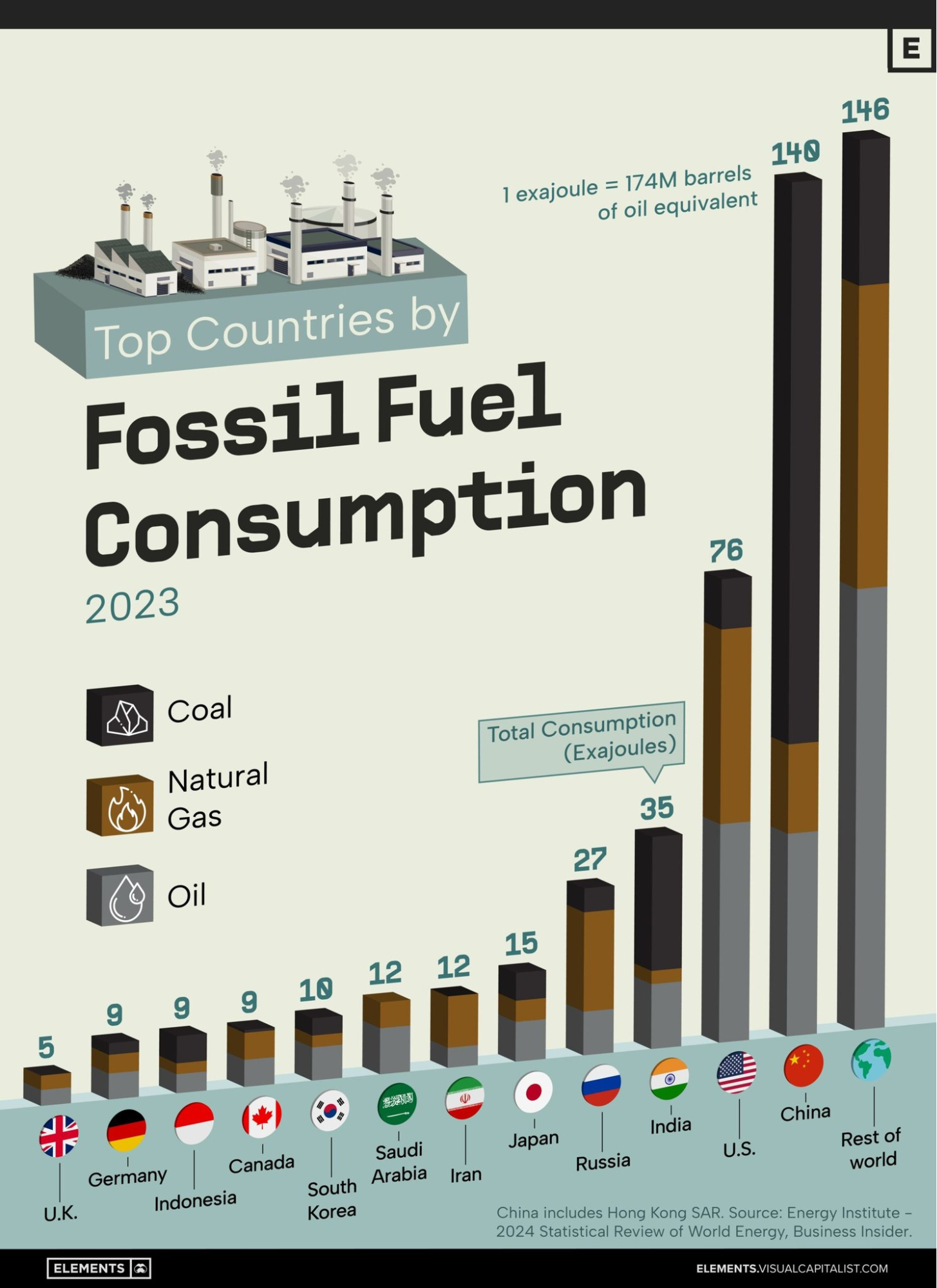
“And note how China-China-China is such a vast energy producer, much of it for industry (versus air conditioning, ice, fast food, etc.). And note how China generates more energy from just coal than the U.S. generates energy in total.
“Point is... when good things happen, follow the energy trail. And when bad things happen with energy... well, that's a predictor as well.”
Something to think about as we recall how the Founders sweltered their way through adoption of the Declaration of Independence in Philadelphia 250 years ago. On this day in 1776, the weather diaries kept by Thomas Jefferson and Phineas Pemberton suggest temps well into the 80s and thick humidity.
And no AC for any relief.
Now there’s something to be grateful for this week as you crank down the thermostat. Only in America! (Well, Japan and South Korea, too. Their adoption of AC in the home is nearly as extensive as our own…)
 Meta, Markets, Oil
Among the big market movers today is Facebook/Instagram parent Meta.
“META is up 10% today after giving investors exactly what they wanted: a plan to monetize its massive AI spending,” says colleague Davis Wilson at The Million Mission.
“The company is reportedly developing a cloud computing business that would rent excess AI compute to outside customers — putting it in competition with Amazon Web Services, Microsoft Azure, Google Cloud and even CoreWeave.
“For months, investors questioned whether Meta's hundreds of billions of dollars in AI infrastructure spending would ever generate a return.
“Now they have an answer.
“Instead of letting unused computing power sit idle, Meta’s turning it into a new revenue stream.”
Not that Meta’s move is powering the rest of the stock market today.
To be sure the major indexes are in the green — but in the case of the Nasdaq, just barely. The S&P 500 is up about a quarter percent; the 7,500 level is looking more and more like a ceiling at the moment.
The Dow is up 0.4% — once more in record territory at 52,522, goosed by the addition of Google parent Alphabet to the index this week (replacing Verizon) along with strong performance by Caterpillar.
Precious metals are staging a modest comeback, gold up nearly $75 to $4,079 — with silver up 2.7% and back over $60. Bitcoin has hefted its way back over $60,000 and Ethereum over $1,600.
U.S. crude futures are sinking toward $68 — apparently because there’s no sign that U.S. reserves are being replenished.
The Energy Department is out with its weekly inventory numbers: Despite a shaky “memorandum of understanding” between the United States and Iran, the U.S. government drained another 5.5 million barrels from the Strategic Petroleum Reserve, dropping its total level to another low last seen in 1983.
Private-sector reserves were drained an additional 3.8 million barrels. The silver lining here is a small inventory build at the giant terminal in Cushing, Oklahoma. As mentioned here in recent days, Cushing was approaching “tank bottoms” beyond which it can’t go on pumping and transferring crude.
 “It’s for the Children”
Ready to verify your age before you go online? The U.S. House just took a huge step in that direction.
The late Rush Limbaugh observed that some of the worst legislation tends to be enacted “for the children” — and that’s certainly the case with the “Kids Internet and Digital Safety Act,” which of course shortens to KIDS Act.
Digital rights groups like Reclaim the Net warn that the KIDS Act raises huge concerns “about government overreach, privacy erosion and the expansion of online surveillance.”
So of course the legislation passed the House Monday night with overwhelming bipartisan support, 267-117.
“Buried inside the KIDS Act are provisions that will push online services to verify all users’ ages, require government-directed moderation policies for online speech and even create new rules about private and encrypted communications,” writes Joe Mullin for the Electronic Frontier Foundation.
“While supporters continue to claim this bill protects minors online, its requirements come at the expense of privacy, free expression and the ability of people of all ages to use the internet without revealing sensitive data.”
Technically the measure doesn’t require websites and apps to conduct age verification. But it sure as heck pressures them to do so.
“The problem,” Mullin writes, “is a website operator doesn’t need actual knowledge that a user is a minor to get in legal trouble. It applies when a platform ‘knows or should have known’ a user’s age — a low, negligence-style standard of knowledge. If an online service gets it wrong, it’s going to be up to courts and regulators to decide, after the fact, if an online service ‘should’ have known a user was 16.”
Given that burden, most website/app operators will simply opt to make all users verify their age.
“Some companies may respond by requesting driver's licenses or passports,” Mullin continues.
“Others will rely on age-estimation systems that attempt to guess users' ages by looking at existing activity or doing facial scans.”
Say goodbye to online anonymity.
And it gets worse. Another section of the bill creates new rules for encrypted messaging platforms like WhatsApp — aimed at curbing discussion among young people about drugs, alcohol, gambling and so on.
“The KIDS Act never answers an obvious question,” Mullin says: “how exactly is a platform supposed to address those activities if they’re inside encrypted communications that it can’t read?
“That will create pressure for providers to weaken private communications or limit features on encrypted private services.”
The good news is that the Senate has yet to act. The bad news is that the Senate version of the KIDS Act is even more restrictive.
We’ll keep you posted…
 Comic Relief
You laugh because you know it’s true…

Amazing how they can pass legislation shredding online privacy but just can’t get around to that bill limiting their own trading activity…
 Mailbag: “Unalienable”
After I closed yesterday’s edition with a reference to “our inalienable rights,” a longtime reader was quick to correct…
“Um, Dave, that's ‘unalienable’ rights. More than a slight difference — means we can't even give 'em away.
“New poll for you -- how many of your readers catch it?”
Dave responds: You’re the only one who wrote in. And it is true: The parchment says “unalienable.”
I confess to listening to an authoritative lecture years ago about the distinction — and it’s become muddled in my mind with the passage of time.
Unfortunately, I’m on deadline and I can’t trust AI to refresh my memory.
One link after another suggests no difference between the two, even at the time the Declaration of Independence was adopted… that Jefferson’s early drafts said “inalienable” and somewhere along the line it was inadvertently changed to “unalienable”... and that throughout the 19th century, common usage adopted “inalienable” especially as Abraham Lincoln used the word in his speeches.
And I don’t trust any of it. I’ve got the authoritative lecture in audio form somewhere on my computer, but Apple’s deprecation of iTunes over the years has made it impossible for me to locate it readily. (Maybe AI can help me?)
Don’t get me started on how Apple has gone down the tubes, a process underway even while Steve Jobs was still alive…


